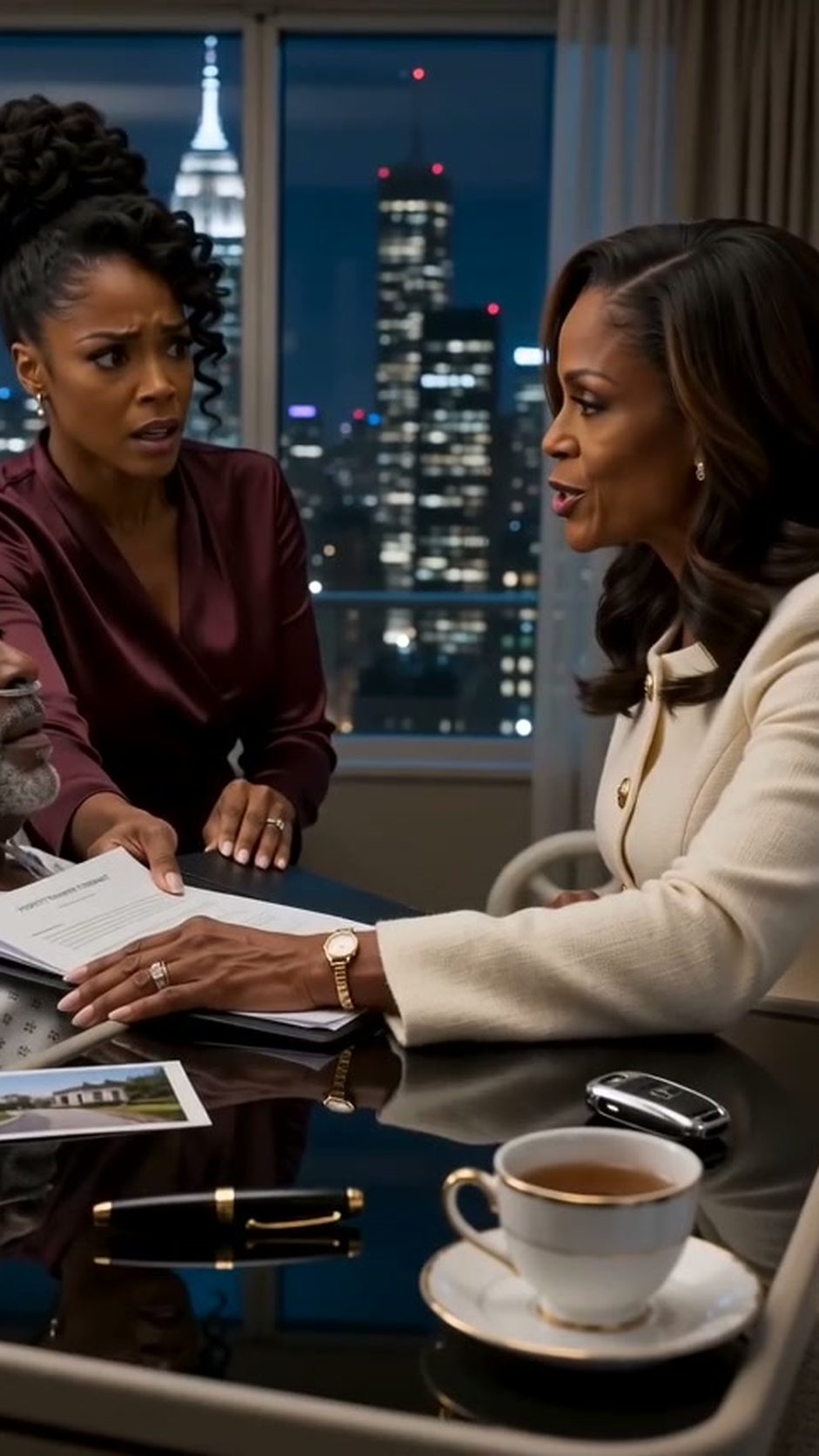
The boy was ten years old the first time Vanessa saw him in person, and he had his mother's laugh.
It was the Calloway Foundation's annual gala — her gala, really, though the programs said otherwise; she had built it from a charity luncheon into the night the city's money competed to be seen at. Twelve hundred guests. A string quartet. The Harborview towers lit like a promise across the water. Sabrina Cole was there in burgundy, on the arm of no one, introduced in the program as an interior design consultant to the foundation, which was a sentence so brazen that Vanessa had actually admired it in proof. A decade had taught her to respect craftsmanship, even in a lie.
Owen stood beside his mother in a boy's blazer a fraction too formal for him, enduring a receiving line with the martyred patience of a ten-year-old at a fundraiser, and when the quartet stumbled into something with a beat, he grinned up at Sabrina — quick, unguarded, delighted — and Vanessa, thirty feet away with a glass of champagne she was not drinking, felt the old grief stand up in her chest and then, to her own astonishment, sit back down.
He was a child. He had not chosen the burgundy dress or the blank line on his birth certificate or the brownstone across the river. Hating him would be like hating the rain for the flood. She had known that in principle for ten years. Knowing it with his laugh in her ears was different, and harder, and she did it anyway, the way she did everything: completely, and without letting it reach her face.
Raymond claimed her for a dance an hour into the evening, in front of everyone — a husband's public devotion, performed with the confidence of a man who has never once been caught by an audience. The quartet had found something slow. He was sixty-one that year and still led like a man who intended the floor to know it.
"You built all this," he said, turning her under the chandeliers, past the silent auction, past his mistress's table. "Say what they like about me, Vanessa — the foundation is yours. The city knows whose taste this is."
"You give me too much credit," she said.
"I give you exactly what you're owed." He smiled down at her with the old, real warmth in it — that was his gift and his curse, that the warmth had always been real, it had simply never been exclusive. "Dance with me at the boy's wedding someday. Promise."
And there it was, arriving on schedule like weather: the casual someday, the assumption folded inside it — that there was a boy, that the boy was his, that the boy's future was a room in the house of the future they were all supposedly building together. Sabrina, at her table, watched her lover dance with his wife and did not look away, because she had read the same future and knew whose name was on the wedding.
"I promise I'll be at the wedding," Vanessa said, which was true, and he laughed and spun her, and she let him, and the cameras of two society photographers caught the moment and ran it the next morning under a caption about the Calloways, nineteen years on — the golden couple, the caption said, and it was, in every way the word can bear, accurate.
It was Margaret who ruined the night, in the end. Margaret usually did; she had a talent for it the way some women have perfect pitch.
Vanessa found her mother-in-law holding court near the silent auction, pearls bright, voice pitched precisely at the frequency of indiscretion. "—of course, a foundation needs a future," Margaret was saying to a circle of women who had known her forty years. "A name needs blood to carry it. All this—" the pearl-heavy hand swept the ballroom, the towers beyond the glass, the empire "—will need someone to inherit it who is actually of the family. Whatever some people prefer to pretend."
The circle noticed Vanessa a half-second before Margaret did. It was not enough time to arrange her face into anything but what it was: the face of a woman who had been caught knowing.
She turned. She took in her daughter-in-law — the ivory suit, the stillness, the ten-year-old smile that had never once cracked in public — and for a moment something complicated moved behind the old woman's eyes. Not guilt. Margaret Calloway did not stock guilt. It was closer to the expression of a chess player who realizes the quiet opponent across the board has been playing a longer game than the one on the table.
"Mother," Vanessa said pleasantly. "Your brooch is crooked. Let me—" She stepped close, close enough to smell the gardenia perfume Margaret had worn since the Johnson administration, and adjusted the gold floral brooch with two gentle fingers, and said, in the warm, carrying tone of a woman paying a compliment: "You should be careful what you say about blood in a room this size. Blood is exactly the kind of thing people test."
She walked away before Margaret could decide whether she had been threatened.
She had been. Vanessa had decided it in the car that night, driving home alone — Raymond had stayed behind, Raymond always stayed behind — with her hands at ten and two and her heart beating in the high, clear register that meant her mind had finished consulting her feelings and dismissed them. Eleven years she had documented the affair, the money, the properties, the school fees, the car, the brownstone. She had documented everything except the obvious.
She had never checked whether the boy was actually Raymond's son.
She had simply believed Sabrina. Everyone had. Sabrina, who had lied about her name at the leasing office, lied about her age, lied — Ruth's paperclips testified — on eleven expense reports. Vanessa had built a cathedral of evidence about the woman's dishonesty and had never once questioned the woman's largest claim, the load-bearing lie. It sat in the middle of the whole structure, untested, glowing.
"Deke," she said into the phone the next morning. "I need one more thing."
* * *
It took six weeks, and it was almost embarrassingly easy, which somehow made it worse.
Owen played Little League in the spring, shortstop, for a team the foundation sponsored — Vanessa read that line in Deke's report three times, the irony arriving in waves. Deke, who had grandsons and therefore both cover and competence, attended three games as a spectator. On the third Saturday, in the bottom of the sixth, a sweating, triumphant ten-year-old discarded a sports-drink bottle into the dugout trash and ran, shouting, back onto the field.
The bottle went to a laboratory in Maryland that asked no questions beyond a signature and a fee. The results went to Pierce's office in a sealed envelope that sat on Vanessa's kitchen counter — her kitchen counter, in her house, three feet from the fruit bowl — for two full days before she opened it, because some part of her understood that whatever was inside would rearrange the furniture of the next thirteen years, if there were to be thirteen more.
Probability of paternity: 0.00%.
Exclusion confirmed. The tested man is not the biological father of the child.
She read it standing up, in the morning light, with the coffee maker sighing behind her. Then she sat down — not dramatically; the chair was simply there, and her knees had filed a request. Zero. Not ambiguity. Not a lab error's gray country. Zero. Owen Cole, the heir, the blood, the whole roaring point of thirteen years of theft and tenderness and treason, was not Raymond Calloway's son.
He was, Deke's supplementary report suggested with a detective's delicacy, almost certainly the son of Marcus Webb — Raymond's driver and personal fixer for six years, a handsome, laughing man who had resigned abruptly twelve years ago, three months before Owen's birth, with a severance package so generous that Ruth had flagged it at the time and Vanessa, drowning in fresher griefs, had filed it unread. Webb lived now in Florida. Webb had a record of minor fraud. Webb had, in the photographs, the same grin as a ten-year-old shortstop at the moment the quartet finds the beat.
Sabrina had not merely deceived Raymond. Sabrina had deceived Raymond with a precision that Vanessa — who had devoted a decade to out-waiting the woman — had to stand in her kitchen and salute. She had found a rich man terrified of his own extinction, a man whose mother prayed nightly for an heir, and she had handed them a counterfeit prince and let their own hunger crown him. Every property demand, every school fee, every "the boy deserves" for thirteen years had been spoken over a signature that was, biologically speaking, a forgery.
Vanessa laughed. Alone in the kitchen, holding the report, she laughed until it turned into something else and then back into laughter again, and then she dried her eyes, made a second cup of coffee, and called Pierce.
"Seal it," she said. "The original report, the chain of custody, Deke's notes — seal it in an envelope and put it in the office safe, and make me a copy for box nine. Nobody knows. Not Ruth. Nobody."
"Vanessa." Pierce's voice had the wonder of a man watching a continent move. "You are holding the single document that ends this entire war in an afternoon. One letter to Raymond. One copy to Margaret. You could burn their whole world down before lunch."
"Yes," she said. "And the boy would burn with it. He's ten, Jonathan. And Raymond—" she stopped. Examined herself honestly, the way she had taught herself to do on the hard anniversaries, at the graveside, with the coffee cold. "Raymond would survive it. Men like Raymond survive everything; it's their one undeniable talent. He'd divorce her, marry someone else, and spend the settlement war trying to take my father's ground. No. This—" she touched the report "—is not a letter. It's a key. Keys are no use until you're standing at the right door."
"And when will you be standing at it?"
"When he reaches for the ground itself," Vanessa said. "When he tries to give away what was never his. He'll do it, too. A man who believes the boy is his blood will try to settle the kingdom on him. It's the last move left on his board."
She didn't know — she would think about this later, in the ICU, with the envelope's edge against her fingertips — whether the voice that answered was hers or her father's.
"And when he does," she said, "I'll be in the room."
That night she drove across the river.
She told herself it was the long way home, which was a lie of a quality she had spent eleven years learning to detect in others. The brownstone sat in its row of brownstones, curtains drawn, one upstairs window lit the warm gold of a lamp she had paid for in every sense except the signing. A child's window — she knew the layout from the deed, from Deke's sketches, the way you know a country you have been at war with for a decade: intimately, and only from the border. Behind that glass a ten-year-old boy who was not her husband's son was probably being read to, or arguing about bedtime, marinated in the ordinary mercies of a childhood that a fraud had purchased and a wife's silence had protected.
Vanessa sat in the dark of her car and put both hands flat on the wheel to keep them from doing anything at all.
"Not you," she said aloud, to the lit window. "Whatever else happens, little man — not you."
She kept the envelope sealed for two more years, through everything that followed. But the decision about the boy was made that night, in the car, before the door she had predicted had even come into view: the key would turn, when it turned, in a lock built for exactly three people, and a child was not one of them.
Three nights later, Raymond collapsed at his desk with his hand pressed to his chest and the Harborview contracts scattered under him like a hand of cards he'd dropped, and in the hushed, expensive corridor of St. Aurelia Private — a warning shot, the doctors said, not the war itself — Margaret Calloway took her daughter-in-law's wrist in a grip like a bird's claw and pulled her close, and whispered, with the tears of genuine terror standing in her seventy-year-old eyes:
"If God takes him, at least his blood goes on. At least the boy—"
"Yes, Mother," Vanessa said gently, and covered the claw with her own steady hand. "His blood. Rest now."