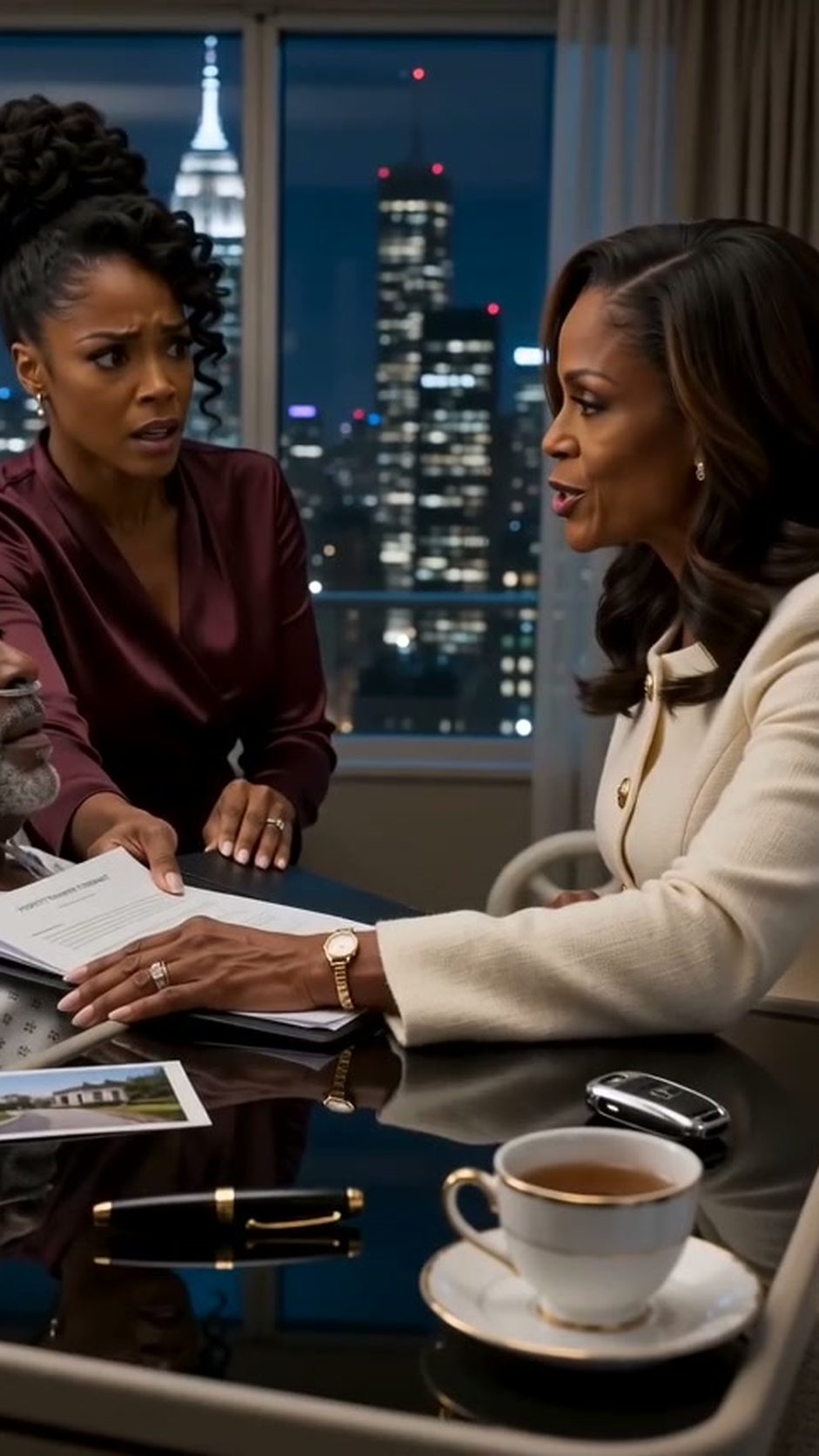
Raymond ignored the warning shot with the same magnificent carelessness he brought to all intelligence he disliked.
He took the pills when a nurse or a wife was watching. He kept the whisky decanter in the sideboard of the study and the cigars in the humidor his board had given him for thirty years of service, and if his color was worse and his temper shorter and his famous laugh arrived half an octave thinner, the empire still said Calloway on the tower, and that, to Raymond, was the only vital sign that had ever mattered. He settled into his sixties like a king settling into a throne he believed had been built to his personal measurements.
The kingdom, meanwhile, was quietly changing hands in the only way kingdoms actually do: in documents, in daylight, in rooms he never entered.
Nine years after the Rosewood Hotel — during the great refinancing that every property company in America did that decade, when rates fell and every CFO alive was restructuring debt — Raymond signed, over the course of one long afternoon in the Pierce & Alden boardroom, roughly four hundred pages. He signed where the tabs told him to sign. He signed the loan consolidations, the tax elections, the insurance riders. And he signed the Hart Family Trust Consolidation and Trustee Confirmation, which moved the legal title of eight properties — the eight properties, the waterfront houses and hillside houses and the lake house her father had built with his own design and other men's hands — formally and finally under the trust's sole trusteeship.
Hers.
Pierce had explained it to him. Pierce was an honest man in the ways that mattered and he had explained it fully, in the meeting, in the minutes: "This merely formalizes the existing trust structure, Mr. Calloway. The properties have been trust assets since Mr. Hart's time. Management authority remains with you and the company, unchanged." All true. Every word true. And Raymond, who had never in his life met fine print he considered worth his eyes, had said, "Fine, fine — where's the lunch menu?" and turned the page.
Vanessa, informed by phone that evening, had stood in her kitchen for a long time with her hand flat on the counter where the DNA report would one day rest.
"The ground is mine," she said.
"The ground was always yours," Pierce said. "Now it is also provable in a single document, by a tired judge, in one afternoon. Your father sends his regards, I believe, from wherever careful men go."
She kept the confirmation certificate in an envelope in her handbag for the last four years of her marriage. Not always the same handbag. But always an envelope, close to her hand, the way other women carry photographs of their children.
* * *
The collapse, when it finally came, came on a Tuesday, in the boardroom, in the middle of Raymond's sentence — he was saying the words "strongest quarter in the company's history" when the sentence simply stopped, the way a song stops when the power fails, and the board of Calloway Properties watched their chairman look at them with sudden, naked confusion and slide sideways out of his chair like a man leaving a theater.
This time it was not a warning shot. This time the doctors at St. Aurelia used words like massive and ejection fraction and window, and the window had numbers in it, and the numbers were not the kind you frame.
The ICU suite on the fourteenth floor was the best money could rent: a corner room, a wall of glass, the city doing its nightly impersonation of forever. There was a sitting area with a sofa that converted for family. There was a small black table, polished to a mirror. There was a view of both towers — Harborview and the Calloway tower, facing each other across the river like the two halves of Vanessa's life.
The family gathered the way water gathers, by gravity and old channels. Margaret arrived with her pearls and her pastor and her absolute refusal to pronounce the word dying. Sabrina arrived on the second day — not sneaking, not summoned, simply arriving, in burgundy, with the confidence of a woman who has been promised by a dying man that the future has her name on it, and if the nurses exchanged a glance, they were professionals, and they had seen this exact opera before in other expensive rooms.
And Vanessa sat in the chair nearest the bed, in ivory, with her handbag in her lap, and held the vigil the way she had held everything else: completely.
On the third night, at three in the morning, the nurses let her stay past the rules because she had learned all their names and because grief with good manners is the one currency every ICU honors. The suite was dark except for the monitor's green notation and the city, which does not sleep so much as change shifts. Raymond lay in the narrow bed with his mouth slightly open, breathing like a man carrying something heavy up a long flight of stairs, and Vanessa sat in the chair that had become hers and read him — out of old habit, out of the marriage's muscle memory — the business pages, in a low voice, the way she had once read him to sleep on trains.
"You'd hate the new Harborview numbers," she murmured. "Ruth says the third quarter carried the year. You'd take the credit at the board lunch. I'd let you."
His hand, on the blanket, found her sleeve with the blind accuracy of long marriage and held on, asleep, unaware, the way it had held her hand under Margaret's Christmas table in the years before the Rosewood. She looked at the hand — older, spotted, the nails still manicured by the woman who came to the house on Thursdays — and she did not pull away, and she did not soften either. She filed the moment where she filed everything: under evidence, under mercy, under the long heading of things that were both.
"Thirteen years I have been preparing to ruin you," she told the sleeping man, conversationally, "and I want you to know I have never once enjoyed the arithmetic. That's the difference between us, Raymond. You enjoyed all of yours."
He breathed on, carrying his weight up the stairs, and she turned the page.
It was on the fourth day that Raymond, surfacing from the gray country of sedation into a lucidity so clear it frightened the doctor, asked for his attorney. Not Pierce — his own man, Hale, a silver-haired facilitator who had spent twenty years helping Raymond Calloway do exactly what Raymond Calloway wanted and invoicing by the hour for the privilege.
The instructions, given in a voice like gravel settling, took eleven minutes. Hale emerged from the suite with the expression of a man carrying a lit candle through a powder magazine, and by the next morning the word had traveled the corridor in the way of all hospital news:
The chairman was putting his affairs in order. Eight properties. Three luxury cars. A new irrevocable trust, for the benefit of Owen Cole, age twelve, with the boy's mother as trustee until he turned twenty-five — and the signing, at the dying man's insistence, would be tomorrow night, at his bedside, with the family present.
"The family," Sabrina repeated happily, in the corridor, in Vanessa's hearing, touching up her lipstick in the black glass of a vending machine. "He wants everyone there. He wants it witnessed."
Vanessa smiled at her, warmly, the way she had smiled for thirteen years. "Then we mustn't disappoint him."
An hour before Hale arrived with the folders, Sabrina found her by the elevators — cornered her, really, though the cornering was done in the dialect of sisterhood, with a hand laid lightly on Vanessa's forearm and a voice kept low and warm with everything except warmth.
"I've been wanting to say this properly," Sabrina said. "Woman to woman. I know this is hard for you. But Raymond has made his wishes clear, and fighting a dying man's wishes — dragging lawyers into his last days — it would look a certain way. For you. The city talks, Vanessa. You have a reputation for grace. I'd hate for his illness to cost you that."
It was, in its way, a masterful little speech: the threat gift-wrapped as concern, the reputation held up like a hostage photograph. Thirteen years earlier it might have worked. Thirteen years earlier Vanessa had still believed that what the city said about her was a thing that could be taken from her, like a coat.
"You're kind to worry," Vanessa said. "Let me relieve you of it. Tomorrow night, I intend to sit in that room and watch my husband sign whatever brings him peace. Every page. Every witness he wants. If the city talks, Sabrina, it will have material." She smiled — the gala smile, the lighthouse smile — and gently removed the hand from her forearm, the way one returns a borrowed object. "Wear the burgundy. It suits the occasion. Endings should be well dressed."
She called Pierce from the chapel on the fourteenth floor, where the light came through amber glass and a plastic plant achieved a kind of immortality. She could hear the old man smiling in the silences.
"The title certificates?" she asked.
"Copied, certified, and bound. The trust confirmation. The voting share registry. The full archive — thirteen years, Vanessa, catalogued like a library. Ruth has the ledgers. Deke is on standby with the originals."
"The other envelope?"
"In my safe, as instructed, these nine years. It will be in your handbag by six o'clock, sealed, with the chain-of-custody documentation. Are you certain you want to let him sign? We can stop this tomorrow afternoon with one letter to Hale. A quiet ending is available to you. It has always been available to you."
Through the amber glass, the light lay in bands across the empty pews. Vanessa thought about an October afternoon, a paper bag of pasta going cold on a desk, a man laughing with his hand on another woman's belly in the dusk outside a hotel. She thought about two small hospital rooms and the word unlikely ever. She thought about a boy in a blazer too formal for him, laughing at a quartet, innocent as weather. She thought about a hand coming down, gently, flat and final, on a stack of paper.
"No," she said. "He has spent thirteen years explaining to himself that I don't know. Let him finish the sentence. Let him sign his name to the whole of it — the properties, the cars, all of it — in front of his mother and his mistress and God. A signature is the one thing a man can't take back, Jonathan. I want his."
She heard Pierce exhale, slow and satisfied, the sound of a chess master whose queen has finally been invited to move.
"Then tomorrow night," he said, "wear the ivory. And Vanessa — when it is over, whatever it looks like when it is over — the boy is twelve years old. Remember that you remembered that."
"I have remembered it every day for thirteen years," she said. "It's why I'm still married."
She went back up to the fourteenth floor and took her chair beside the bed, and when Raymond surfaced briefly in the dusk, gray-faced, frightened under the arrogance like a child under a blanket, she took his hand — the trembling, contract-signing hand — and held it until he slept, because she was, whatever else thirteen years had made of her, still the woman who had married him in a garden in June.
"Tomorrow," she told him, though he could not hear her. "Tomorrow, Raymond, we finish it."
The envelope arrived at six o'clock the next evening, as promised, carried up to the fourteenth floor not by a courier but by Pierce himself, in his overcoat, with his hat in his hand like a man attending a christening or a hanging. He had overseen the safe for nine years. He would oversee the delivery.
He found her in the family lounge, where a nurse had shown her a mirror and left her alone with it, and he set the envelope on the low table between them without ceremony. It was heavier than it looked. Nine years of chain of custody will do that to paper.
"Chain's intact," Pierce said. "Seals verified, witnessed, logged. Whatever else tomorrow night is, Vanessa, it is admissible." He studied her — the ivory blazer, the gold buttons, the hair arranged like a treaty — and something in his old lawyer's face softened into the expression he had worn at her wedding, standing in the back, watching Charles give her away. "Your father made me promise him one thing, the week before he died. He said: 'When she calls, Jonathan, don't talk her out of it. She's the only one of us who never flinches.' I've kept the letter of that promise for nine years. I intend to keep the spirit of it tonight."
"Then sit where I can see you tomorrow, Jonathan. Hale will want a grown-up in the room."
She picked up the envelope and put it in her handbag, where it settled against the other envelope — the trust certificate, her companion of four years — like two cards of the same suit finally lying side by side in the hand that had been dealt them.
Upstairs, in the suite at the end of the corridor, a nurse was plumping pillows and laying out folders, and a man who had never read the fine print of anything was sleeping the last untroubled sleep of his life.
"Tonight," Vanessa said.