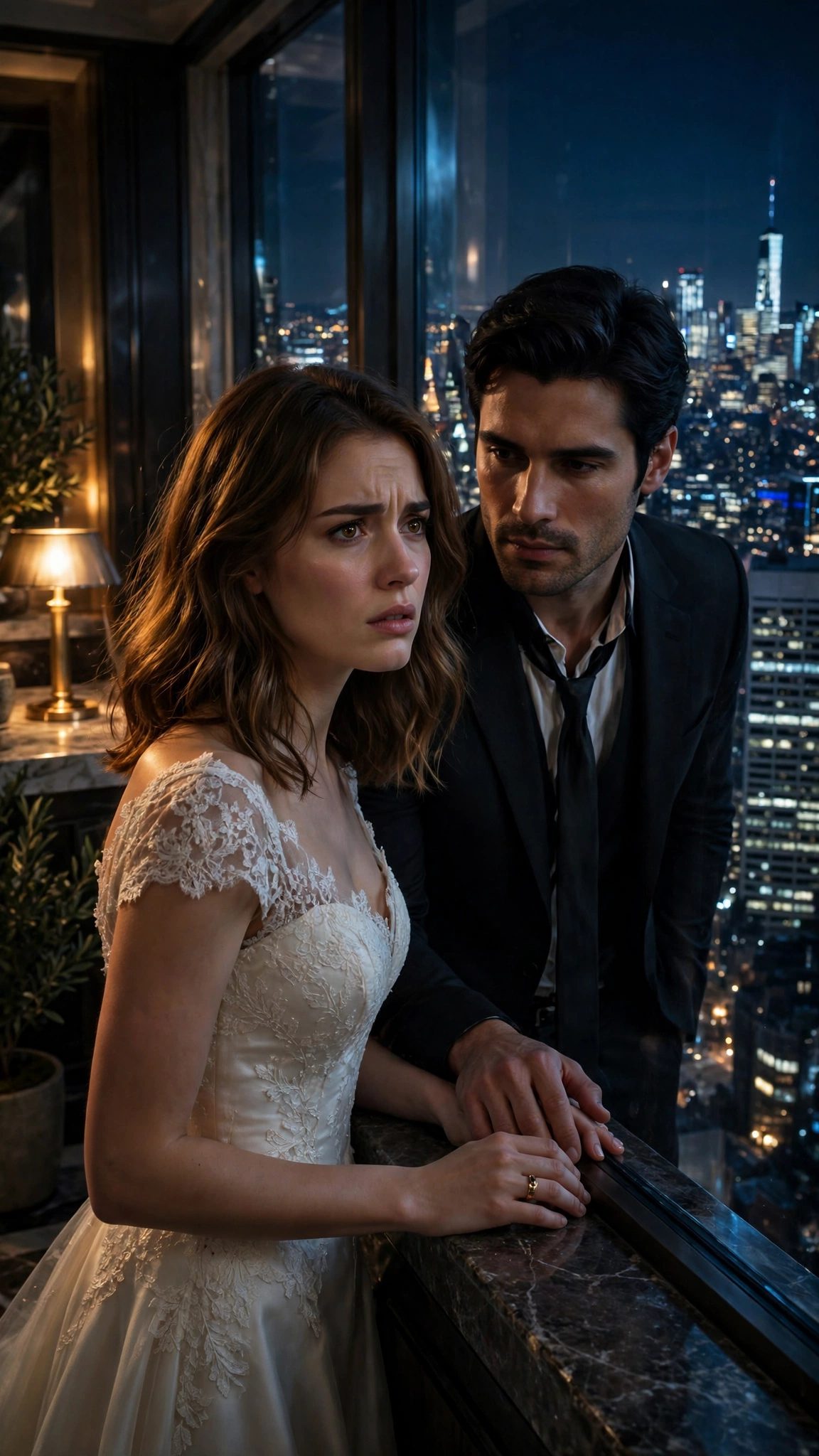
On the fourth day, Dominic broke his own rule.
"You're going out," he said at breakfast, setting down his coffee with a precision that told me he had already decided and was only informing me. "There's a gallery opening tonight. A small one. A friend of the family owns it. It will look strange if my wife never leaves the penthouse, and strange is dangerous right now. Jack will drive. I will be beside you the entire time. You will not leave my side for one second."
"A gallery," I said. "You want me to stand in a room full of strangers and look at paintings while someone wants me dead."
"I want you to look like a woman whose husband takes her to galleries," he said. "That is the job tonight. Smile. Look at the art. Let people see us together. The man who wants you dead needs to know that killing you would mean a war with me, in public, in front of witnesses. That is the point."
I had never been to a gallery opening as a guest. I had been to dozens as a teacher, herding teenagers past sculptures they were not allowed to touch. Now I stood in front of the wardrobe in the penthouse bedroom and stared at the clothes someone had bought for me: dresses in dark green and navy and black, shoes with heels I would break my ankle in, a coat softer than anything I had ever owned.
I chose the dark green dress, because it was the color of the dress in the photograph of Isabella, and because I wanted, for reasons I could not explain, to carry her with me into that room.
Dominic waited in the living room, and when I came out, he stopped what he was doing and looked at me for a long moment. He was wearing a black suit, black shirt, no tie, and he looked like a man who had been carved out of something harder than the rest of us.
"You look like her," he said quietly. Then he caught himself, and his face closed, and he said, "The car is downstairs. Stay beside me."
The gallery was a white room full of soft light and quiet voices, paintings on every wall, a table of wine glasses catching the light like small lanterns. People turned to look when we walked in, and I could feel their curiosity like a physical thing: who is she, where did she come from, how did Dominic Moretti, who never brings anyone anywhere, end up with a wife?
Dominic's hand rested lightly on the small of my back, and it was the first time he had touched me since the parking lot, and I was surprised by how steadying it was. His hand was warm. It did not tremble. It said, without words, that whatever happened in this room, he was here, and I was not alone.
"Smile," he murmured. "Look at the paintings. Tell me what you see."
So I did what I had done a thousand times in classrooms. I looked at the art, and I talked about it, and for a few minutes I almost forgot why we were there. There was a painting of the sea at dusk, all grey and gold, and I told Dominic that the painter had been afraid of the water and loved it anyway, because you could see it in the way he painted the waves, like something that could save you and drown you at the same time.
Dominic listened, and then he said, "That's how I feel about this family."
I turned to look at him, but before I could answer, the room changed.
It was nothing dramatic at first. A man near the door, too still, his hand inside his jacket. A second man by the window, watching us instead of the paintings. Jack, across the room, going rigid in the way a guard dog goes rigid before it moves. And Dominic, whose hand on my back suddenly became a wall, pushing me gently but firmly behind him.
"Emily," he said, very quietly. "Do not move."
The man near the door took a step forward, and I saw the gun. It was small and black and ordinary, and it was aimed directly at my heart.
Time did something strange then. It slowed down and sped up at the same time. I heard a woman laugh somewhere behind me, a bright, careless sound, completely unaware. I heard a glass clink. I heard my own breath, too loud in my ears. I saw the gunman's face, young and frightened, his hand shaking, and I understood in that frozen second that he did not want to do this, and that he was going to do it anyway.
And before I could even scream, Dominic Moretti stepped between me and the bullet.
He did not hesitate. He did not duck. He moved like a man who had made this decision long before tonight, like a man who had known, from the moment he said "I'm marrying you," that this was the price, and he had already agreed to pay it.
The gun went off. The sound was not like in the movies. It was flat and ugly and too loud for the white room, and the painting of the sea seemed to tilt, and Dominic staggered, and I saw the blood bloom across his white shirt, dark and fast, and I heard myself scream his name.
"It was his blood," I thought, stupidly, clearly, as if my mind had decided to narrate the worst moment of my life in plain words. It was his blood. It was his blood.
Dominic went down on one knee, his hand pressed to his side, his face white, and he looked up at me and said, through gritted teeth, "Run."
I did not run. I went down on the floor beside him and pressed my hands over his, over the wound, over the blood that was too warm and too fast, and I said, "No. No, I'm not leaving you. Don't you dare tell me to run."
Jack was there then, and the room was full of shouting, and the gunman was on the floor with two men holding him down, and someone was calling for an ambulance, and someone else was saying, "Clear the room, clear the room," and through all of it Dominic kept his eyes on my face, like I was the only fixed point in a world that had come loose.
"Emily," he said, and his voice was weaker than I had ever heard it. "The marriage—"
"Don't," I said. My hands were covered in his blood. My green dress was covered in his blood. "Don't you say it means nothing. Not now. Not ever again."
He tried to smile, and it was the saddest, bravest smile I had ever seen. "It never did," he whispered. "I lied. It never meant nothing."
Then the paramedics were there, and the stretcher, and the lights of the ambulance washing the gallery white and red, and I rode with him because no one could make me leave, not Jack, not Rosa, who arrived with her face like stone, not the police officer who asked me questions I could not answer.
In the hospital, they took him away through swinging doors, and I sat in a plastic chair in a hallway that smelled like disinfectant, with his blood drying on my hands and my dress, and I waited.
Rosa sat beside me. She did not speak for a long time. Then she said, "He stepped in front of a bullet for you. Do you understand what that means in our family, Emily?"
I nodded, because I could not speak.
"It means you are not a contract," she said. "It means you are not a wall, or a name, or a way to keep a witness alive. It means my son has chosen you. And now the whole family will know it, including the man who sent that boy with the gun."
"The gunman," I said. My voice sounded like it belonged to someone else. "He was young. He was scared."
"He was a message," Rosa said. "A cheap one. Whoever sent him wanted us to know they could reach you anywhere, even in a room full of people. They wanted Dominic to know it too."
A doctor came out then, tired and kind, and said the bullet had missed the vital organs, that Dominic was stable, that he would need surgery and time, and that he was asking for me.
I went into the room, and there he was, pale against the white sheets, an IV in his arm, a bandage thick around his ribs, and he looked up at me and said, "You stayed."
"Of course I stayed," I said. I sat beside the bed and took his hand, careful of the tubes. "You stepped in front of a bullet for me, Dominic. Where else would I be?"
He was quiet for a moment. Then he said, "The gunman is Anthony's boy. I know his face. I know who pays him."
"Anthony," I said. "Your cousin."
"My cousin," he agreed, and his voice went cold in a way I had never heard before. "He runs the docks. He changed the routes. And now he has tried to kill my wife in a room full of witnesses, which means he is either very stupid or very desperate. Either way, he has made his last mistake."
I looked at his hand in mine, at the ring on my finger, at the blood still under my fingernails that I had not washed off, and I felt something change inside me. The fear was still there, but underneath it was something else now, something hard and clear and furious.
"I found the ghost warehouse," I said. "You found the gunman. We have the flash drive, and the folder, and the police report. We are going to finish this, Dominic. All of it. For Isabella. For you. For us."
He squeezed my hand, weakly but surely. "For us," he repeated, like he was trying the words out for the first time.
Outside the hospital window, the city glittered, cold and beautiful and indifferent, the same as it had been on our wedding night. But inside the room, something had changed. The marriage that had meant nothing had just been paid for in blood, and neither of us could pretend anymore that it was only a wall built out of a name.
Four days earlier, a stranger had aimed a gun directly at my heart. And the man I had married to stay alive had stepped between me and the bullet, and in doing so, he had shown me the truth I had been afraid to see: he had never been protecting a contract.
He had been protecting me.
In the ambulance, the world narrowed to a small white box full of noise: the siren, the paramedic's voice calling out numbers, the oxygen mask hissing, Dominic's hand in mine, cold and slick with blood. I held on to it with both of mine, and I talked to him the whole way, because the paramedic said to keep him awake, to keep him talking, and I did not know what else to do.
"Stay with me," I said. "Dominic, stay with me. You don't get to step in front of a bullet and then leave. That's not how this works. You married me to keep me alive, remember? That means you have to stay alive too. That's the deal. That's the whole deal."
His eyes opened, just a slit, and he tried to say something, but the mask was in the way, so I leaned closer, and I heard him whisper, "The flash drive. It's in the safe. Don't let Anthony—"
"Don't worry about the flash drive," I said. "Don't worry about Anthony. Don't worry about any of it. Just breathe. Just stay."
The paramedic pushed me back gently when we reached the hospital, and they wheeled Dominic through swinging doors that said NO ENTRY in red letters, and a nurse put her hand on my arm and said, "Ma'am, you can't go in there. You need to wait out here. He'll be all right. He's strong."
I nodded, because there was nothing else to do, and I sat down in a plastic chair in a hallway that smelled like disinfectant and old coffee, and I looked down at my hands.
They were covered in blood. It was under my fingernails. It was on my wrists. It was on the green dress, stiff and dark. I had not noticed any of it in the gallery. I had only noticed his face, and the way he had looked at me, like I was the only fixed point in a world that had come loose.
A nurse came with a wet cloth and a kind voice and helped me wash my hands in the bathroom down the hall. I stood at the sink for a long time, watching the water run red and then pink and then clear, and I looked at myself in the mirror: a woman in a bloodstained green dress, her hair coming loose, her eyes too wide, a gold ring on her finger that had felt like it was strangling her four days ago and now felt like the only solid thing in the world.
"You're his wife," the nurse said. It wasn't a question. "He'll be all right. Men like him are stubborn. They don't die easy."
"Men like him," I repeated.
"I've seen his type," she said, wringing out the cloth. "They come in here shot and stabbed and broken, and they all say the same thing when they wake up: 'Where is she? Is she all right?' They never ask about themselves. Not once."
I went back to the hallway, and Jack was there, standing by the door with his arms folded, his face grey. He had been with the family for twenty years. He had driven Isabella to school when she was a girl. He had cried when she died.
"He stepped in front of it," Jack said quietly. "I saw the whole thing. He didn't hesitate. Not for one second. I've worked for this family for twenty years, and I have never seen Dominic hesitate about anything, but I have also never seen him step in front of a bullet for anyone. Not even for himself."
"The gunman," I said. "Who is he?"
"Nineteen," Jack said. "Scared. Anthony's people picked him up off the street and promised him money. He'll talk. They always talk. And when he does, we'll know everything."
A police officer came then, with a notebook and tired eyes, and asked me what had happened. I told him, slowly, carefully, the way I would tell a student to describe a painting: what I saw, in order, without guessing, without adding anything. The man near the door. The gun. Dominic stepping between us. The sound. The blood. The ambulance. The officer wrote it all down, and thanked me, and said someone would be in touch.
Then Rosa arrived, black dress, silver hair, face like stone, and she took one look at me, at the blood on my dress, at my hands, still shaking, and she did something I did not expect. She took me in her arms and held me, hard, like a mother holds a child who has just survived something terrible.
"He's going to be all right," she said. "My son is too stubborn to die. And you, Emily, are too stubborn to let him. That's why this is going to work."