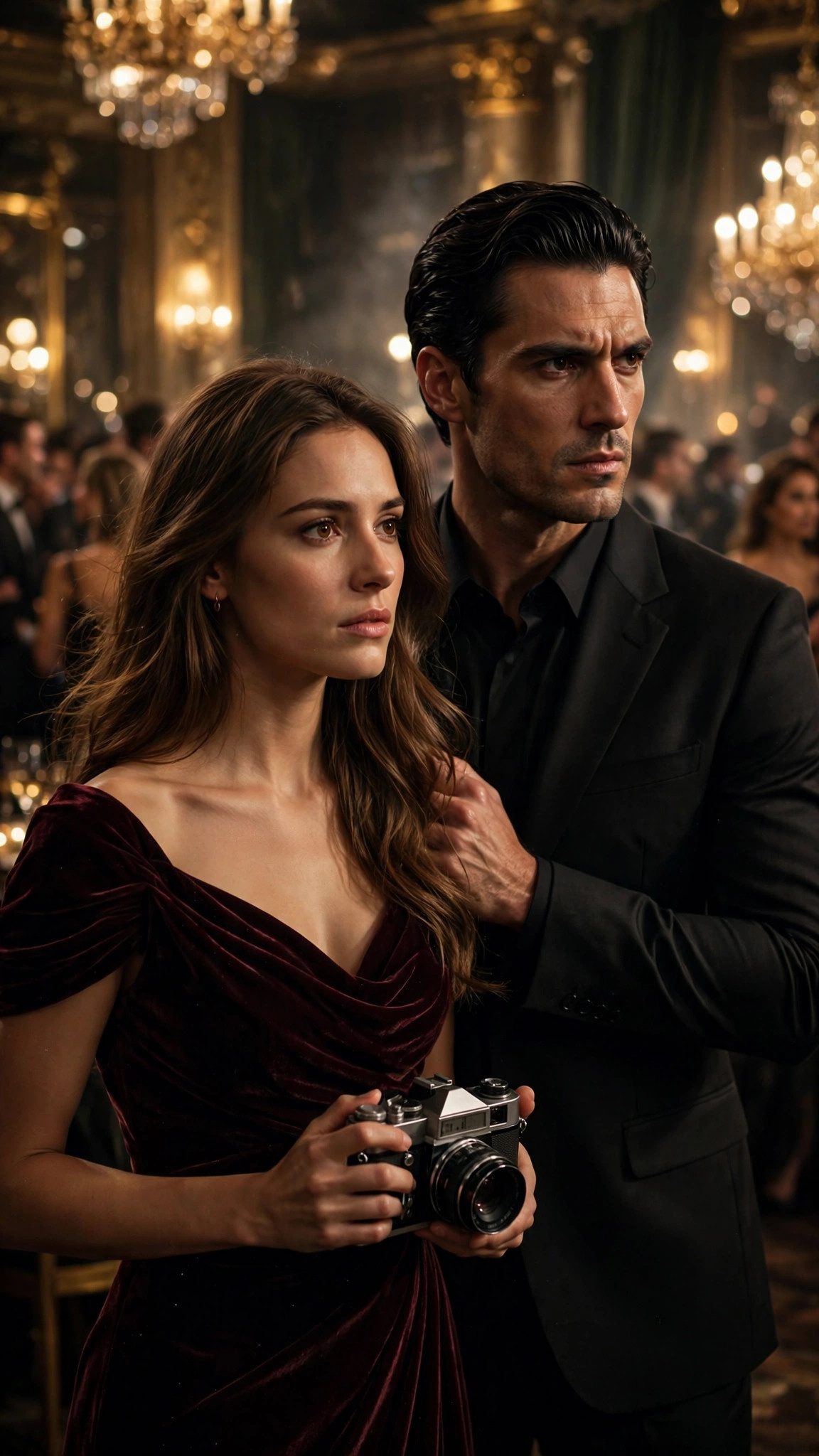
The bottling plant on Canal Street was four stories of broken windows and rusted iron, and the sign above the door, "Royal Crown Bottling," hung crooked, one letter missing, the way a smile looks when it is missing a tooth. The green side door was open, and a single light burned above it, and as I walked toward it at midnight, with my camera in my hand and the wire under my sweater and Sal's voice in my ear, I thought about every photograph I had ever taken, and I thought about the man in the basement, and I thought about the woman on the third floor, and I did not stop walking.
"You're doing fine," Sal said in my ear. "Slow and steady. We are right behind you. Two cars on the street, four men at the back, Alvarez at the front. You are not alone."
A man was waiting inside the green door. He was tall, with a shaved head and a scar on his neck, and he held a gun, not pointed at me, but held where I could see it, which was the same thing.
"Give me the camera," he said.
"No," I said. "The camera stays with me until I see King and Vera. That was the deal."
He looked at me for a moment, and then he nodded toward the stairs. "Second floor," he said. "Blake is waiting."
I climbed the stairs, and my footsteps echoed, and the air smelled like dust and old sugar and something else, something sweet and rotten, the way abandoned buildings smell. On the second floor, there was an office with a desk and a lamp, and behind the desk sat Marcus Blake, in a suit that cost more than my rent for a year, with his silver hair combed back and a glass of whiskey in his hand, looking like a man who had already won.
"Miss Bennett," he said, and he smiled. "Thank you for coming. I knew you would. Women like you always come. You care too much. That is your weakness."
"Where are they?" I asked.
"All in good time," Blake said. "First, the camera."
"No," I said. "First, King and Vera. Then the camera. That was the deal you made on the phone."
Blake's smile faded. He put his glass down. "You are in no position to make demands, Miss Bennett. I have your mafia boss in my basement, and his sister on the third floor, and I have six armed men in this building. You have a camera and a brave face. Do not mistake courage for power."
I thought about Derek, in the small room at the back of the brownstone, crying into his coffee. I thought about Vera, who ran a shelter for women who were running. I thought about King, who had stood up in a nightclub for a stranger. And I looked at Marcus Blake, and I said the words I had been saving since the night with the cake.
"I am not afraid of you."
Blake laughed. It was a short, ugly laugh. "We will see," he said. He picked up a phone on the desk and spoke into it. "Bring them up."
Two men brought King up from the basement, and two more brought Vera down from the third floor, and when I saw them, my heart stopped and then started again, too fast.
King was hurt. His face was bruised, his shirt was torn, and there was a cut above his left eye that had bled down his cheek and dried there. But he was standing. He was standing on his own two feet, and when he saw me, he smiled, a small, careful smile, the same smile from the restaurant.
"Harper," he said. "I told you not to come."
"I don't listen very well," I said.
Vera was beside him, thirty-four years old, dark-haired, with the same brave eyes Rosa had told me about, and she was holding King's arm, and she was looking at me with an expression I could not read at first, and then I understood it. It was gratitude. And it was something else. It was recognition, the way you recognize someone you have been waiting to meet.
"You're the photographer," Vera said. "Rosa told me about you. She said you have my eyes."
"I have your bracelet too," I said, and I touched my pocket, where I had put the silver bracelet with the tiny camera charm. "I found it in the mud by the warehouse. I kept it safe."
Vera's eyes filled with tears. "Thank you," she said.
Blake stood up from behind the desk. "How touching," he said. "A family reunion. Now, Miss Bennett, the camera. Give it to me, and I will let them walk out of here with you. Refuse, and I will hurt them, starting with the sister."
He nodded to one of his men, and the man stepped toward Vera, and I saw King's whole body go tense, the way a rope goes tense before it snaps.
"Wait," I said. I held up the camera. "I'll give you the camera. But first, I want you to look at something. I want you to look at the last photograph on it. The one you wanted so badly. The one of you taking cash in the alley."
Blake frowned. "I have seen it. It proves nothing. A man taking an envelope. It could be anything."
"Look closer," I said. "Look at the background. Look at the table behind you. Look at what is sitting on it."
I turned the camera around and held it up, and Blake leaned in, and his face changed, the way a man's face changes when he realizes he has made a terrible mistake.
The ledger. The black ledger with the gold crest. He saw it, and he knew, in that moment, that I had not just photographed a bribe. I had photographed his entire criminal life, written down in his own hand, sitting on a table behind him while he counted his money.
"That photograph is already with the police," I said, and my voice was steady, and I was proud of how steady it was. "Detective Maria Alvarez has a copy. So does the FBI. So does a cloud account that will send it to three newspapers if I don't check in by morning. You can take my camera, Mr. Blake. You can smash it. You can burn it. It won't matter. The photograph is already out there. And so is the ledger, because your men left it in the alley, and Sal's men found it an hour ago."
That last part was a lie. Sal's men had not found the ledger. But Blake did not know that. And in the second that he believed it, in the second that his face went white and his hands started to shake, I said the words.
"The light is good here."
The door behind me burst open, and Sal came in, and Enzo came in, and four more men came in, and Alvarez's detectives came in from the front stairs, and the room filled with shouting and movement, and Blake's men raised their guns, and Sal's men raised their guns, and for one terrible moment, I thought someone was going to die in that office, in front of the desk, in front of the lamp.
Then Alvarez's voice cut through the noise, clear and certain, the way a police officer's voice cuts through a crowd.
"Marcus Blake, you are under arrest for kidnapping, extortion, and embezzlement. Put your hands where I can see them."
Blake looked at the guns, and he looked at Alvarez, and he looked at me, and he understood that he had lost. He put his hands up. Slowly. His men did the same. And as the detectives put handcuffs on him, he looked at me, and he said, "You. You did this. A photographer with a camera. You ruined everything."
"No," I said. "You ruined everything. Twenty years ago, when you started stealing from the family that trusted you. I just took a photograph."
King was beside me then, and his hand was on my shoulder, and his voice was in my ear, low and warm.
"Harper," he said. "You came. I told you not to come, and you came anyway."
"Of course I came," I said. "You stood between me and the world. Now I stood between you and the world. That is how this works."
He looked at me for a long moment, and then he did something I had never seen him do. He laughed. It was a real laugh, rough and surprised, the laugh of a man who had been in a basement for two days and had just been set free by a woman with a camera.
"Rosa was right," he said. "You do have Vera's eyes."
Vera was beside us then, and she put her arms around both of us, and she was crying and laughing at the same time, and she said, "Thank you, Harper. Thank you for coming for us. Thank you for not running."
"I don't run anymore," I said. And it was true. I had run from Detroit. I had run from the alley. I had run from my own life for years. But I was not running anymore. I was standing still, in an office in a bottling plant at midnight, with a mafia boss on one side and his sister on the other, and I had never felt more like myself in my entire life.
The detectives took Blake's men out one by one, and Alvarez took Blake himself, and I watched her put the handcuffs on him, and I thought about the night in the Velvet Room, and the man who had said I didn't belong there, and how small that moment seemed now, compared to this one. Blake had spent twenty years believing that money and fear made him powerful. It had taken one photograph to prove him wrong.
A paramedic came up the stairs and looked at the cut above King's eye, and he cleaned it and put a bandage on it, and King sat still for it, the way a man sits still when he is used to being hurt and not complaining about it. Vera sat beside him, holding his hand, and she told the paramedic that she was fine, that she was just tired, that she had been more frightened than hurt, and I believed her, because Vera did not look like a woman who frightened easily.
Alvarez came over to me with a notebook in her hand. "I need your statement," she said. "Everything. From the nightclub to the phone call. And I need a copy of every photograph on that camera, and the cloud backup, and the memory card you gave Sal. I will get a warrant for Blake's office and his apartment in the morning, and when we find that ledger, and we will find it, your photograph will be the thing that ties it all together."
"You'll find it," I said. "Blake is the kind of man who keeps records. He can't help himself. He wants proof of how clever he was."
Alvarez smiled. "Then he kept his own prison sentence in a book, and you took a picture of it. That is the best kind of evidence there is."
She went back to Blake, and I stood by the window, looking out at the canal, at the police lights flashing red and blue across the water, at the cars arriving and the men being led away, and I felt something I had not felt in a very long time. Not fear. Not anger. Relief. The kind of relief that makes your knees weak, that makes you want to sit down and cry and laugh at the same time.
King came and stood beside me at the window. He did not say anything for a while. He just stood there, with the bandage above his eye and his torn shirt and his quiet, steady presence, and then he said, "Rosa told you about the ring."
It was not a question. I nodded.
"I was going to ask you at Christmas," he said. "I know it is too soon. I know we have only known each other for three weeks. I know that is not enough time. But I also know that I have lived thirty-nine years, and I have never met anyone who looked at the world the way you do, and I have never met anyone who stood up the way you stood up tonight. You walked into a building full of armed men, with a camera and a brave face, for me. For Vera. For people you barely knew. That is not something you do for a stranger. That is something you do for family."
I looked at him, and I thought about the ring in my pocket, next to the rosary, and I thought about the promise he had made in the dining room, and I thought about the night in the nightclub, and I said the truest thing I had ever said to anyone.
"I am not ready to be engaged," I said. "Not yet. Ask me again at Christmas, and I will say yes. But tonight, I will say this. I am not going anywhere. Not back to Detroit. Not away from Chicago. Not away from you. I am staying. That is my answer for tonight."
King smiled, the small, careful smile from the restaurant, and he took my hand, and his hand was warm and strong, and he said, "Then that is enough for tonight. And at Christmas, I will ask you properly, with a real dinner and a real question, and you will say yes, and Rosa will cook for a hundred people, and Vera will cry, and Sal will pretend not to cry, and it will be the best Christmas this family has ever had."
"And what about Blake?" I asked. "And Derek? And the ledger?"
"Tomorrow's work," King said. "Tonight, we go home. Rosa is waiting with dinner. And Harper, there is one more thing. From now on, you don't photograph strangers on the street anymore. You photograph this family. Our weddings, our birthdays, our children, our lives. You are our photographer now. That is your job, if you want it."
"I want it," I said.
Outside, the police cars were arriving, and the lights were flashing red and blue across the canal, and Derek was already in custody, telling the truth for the first time in his life, and the ledger, the real ledger, was still out there somewhere, in Blake's office or his apartment, waiting to be found. But that was tomorrow's work. Tonight, we were alive. Tonight, we were together. Tonight, the man who had stood between me and the world was standing beside me, and I was standing beside him, and the world could do its worst.