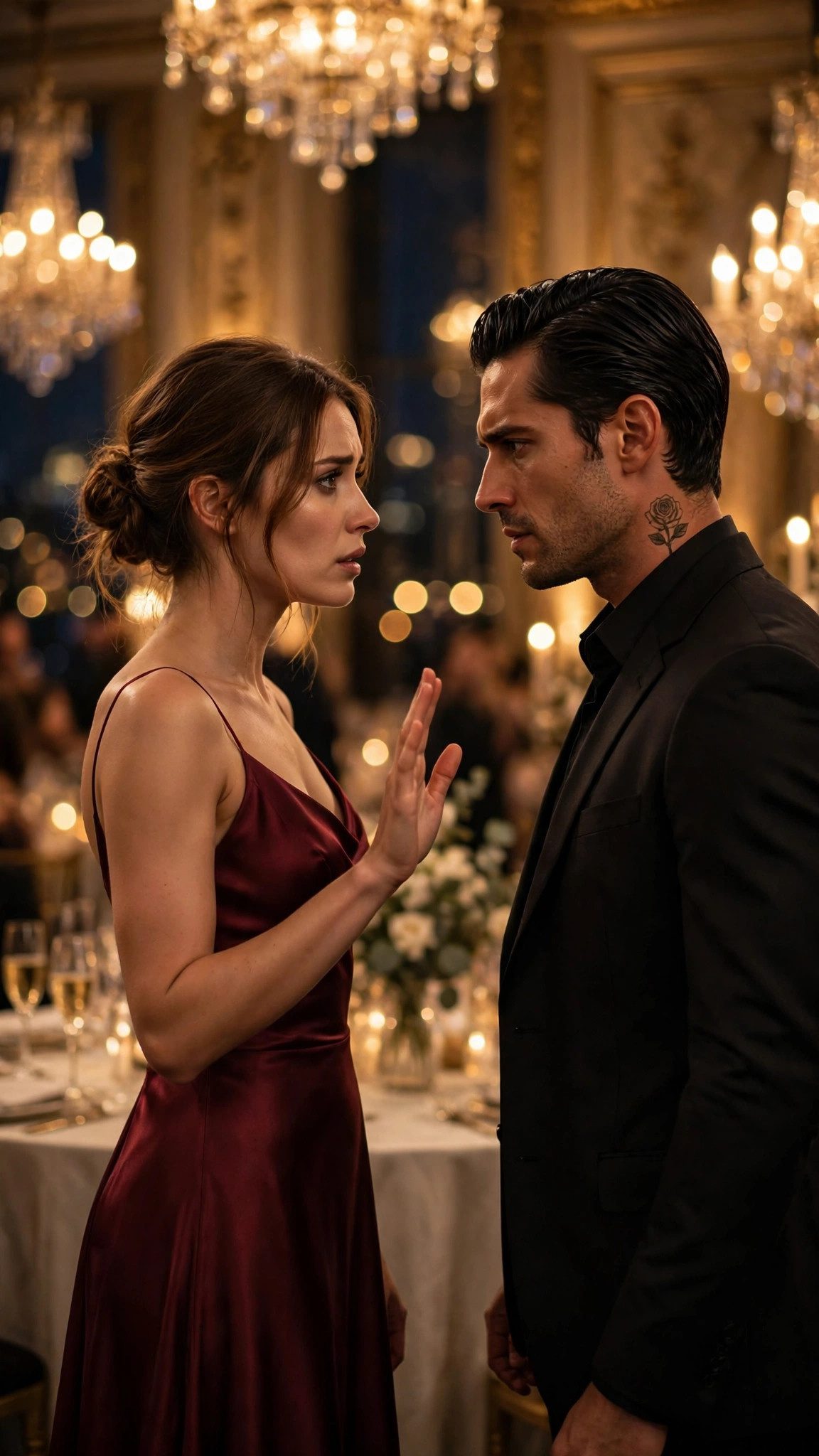
Gabriel came home from the hospital three days later, with his shoulder bandaged and his arm in a sling and strict instructions from his doctor — a doctor who was not me, because I had refused to be his doctor, and his nurse, and his girlfriend, all at the same time.
"I need rest," he told Enzo, on the morning he was discharged. "And I need to learn to do something I have never done before."
"What is that, sir?" Enzo asked.
"Ask," Gabriel said.
He started small. That was the first thing I noticed. Small questions, asked quietly, like a man learning a new language one word at a time.
The first one came on a Tuesday, a week after the docks. I was coming off a twelve-hour shift, and the black sedan was waiting outside the hospital, as it always was. The driver rolled down the window. But this time, Gabriel was sitting in the back seat, and he leaned forward, and he said, "Hannah. Would you like a ride home?"
Would you like. Three small words. The first question he had ever asked me about what I wanted.
"Yes," I said. "I would like that. Thank you."
The second question came two days later. Coffee on the nurses' station, black, one sugar, exactly the way I liked it — and beside it, a note in his strong, slanted hand: "Is this still how you take it? — G."
I wrote back on the same note, in my own handwriting: "Yes. It is perfect. — H."
The third question came on a Sunday. He called me — he called, he did not send a message through Rosa or the driver — and he said, "Would you like to have dinner with me tonight? Not the break room. A real restaurant. If you want to. If you don't want to, that's all right too."
I said yes. We went to the little Italian place on Fifth Street, and he asked me what I wanted to order, and I ordered the pasta, and he ordered the same, and we talked for two hours, about the hospital, and the city, and the rain, and nothing important at all. And when he walked me home, he stopped at my door, and he said, "May I kiss you good night?"
May I. He asked. And I said yes. And he kissed me — gently, carefully, like a man who had waited six weeks and fourteen years for permission — and it was the first kiss of my life that felt like a question and an answer at the same time.
After that, the questions came more easily. "Would you like to walk?" "Shall we sit here?" "Do you want coffee, or tea?" "Is this all right?" Small questions. Ordinary questions. The kind of questions most people ask without thinking. For Gabriel Veseri, each one was a small revolution.
And the board — the board took care of itself, in the end. Mr. Whitfield called me into his office two weeks after the docks, and I went, expecting another warning, or worse. But Whitfield was different this time. He was quiet. He was almost humble.
"Miss Mercer," he said, "I owe you an apology."
I waited.
"The police came to see the board," he said. "They told us about Mr. Rinaldi. About the threats. About the rose. About the parking lot. And Mr. Veseri — Mr. Veseri came to see me himself, the day after he was discharged. He told me that if the board took any action against you, he would withdraw his donation, and he would also tell the press exactly why. But he also told me something else. He told me that you had saved his life twice, and that you had saved the hospital's reputation by refusing to be intimidated, and that the board should be thanking you, not warning you."
Whitfield opened a drawer and took out a letter. My warning letter. He tore it in half, slowly, and put the pieces in his wastebasket.
"Your record is clear, Miss Mercer," he said. "And the board would like to offer you the position of charge nurse on the night shift, if you want it. With a raise. If you want it."
If you want it. Even Whitfield was asking now.
"Thank you, Mr. Whitfield," I said. "I'll think about it."
I did think about it. I thought about it for a week. And then I accepted — on my own terms, in my own time, because it was what I wanted, not because anyone had decided it for me.
Rinaldi's trial came and went. The evidence was overwhelming — the gun, the men, the shipment, the recordings from Gabriel's man inside his organization. Dominic Rinaldi was sentenced to twenty-five years in prison. His lawyers appealed. The appeal failed. The city, which had once whispered his name with fear, stopped whispering it at all.
And Gabriel healed. The shoulder took six weeks — the same six weeks, almost to the day, as the first time. He did his exercises. He took his medicine. He slept, for the first time in years, through the whole night, without waking. And when I asked him how much it hurt, he told me the truth.
"It doesn't hurt anymore," he said, one evening, sitting beside me on the balcony of his apartment, looking out at the city lights. "Not the shoulder. Not the silence. Not any of it. You asked me how I felt, Hannah, and I told you, and the world didn't end. I don't know why I waited fourteen years to learn that."
"Because you were afraid," I said. "And afraid is not the same as weak."
He took my hand. "Come with me tomorrow," he said. "There's somewhere I want to show you. Somewhere I haven't been in a very long time."
"Where?"
"My mother's garden," he said. "In the old neighborhood. Behind the house where I grew up. She grew roses there. I've kept the house all these years, but I haven't been back since she died. I want to go back. And I want you to come with me."
I said yes. Of course I said yes.
The house was small and white, with blue shutters and a garden behind it that had gone wild in the years since his mother died. Roses grew everywhere — climbing the fences, spilling over the stone walls, red and pink and white, with thorns, honest thorns, exactly the way his mother had said.
Gabriel stood in the middle of the garden, in the late afternoon light, and he looked around at the roses, and for a moment he was nineteen years old again, and his mother was alive, and the world was simple.
"She would have liked you," he said quietly. "My mother. She liked people who asked questions. She used to say that a person who asks you how you feel is a person who loves you, even if they don't know it yet."
I took his hand. "I'm glad I came."
"Hannah," he said, and he turned to face me, and his voice was steady, and his eyes were clear, and there was no audience, and no crisis, and no one watching — just the two of us, alone, in a garden full of roses. "I came here to ask you something. Not in front of a crowd. Not because I ran out of other things to decide. Because I want to know the answer."
He took a breath.
"Will you be my girlfriend?"
I laughed. I couldn't help it. I laughed, out loud, in the middle of the rose garden, because after everything — the gunshot, the car, the coffee, the gala, the terrace, the proposal, the docks, the blood — Gabriel Veseri, the most powerful man in the city, was standing in his mother's garden asking me, properly, the question he had never asked.
"Yes," I said. "Yes, Gabriel. I will be your girlfriend."
He smiled — really smiled, the way he had almost smiled in the break room, only this time he didn't stop halfway. His whole face changed, and he looked younger, and lighter, and more alive than I had ever seen him.
"Good," he said. "Because I have one more question."
He went down on one knee, in the grass, among the roses, and he took a small box out of his pocket, and he opened it. Inside was a ring — simple, gold, with a single diamond, and beside the diamond, set into the band, a tiny rose, carved in gold.
"Hannah Mercer," he said, "will you marry me?"
This time, I didn't say "not like this." This time, there was no ballroom, and no audience, and no fight. There was only a man on his knees in a garden, asking me the question properly, because he wanted to know the answer, not because he was afraid of it.
"Yes," I said. "Yes, I will marry you."
He stood up. He put the ring on my finger. And he kissed me, in the rose garden, in the late afternoon light, and the roses were all around us, red and pink and white, with thorns, honest thorns, exactly the way his mother had said.
We were married three months later, in the little garden behind the white house, because it was the only place that made sense. Maya was my maid of honor. Enzo was Gabriel's best man, and he cried, and he pretended he didn't. Rosa came, and the nurses from the night shift came, and even Mr. Whitfield came, in a grey suit, and he danced with Maya, and he told me afterward that the hospital had never looked better.
I wore the burgundy satin gown. It was the same gown I had worn to the gala, the night I told Gabriel Veseri to stop calling me his girlfriend. Only this time, when he looked at me coming down the little path between the roses, he didn't call me anything at all. He just looked at me, and his eyes were wet, and he said, very quietly, so only I could hear it, "You look beautiful."
"I know," I said. "You told me. The first time, you told me. And the second time, you asked me. And that's the difference."
After the wedding, we danced in the garden, under the string lights Enzo had hung from the trees, and the nurses danced, and the men in dark suits danced, and even the city, far away beyond the garden walls, seemed to be dancing too.
Late that night, when the guests had gone and the lights were low and the roses were dark against the night, Gabriel and I sat together on the little stone bench where his mother used to sit, and he put his arm around me, and I put my head on his shoulder — his good shoulder, the one that had healed — and we listened to the quiet.
"Are you still breathing?" I asked him.
"Yes," he said. "Because of you."
"And how much does it hurt?"
He was quiet for a moment. Then he said, "It doesn't hurt at all. Not anymore. Not since you asked me."
I smiled, and I closed my eyes, and I thought about the first night, six weeks — no, a lifetime — ago, when they wheeled a dying man into my trauma bay and I put my hands on his chest and refused to let him go. I thought about the coffee, and the car, and the dinners, and the night neither of us slept. I thought about the gala, and the terrace, and the question he had never asked, and the question he had finally asked, properly, in a garden full of roses.
And I thought about the thing my grandmother had taught me, all those years ago, in a little clinic a long way from here: that the first thing you do with a frightened person is ask them how they feel. Not because you don't know, but because asking is how you tell them they matter.
Gabriel Veseri had spent fourteen years believing that asking was dangerous. It had taken a nurse, and a gunshot wound, and a ballroom full of powerful people, and a garden full of roses, to teach him the truth.
Asking is not dangerous. Asking is how you tell someone they matter. Asking is how you tell someone you love them. And the only question that was ever worth asking was the one he had been afraid to ask all along.
Will you marry me?
I had said yes. And I would say it again, every day, for the rest of my life.
One year later, I stood in the lobby of St. Catherine's General Hospital, in my charge nurse's uniform, and I watched a little girl in a pink coat walk through the doors of the new children's wing, holding her mother's hand, staring up at the sign over the entrance.
"The Rose Garden Wing," the little girl read aloud, slowly, sounding out the words. "Why is it called that, Mommy?"
Her mother smiled. "Because a kind man built it for his mother, who loved roses. And because the nurse who runs it loves roses too."
The little girl looked at me. "Are you the nurse?"
"I am," I said, kneeling down so I was at her eye level. "My name is Hannah. What's yours?"
"Lily," she said. "Is the man with the rose on his neck your husband?"
I laughed. "Yes, Lily. He is."
"Is he scary?" she asked, very seriously. "Mommy says he used to be scary."
I thought about Gabriel — about the man who had walked into my trauma bay bleeding, and the man who had knelt on a terrace, and the man who now asked me every morning whether I wanted coffee or tea, and who still sometimes forgot, and caught himself, and smiled, and asked again.
"No," I said. "He's not scary. He's just a man who had to learn to ask. And do you know what? He's very good at it now."
Lily considered this, and then she nodded, satisfied, and she took her mother's hand, and she walked into the Rose Garden Wing, where the walls were painted with roses, and the windows looked out over a little garden, and where every child who came through those doors would be asked, first thing, how they felt.
Gabriel was waiting for me by the garden door, with two cups of coffee in his hands. "How do you take it?" he asked, holding them out. "Black, one sugar? Or did you change your mind?"
"Black, one sugar," I said, taking the cup. "I never change my mind about the important things."
He kissed me then, in the lobby of the hospital, in front of the nurses and the visitors and the little girl in the pink coat, and he didn't care who was watching. Because some questions, he had learned, don't need to be asked in private. Some questions are meant to be asked out loud, in front of the whole world.
And the answer, I had learned, is always yes.
THE END