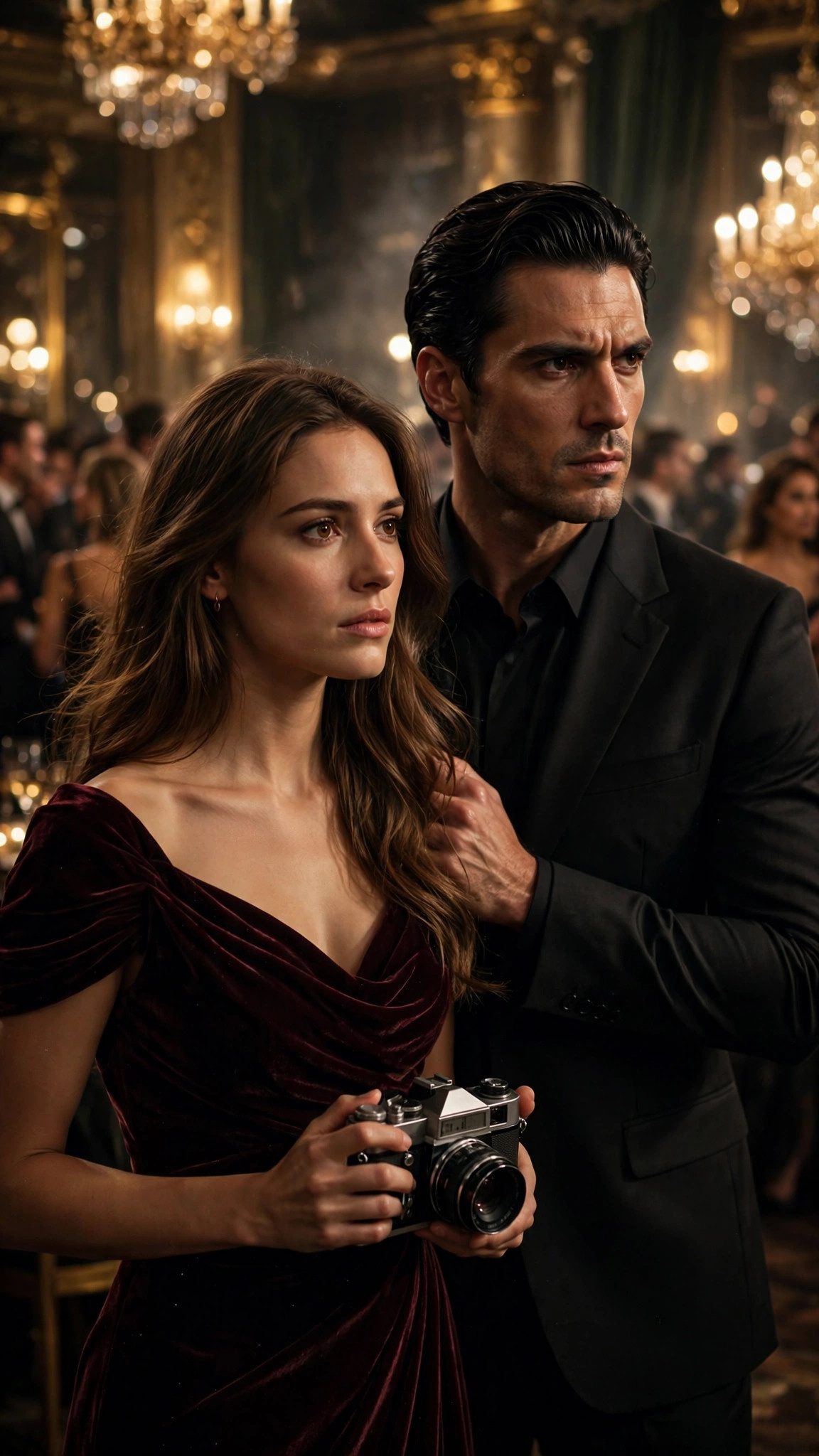
We took Derek to the brownstone, and Sal put him in a small room at the back of the house, with a guard at the door and a cup of coffee on the table, and Derek told us everything.
He told us how Blake had found him. Three weeks after I left Detroit, Derek had lost his job at the car dealership, and Tessa had left him, and he had been drinking too much and sleeping on a friend's couch. A man had come to the bar where Derek drank every night, a man with a silver watch and a quiet voice, and the man had said he worked for a businessman in Chicago who needed someone to keep an eye on a woman. The woman's name was Harper Bennett. The pay was fifty thousand dollars. Derek had not asked any questions. He had not wanted to know the answers.
"He gave me a phone," Derek said, staring into his coffee. "A second phone. He said to call a number every night and report where you went, who you talked to, what you photographed. I did it for two weeks. Then Blake called me himself. He said you had photographed something you shouldn't have, and he said he needed me to help him take King Moretti. He said it would be easy. He said King wouldn't fight, because King would be worried about you. He was right. King didn't fight. When we took him, he just looked at me, and he said, 'You must be Derek.' He knew my name. He knew who I was. And he wasn't afraid. He was just… disappointed. Like a teacher looking at a student who failed a test he could have passed."
"Where is the bottling plant?" Sal asked.
"On the south side, by the canal," Derek said. "Canal Street, past the rail yard. It's an old building, four stories, with a green door on the side and a broken sign that says 'Royal Crown Bottling.' Blake owns it through a shell company. He has six men there, maybe seven. He has King in the basement, and Vera on the third floor. He is going to call Harper tonight, at nine o'clock, and he is going to tell her to bring the camera to the plant at midnight, alone, and if she doesn't come, or if she brings the police, he is going to hurt them."
Sal wrote it all down, and Enzo made phone calls, and I sat in the kitchen with Rosa, who made me tea and did not ask me any questions, which was exactly what I needed.
"Tell me about Vera," I said to Rosa, after a while. "King's sister. What is she like?"
Rosa smiled, a sad smile. "Vera is thirty-four years old, and she is the bravest person I know. She runs a shelter for women in the city, women who are running from men who hurt them. She has been doing it for ten years. She is the reason King has his rule, you know. His rule about never hurting women. He made that rule because of Vera. When they were young, their father was a hard man, and Vera protected King, and King protected Vera, and they promised each other that no woman would ever be afraid in their family. Not ever. That is why he stood up for you in the nightclub. That is why he took your camera and told Marcus Blake he would pay for it. You reminded him of Vera. A woman standing alone in a room full of men, refusing to be afraid."
I thought about that for a long time. I thought about Vera, a woman I had never met, who ran a shelter for women who were running, and who had gone looking for her brother and been taken. I thought about King, who had made a rule when he was a boy and kept it for his whole life. And I thought about myself, a woman who had spent years trying to please a man who had never appreciated her, and who had finally learned to stand up.
"Harper," Rosa said, and she put her hand over mine. "You are part of this family now. Whether you want to be or not. King chose you the moment he stood up in that nightclub. That is how it works in this family. You stand up for someone, and they are yours, and you are theirs. Forever."
At six o'clock, Enzo came into the kitchen with a woman I had never seen before. She was in her forties, with short dark hair and a sharp suit, and she carried herself like someone who was used to being listened to.
"This is Detective Maria Alvarez," Enzo said. "Chicago Police, Organized Crime Division. She has been investigating Marcus Blake for three years. She is the only police officer we trust."
Detective Alvarez shook my hand, and her grip was firm. "Miss Bennett," she said. "Enzo tells me you have a photograph of Marcus Blake taking a bribe, and a photograph of a ledger with the Moretti crest on it. Is that true?"
I showed her the photographs on my camera, and she looked at them for a long time, and then she smiled, a slow, satisfied smile.
"Three years," she said. "Three years I have been trying to prove that Blake has been skimming from Moretti businesses and laundering the money through his own companies. Three years, and no one would talk, and no paper trail would hold. And you walked into an alley with a camera and got it all in one afternoon."
"It was luck," I said.
"No," she said. "It was a photographer's eye. Luck is when you win the lottery. This is work. Now, here is what we are going to do. I cannot send a police team into that bottling plant. Blake has people inside the department. If I call it in, he will know before we get there, and he will move King and Vera, or worse. So we do this quietly. You take the call at nine o'clock. You agree to the exchange. You go to the plant at midnight, and you wear a wire, and Sal's men and my two best detectives will be in position, and when Blake shows you King and Vera, we move in. And when this is over, you give me a copy of every photograph you have, and I will make sure Marcus Blake spends the rest of his life in prison."
"And Derek?" I asked.
"Derek cooperates, and he testifies, and he gets a deal," Alvarez said. "He helped kidnap two people. He does not walk away clean. But if he tells the truth, and he helps us, he will not spend the rest of his life in prison. That is the best I can do."
I nodded. It was more than Derek deserved, and less than he feared, and it was fair, which was more than he had ever given anyone.
After Alvarez left, Sal took me into the study and opened a drawer, and inside the drawer was a small black case, and inside the case was a wire, a listening device no bigger than a button, and a tiny earpiece.
"This goes under your sweater," Sal said, fitting it carefully, his hands gentle and professional. "It will pick up everything Blake says, and everything you say, and it will send it to us, in the cars outside. And this," he tapped the earpiece, "will let you hear me. If I tell you to leave, you leave. If I tell you to stay, you stay. If I tell you to say something, you say it. Do you understand?"
"I understand," I said.
Enzo spread a map on the desk, a hand-drawn map of the bottling plant, with the green side door marked in red ink and the basement stairs marked in blue.
"Blake will bring you in through the green door," Enzo said. "He will take you to the second floor, where he has an office. King is in the basement. Vera is on the third floor. There are two staircases, one at the front and one at the back. Sal's men will be at the back staircase, and Alvarez's detectives will be at the front. When you see King and Vera, when you know they are alive, you say the words, 'The light is good here.' That is the signal. And then we come in."
"The light is good here," I repeated. "I can remember that."
"Good," Enzo said. "And Harper, one more thing. Blake is going to try to frighten you. He is going to tell you that he will hurt them if you don't do what he says. He is going to tell you that no one is coming to help you. He is lying. We are coming. We are always coming. You just have to hold on until we get there."
I nodded, and I thought about my father, who had left when I was twelve years old, who had walked out of our house in Detroit one morning and never come back, and who had taught me, without meaning to, that the only person you can truly count on is yourself. And then I thought about Rosa, who had put her arms around me as if we had known each other for years, and Sal, who had come to my apartment in eleven minutes, and Enzo, who had drawn me a map in red and blue ink, and King, who had bought me a ring after knowing me for less than a week, and I understood something my father had never understood.
You can count on yourself. But you do not have to count only on yourself. Sometimes, if you are lucky, and if you are brave, you find people who will stand beside you. And that is not weakness. That is family.
Rosa came into the study then, with a dark sweater, soft and warm, and she helped me put it on over the wire, and she braided my hair back from my face, the way a mother braids a daughter's hair, and she looked at me in the mirror, and she said, "You look like Vera. Did you know that? The same eyes. The same brave eyes. King saw it the first night. He told me. He said, 'Rosa, she has Vera's eyes.'"
I looked at myself in the mirror, at the woman in the dark sweater with the wire under it and the rosary in her pocket and the camera in her hand, and I did not recognize her at first. She did not look like the woman who had carried a birthday cake through the rain in Detroit. She looked like someone else. Someone stronger. Someone who had learned to stand up.
At eight o'clock, I backed up every photograph on my camera to three places: a cloud account, a memory card I gave to Sal, and a small drive I put in Rosa's kitchen drawer, because Rosa was the most trustworthy person I had met in Chicago and her kitchen was the safest place I knew. I checked the camera's battery. I cleaned the lens. I put on the dark jeans and the dark sweater Rosa lent me, and I put the rosary in my pocket, and I waited for nine o'clock.
The phone rang at exactly nine. The number was blocked. I answered it, and Marcus Blake's voice came through, smooth and calm, the way a man speaks when he believes he has already won.
"Miss Bennett," he said. "I believe you have something of mine. A camera. And a photograph. And I believe I have something of yours. Two somethings, actually. A man, and a woman. I would like to make a trade."
"Let me talk to them," I said. My voice was steady. I was proud of how steady it was. "Let me hear their voices, or there is no trade."
There was a pause. Then a woman's voice came on the phone, clear and strong, without a trace of fear. "Harper, this is Vera. I am all right. King is all right. He is hurt, but he is all right. Don't do what he says. Don't come alone. Promise me."
Then King's voice, low and calm, the same voice from the nightclub. "Harper. Listen to me. Do not come. I will get out of this. I always get out. Go to the police. Go to Alvarez. Do not trade yourself for me."
Blake came back on the line. "Touching, isn't it? Midnight. The bottling plant on Canal Street. Come alone. Bring the camera. If I see police, if I see Sal's men, if I see anyone at all, you will never see them again."
The line went dead.
I put the phone down. Sal was standing in the doorway. Enzo was standing behind him. Rosa was standing in the kitchen, holding a wooden spoon like a weapon.
"I am going," I said. "At midnight. Alone, as far as Blake can see. And you will be there, in the dark, where he cannot see you. That is the plan. That has always been the plan."
Sal nodded. "Then we have three hours to get ready," he said. "And Harper, there is one more thing. Mr. Moretti left something for you, before all of this. He left it with Rosa, in case anything ever happened to him. She was supposed to give it to you when the time was right."
Rosa went to the kitchen drawer, the same drawer where I had put the small drive, and she took out a small velvet box. Inside was a ring. Not a diamond. A simple gold band, with a tiny camera engraved on the inside, so small you could barely see it unless you looked closely.
"He bought it the day after the family dinner," Rosa said. "He told me he had never met a woman who looked at the world the way you do, and he said he wanted to spend the rest of his life watching you look at it. He was going to ask you at Christmas. He wanted it to be a surprise."
I held the ring in my hand, and it was warm from the drawer, and I thought about the man in the basement of a bottling plant, hurt but alive, who had bought me a ring after knowing me for less than a week, and I thought about the promise he had made in the dining room, and I understood, finally, what it meant.
"I won't let anyone hurt you or the people you love." He had meant it. He had meant every word of it. And now it was my turn to mean it back.
I put the ring in my pocket, next to the rosary, and I said, "Let's go get him."