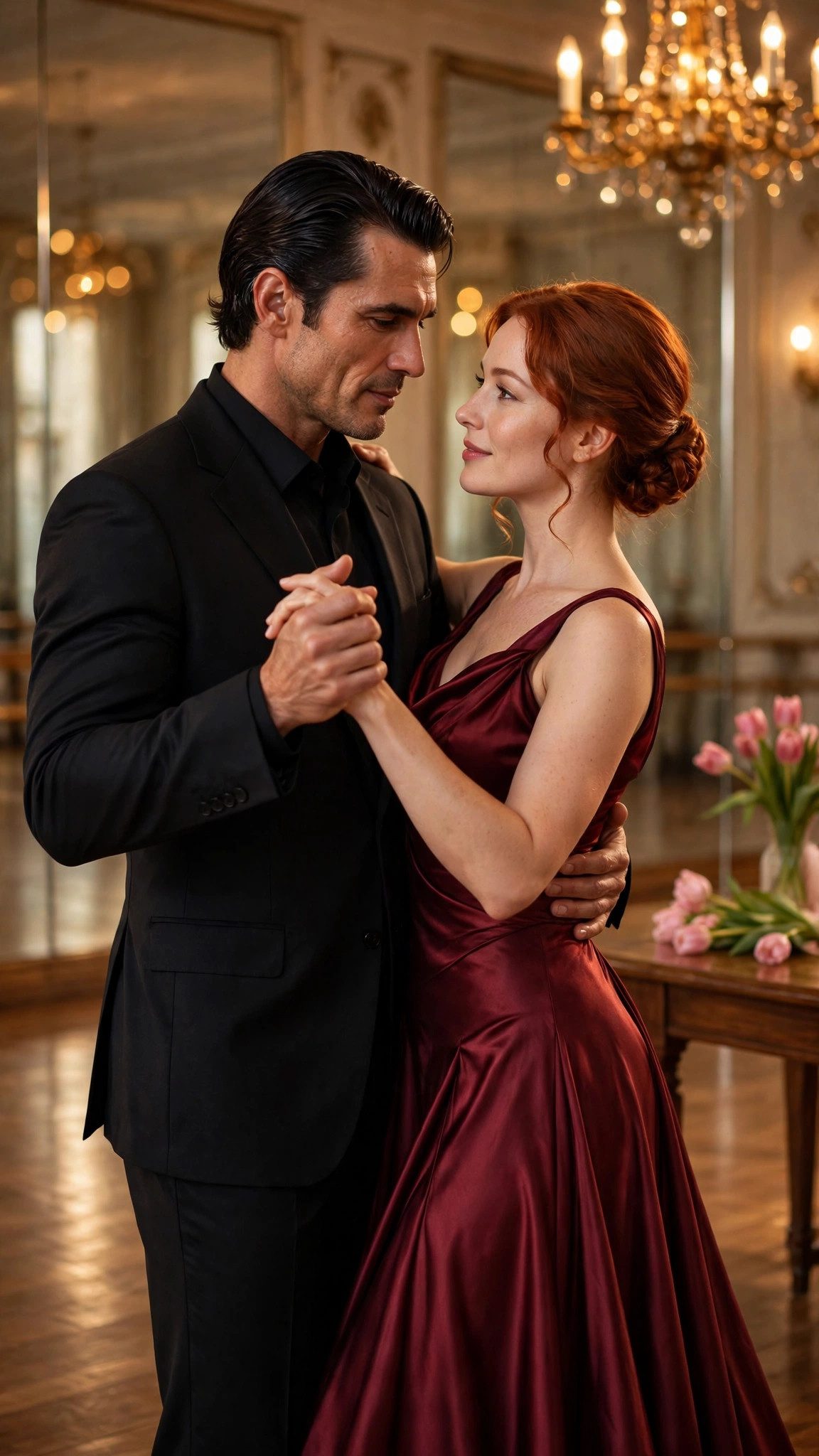
Chicago's most feared mafia boss walked into my dance studio wearing a ten-thousand-dollar suit and looking like he wanted to fire everyone in the building.
It was 3:47 on a Thursday afternoon.
He did not come alone. A tiny eighty-year-old woman with a bright smile was dragging him by the sleeve with one hand and dragging an enormous pink purse with the other, and she marched him straight across my polished wooden floor as if she owned the place, as if she had already decided exactly how this afternoon was going to go.
"Don't be rude, Gabriel," she said, smiling brightly. "Behave yourself."
Gabriel Moretti looked at me the way a man looks at a problem he intends to solve by removing it. He was tall, dark-haired, broad-shouldered, and furious, and every line of his expensive suit said that he did not belong in a small ballroom studio on Chicago's west side, among mirrors and tulips and retired couples learning to waltz.
"I attend meetings, not dances," he said.
I looked him in the eyes and said, "Mr. Moretti, I don't care how scary you are. This is my studio, and inside these walls you are just another student."
Something flickered in his face then. Surprise, maybe. Nobody talked to Gabriel Moretti like that. I could see it in the way his jaw tightened, in the way his shoulders went up another inch, in the way the air in the room seemed to get thinner. The retired couple by the window stopped mid-step. The nervous bride in the corner stopped breathing. Even the tulips on the table by the mirror seemed to hold still.
His grandmother patted his arm with one small hand and beamed at me.
"She paid in full, in cash," she told me, as if she were announcing a birthday. "Twelve lessons. I need to learn waltzing for my eightieth birthday party."
Moretti looked like he would rather be anywhere else on earth. He told me, in a voice cold enough to frost the mirrors, that he attended meetings, not dances, and he hinted — very clearly, very politely, the way only a dangerous man can hint — that my studio might soon be under new ownership if I insisted on wasting his time.
I had been teaching ballroom dance for eleven years. I had taught men who stepped on my feet and blamed me for it. I had taught brides who cried and grooms who froze. I had taught a seventy-year-old retired bus driver who showed up to every lesson in a tuxedo because he said his wife deserved the full occasion. I had never once been threatened in my own studio.
I looked Gabriel Moretti in the eyes, and I did not step back.
"Then you had better learn quickly, Mr. Moretti," I said. "Because your grandmother has already paid, and I do not give refunds."
His grandmother laughed. It was a small, delighted sound, like a bell.
"See?" she said to him. "I told you she was wonderful."
That was how it started. That was how the most feared man in Chicago became my student, and how my small, ordinary, carefully ordered life began to come apart at the seams in the best possible way.
But I am getting ahead of myself. To understand what happened that Thursday afternoon, you have to understand what my life looked like before Gabriel Moretti walked into it — and what his grandmother had already seen in me long before he did.
My name is Claire Donovan. I am thirty-six years old, with copper-red hair, a curvy figure, and a small ballroom dance studio on Chicago's west side. The studio is everything to me. I opened it eight years ago with my savings, a secondhand sound system, and a stubborn belief that people deserved one beautiful hour a week when somebody held them properly and the rest of the world went quiet.
Most of my students are ordinary people. Retired couples. Nervous brides and grooms. Men who want to surprise their wives on anniversaries. Office workers who have always wanted to learn the waltz and finally, at fifty or sixty, decided to stop waiting. I teach them to count one-two-three, to hold a frame, to trust their partner's hands. I teach them that dancing is not about being perfect. It is about paying attention to another person for three whole minutes.
I love the mornings best. I arrive at seven, before anyone else, and I unlock the door and breathe in the smell of polished wood and lemon cleaner. I put fresh tulips on the table by the mirror — I buy them from Jenna at the flower shop two doors down, and she always saves me the best bunch, the ones with the stems still firm and the petals just beginning to open. I turn on the lights one by one. I run a cloth over the barre. I play a slow waltz on the sound system, just for myself, and I dance alone across the empty floor while the sun comes up over the rooftops, and for those few minutes the studio belongs only to me.
Three weeks before that Thursday, on an ordinary Tuesday morning, I was doing exactly that when the door opened and a tiny old woman came in carrying an enormous pink purse.
She was no taller than my shoulder. Her hair was white and carefully waved. She wore a powder-blue coat with a brooch shaped like a rose, and she smiled at me as if we had known each other for years.
"Good morning, dear," she said. "I have been watching your classes through the window for a month. You are very kind to your students. My grandson needs kind people. He does not know it yet, but he does."
I did not know then who her grandson was. She introduced herself as Rosa Moretti, and she asked me about my prices, and she listened very carefully while I explained the packages, and then she asked me the strangest question.
"If a man has forgotten how to be gentle," she said, "can dancing teach him again?"
I told her the truth. I told her that dancing cannot change a person's past, but it can teach a person to listen with their hands, and that sometimes that is enough to begin.
She nodded as if I had confirmed something she already believed. She booked twelve lessons, paid in full, in cash, counting out the bills from that enormous pink purse with small, steady fingers. She told me her eightieth birthday party was in two months and she wanted to waltz at it. She did not tell me that her grandson was Gabriel Moretti. She did not tell me that he would have to be dragged here. She simply smiled, patted my hand, and said, "Thursday, at a quarter to four. Bring your patience, dear. You will need all of it."
Then she left, and I went back to my waltz, and I did not think about her again until Thursday at 3:47, when the door flew open and the most feared man in Chicago came in wearing a ten-thousand-dollar suit, being dragged by the sleeve by a tiny old woman with a pink purse.
Gabriel Moretti. The Gabriel Moretti. A forty-two-year-old mafia boss who controlled warehouses, nightclubs, shipping businesses, and half the criminal operations in Chicago. People whispered his name. Even dangerous men stepped aside when he entered a room.
But apparently, none of that impressed his grandmother.
I took a breath. I put on my teacher's voice — the calm, clear voice I use with nervous grooms who are about to faint.
"Thank you for coming, Mrs. Moretti," I said. "Mr. Moretti, if you will stand here, please. Feet apart. Arms relaxed. We will begin with the basic box step."
He stared at me.
"Do you know who I am?" he asked.
"Yes," I said. "You are my three forty-seven appointment. And you are late by four minutes, because your grandmother is a very determined woman and the traffic on Halsted is terrible. Please stand here."
His grandmother laughed again, delighted, and settled herself on the bench by the mirror with her pink purse in her lap like a queen taking her throne.
"I like her," she announced to the room. "Gabriel, do what the nice lady says."
For a moment I thought he was going to walk out. His jaw worked. His hands curled into fists at his sides. He looked at the door, and I could see him calculating — the drive back to his office, the meetings waiting for him, the men waiting for his orders, all the important, dangerous business of being Gabriel Moretti, all of it so much more sensible than standing in a dance studio in a ten-thousand-dollar suit.
Then he looked at his grandmother, small and bright-eyed on the bench, watching him with complete trust, and something in his face gave way. Not softened — not yet. But gave way, the way a locked door gives a fraction of an inch when someone leans on it long enough.
"Twelve lessons," he said, through his teeth. "And then we are done."
"Twelve lessons," I agreed. "And then you will waltz at your grandmother's birthday party like a man who has always known how."
He stepped onto the floor. He stood where I told him to stand. He held out his hand the way I showed him, stiff as a board, his palm flat and his fingers rigid, as if I had asked him to hold a live wire.
I took his hand in mine. His hand was large and warm and calloused in places I did not expect — the hands of a man who had done hard things, whatever else he was. I placed his other hand on my waist, the way the waltz requires, and I put my hand on his shoulder, and I looked up at him.
"Mr. Moretti," I said quietly, "you're holding a person, not controlling one."
And that was the moment everything changed.
I felt it happen under my hands, the way a dance teacher feels everything. His shoulders dropped. Just an inch. Just enough. The tension ran out of his arms like water. He stopped glaring at me, and for the first time since he had walked through my door, Gabriel Moretti looked like a normal human being — a man standing in a dance studio, holding a woman's hand, not knowing what to do next, and quietly terrified of getting it wrong.
"One," I said. "Two. Three. One. Two. Three."
We moved. Slowly. Badly, at first — he stepped on my foot twice and apologized in a voice so stiff it sounded like a threat, and his grandmother clapped from the bench and called out, "Beautiful, Gabriel, beautiful!" — but we moved. One-two-three. One-two-three. Around the floor, past the mirrors, past the tulips, past the retired couple who had resumed their own careful steps in the corner.
By the end of the lesson, the sun had moved across the mirrors and the room was full of gold light, and Gabriel Moretti was sweating through his ten-thousand-dollar suit and counting under his breath like a schoolboy.
"One-two-three," he muttered. "One-two-three."
When the music stopped, he stood there holding my hand, breathing hard, looking down at our joined hands as if he had never seen his own hands before.
His grandmother stood up from the bench, tucked her pink purse under her arm, and walked over to us.
"Same time Thursday?" she asked me brightly.
"Same time Thursday," I said.
Gabriel cleared his throat. He looked at me, and then he looked away, and then — very quietly, as if the words were being pulled out of him against his will — he asked, "How much are the next twelve lessons?"
"Same price," I answered.
He nodded once, sharply, the way a man nods when he has just signed a contract he did not intend to sign.
"Thursday," he said.
Then he took his grandmother's arm, very gently, and walked her out of my studio into the late afternoon sun, and I stood alone on the polished wooden floor, holding the echo of his hand in mine, and I thought: what have I just done?
I did not know then that Gabriel Moretti would come back the next afternoon, fifteen minutes early, alone. I did not know that within a month, tall men in black cars would be parked outside my studio, watching the door. I did not know that a man I had never met would try to take my studio from me, or that Gabriel Moretti would decide to buy it out from under him to protect it, or that the most feared man in Chicago would stand in my studio in the dark holding a bunch of tulips and say the words that changed everything.
I did not know any of that yet.
All I knew, standing there in the gold light with the tulips on the table and the music still hanging in the air, was that for one hour, Gabriel Moretti had not been a mafia boss. He had been a man learning to hold another person gently. And his grandmother, small and bright-eyed on the bench, had known exactly what she was doing all along.
That evening, after I locked up the studio, I stopped at Jenna's flower shop two doors down. She was sweeping the floor, and she looked up when the bell over the door rang, and she took one look at my face and said, "Well. That is the face of a woman who has had a day."
"Something like that," I said.
Jenna leaned on her broom. "Was that the man? The one in the ten-thousand-dollar suit? The one who came in with the little old lady and the pink purse?"
"That was him," I said.
"And?" she said.
"And he is my student now," I said. "Twelve lessons. Paid in full, in cash."
Jenna stared at me. "Claire. Honey. Men like that do not take dance lessons. Men like that buy the building and knock it down."
"He is not going to knock it down," I said, with more confidence than I felt. "His grandmother wants to waltz at her eightieth birthday party. That is all this is."
Jenna did not look convinced, but she handed me a bunch of pink tulips — on the house, she said, for the new student — and I carried them home to my apartment above the studio. I put them in water on my kitchen table, and I sat there for a long time, looking at them, thinking about Rosa's question from that first morning. If a man has forgotten how to be gentle, can dancing teach him again?
I did not know the answer. But as I sat there with the tulips and the quiet of my little apartment, I thought about the way Gabriel Moretti's shoulders had dropped when I placed his hand in waltz position, and I thought: maybe. Maybe it can. Maybe that is exactly what dancing is for.