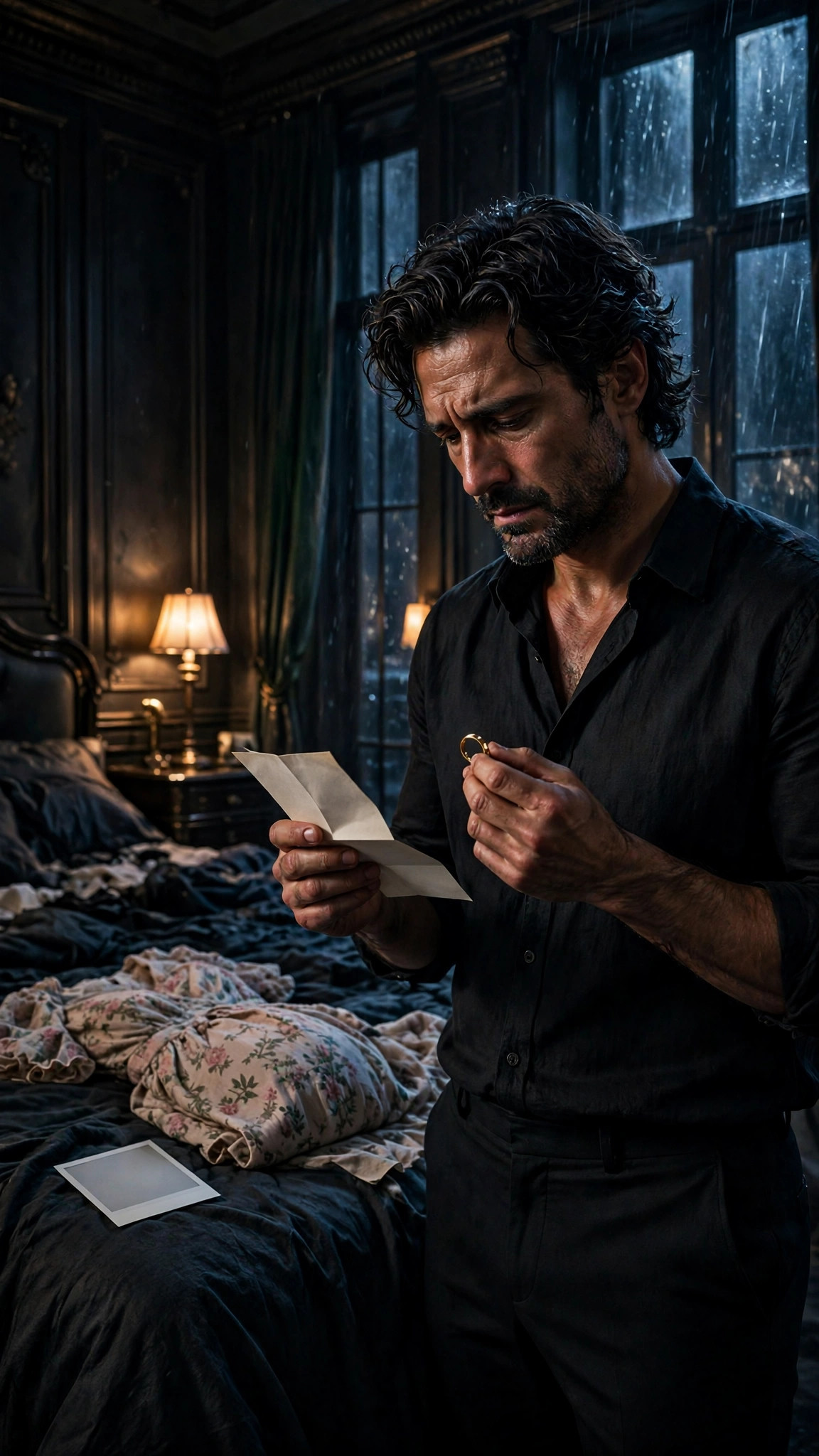
At 4:26 in the morning, my helicopter set down on the roof of my own mansion, and I came home to a house that had already learned how to live without me.
The rotors were still slowing when I crossed the roof and took the private elevator down to the top floor. Another woman's perfume was still on my collar. I had spent ten months cheating on my pregnant wife, and thirty-four nights in my mistress's secret penthouse in Chicago, and I had told myself, the way men like me always tell themselves, that I would fix it tomorrow. Tomorrow had run out while I was in the air.
The bedroom door was open. The bed was unmade. On the mattress, laid out with a terrible, deliberate care, were three things: a floral maternity dress, folded once; a gold wedding ring, standing upright on its edge against the pillow; and a Polaroid photograph, face down.
I picked up the photograph first. On the back, in Emily's handwriting, were the words that would follow me for the rest of my life.
"Noah Carter. Born at 1:17 a.m. You missed it by exactly three hours and nine minutes."
My son had been born while I was asleep in another woman's bed, and my wife had taken him and gone.
Under the photograph was a letter. Seven words at the end of it destroyed me more completely than any bullet ever had.
"You were never there when we needed you."
My name is Michael Carter, and at forty-five I controlled four shipping ports, thirteen freight routes, and three underground casinos. Men in three cities called me a mafia boss, and they were not wrong. I had built an empire out of threats and debts and favors, and I had believed, the way powerful men always believe, that the empire was the thing that mattered, and that the woman who had stood beside me for fourteen years would simply always be there, waiting, the way she had always waited.
Emily married me when I had nothing but a small apartment, a gun beneath my bed, and enemies who wanted me dead.
I met her on a Tuesday in October, in the emergency room of a county hospital, when I came in with a knife wound in my side and a lie about a bar fight already prepared. She was twenty-four years old, a nurse on the night shift, with dark hair pulled back and tired eyes and hands that did not shake. She cleaned the wound, stitched it, and looked at me the way nobody in my life had ever looked at me — not afraid, and not impressed, either. Just unimpressed, and faintly annoyed that I had waited so long to come in.
"You're lucky," she said. "Another inch and you would have bled out in the street."
"I've been lucky before," I told her.
"Then stop spending it," she said, and went to the next bed.
I came back the next week with a bruised rib and no good reason. I came back the week after that with a split lip. The third time, she looked at me over her clipboard and said, "Mr. Carter, if you want to ask me to dinner, ask me to dinner. Stop getting yourself hurt to do it."
So I asked her to dinner. She said yes, and then she said, "But I pay for my own. I don't owe anyone anything."
We married eight months later in a courthouse, because I had no family to invite and she had a mother who had died when she was sixteen and a brother who lived two states away. She wore a dress she had bought on sale. I wore the only suit I owned. Afterward we went back to my small apartment and ate takeout on the floor, because I had sold my table to pay a man who had threatened to burn the building down.
That was the beginning of everything. Emily bandaged my wounds. She waited through hospital nights. She learned the names of my enemies and the sound of a car slowing down outside our window at two in the morning. Once, when I came home late for the fourth night in a row and found her asleep at the kitchen table with two plates of food gone cold, she woke up and said, "I wait for dinner because I like feeling I still have a husband."
I promised her, then, that one day she would never have to wait again. I meant it. I meant every word of it, the way I meant everything in those days, before I learned how easy it is for a man to mean something and still not do it.
The empire came slowly, and then all at once. A shipping route. A second port. A favor called in, a debt collected, a rival persuaded to retire to Florida. By the time I was thirty-five, we lived in a house with a name instead of an address, and Emily had a closet full of dresses she never wore and a calendar full of charity galas she attended alone, because I was always somewhere else, closing something, collecting something, becoming something.
She never complained. That was the worst of it. She never once raised her voice and told me that the bargain had changed. She just kept waiting for dinner, and I kept telling myself that the waiting was temporary, that the empire would be finished soon, that one day I would come home early and stay.
Then Vanessa appeared.
It was a charity gala in the spring, the kind of event where the city's two kinds of power — the kind with money and the kind with guns — pretend to be the same thing for one evening. Vanessa Bellini was thirty years old, beautiful in the way that women who have never been told no are beautiful, the daughter of Don Arturo Bellini, whose family and mine had been allies for a decade. She wore a red dress and laughed at something I said, and when the music started she took my hand and said, "Dance with me, Michael. Your wife is across the room, and she won't mind."
Emily was across the room. She was talking to a woman from the hospital board, and she was smiling, and she did not look at me once.
I danced with Vanessa. I should not have. I knew it even then, with her hand in mine and her perfume in the air, and I did it anyway, because the music was loud and the room was warm and she looked at me the way Emily had stopped looking at me years ago — like I was the most interesting man in the room, instead of the man who had forgotten to come home.
One drunken kiss became twenty-one secret trips. Twenty-one trips became thirty-four nights away from the woman who still believed I would come home.
I told myself it was nothing. I told myself it was business — that keeping the Bellini alliance warm mattered, that Vanessa was a complication I could manage. I told myself that Emily did not know, and that what she did not know could not hurt her, and that I would end it soon. I told myself all of it, and I believed all of it, because that is what men do when they are walking away from their own lives one small step at a time.
Then Emily told me she was pregnant.
She came into my study one evening with a small white stick in her hand and tears in her eyes, and she said, "We're having a baby, Michael." I stood up from my desk, and I held her close, and I promised her things would change. I promised her the affair was over. I promised her I would be there for every appointment, every ultrasound, every kick. I promised her I would be the husband she had waited fourteen years for.
Three days later, I was back in Vanessa's bed.
I do not know how to explain that, except to say that a man can be two men at once, and both of them can believe they are telling the truth. The man who held Emily and promised to change was real. The man who drove to Chicago three days later was real too. They lived in the same body, and they took turns, and the second one always won when the first one was not looking.
I missed the ultrasounds. I ignored six calls the day she learned we were having a boy, and when she finally reached me, I told her to choose our baby's name herself, as if a name were something a father could delegate, as if it were a shipment or a contract.
One evening I came home early — early for me, which meant nine o'clock — and found her standing in the nursery she had decorated alone. She had painted the walls herself, a soft blue, and hung paper stars from the ceiling, and built the crib with her own hands because I had not been there to do it. She was standing in the middle of that room with her hands on her belly, and when she turned and saw me, she did not cry. She just looked at me, and said, very quietly, "I don't want your money, Michael. I want my husband."
I had nothing to say to that. There was nothing to say. So I said nothing, and I went to my study, and I poured a drink, and I told myself I would fix it tomorrow.
Two months before her due date, she confronted me about Vanessa. She did not shout. She did not throw anything. She stood in the doorway of my study with her arms folded over her belly, and she said, "I know, Michael. I have known for months. I was waiting to see if you would tell me yourself."
I did not deny anything. There was nothing left to deny. And when she said, "Nobody stole you from me. You walked away," I turned my back on her. I turned my back, and I walked to the window, and I stood there looking out at the city I owned, and I listened to her footsteps going down the hall, and I told myself I would fix it tomorrow.
Tomorrow never came. The baby came instead, twelve days early, while my phone lay silent beside Vanessa's bed, and my wife called me five times and I did not answer a single one.
That was the man I had become. And at 4:26 in the morning, standing in an empty bedroom with a ring and a photograph and a letter in my hands, I finally understood what Emily had known for months: nobody had stolen me from her. I had walked away. And now she had walked away too — and she had taken the one thing I could never buy back.
My son.
I sat down on the edge of the unmade bed, still holding the photograph, and I thought about the night I had almost lost her once before — not to another man, but to my own life.
It was our third year of marriage. I had a shipment coming through the second port that a rival family wanted, and the rival family sent two men to my apartment to explain, in their own way, that the shipment would not be arriving. I was not home. Emily was. She heard them picking the lock, and she did what she had always done: she stayed calm. She put the ledger — the one book that could have put me in prison for twenty years — into the oven, under a roasting pan, and then she opened the door before they could break it, and she told them, in a voice so steady it could have cut glass, that her husband was at the hospital with a dying man and would be home any minute, and that if they wanted to wait, they could wait on the landing, where the neighbors could see them.
They left. She never told me until a year later, when she mentioned it the way another woman might mention a leaking pipe. "I knew what to do," she said. "I always know what to do. I just wish, sometimes, that I did not have to."
That was Emily. She had never once asked me to be a different man than the one she married. She had only asked me to come home. And I had spent fourteen years promising her that I would, and ten months proving that I would not.
I thought about the first secret trip, too, because a man who has lost everything replays the moment he started losing it, the way a driver replays the moment before the crash.
It was a Tuesday. Vanessa called me from a number I did not recognize and said her father wanted to discuss a shipping contract, and could I meet her in Chicago to go over the terms. There was no contract. There was a hotel suite on the fortieth floor, and a bottle of wine already open, and a woman who knew exactly what she was doing and exactly who I was. I stayed one night. I told Emily I had been delayed at the port. She believed me, because she had no reason not to. She made me dinner the next night, and she asked me how Chicago was, and I lied to her face across a table she had set with the good plates, and she smiled at me, and I told myself it would never happen again.
It happened twenty more times. The trips got longer. The lies got easier. The penthouse in Chicago — Vanessa's secret penthouse, the one her father did not know about, the one she kept for the things she did not want her family to see — became a second home, with my toothbrush in the bathroom and my shirts in the closet, and I never once stopped to ask myself what kind of man keeps a toothbrush in another woman's apartment while his pregnant wife paints a nursery alone.
I know what kind of man now. A man who wakes up at 4:26 in the morning to an empty house, holding a photograph of a son he has never met, and a letter that tells him the truth he spent fourteen years refusing to hear.
"You were never there when we needed you."
She was right. God forgive me, she was right about every word of it.