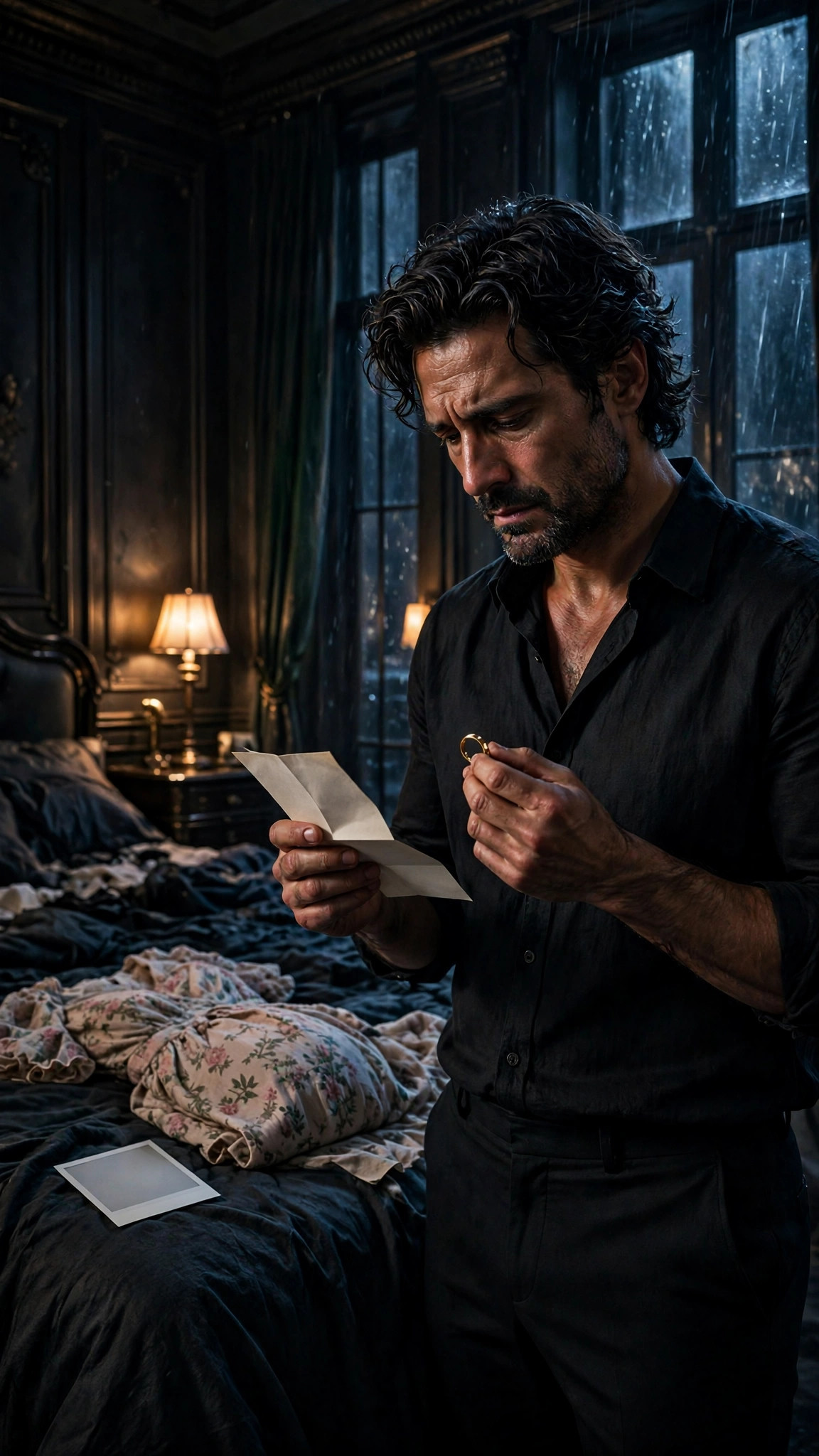
I read the letter three times. Then I folded it, very carefully, the way a man folds a thing he is afraid will fall apart in his hands, and I put it in my jacket pocket, next to my heart, and I went downstairs, and I became a different man.
Not a better man. Not yet. A different one — the man I had been before Emily, the man who had built an empire out of threats and debts and favors, the man who knew how to find things that did not want to be found.
I called my second-in-command, Tony Ricci, a man who had been with me since the days of the small apartment and the gun beneath the bed, and I said, "My wife is gone. My son is gone. I want every man we have, and I want them now."
By noon, I had a hundred and twenty men looking for her. They searched the airports. They searched the train stations. They searched the bus depots and the taxi stands and the hotels and the hospitals, and they called in favors from policemen and port officials and men who owed me their lives, and by evening I had a list of every flight, every train, and every car that had left the city in the last twenty-four hours, and Emily Carter was not on any of them.
I called her phone a hundred and thirteen times. I know the number because I counted. I called her in the morning, and I called her at noon, and I called her at night, and every time the phone rang and rang and went to voicemail, and every time I heard her voice on the recording — "Hi, you've reached Emily Carter. I'm sorry I can't come to the phone right now" — I felt like I was listening to a ghost.
I left messages. The first ones were angry. "Emily, call me back. This is not funny. Where are you?" The middle ones were desperate. "Emily, please. I'm sorry. I know what I did. Please come home. Please let me see my son." The last ones were just her name, said over and over, the way a man says a prayer when he has forgotten all the other words.
On the third day, I went to Vanessa's penthouse, and I told her it was over. I told her Emily was gone, and my son was gone, and I did not know where they were, and I did not know if they were alive, and I needed to find them, and I could not do that with Vanessa in my life. She laughed at me. She was lying in bed in a silk robe, with her hair spread across the pillow, and she laughed, and she said, "She'll come back, Michael. Women always come back. She has nowhere else to go."
"She has a son," I said. "She has my son. And she has somewhere to go, or she wouldn't have gone."
Vanessa sat up, and her face changed, and for a moment I saw something in her eyes that I had never seen before — not love, not anger, but calculation, the cold, quick arithmetic of a woman deciding what a thing is worth.
"Find her, then," she said. "Find her and bring her home. But don't expect me to wait forever, Michael. My father is already asking questions."
I left. I did not go back. I would not see Vanessa again for nine days, and when I did, it would be in a room full of men with guns, and she would not be laughing.
On the fourth day, I went back to the hospital. Not the emergency room — the maternity ward, the place where my son had been born while I was asleep in another woman's bed. I walked in through the front doors in my black suit, with Tony and two of my men behind me, and the nurses at the desk looked up, and one of them — a young woman with tired eyes — said, "Can I help you, sir?"
"My wife gave birth here four days ago," I said. "Emily Carter. I want to see her records. I want to see who came to see her. I want to see everything."
The nurse looked at Tony, and then at the two men behind me, and then at me, and she said, "Sir, I can't give you medical records without —"
I put a hand on the desk, very gently, and I said, "My wife is gone. My son is gone. I am not asking you to break the law. I am asking you to help me find my family."
She looked at me for a long moment, and then she picked up the phone, and she called the administrator, and the administrator came down, and I said the same thing to him, and he said the same thing the nurse had said, and then I said, "I will pay for a lawyer. I will pay for a court order. I will do this the right way, and it will take three weeks, and my son will be three weeks older, and I will still not know where he is. Or you can help me now, and I will remember that you did."
He helped me. Not with the medical records — those, he said, he truly could not give me — but with the security footage. He took me to a small room with a monitor, and he played the cameras from the night of the birth, and I watched my wife — my wife, exhausted, holding a newborn baby in her arms, sitting in a wheelchair by the back door of the hospital — and I watched a man I had never seen before walk in through the service entrance, take her bag, and help her into a black car.
"Who is that?" I asked.
The administrator shook his head. "I don't know. He signed in as a visitor, but the name on the log is false. He was in and out in six minutes."
I had the footage copied. I had the car traced — a black sedan, no plates on the camera, registered to a rental company that had no record of the rental, because the man had paid in cash. I had the man's face printed, and I gave it to my men, and I said, "Find him. Find the man in the black car. He knows where my wife is."
That same night, I went through our house the way a detective goes through a crime scene — room by room, drawer by drawer — looking for anything Emily might have left behind that would tell me where she had gone.
Her closet was half empty. She had taken the practical things: jeans, sweaters, the warm coat, the boots. She had left the dresses, the jewelry, the things that belonged to the life of a mafia boss's wife. On the dresser, her perfume was gone, but her wedding ring box was still there, empty, the velvet worn where the ring had sat for fourteen years. In the nursery, everything was in place — the stars, the tiny clothes, the crib — except for one thing: the white blanket with the blue anchors, the one she had knitted herself, was gone. She had taken it for Noah.
I stood in that nursery for a long time, holding the edge of the empty crib, and I thought about the fact that my wife had packed a bag and left my house in the middle of the night, with a newborn baby, and I had not even known she was gone until I walked in at 4:26 in the morning. I had not known my own wife was gone. That was the measure of the man I had become.
The next morning, I talked to the neighbors. Mrs. Kowalski, who lived across the street and had watched our house for fourteen years the way only a retired schoolteacher can, told me she had been awake at four in the morning — she never slept well — and she had seen a black car pull up to our house, and a man help a woman inside, and then the woman came out again, carrying something small and white, and the car drove away. She had thought it was a taxi. She had thought Emily was going back to the hospital. She had not thought to call anyone, because why would she? It was four in the morning, and the street was dark, and the car was gone before she could even put her glasses on.
"Did you see the man's face?" I asked her.
She shook her head. "Only his back. Tall. Dark hair. He moved like a soldier, Mr. Carter. Like a man who knew what he was doing."
A soldier. A medic. Daniel.
On the sixth day, one of my men found a gas station camera, forty miles north of the city, that had caught the black car at 5:12 in the morning. The car had stopped for fuel. The man had paid in cash. The camera had caught his face, just for a second, as he turned toward the pump — and it was the same face as the man in the hospital footage. He had bought coffee, and a bottle of water, and a pack of diapers, and the attendant remembered him, because he had been polite, and because he had asked for directions to the lake.
"The lake," the attendant said. "He asked which road goes to the lake. I told him the north road. He thanked me. He seemed like a nice man. Tired, though. Like he hadn't slept."
The lake. Emily's mother's cottage was on a lake. I did not know that then — I did not know about the cottage at all — but I wrote the word down in my notebook, and I circled it, and I told my men to check every lake, every cottage, every rental within two hundred miles, and to start with the ones to the north.
On the eighth night, I made the one hundred and thirteenth call. It was two in the morning, and I was sitting in my study, in the dark, with the letter in front of me and the photograph beside it, and I dialed her number, and I listened to it ring, and when the voicemail came on, I did not leave a message. I just sat there, holding the phone to my ear, listening to her voice on the recording, over and over, until the phone went dead in my hand.
"Hi, you've reached Emily Carter. I'm sorry I can't come to the phone right now."
I played it five times. And then I put the phone down, and I put my head in my hands, and for the first time since I was a boy, I prayed — not to God, exactly, but to whatever was listening — and I said, "Let them be alive. Let them be safe. And let me find them. Please. Let me find them."
Nine days. It took nine days to find him, and in those nine days I did not sleep. I ate standing up. I drank coffee until my hands shook. I went to every place Emily had ever loved — the park where we used to walk, the restaurant where we had our first dinner, the church where she used to light candles for her mother — and she was not in any of them. I went to her brother's apartment two states away, and the landlord said Daniel Hart had moved out a month ago, and no, he did not know where he had gone, and no, he did not leave a forwarding address.
On the ninth day, Tony came to my office with a folder in his hand, and he put it on my desk, and he said, "We found the car. And we found the man. And you're not going to like what we found."
The man was Daniel Hart. Emily's brother. The brother I had met twice in fourteen years, at our wedding and at a Christmas dinner, a quiet man with a medic's hands and a soldier's eyes, a man I had dismissed as unimportant because he had no money and no power and nothing I wanted. He had driven through the night to reach his sister, and he had taken her away from me, and he had done it because she had asked him to.
But Tony's folder had something else in it, too. Something worse.
"There's a doctor," Tony said. "Her obstetrician. Dr. Whitfield. He's been trying to reach you. He called the house three times. He said it's about Emily, and it's about the baby, and he said — his exact words — 'Tell Mr. Carter his wife didn't leave because of the affair.'"
I drove to Dr. Whitfield's office that afternoon. It was a small office in a medical building near the hospital, with a waiting room full of pregnant women and nervous husbands, and I sat among them in my black suit, with my hands folded, and I waited, and when the nurse called my name, I followed her down a hallway, and Dr. Whitfield was standing in his office doorway, a man in his late fifties with grey hair and glasses, wearing a white coat over a grey suit, and his face was pale, and his hands were shaking.
"Mr. Carter," he said. "Thank you for coming. Please. Sit down."
I did not sit down. I stood in the middle of his office, and I said, "Where is my wife?"
"I don't know," he said. "I swear to you, I don't know. But I know why she left, and I think you need to hear it from me before you hear it from anyone else."
He opened a drawer, and he took out a folder, and he laid it on his desk, and he opened it, and inside were two reports. The first was a genetic test, done after Noah's birth. The results confirmed what I already knew — that I was Noah's father — but beneath the results, in Emily's handwriting, were seven words that I did not understand.
"That was never what I needed tested."
The second report was attached behind the first, dated seven months earlier. It had Emily's name on it, and a medical result I could not understand — a page of numbers and chemical names, a toxicology screen, a list of substances found in her blood.
I stared at it, and I said, "What is this? What does this mean?"
Dr. Whitfield looked at me, and his hands trembled, and he said, "Mr. Carter, your wife didn't leave simply because of your affair."
"Then why?" I said. "Tell me why."
He stared at the report, and he said, very quietly, "Because if she had stayed even one more day…"
He stopped. He looked at the door, as if he were afraid someone was listening. And then he finished the sentence — the sentence that would change everything I thought I knew about my life, my marriage, and the woman I had married.
"You might never have been allowed to see your son again."