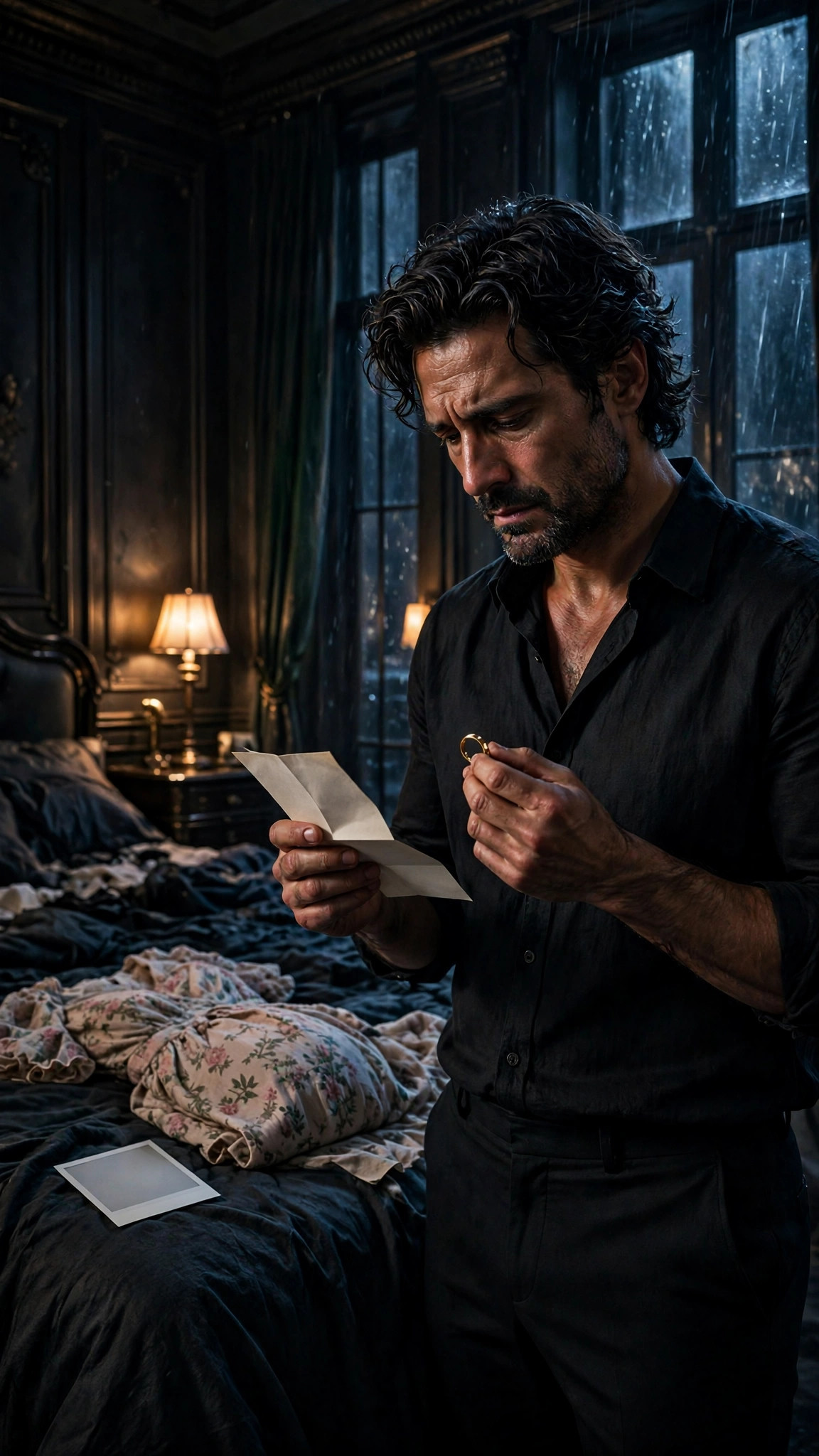
Daniel Hart was not hard to find, once I knew his name.
He had not hidden. That was the first thing I learned about him, and it told me everything I needed to know about the kind of man he was. He had not changed his name. He had not covered his tracks. He had driven his sister to a cottage on a lake that had belonged to their mother, and he had stayed there with her, and he had gone into town every day to buy milk and bread and diapers, and he had paid in cash, and he had not been afraid, because he had done nothing wrong, and he knew it.
I found the cottage on the eleventh day. My men traced Daniel's phone — he had not turned it off, because he had nothing to hide — and they traced his car, and they traced a cash withdrawal from a bank in a town I had never heard of, and by the afternoon of the eleventh day, I was driving north, alone, in a black car of my own, with Tony following at a distance because I had told him to, and with a folder on the passenger seat that contained everything I had learned: the toxicology report, Rosa's written statement, the custody papers my men had found in Don Arturo's lawyer's office, and the photograph of my son that I had carried in my jacket pocket since the morning I found it on the bed.
But before I drove north, I did one more thing. I went to see Don Arturo Bellini.
His house was on a hill outside the city, behind iron gates, with guards at the door and cameras on the walls, and when I drove up, the guards stopped me, and one of them said, "Mr. Bellini isn't seeing anyone today."
"Tell him Michael Carter is here," I said. "Tell him I want to talk about my son."
They let me in. They took my gun — I let them, because I had not come to shoot anyone, and because a gun would not have helped me with what I needed to say — and they walked me through a house that was bigger than mine, and colder, and emptier, into a study where Don Arturo Bellini was sitting behind a desk the size of a small boat, smoking a cigar, looking at me the way a man looks at a problem he has already decided how to solve.
"Michael," he said. "Sit down. Have a drink."
"I didn't come to drink," I said. "I came to tell you something."
He smiled, and he said, "Then tell me."
"You poisoned my wife," I said. "Your daughter paid my housekeeper to put a drug in my wife's tea. A slow poison. It was supposed to kill her in one more week. And you prepared papers — custody papers — that would take my son away from me the moment she was dead, and give him to your family, to be raised by the woman who tried to kill his mother."
Don Arturo did not deny it. He did not even look surprised. He took the cigar out of his mouth, and he tapped the ash into a tray, and he said, "Your wife was weak, Michael. She was always weak. A woman who waits for dinner is not a wife for a man like you. Vanessa is strong. Vanessa would have made you a king."
"Vanessa tried to kill my wife," I said.
"Vanessa did what was necessary," he said. "That is what strong women do. Your wife — your wife was going to die anyway. She was sick. She was always sick. The drug only hurried what was already happening."
"She wasn't sick," I said. "She was poisoned. By your daughter. And you knew. You knew all of it, and you wrote the papers, and you were going to take my son."
He leaned back in his chair, and he said, "Your son is a Carter. But he could have been a Bellini. He could have had a future. With you, what future does he have? A father who is never home. A father who cheats on his wife. A father who missed his own son's birth. You talk to me about papers, Michael, but I have seen the way you live, and I ask you — honestly, man to man — do you think you deserve that child?"
For a moment, I did not answer. Because the terrible thing was that part of what he said was true. I had cheated on my wife. I had missed my son's birth. I had not been there when they needed me. Don Arturo knew it, and he was using it, the way a man uses a knife, to cut me where I was already bleeding.
But then I thought about Emily, sitting in a wheelchair by the back door of a hospital, holding our son, making a decision that no woman should ever have to make. I thought about Rosa, kneeling beside her chair, crying. I thought about Daniel, driving through the night. I thought about Noah, six pounds and four ounces, born at 1:17 in the morning, while his father was asleep in another woman's bed.
And I said, "You're right. I didn't deserve him. I didn't deserve any of them. But I am his father, and she is his mother, and you are never going to touch either of them again. Not while I'm alive. Do you understand me?"
Don Arturo looked at me, and for the first time, the smile went away from his face, and I saw what was underneath it — an old man, afraid, holding on to an empire that was already slipping through his fingers.
"The alliance is over," I said. "The shipping contracts are over. The casino arrangements are over. If your men come near my ports, I will sink them. If your daughter comes near my house, I will have her arrested. And if you ever — ever — put my son's name on a piece of paper again, I will come back here, and I will not be alone, and I will not be unarmed."
I walked out. The guards did not stop me. They watched me go, and I could feel their eyes on my back, and I knew that Don Arturo would not forget what I had said, and I knew that he would try again, someday, in some other way, because men like him always try again.
But that day, he let me go. And I got in my car, and I drove north, and I did not stop until I reached the town by the lake.
The drive took four hours, and I spent all four of them thinking. The folder was on the passenger seat — the toxicology report, Rosa's written statement, the custody papers my men had found in Don Arturo's lawyer's office, and the photograph of my son that I had carried in my jacket pocket since the morning I found it on the bed. I had brought them because I thought Emily might need proof. I thought she might need to see, in black and white, that I knew, and that I understood, and that I was sorry. But as the miles went by, and the city fell away behind me, and the highway opened up into farmland and forest, I began to understand that no folder in the world would be enough. Proof was not what she needed. She needed a man who had changed. And a folder could not prove that. Only time could prove that. Only staying could prove that.
I stopped once, at a diner off the highway, for coffee I did not drink. The waitress was a woman about Emily's age, with tired eyes and a kind face, and she asked me if I was all right, and I said I was fine, and she looked at me the way people look at a man who is lying, and she said, "You're going to see someone, aren't you? Someone you hurt."
"My wife," I said. "And my son. He's eleven days old, and I've never held him."
She did not say anything for a moment. Then she refilled my cup, and she said, "Then you'd better say that first. Before anything else. Say that first, and mean it, and the rest will follow."
I thanked her, and I got back in the car, and I drove the last hour in silence, and I practiced the words in my head. "I'm sorry. I know. I was wrong. I'll stay." They sounded small. They sounded like nothing, after fourteen years of promises. But they were all I had.
In the town by the lake, I stopped at a gas station, and I asked the attendant if he knew a man named Daniel Hart. He did. Everyone in a small town knows everyone, and Daniel had been coming in every day for milk and bread and diapers, and the attendant pointed down the road and said, "White cottage, blue shutters, at the end of the lane. He's been there about a week, with his sister and a baby. Nice people. Quiet. The sister doesn't go out much. The brother does the shopping."
I drove down the lane, slowly, and I parked on the road outside the cottage with the blue shutters, and I sat there for a long time, looking at the small white house, and trying to find the words to say to the woman inside it.
Daniel came out first. He must have seen the car from the window, because he came out onto the porch with a shotgun in his hands — not pointed at me, but held ready, the way a man holds a weapon when he is protecting something precious — and he said, "That's far enough, Carter."
I got out of the car, slowly, with my hands where he could see them, and I said, "I'm not here to fight you, Daniel. I'm here to see my wife. I'm here to see my son."
"She doesn't want to see you," he said.
"I know," I said. "I know she doesn't. But I need to tell her something, and I need her to hear it from me, not from a letter, not from a phone call, not from anyone else. Will you tell her I'm here? Will you let her decide?"
Daniel looked at me for a long moment, and then he lowered the shotgun, and he went inside, and a minute later, the door opened again, and Emily came out onto the porch.
She was thinner than I remembered. Her face was pale, and her hair was pulled back, and she was wearing a sweater that was too big for her, and she was holding Noah in her arms, wrapped in a white blanket, asleep. She looked at me, and she did not speak, and I looked at her, and I did not speak, and the lake was behind her, and the sky was grey, and the whole world seemed to hold its breath.
"Emily," I said. "I know."
She did not move. "Know what?"
"I know about the tea," I said. "I know about the poison. I know about Vanessa, and her father, and the papers. I know that if you had stayed one more day, you would have died, and they would have taken Noah, and I would never have seen him again. I know that you left to save him. I know that you left to save yourself. And I know that I am the reason you had to."
She looked at me, and her eyes filled with tears, and she said, "Then you know everything. So why are you here?"
"Because I want to ask you something," I said. "And I want you to answer me honestly, the way you have always answered me honestly, even when it hurt."
She waited.
"Do you still love me?" I asked. "Not the man I was. Not the man who cheated on you, and missed your son's birth, and turned his back on you in my study. Do you still love the man I could be? The man you married in a courthouse, who ate takeout on the floor with you and promised you would never have to wait again? Do you still love him? Because if you do — if there is anything left, even a little, even a spark — I will spend the rest of my life earning it back. I will end the casinos. I will end the alliance. I will sell everything that kept me away from you, and I will come home, and I will stay. I will be your husband. I will be Noah's father. I will be the man you waited fourteen years for. But I need you to tell me if it's too late. I need you to tell me the truth."
She looked down at Noah, sleeping in her arms, and then she looked back at me, and she said, very quietly, "It's not too late, Michael. But it is almost too late. And I will not wait another fourteen years. If you come home, you come home all the way. No more Chicago. No more Vanessa. No more tomorrow. You come home now, and you stay, or you don't come home at all."
Daniel stepped forward then, and he put a hand on my shoulder — not hard, but firm, the way a medic holds a man who is about to do something foolish — and he said, "She means it, Carter. I have known her since she was born. I have never once heard her say a thing she did not mean. If you walk through that door, you walk through it all the way. If you can't, then get back in your car, and drive away, and don't come back. Because if you hurt her again, I will not be standing on a porch with a shotgun next time. Do you understand me?"
"I understand," I said. "And I am not going anywhere."
Emily looked at Daniel, and she nodded, very slightly, and Daniel took his hand off my shoulder, and he stepped aside, and Emily turned, and she walked back into the cottage, and she left the door open behind her.
An open door. After fourteen years of closed ones, she had left the door open.
I nodded. I could not speak. I nodded, and I took a step toward the porch, and Daniel watched me, and Emily watched me, and Noah slept on, unaware that his father had just been given the one thing he did not deserve — a second chance.