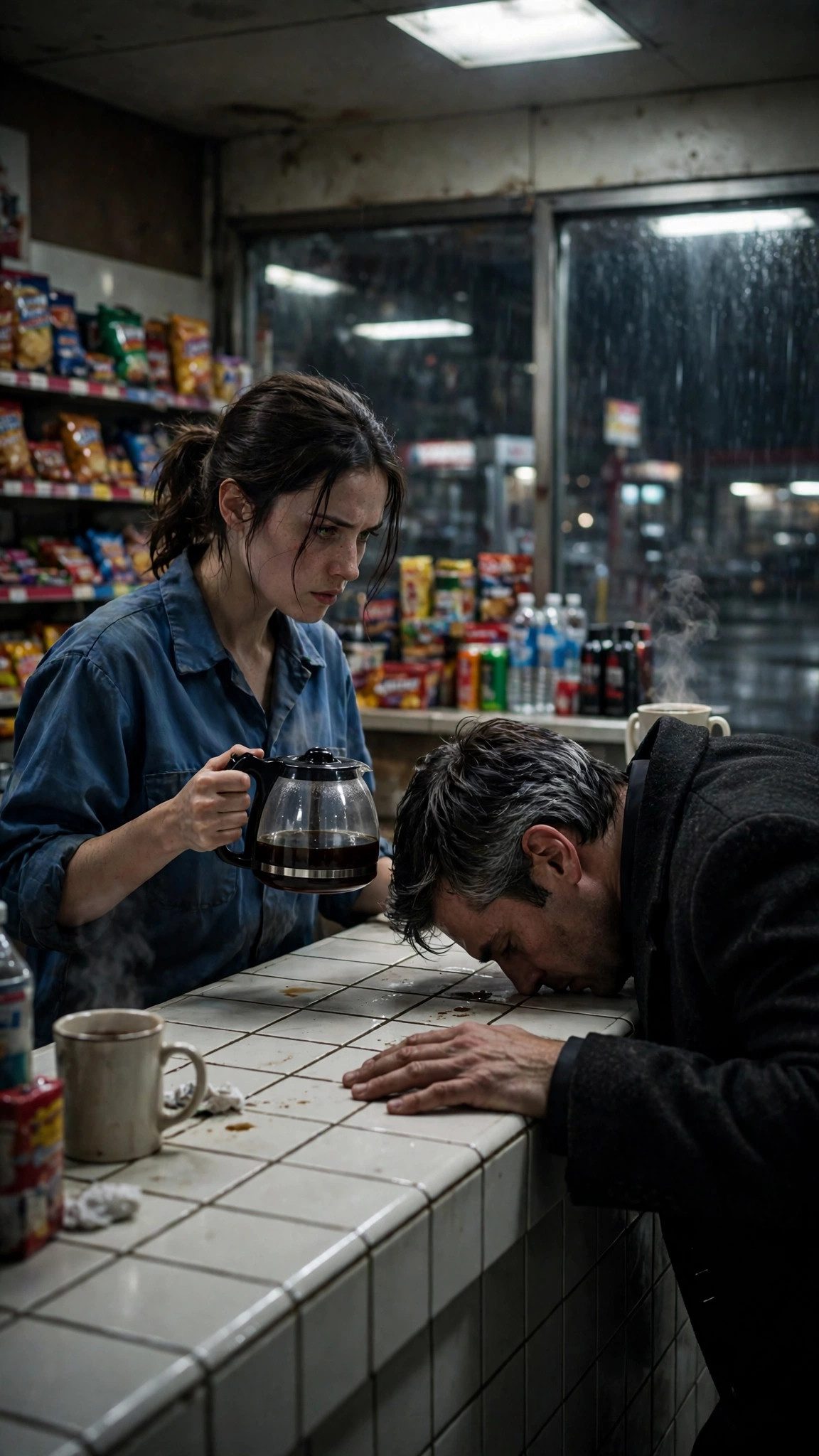
At 3:14 A.M., four armed hitmen forced one of New York's most feared mafia bosses face-first against my gas station counter and pressed a gun to the back of his head.
"Give him one last cup," the gunman said, smiling.
My manager had locked himself safely in his office, leaving me alone with four killers, two terrified truckers, and a man who was seconds away from being executed.
What the gunman didn't know was that my father had been a sheriff — and I'd just spotted the pistol hidden beneath the mafia boss's open coat.
My name is Gemma Boon. I'm twenty-eight years old, and for six years I have worked the overnight shift at a gas station on the highway outside the city, the kind of place people only stop at when they have no other choice. I wear an oversized blue uniform with my name stitched crookedly over the pocket. I clean bathrooms that nobody thanks me for cleaning. I count change for drivers who rarely bother to say thank you. I pour coffee for men who look straight through me like I'm part of the counter.
Most people barely noticed me. That was fine. I had learned a long time ago that being invisible was safer than being seen.
My father had spent twenty-three years as county sheriff before illness forced him to retire. He used to say that a sheriff's job was mostly waiting — waiting for the phone to ring, waiting for the trouble to come to you, waiting for the moment when you had to decide who you were. "Fear is normal, Gemma," he told me once, when I was sixteen and shaking after a drunk driver had run a stop sign right in front of our car. "But don't let it make every decision for you."
I didn't understand him then. I understood him at 3:14 in the morning, with a gun pressed to the back of a stranger's head and my manager hiding behind a locked steel door.
That night had started like any other night, which is to say it had started badly.
At 2:54 A.M., I knocked a glass coffee pot onto the floor. It shattered everywhere, black coffee spreading across the tiles like spilled ink, glass glittering under the fluorescent lights. I was on my knees gathering the pieces when my manager stormed out of his office.
Dale Kessler was a man who had been given a small amount of power and had decided to use all of it on the people below him. He was fifty-two, soft around the middle, with thinning hair he combed forward and a voice that always sounded like he was talking down to someone. He looked at the broken glass, then at me, and his mouth curled into the smile he wore whenever he found a reason to remind me where I belonged.
"You know how much those cost, Gemma?"
"I'll clean it up," I said. "It was an accident."
He looked down at me while I gathered the broken glass, and I could feel his eyes on the back of my neck. "Stop acting like you're worth more than this job."
I didn't answer. I needed the paycheck. My father's medical bills had swallowed our savings years earlier, and the house we lived in was one missed payment away from belonging to the bank. I had learned that sometimes surviving meant swallowing words you desperately wanted to say.
Dale went back into his office and closed the door, but not all the way. He liked to leave it open just enough to watch me. He liked knowing I knew he was watching.
The radio was playing low behind the counter, a late-night talk show where a man with a tired voice read the news and took calls from truckers who couldn't sleep. I had heard the same show a hundred times. It was part of the night, like the hum of the coolers and the buzz of the lights and the way the tiles felt cold through the soles of my shoes.
At one o'clock, the night nurse came in. Her name was Priya, and she worked at the county hospital, and she always ordered tea, never coffee, because coffee made her hands shake during surgery. She was the only regular who ever asked me how I was doing, and I always told her the same thing — "I'm fine, Priya, how are you?" — and she always said, "Tired, Gemma, but alive," and we both understood that this was a kind of friendship, even if we never said so.
At midnight, my father called. He called every night at midnight, without fail, because he had promised my mother, years ago, that he would always make sure I was safe, and a promise like that doesn't end just because a man gets sick. His voice was thin over the phone, and I could hear the oxygen machine hissing in the background, but he asked me about my night, and I told him about the broken coffee pot, and he laughed, a short, rasping laugh, and he said, "Your mother broke three pots in one week when she worked at the diner. You're doing fine."
I thought about the house payment while I wiped down the counter. It was due on the fifteenth, and the money in my account would cover it, but only just, and after that there would be almost nothing left for the pharmacy. My father's medicine cost more every month, and the insurance covered less, and the stack of bills in the kitchen drawer grew taller every week. I had done the math a hundred times. There was no version of the math where I won. There was only the version where I survived one more month.
On the mantel at home, beside the photograph of my mother, there was my father's sheriff's star, polished and bright, in a little wooden case. He had worn it for twenty-three years. He had told me once, when I was seventeen and he had taken me to the range for the first time, that the star didn't make a person brave. "Brave is what you do when the star doesn't help anymore," he had said, and he had put the pistol in my hands, and he had shown me how to stand, how to breathe, how to squeeze the trigger instead of pulling it. "Breathe, Gemma," he had said. "The shot will wait for you. Don't rush it. The moment will come to you."
I remembered the smell of gunpowder that day, and the way the target had jumped, and the way my father had nodded, once, the way he nodded when something was right.
I kept the memory in the back of my mind, the way you keep a flashlight in a drawer, not because you need it now, but because you might need it later.
I finished cleaning the glass, mopped the floor, and set a fresh pot to brew. The night was quiet in the way only highway nights can be quiet — the hum of the coolers, the buzz of the lights, the occasional truck rolling past without stopping. The two truckers who were parked out back came in around three o'clock, the way they always did on their run. Earl was sixty and had a belly like a barrel and a laugh that filled the whole station. The other one, Marcus, was younger, maybe thirty, with a beard and a tattoo of a rose on his forearm. They ordered coffee and sandwiches and sat at the little table by the window, talking about the price of diesel and a dispatcher they both hated.
I was wiping down the counter when the bell over the door rang and a black luxury sedan pulled up outside.
A tall man stepped inside wearing a dark wool coat.
I recognized him immediately.
Carmine Zito. Forty-one years old. One of the most powerful mafia bosses in New York. His photograph had appeared in newspapers beside stories about organized crime, disappearances, and investigations that never seemed to lead anywhere. The papers called him the Ghost of the Hudson, because nobody could ever prove anything, and the men who tried to prove things had a habit of stopping.
But he didn't behave like the monster I had imagined.
He walked to the counter with the calm of a man who had never once hurried in his life, and he placed a few bills on the counter, neatly, like he was setting a table.
"Black coffee, please," he said. His voice was low and even, the kind of voice that didn't need to be loud to be obeyed.
I reached for a cup. My hands were steady. I told myself it was just coffee. Just another driver. Just another man who would look through me and leave.
Then the entrance door opened again.
Four men entered, and something about the way they spread out made my stomach tighten. They didn't move like customers. Customers moved toward the coffee or the bathroom or the shelves. These men moved like they had already decided where everyone in the room was going to stand.
One of them locked the front door. The click of the lock was the loudest sound I had ever heard.
Another pulled a pistol from his jacket.
Before Carmine could react, two of the men grabbed his arms and slammed him against the counter, face-first, hard enough that the whole counter shuddered and the napkin dispenser fell over. Carmine didn't cry out. He didn't struggle. He went still in the way a man goes still when he is calculating how many seconds he has left.
"Don't move, Zito," the leader said. He was a lean man with a scar through his left eyebrow, and he smiled when he said it, like this was the best part of his night.
The coffee cup slipped from my hand and hit the floor. It didn't break. It just rolled, and I watched it roll, because watching it was easier than watching the gun.
Two truckers dropped to the floor. Earl went down behind the table with a grunt, and Marcus flattened himself against the wall by the coolers, his hands up where they could be seen.
Outside, through the window, I saw Carmine's driver disappear behind the raised hood of his sedan. He had been checking the engine when the men walked in, and now he was gone, swallowed by the dark. I didn't know if he had run or if he was doing something else. I didn't have time to wonder.
I looked toward my manager's office.
Dale was standing in the doorway. Our eyes met. He saw the guns. He saw the men holding Carmine down. He saw me standing behind the register with my hands shaking.
Then he stepped backward and slammed the steel door shut.
Click. The deadbolt turned.
He had locked himself inside. And left me out here.
One of the gunmen laughed. "Looks like your boss knows when to stay out of trouble, sweetheart."
I stood motionless behind the register. My heart was beating so hard I could feel it in my throat, in my ears, in my fingertips. The leader shoved his pistol against the back of Carmine's head, and Carmine's fingers tightened on the edge of the counter, the knuckles going white.
"Give him one last cup," the leader said.
My hands trembled. I glanced toward the coffee brewer. A fresh glass pot sat on the heating plate, steam curling up from the black coffee inside. The pot was hot. The handle was cool. I had poured a thousand cups from pots just like it, and my hands knew the weight of it even when my mind couldn't think.
Carmine lifted his eyes just enough to look at me. He didn't beg. He didn't promise me money. He simply watched me, as though trying to decide whether I would panic.
And then I noticed his coat.
It had fallen open when the men slammed him against the counter, and beneath it, on his right side, I saw the edge of a holster. Dark leather. The grip of a pistol, black and matte, sitting where his hand could have reached it if his arms hadn't been pinned.
My father's voice suddenly echoed in my memory, clear as if he were standing right behind me.
"Fear is normal, Gemma. But don't let it make every decision for you."
I looked at the gunman. Then at Carmine's exposed holster. Then back at the gunman, who was grinning at me like I was the entertainment.
"Come on, sweetheart," he said. "We're waiting."
I reached for the coffee pot.
And in that instant, I knew there was one chance to change what happened next. One chance, and if I reached for Carmine's gun and missed, nobody in that gas station would be safe — not the truckers on the floor, not Carmine, and not me.
But my father had also taught me something else, on the night he took me to the range for the first time and put a pistol in my hands and told me to breathe.
"Don't rush the shot, Gemma. Wait for the moment. The moment will come to you."
I wrapped my fingers around the handle of the coffee pot. The glass was hot against my palm. I could feel the weight of the coffee inside it, heavy and dark, and I could feel my own pulse hammering in my wrist.
The gunman leaned closer to Carmine's head. "Any last words, Zito?"
Carmine's eyes were on me. Steady. Waiting.
I lifted the pot from the heating plate, and I poured.
I poured the coffee into the cup with hands that had stopped shaking, and I set the cup down on the counter, right beside Carmine's pinned hand, close enough that he could see the steam rising from it.
"One last cup," I said, and my voice sounded like someone else's voice. Someone braver. Someone my father would have recognized. "Black. Just the way he likes it."
The gunman laughed, and in that laugh — in that single second when all four men were looking at the cup instead of at me — I saw the moment my father had told me about.
It came to me. And I took it.