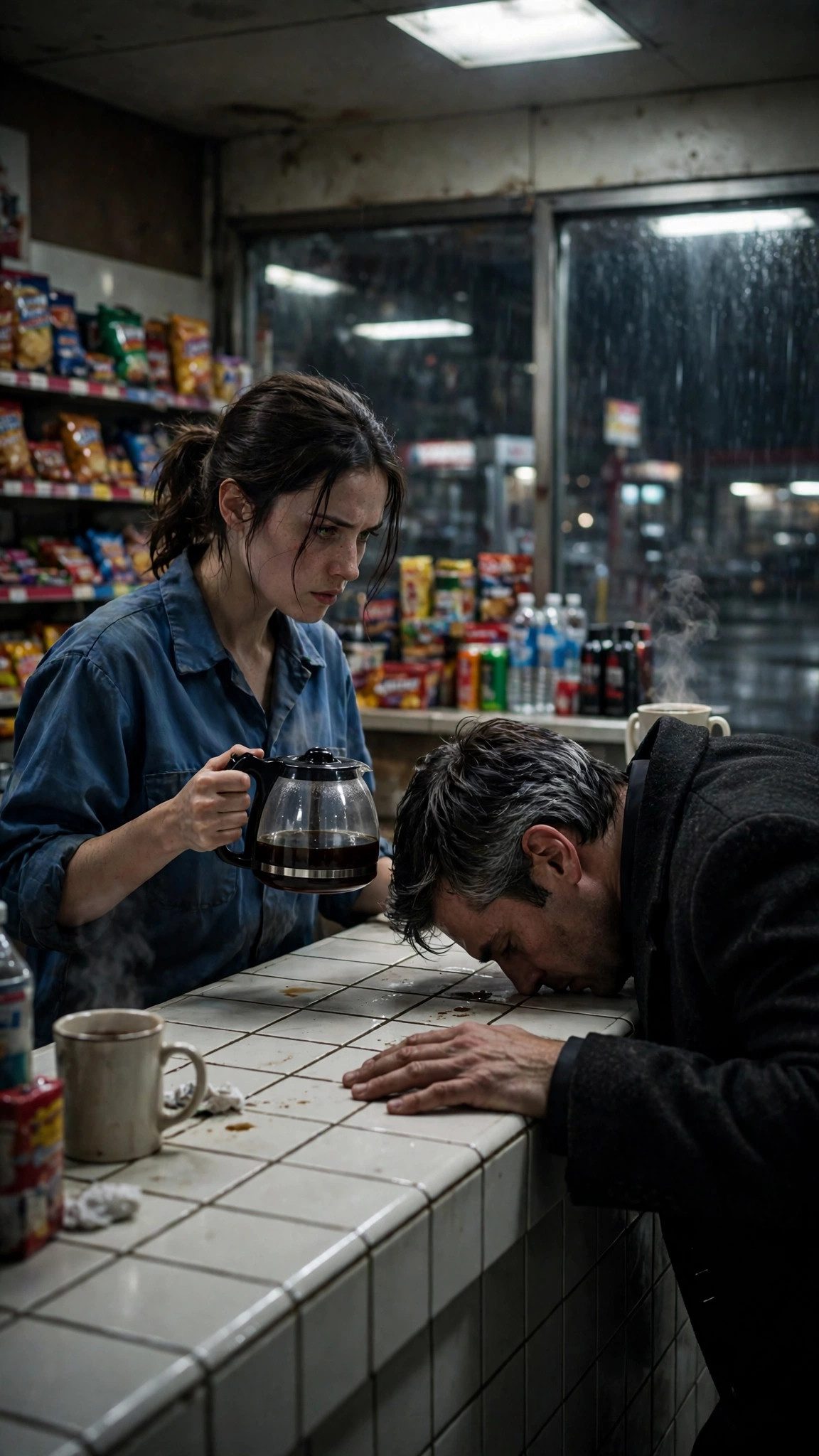
The police kept me at the station until almost dawn.
They asked me everything. They asked me what time the black sedan arrived. They asked me what the four men looked like. They asked me what the leader had said, word for word, and I told them: "Give him one last cup." They asked me about the coffee pot, and I showed them the handle, still in my hand when the first officer walked in — I hadn't even realized I was still holding it until a paramedic gently took it from me and set it on the counter.
They asked me about the gun. Whose gun it was. How it had ended up in my hand. Whether I had fired it.
"No," I said. "I didn't fire it. I just held it. And then I gave it to Mr. Zito."
"Mr. Zito," the officer repeated, writing it down. He was a young man, younger than me, with a notebook that was already full of other people's bad nights. "And you know Mr. Zito how?"
"I don't know him," I said. "He came in for coffee. Black coffee. He paid with cash."
The officer looked at me, then at Carmine, who was sitting on a chair by the window talking quietly with two detectives, his coat buttoned now, his hands folded, his face calm in a way that made the detectives lean toward him instead of the other way around. The officer looked back at me.
"You threw hot coffee in a man's face and took a mafia boss's gun," he said. "That's not a normal Tuesday, Miss Boon."
"It was a Thursday," I said. "Technically. It was three-fourteen in the morning on a Thursday."
He almost smiled. Then he remembered where he was, and the almost-smile went away.
He looked at his notebook, and then he looked at me, and his voice went a little softer. "Your father was a sheriff, Miss Boon. Twenty-three years. That's a long time."
"Yes," I said.
"Did he teach you to do what you did tonight?"
"He taught me to think before I acted," I said. "And he taught me that fear is normal, but it can't make every decision for you. Tonight, I was afraid. But I made my decision anyway."
The officer nodded, slowly, like a man writing something down in his mind instead of on paper. "My father was a mechanic," he said. "He taught me to fix engines. I guess every father teaches his kid the thing he knows best."
"Yours taught you well," I said, and he almost smiled again, and this time he let himself, just for a second, before he remembered where he was.
The paramedics took the leader to the hospital with a police escort. His face was burned, the skin red and blistering where the coffee had hit him, and he kept cursing as they loaded him onto the stretcher, cursing me, cursing Carmine, cursing the whole gas station. The other three were handcuffed and put into the backs of police cars. The one with the hurt ribs needed help walking. The one who had locked the door kept saying the same thing over and over — "I didn't know, I didn't know, I was just the driver" — and nobody answered him.
Earl and Marcus, the two truckers, gave their statements sitting at the little table by the window, drinking the coffee I poured for them with hands that had finally stopped shaking. Earl told the police he had been coming to this station for four years and had never seen anything like it. Marcus said he had hit the floor so fast he thought he'd broken his nose on the tiles, and then he laughed, a short, shocked laugh, and said he guessed he hadn't.
"She saved us all," Earl said, pointing at me with a thick finger. "That girl right there. She saved the whole room."
I didn't feel like I had saved anyone. I felt like I had survived, and there was a difference, and I wasn't sure I understood it yet.
It was Dale who surprised me most. When the police finally knocked on the office door, he opened it slowly, like a man coming out of a bunker after the bombing has stopped, and he blinked at the lights and the uniforms and the broken glass, and he said, "I was calling for help. I was in there calling for help the whole time."
He hadn't been. I had seen him step backward and turn the deadbolt with his own hand. I had heard the click. But nobody asked me, and Dale stood there in his shirt with his tie loosened, playing the shaken manager, and the police wrote down what he said, and I said nothing. Not yet. I was too tired to start a fight I couldn't finish at four in the morning.
Then a woman arrived who was not police, or not only police. She wore a dark suit and flat shoes and a badge on a chain around her neck, and she moved through the station like she had already decided what mattered and what didn't. She introduced herself to the detectives first, then to Carmine, and then she came to me.
"Miss Boon," she said. "I'm Special Agent Dana Cole. FBI. I'd like to ask you a few questions."
She didn't ask them at the counter. She asked them in the little break room behind the office, where there was a table and two chairs and a vending machine that had been broken since before I started working there. She set a recorder on the table and asked me if I minded, and I said I didn't, and she asked me to start from the beginning — not from 3:14, but from the beginning of the night, from the broken coffee pot at 2:54, from the moment Dale had stood over me and told me to stop acting like I was worth more than the job.
I told her everything. I told her about the black sedan and the wool coat and the bills laid neatly on the counter. I told her about the four men and the way they spread out. I told her about the driver disappearing behind the hood. I told her about Dale stepping backward and turning the deadbolt. I told her about the holster and my father's voice and the coffee pot and the moment.
Agent Cole listened the way good listeners do — without interrupting, without reacting, her eyes on my face the whole time. When I finished, she was quiet for a moment, and then she said, "Your father was a sheriff. Twenty-three years. County."
"Yes," I said. "He retired. He's sick now."
"I'm sorry to hear that," she said, and she sounded like she meant it. "Did your father teach you to shoot?"
"When I was seventeen. At the range. He said a person should know how a gun feels before they ever have to decide about one."
"Smart man," Agent Cole said. She turned off the recorder. "Miss Boon, I'm going to be honest with you. Carmine Zito is not a man who has accidents. He has routines, and he has enemies, and those two things together are how men like him get killed. Four men knew he would be here tonight, at this station, at this hour. That means somebody told them. Somebody who knew his route."
"His route?" I said. "He just stopped for coffee."
"He stops for coffee here every Thursday night," Agent Cole said. "On his way back from visiting his mother in the city. Same station. Same hour. For three years. The only people who know that are his own men — and whoever his men talk to."
I thought about that. I thought about the driver, Tony, disappearing behind the hood of the sedan, and I thought about Dale, stepping backward into his office, and I thought about the leader of the hitmen smiling at me and calling me sweetheart, like he already knew my name.
"Are you saying someone inside his organization set this up?" I asked.
"I'm saying someone did," Agent Cole said. "And I'm saying that the four men on your floor tonight were hired by someone with money and a reason. The leader's name is Rook — that's a street name, not a real one. He doesn't talk. The other three don't talk either. But they will, eventually. Men like that always do, when they realize nobody is coming to save them."
She stood up. "One more thing, Miss Boon. Mr. Zito would like to speak with you before you leave. He's waiting outside. You don't have to. But I think you should."
I found Carmine standing by his sedan in the pale light before dawn, his coat buttoned against the cold, Tony a few feet away, watching the road. The sedan was the same black car that had pulled in at 3:11, and it looked untouched, like nothing had happened to it at all.
"Miss Boon," Carmine said. "How are you?"
"Tired," I said. "I think I'm still shaking, a little."
"That will pass," he said. "Or it won't, and you'll learn to live with it. Either way, you did something tonight that most people wouldn't have done. I owe you a debt."
"I don't want money," I said, quickly, before he could offer it. "I don't want a payoff. I just want to go home."
He studied me for a moment, and I had the feeling he was seeing something in me that I couldn't see in myself. "I'm not offering a payoff," he said. "I'm offering my thanks. There's a difference. And I'm telling you something else, because you deserve to hear it from me and not from the newspapers: those men came here tonight because someone I trusted told them where I would be. That is my problem, not yours. But it became your problem at three-fourteen in the morning, and for that, I'm sorry."
"Don't be sorry," I said. "Just find out who it was."
"I will," he said. "I promise you that."
He reached into his coat and took out a card — plain, white, with a phone number written on it in black ink, no name. He held it out to me.
"If anything happens — anything at all — you call this number. Day or night. Someone will answer. That's not a threat, Miss Boon. That's a promise."
She stood up, and she gathered her papers, and at the door she turned back. "One more thing, Miss Boon. Don't go back to the station tonight, and don't answer the door for anyone you don't know. If a car follows you, drive to the nearest police station and honk your horn until someone comes out. And keep that card Mr. Zito gave you. If anything happens — anything at all — you call that number first, and you call me second."
"I will," I said.
"And Miss Boon," she said, "your father raised a brave daughter. You should tell him that, when you get home. Men like your father — they don't always hear it enough."
She left, and I sat in the break room for a moment, listening to the hum of the broken vending machine, and I thought about what she had said, and I thought about my father, sitting in his chair by the window, waiting for me to come home.
I took the card. It was warm from his coat.
"One more thing," he said. "The coffee. You make good coffee. The best I've had in years, and I've had coffee in a hundred places. When all of this is over, I'd like to come back and have another cup. Properly this time. No guns."
I almost laughed. It came out as something between a laugh and a sob, and I pressed my hand to my mouth. "You can come back anytime," I said. "We serve coffee all night."
"Then I'll be back," Carmine said, and he opened the door of his sedan and got in, and Tony folded himself into the driver's seat, and the black car pulled out of the lot and onto the highway, and the taillights disappeared into the dark, and I stood there in the cold with a white card in my hand and the smell of coffee and gunpowder still in my hair.
The sun was coming up when I finally drove home. My father was awake in his chair by the window, wrapped in his blanket, his breathing thin and rattling, and he looked at me and he knew. He had been a sheriff for twenty-three years. He could read a bad night on a person's face the way other men read the newspaper.
"Gemma," he said.
I sat down beside him, and I told him everything. I told him about the coffee pot and the gun and the men on the floor and the agent from the FBI and the card in my pocket. And when I finished, he reached out with a hand that shook — not from fear, but from illness, from the body that was slowly giving up on him — and he put it over mine.
"Your mother would have been proud of you," he said. "And so am I."
The drive home took forty minutes, and the sun was coming up over the highway, and the sky was the color of a bruise — purple and gold and pink, all at once, like the world couldn't decide what it wanted to be. I stopped at the pharmacy on the way, because my father's medicine was running low, and the pharmacist, a woman named Mrs. Alvarez who had known my father for twenty years, looked at my face and said, "Gemma, you look terrible. Are you all right?"
"I'm fine," I said, because that was what I always said, and she gave me the medicine, and she told me to take care of myself, and I promised I would, and I didn't believe it.
When I got home, the house was quiet, and the kitchen smelled like the tea my father had made for himself, and I stood in the doorway for a moment, just listening to the house breathe — the tick of the clock, the hum of the refrigerator, the soft rattle of my father's oxygen machine from the living room. It was the sound of home. It was the sound of the life I had built out of small, ordinary things, and I thought about how fragile it was, and how quickly it could have been taken away from me in a gas station at three-fourteen in the morning.
I put the medicine on the kitchen table, and I went into the living room, and my father was awake, and he looked at me, and he knew. He had been a sheriff for twenty-three years. He could read a bad night on a person's face the way other men read the newspaper.
I cried then, for the first time all night. I cried for the broken coffee pot and the manager who had locked himself away and the men on the floor and the father who was dying in a chair by the window. And my father held my hand, and outside the window the sun came up over the highway, and somewhere in the city a mafia boss was looking for the man who had betrayed him, and I knew — I knew with a certainty that sat in my chest like a stone — that this night was not over.
It was only the beginning.