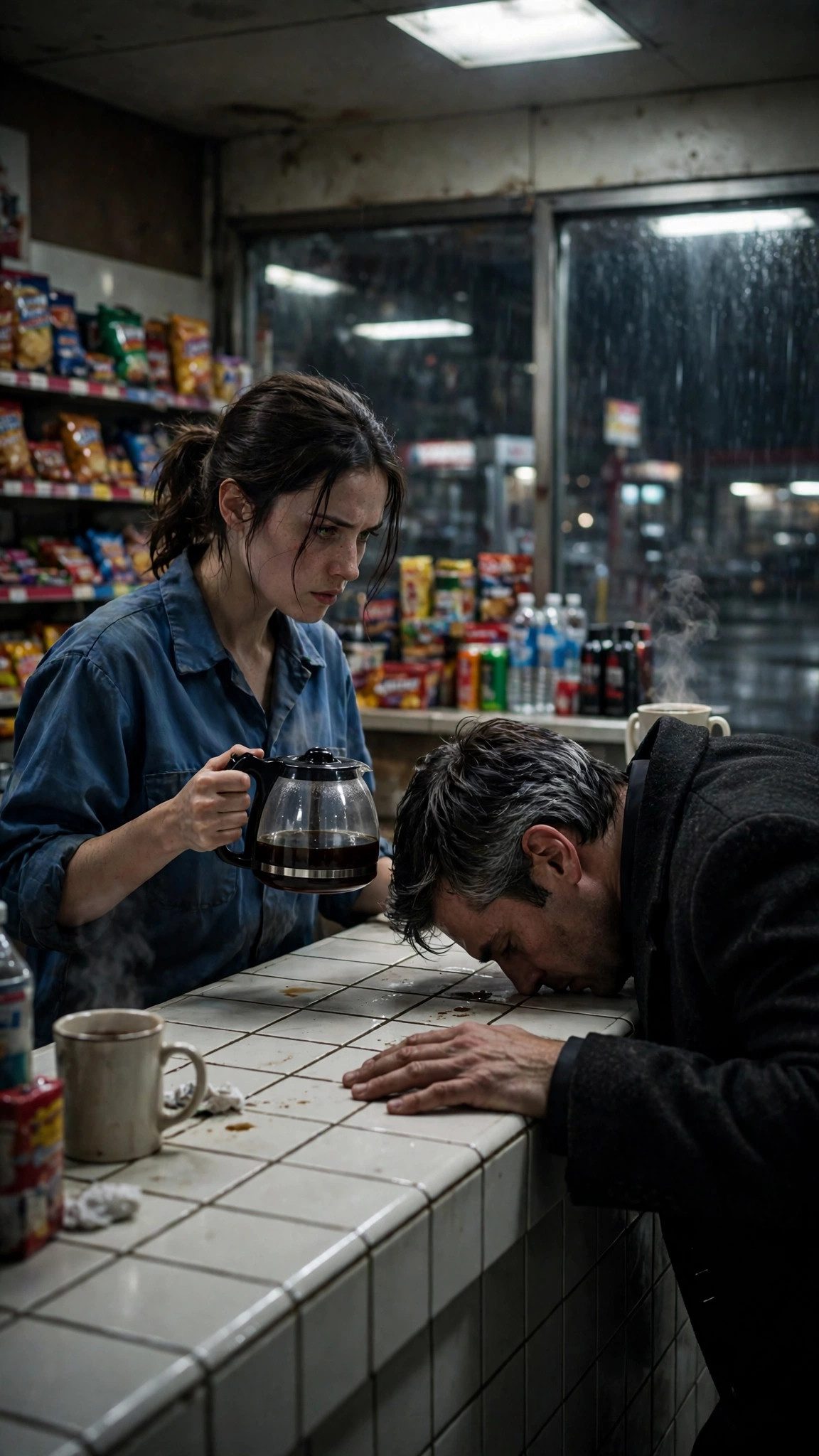
The car started following me on the second day.
I noticed it the way my father had taught me to notice things — not by looking at it directly, but by watching the edges of my vision, the way a good sheriff watches a room without seeming to. A dark sedan, two cars back, always two cars back, never closer, never farther. When I turned, it turned. When I stopped for gas, it stopped at the light and waited. When I pulled into my father's driveway, it kept going, slow, past the house, and I saw the driver's face for half a second in the mirror — a young man, clean-shaven, his eyes forward, pretending he wasn't looking.
I didn't pretend back. I went inside, locked the door, and called the number on the white card.
"There's a car," I said. "A dark sedan. It's been behind me since the pharmacy."
"Stay inside," the voice said — not Carmine, but a man I didn't know, calm and professional. "Sal is outside. He sees it. Don't open the door for anyone."
I stayed inside. I sat with my father, who was having a bad day — his breathing was worse, and his hands shook when he tried to lift his tea — and I read to him from the newspaper, and I tried to keep my voice steady, and all the while I could feel the house being watched, the way you can feel a storm coming before the first drop of rain.
At nine o'clock, the phone rang. Carmine.
"Miss Boon," he said. "I need you to come to the station tomorrow night. Your normal shift. I need you to be behind that counter at three in the morning, exactly where you were."
"Are you out of your mind?" I said. "They tried to kill you there. They'll try again."
"That's the point," Carmine said. "Falco knows Rook talked. He knows we have the phone. He's running out of time, and men who are running out of time make mistakes. He'll come for you, Miss Boon, because you're the witness, and without you, the case against him falls apart. He'll come to the station because that's where the story started, and he thinks he can finish it there."
"And you want me to be the bait," I said.
"I want you to be the trap," Carmine said. "There's a difference. The station will be full of my men, dressed as customers, as truckers, as the night clerk in the office next door. Sal will be outside. Tony will be in the lot. Agent Cole will have the building surrounded, because I called her myself, and she wants Falco more than I do. You won't be alone for one second. I swear it on my mother's grave."
I thought about it. I thought about the card in my pocket, and the coffee pot, and the men on the floor, and the word useful. I thought about my father, asleep in his chair, his medicine on the table beside him, the bills stacked in the drawer that I couldn't pay.
"All right," I said. "I'll be there."
"Thank you," Carmine said. "And Miss Boon — wear something you can run in."
I wore jeans and my father's old boots and a dark sweater, and I tied my hair back tight, and I drove to the station at eleven o'clock on a Thursday night, and the lot was empty, and the lights were on, and the coffee was brewing, and it was exactly like every other night, except that it wasn't.
Earl was there, sitting at the little table by the window, reading a newspaper. Only Earl wasn't really reading. His eyes were on the door. Marcus was at the coolers, pretending to look at sandwiches, his hand never far from his jacket. A woman I didn't recognize sat in the corner booth with a laptop, her fingers not moving on the keys. A man in a trucker's cap stood by the cigarette rack, his back to the wall.
They were all Carmine's people. And they were all watching the door.
The hours crawled. At midnight, Earl told me a story about a run he had once made to Chicago in a blizzard, with a load of frozen turkeys and a dispatcher screaming at him over the radio, and he made it funny, and I laughed, and the laughing helped, a little. At one o'clock, the woman with the laptop — her name was Rosa, and she worked for Carmine, and she had a scar on her left hand that she didn't explain — came to the counter and ordered a coffee, and she stood there for a moment, and she said, "He talks about you, you know. Carmine. He says you have a steady hand. He says that matters more than anything."
"What does he mean?" I asked.
"He means," Rosa said, "that most people shake when the moment comes. You didn't. He noticed. Men like Carmine notice things like that."
At two o'clock, I went into the office and looked at the security camera monitor, the little black-and-white screen that showed the lot and the pumps and the door. The lot was empty. The highway was empty. The night was holding its breath.
At 2:54 A.M., I knocked a glass coffee pot onto the floor, and it shattered, and for one terrible second I was back in the other night, on my knees, gathering glass while Dale stood over me. But this time, when I looked up, there was no Dale. There was only Earl, watching me, and Rosa, watching me, and Marcus, watching me, and all of them were very still, and all of them were ready.
I cleaned up the glass. I set a fresh pot to brew. I wiped down the counter. And I waited, and the clock on the wall ticked toward 3:11, and my heart beat in my throat, and I thought about my father, asleep in his chair, and I thought about the card in my pocket, and I thought about the word useful, and I thought about the man who had looked at me across the counter and decided I was worth saving.
And then, at 3:11 A.M., a black sedan pulled into the lot.
My heart stopped. It wasn't Carmine's sedan. It was a different car, longer, with tinted windows, and it parked in the same spot Carmine's car had parked, and the driver's door opened, and a man got out.
Vincent Falco. I knew him from the photograph Agent Cole had shown me that afternoon — a man in his fifties, silver hair, a tailored suit, a face like a closed door. He walked into the station like he owned it, like he had walked into it a hundred times before, and behind him came three men, younger, harder, their hands in their jackets.
"Miss Boon," Falco said, smiling. "The girl with the ponytail. I've heard so much about you."
He didn't reach for a gun. He didn't need to. The three men spread out, the way the hitmen had spread out, and one of them went to the door, and I heard the lock click, and the whole room went quiet, the way a room goes quiet when everyone in it knows what is about to happen.
"I want you to come with me," Falco said. "Just for a little drive. We need to talk about what you saw the other night. About what you think you saw."
"I saw enough," I said.
"Did you?" Falco said. "Because what you saw was a misunderstanding. A business disagreement. And if you tell the police a different story, a lot of people are going to be unhappy. People with long memories."
"Like you?" I said.
He smiled wider. "Like me."
One of his men took a step toward the counter. Earl stood up. Marcus stood up. The woman with the laptop closed the laptop. The man by the cigarette rack turned around, and his hand was inside his jacket, and suddenly the room was full of men who were not pretending anymore.
Rosa stood up too, closing her laptop with a quiet click, and the man by the cigarette rack turned around, and his hand came out of his jacket holding a pistol, steady and level, and I saw Falco's eyes flick toward him, and then toward Earl, and then toward Marcus, and I saw the calculation happening behind his face — three of his men against a room full of people who were no longer pretending.
"Don't," Rosa said, and her voice was calm, the way a woman's voice is calm when she has done this before. "There's no version of this where you walk out of here with her, Vincent. You know that. I know that. The only question is how many of your men get hurt finding out."
Falco's smile faded, a little at a time, like a light going out. He looked at the door, and the man who had locked it was standing beside it, his hand on the handle, and I saw him shake his head, once, very slightly — the door was locked, but the room was full, and there was nowhere to run to.
"You planned this," Falco said. "All of you. The girl. The trap."
"The girl planned it," a voice said, and I turned, and Carmine was standing in the doorway of the office, and he was looking at Falco the way a man looks at something he used to respect.
Falco's three men looked at each other, and I saw their hands move, slowly, away from their jackets, and I saw them understand what I had understood an hour ago — that the moment had come, and it had not come for them.
"Don't," a voice said from the back of the station, and the office door opened, and Carmine Zito walked out, calm as still water, his coat buttoned, his hands at his sides, Tony behind him and Sal behind Tony and Agent Cole behind Sal, her badge on her chain and her hand on her holster.
Falco's smile froze. "Carmine."
"Vincent," Carmine said. "Fifteen years, and you come to a gas station to threaten a girl who pours coffee. Is that what we've come to?"
"You don't understand," Falco said, and for the first time, his voice shook. "The family was dying. Your way was dying. Someone had to—"
"Someone had to hire four men to shoot me in the back of the head?" Carmine said. "Someone had to pay a gas station manager to report my movements? Someone had to walk those men through this station and show them where the lock was and where the girl stood?"
Falco's eyes flicked to the three men with him, and then to the door, and then back to Carmine, and I saw him calculate — the way a man calculates when he knows the room is full of guns and every one of them is pointed at him.
"Rook talked," Carmine said. "Your manager talked. The phone talked. And Miss Boon — Miss Boon saw everything, and she told the truth, and the truth is the one thing you can't shoot."
Agent Cole stepped forward. "Vincent Falco," she said, "you're under arrest for conspiracy to commit murder, attempted murder, and witness intimidation. You have the right to remain silent."
Falco laughed. It was a short, bitter laugh, the laugh of a man who has run out of moves and knows it. "You think this is over?" he said. "You think arresting me changes anything? The family—"
"The family will survive," Carmine said. "It survived before you, and it will survive after you. Take him."
They took him. They took his three men too, their hands cuffed behind their backs, their faces blank.
The woman with the laptop was already on the phone, calling it in, her voice low and professional, and I thought about how strange it was that a room could go from terror to paperwork in the space of a minute. One moment, men with guns. The next, handcuffs and phone calls and forms. The world has a way of putting itself back together, even after the worst nights. It just needs someone to hold the pieces still long enough for the glue to set.
The woman with the laptop was already on the phone, calling it in. Earl sat back down at his table and ordered another coffee, like nothing had happened, and Marcus laughed, a real laugh this time, and said he was going to tell this story at every truck stop from here to Chicago.
And I stood behind the counter, in my jeans and my father's boots, with my hands flat on the tile, and I watched Vincent Falco walk out of my gas station in handcuffs, and I felt something in my chest unclench for the first time in days.
My hands were shaking again. I hadn't noticed until Rosa came to the counter and put her hand over mine, and her hand was steady, and warm, and she said, "Breathe, Gemma. It's over. He's going away, and he's never coming back."
Agent Cole came over too, and she looked at me, and she nodded, once, the way a person nods when they have seen something they respect. "You did well tonight," she said. "Better than well. You held the line. That's not easy."
"I was scared," I said.
"I know," she said. "That's what makes it brave."
Earl came to the counter and ordered another coffee, and his hands were steady now, and Marcus laughed, and the room felt like it could breathe again, and outside the window the sky was starting to lighten, just a little, at the edges, like the night was finally letting go.
Carmine walked to the counter. He looked tired. Older than forty-one. The last three days had put lines on his face that hadn't been there before.
"Black coffee, please," he said.
I reached for a cup. My hands were steady.
"On the house," I said, and I poured, and I set it down in front of him, and he lifted it to his lips, and he closed his eyes, and for a moment, in a gas station on a highway outside the city at three-fourteen in the morning, there were no guns and no traitors and no men on the floor.
There was just coffee. And quiet. And the smell of rain coming in through the open door.