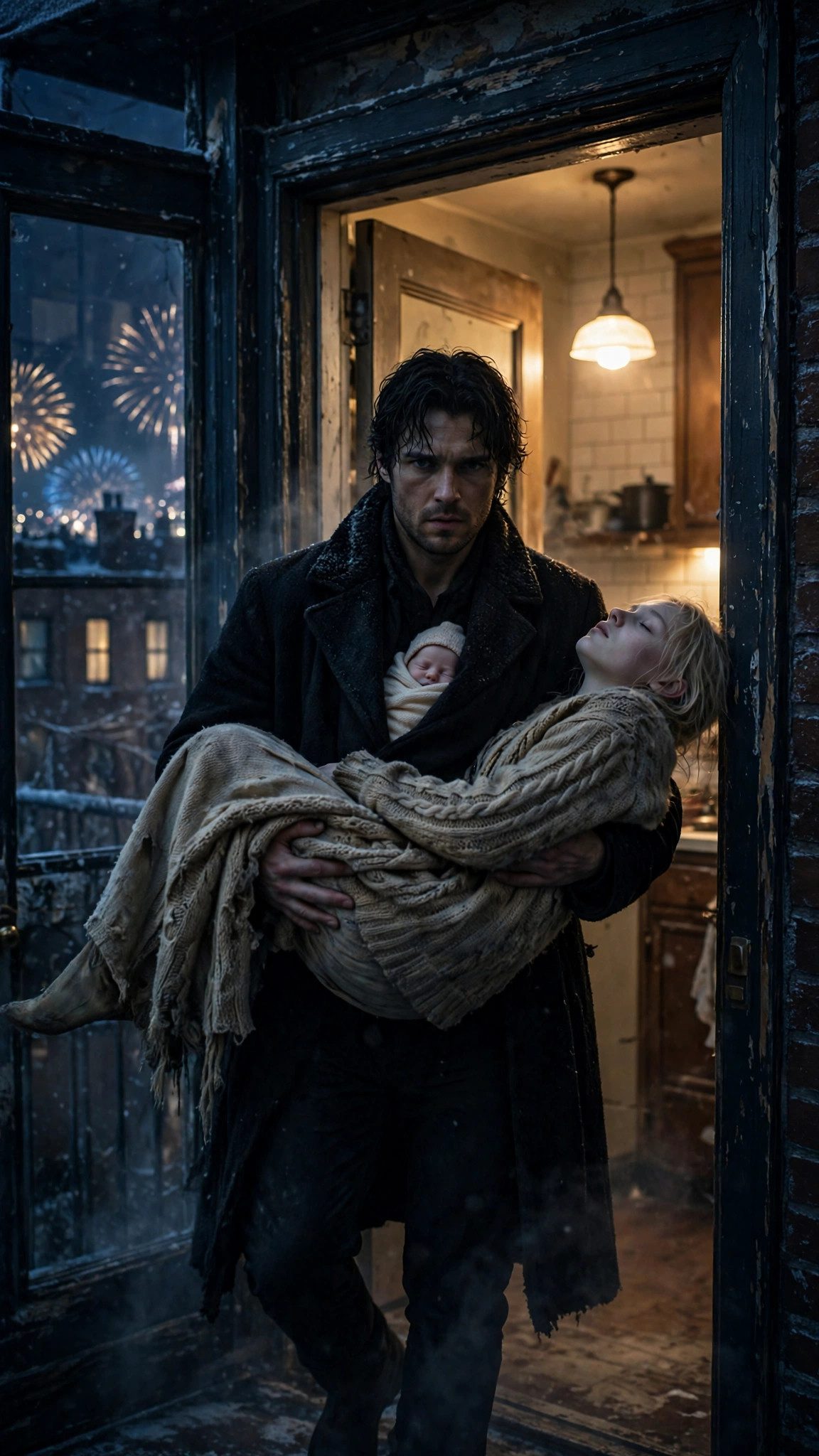
At 11:27 p.m. on New Year's Eve, I unlocked the door to my own apartment in Brooklyn without making a sound, and I knew within three seconds that something was terribly wrong.
No one knew I was back. I was supposed to remain in Stuttgart until the first week of January, handling a business problem that could not be discussed over the phone. But I had changed my flight, paid nearly triple for the last available seat, and crossed the Atlantic in the middle of winter because I wanted to surprise my wife.
Maya had nearly died giving birth to our son eleven days earlier. I had never even held him.
Inside my suitcase were winter clothes for the baby, expensive recovery creams for Maya, chocolates for my mother, perfume for my sister Chloe, and a watch for her husband, Mark. Looking back, the gifts were almost insulting. I might as well have brought flowers to a house fire.
The apartment was completely dark. No music. No food. No warmth. The heating system had been turned off, and the cold in the hallway bit through my coat the moment I stepped inside. I stood in the entryway with my suitcase in my hand and listened. A home with a newborn baby in it should never be this silent.
Then I heard it. A weak, broken cry coming from the kitchen.
"Where are Maya and Liam?" I called. No one answered.
I set the suitcase down and followed the sound. I stopped in the kitchen doorway, and what I saw there is burned into me so deeply that I can still see it with my eyes closed, years later, whenever I walk into a dark room.
Maya was sitting on a hard plastic chair, wrapped in an old cardigan that was not hers. Her skin looked gray beneath the kitchen light. Her lips were cracked, her hair was damp with sweat, and one hand pressed against her stomach. Blood had soaked through the fabric over her surgical incision, a dark stain spreading slowly across the front of her dress.
On the table sat a cup of instant noodles that had gone cold hours ago. Beside her, our son lay inside a wicker bassinet, trembling beneath a blanket too thin for winter. His tiny fists were clenched. His cry was not the strong, angry cry of a healthy baby. It was thin and exhausted, the sound of a creature that had been crying for a long time and was running out of strength to do it.
"David?" Maya whispered. She tried to stand. Her knees gave out. I caught her before her head struck the floor.
"Where is everyone?" I asked. "Where is my mother? Chloe? Mark?"
Maya looked away. That frightened me more than the blood.
"They went to Miami," she said softly. "Your mother said they would only be gone for a few days."
I stared at her. "I sent them fourteen thousand dollars."
She said nothing. She did not have to. The silence was the answer.
I opened the refrigerator. Empty. The smoked salmon, fresh fruit, medical broth, vitamins, milk, and prescription formula I had ordered before I left were all gone. Even the bottled water had disappeared. Only one thing remained. A note taped to the refrigerator door, written in my mother's neat, looping handwriting.
We're celebrating New Year's in South Beach. Make do with what is left. Don't call David and play the victim. He works hard enough without listening to your complaints.
I read it twice. The words did not change. My mother had written them. My mother had taped them to an empty refrigerator and left my wife, eleven days after a C-section that nearly killed her, alone with a newborn baby in a freezing apartment with a cup of cold instant noodles.
Then Maya grabbed my wrist. Her fingers were cold. Her grip was weak, but there was terror in it.
"Please," she whispered. "Don't confront them. Your mother said if I turned you against the family, she would make sure you took Liam away from me."
For several seconds, I could not speak. I could not breathe. My mother had threatened my wife — my wife, who had nearly died bringing my son into this world — with losing her child. And Maya had believed her. She had sat in that cold kitchen for days, bleeding and starving, because she was afraid that if she asked for help, she would lose her baby.
Then I noticed something behind her chair. A small black pharmacy bag. Inside were Maya's painkillers, antibiotics, and discharge medication — still sealed. Someone had hidden them from her. Someone had deliberately kept the medicine that would have stopped her pain and fought her infection out of her reach, and left it sitting there in the dark like a taunt.
That was the moment I stopped being a son. I became something else entirely, something colder and clearer. I photographed everything. The blood. The empty refrigerator. The note. The unopened medication. I photographed the thin blanket and the cold noodles and the thermostat set to fifty degrees. I photographed it all because I knew, even in that moment, that my family would lie about it later. They would say it was a misunderstanding. They would say Maya was exaggerating. They would say I was overreacting. And I wanted proof that would survive every lie they could invent.
Then I wrapped Liam inside my coat, lifted Maya into my arms, and carried them both downstairs. She weighed almost nothing. Eleven days ago she had been round and glowing and full of life. Now she felt like a bird in my arms, all bones and fever.
As I carried her down the stairs, I passed the photographs on the landing wall. My mother holding me as a baby. Chloe at her wedding, laughing, Mark's arm around her waist. Maya and me on our own wedding day, her hand in mine, both of us smiling like people who believed the hardest part of life was already behind us. I had grown up in a house where family meant everything. My father, before he died, used to say that a man with no family was a man with no spine. He said it at every holiday dinner, every birthday, every christening, and I had believed him the way a child believes anything his father says with enough conviction.
I thought about my father as I carried my wife down those stairs. I thought about what he would have said if he had walked into that kitchen and seen what I had seen. My father was not a gentle man. He had built everything we had with his hands and his nerve, and he had rules, and the first rule was that you protected your own. He would have looked at that empty refrigerator and that note on the door, and he would not have needed a second look. I knew that. I had always known that, somewhere underneath everything else. The difference between my father and me was that I had spent my whole adult life trying to be the reasonable one, the one who kept the peace, the one who paid for everything and asked for nothing and told myself that was what strength looked like.
It was not strength. It was fear, wearing a good suit.
In the stairwell, Maya stirred against my chest. "David," she whispered, "don't be angry. Please don't be angry. She said you would be angry with me."
"I'm not angry with you," I said, and my voice sounded strange to my own ears, low and rough, like a voice coming from someone else's throat. "I will never be angry with you for this. Do you hear me? Never."
"She said I was weak," Maya said. Her eyes were half closed. Her forehead was burning against my jaw. "She said a real wife would have handled it. She said you married beneath you and I proved her right."
I stopped on the landing. The cab was waiting outside. The driver had his hazard lights on. But I stood there for a moment with my wife in my arms and my son pressed against my chest, and I let myself feel the full weight of what my mother had done. She had not simply been careless. She had not simply been selfish. She had spent eleven days systematically breaking my wife down — taking her food, hiding her medicine, turning off the heat, threatening her with the loss of her child — and she had done it while I was an ocean away, trusting her with the two people I loved most in the world.
I had sent her fourteen thousand dollars. I had called her from Stuttgart and asked her, specifically, to take care of Maya. I had said the words out loud: take care of her, she nearly died, she needs food and medicine and warmth. And my mother had said, "Of course, darling. Don't worry about a thing." Then she had taken the money and gone to South Beach.
"She was wrong," I told Maya. "About all of it. You are the strongest person I have ever known. You kept our son alive for eleven days with nothing. Nothing. Do you understand what that means? You did that."
Maya's eyes opened, just barely. "Liam," she whispered. "Is he all right?"
"He's going to be all right," I said. "We're going to the hospital right now. Both of you. And I am not leaving your side again. Not for Stuttgart. Not for business. Not for anyone."
Outside, the cold hit us like a wall. The cab driver got out and opened the door, and when he saw Maya in my arms and the baby inside my coat, he didn't ask a single question. He just said, "Hospital, right? Which one?" and I told him, and he drove like the devil himself was behind us.
In the cab, fireworks exploded above Manhattan as Maya's fever climbed. The driver kept glancing in the mirror. I told him to drive faster. I opened my banking app and canceled every card linked to my mother, Chloe, and Mark. Every single one. If they wanted to celebrate New Year's in South Beach, they could do it on whatever cash they had left in their pockets.
I thought about the money as the cab crossed the bridge. Fourteen thousand dollars. I had sent it the day after Liam was born, the moment the doctors told me Maya had lost too much blood and would need weeks of careful recovery. I had wired it from Stuttgart with a note: for Maya and Liam — food, medicine, anything they need. My mother had called me that same evening to thank me. She had sounded warm. She had sounded grateful. She had said, "You take care of business, David. We'll take care of her." And I had believed her, because she was my mother, and because believing her was easier than admitting what I had known about her for years — that her love had always come with a price, and that the price was obedience.
I looked down at Liam, tucked inside my coat. His face was red from the cold and from crying. His tiny hand had found its way out of the blanket and was curled around my finger, holding on with a strength that didn't make any sense for something so small. I thought about the fact that I had never held him before tonight. I had been in Stuttgart when he was born. I had heard his first cry over the phone. I had missed the first eleven days of his life because of business, and in those eleven days, my own family had nearly let him die.
I made myself a promise in that cab, with fireworks going off over the river and my wife burning with fever beside me. I promised that I would find out exactly what had happened in that apartment, day by day, hour by hour, and that every person responsible would answer for it. Not with violence. I was done with the old ways, or at least I told myself I was. But with truth. With consequences. With the end of every privilege they had ever taken from me.
I also promised myself something else, something smaller and more selfish: that I would never again leave my family in the hands of people who had not earned my trust. I had handed my wife and my newborn son to my mother because she was my mother, and I had not asked a single hard question about whether she was capable of caring for them. I had not asked whether she even wanted to. I had simply assumed that blood meant safety. That assumption had nearly cost me everything I loved, and I would not make it twice.
The cab driver turned onto the avenue that led to the hospital. Maya's breathing had gone shallow. I pressed my hand to her forehead and felt the heat coming off her skin like a stove. "Stay with me," I whispered. "We're almost there. Stay with me, Maya." Her eyes fluttered open for a second, and she looked at me, and for a moment she looked like the woman I had married — the woman who had laughed at me across a crowded restaurant and told me I was too serious for my own good. Then her eyes closed again, and the fear came back, cold and sharp, because I did not know if the infection had already gone too far.
Then my phone vibrated. It was a notification from the security system.
Motion detected: Apartment storage room.
No one was supposed to be inside. The storage room was locked. It held my safe, my papers, the things I kept separate from the rest of my life. I opened the live camera feed with one hand while I held Maya with the other. At first, I saw only darkness. Then someone stepped into view.
Someone who was supposed to be in Miami.
And when that person looked directly into the camera, I finally understood why my wife had been so afraid.