I met Adrian DeLuca on a Tuesday in October, and I remember that it was a Tuesday because Tuesdays were the slowest days at the hotel, and on slow days I used to stand behind the front desk and watch the rain come down Michigan Avenue and dream about a life that was bigger than the one I had.
I was twenty-six years old. I had been working at the hotel for three years, ever since I finished college with a degree in literature and discovered that a degree in literature qualifies you to do almost nothing except love books very much. My mother had wanted me to teach. My father had wanted me to be practical. I had wanted to write, but writing did not pay the rent on my small apartment, so I wore a navy blazer and a name tag that said CLAIRE, and I smiled at guests, and I told myself that someday, somehow, my real life would begin.
Adrian walked into the lobby that Tuesday with two men behind him, and the whole room changed. I cannot explain it any better than that. The air itself seemed to rearrange around him. He was tall, dark-haired, with a scar through his left eyebrow that I would later learn came from a bottle in a bar fight when he was nineteen. He wore a charcoal suit that fit him like it had been sewn onto his body, and when he reached my desk, he looked at me — really looked at me, the way almost no one in that hotel ever did — and said, "You have kind eyes. I hope the rooms are as kind as you are."
I laughed. I was not supposed to laugh at guests, but I laughed, and he smiled, and that was the beginning of everything.
He stayed at the hotel for four nights. Every morning he came down to the desk, and every morning he found a reason to talk to me. The weather. The traffic. A restaurant recommendation. On the third morning he asked me if I would have dinner with him, and I said no, because I did not have dinner with guests, and he said, "Then I will not be a guest anymore. I will check out tomorrow and ask you again as a free man." And he did. He checked out the next morning, and that evening he was waiting outside the hotel with flowers — not roses, but white lilies, because he had noticed the small vase of lilies on my desk and remembered — and he took me to a restaurant on the river where the candles were real and the waiter knew his name.
That was Adrian. He noticed things. He remembered things. He made a woman feel like she was the only person in the room, in the city, in the world. For a girl who had grown up in a two-bedroom apartment above a bakery, who had spent her whole life being ordinary, that feeling was intoxicating. It was also, I understand now, a skill. A man who runs an empire learns to make people feel chosen. It is how he gets them to stay.
We dated for eleven months. He was patient. He was generous. He met my parents and charmed my mother so thoroughly that she called me the next day and said, "Claire, this one is different. This one looks at you like your father looked at me." My father, who had driven a bus for thirty-one years and never once raised his voice in our house, shook Adrian's hand and said, "Take care of my girl," and Adrian said, "I will, sir. I swear it on my life."
He proposed on a rooftop in December, with the whole city lit up below us and snow coming down so gently it felt like the world was holding its breath. The ring was too big. I laughed when I saw it, and he laughed too, and said, "Then let us live in a movie." I said yes. Of course I said yes. What else do you say when a man offers you the world?
The wedding was in a church with two hundred guests and a string quartet. I wore my mother's veil, re-sewn by a seamstress Adrian hired, and my father walked me down the aisle with tears in his eyes. Adrian cried when he saw me. I believed those tears. I believed them completely, and I would believe them for nine more years, because I wanted to believe them, and because the man who cried at his wedding could not possibly be the man who would one day use his daughter as a shield.
Our first year of marriage was golden. We lived in a house on Astor Street with a garden I planted myself — tomatoes and basil and roses that my mother helped me choose. Adrian worked long hours, but he came home for dinner, and on Sundays he cooked, badly and joyfully, burning the garlic bread and laughing at himself. He bought me books, first editions, because he remembered that I loved literature. He listened when I talked about the novels I wanted to write someday. He said, "Write them, Claire. I will build you a room with a view and you will write them there." I never wrote them. I was too happy to write. Happiness, I have learned, is the enemy of art. It is also the enemy of suspicion.
Sophie was born in the spring of our third year, on a morning so bright it hurt to look at the sky. I labored for fourteen hours, and Adrian stayed beside me for every one of them, holding my hand, telling me I was the bravest person he had ever known. When they put Sophie on my chest, wet and furious and perfect, Adrian leaned down and whispered to her, "She has your light, Claire. She has all your light." Then he cried again, and I believed those tears too.
She was a beautiful baby. She had my blonde hair, fine as corn silk, and his dark eyes, and from the very beginning she had a way of looking at people as if she could see straight through to whatever was good in them. She smiled early. She talked early. By the time she was three she was making up songs about the mailman and the pigeons in the park. By the time she was five she had decided she wanted to be a veterinarian, a ballerina, and the President, in that order, and she saw no contradiction in any of it.
Adrian adored her. I want to be honest about that, because honesty is the only thing I have left. He adored her. He read her stories in the armchair by the fire, doing all the voices, making her laugh so hard she would fall off his lap. He taught her to ride a bicycle in the park, running behind her with his hand on the seat, and when she finally rode alone, he cheered louder than anyone. He took her to the zoo, to the lake, to the ice cream shop on the corner where the owner knew her order by heart. On her sixth birthday he gave her a pink bicycle with a basket, and she rode it up and down Astor Street until the sun went down, and he stood on the porch watching her with a look on his face that I mistook for contentment.
But there were cracks, even then. I see them now, looking back, the way you see cracks in a wall only after the house has fallen down. Adrian began staying late at the office more often. He began taking calls in the study with the door closed. He began traveling — to New York, to Las Vegas, to places he said were business, and I believed him, because I had no reason not to. He came home smelling faintly of a perfume that was not mine, and when I asked him about it, he smiled and said it was a client's wife, a hostess from the restaurant, a woman who had hugged him goodbye, and I believed him, because believing him was easier than the alternative.
The alternative was that my husband was unfaithful. The alternative was that the golden years were only gold on the surface, and underneath, the metal was something else entirely.
Vivian Cole came into our lives the way a storm comes into a city — slowly, and then all at once. She was thirty-one, dark-haired, beautiful in the sharp way that cuts. She worked in one of Adrian's restaurants on the river, a hostess, and then she did not work in the restaurant anymore, and then she had an apartment Adrian paid for on Wacker Drive, and then she had a car Adrian paid for, and then she had my husband. I found all of this out later, piece by piece, the way you find out about a fire after the house has already burned down — from the neighbors, from the bank statements, from the phone records, from the silence of men who had once called Adrian their friend and now would not meet my eyes.
But I saw her once, before I knew who she was. It was a Saturday in June, the summer before Sophie died. Adrian had taken us to a charity gala at the Drake Hotel, and Sophie was in a white dress with a blue sash, dancing in circles on the ballroom floor while the band played. I was watching her when I noticed a dark-haired woman across the room, watching Adrian. She was not watching him the way a guest watches a host. She was watching him the way a woman watches a man she owns. Adrian caught her eye, and for one second his face changed — a flicker, a tightening, a warning — and then he turned back to me and smiled, and said, "Sophie looks beautiful tonight, doesn't she?"
I said yes. I said she did. And I pushed the moment away, the way you push away a thought that frightens you, because I had a daughter in a white dress dancing in circles, and a husband who smiled at me, and a life that was golden, and I did not want to know what was underneath the gold.
That was my mistake. Not the only one, but the first one. I chose not to know. And because I chose not to know, my daughter paid the price.
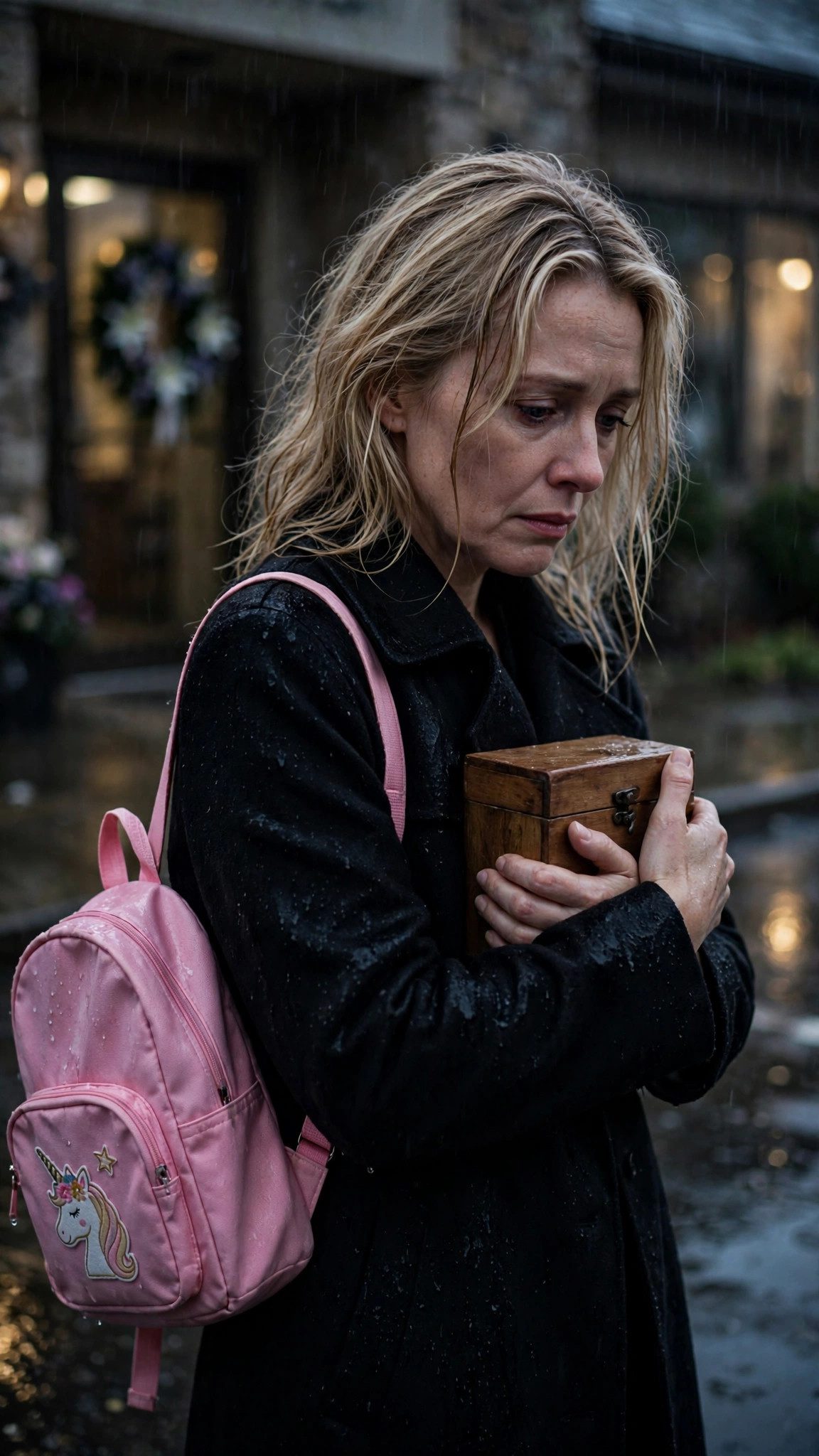
Sophie was seven years old when she died. Seven. She had just lost her first tooth. She had a loose one beside it that she wiggled with her tongue when she was thinking. She wanted an apple pie with a crisscross top. She had a pink backpack with a unicorn patch sewn on slightly crooked. She had her whole life in front of her, and her father took her on a drive up a mountain road so that no one would ask why he was really going to the airport, and she never came home.
I have spent nine years asking myself what I could have done differently. If I had asked harder about the perfume. If I had followed him. If I had looked at that dark-haired woman across the ballroom and trusted what I saw. If I had kept Sophie home that day, if I had said, "No, Adrian, she stays with me," if I had done any one of a hundred small things differently, my daughter might still be alive.
But I cannot change the past. I can only do what I did that night after the funeral, when I took my daughter's ashes and drove north into the dark. I can find the truth. All of it. Every last piece of it. And I can make sure that the people who killed my daughter — all of them, not just the man who was driving — answer for what they did.
That is what the next part of my story is about. It is not a happy story. But it is a true one. And it ends, I promise you, with light. Because Sophie was light, and light does not die. It only changes where it shines.
Sophie's fifth birthday was the happiest day of that golden time. Adrian hired a magician, a real one, with a top hat and a rabbit that was not stuffed, and Sophie sat in the front row with her mouth open, absolutely certain that magic was real. He gave her a dollhouse — a beautiful wooden one, three stories, with tiny furniture and tiny curtains — and she played with it for hours, arranging and rearranging the tiny family inside, giving them names, giving them stories. "This one is the mama," she told me, pointing to a small wooden figure with yellow hair. "And this one is the baby. And the baby is never, ever sad, because the mama always keeps her safe."
My mother came to the party. She stood in the garden, watching Sophie, and she said to me, "You have a good life, Claire. A good husband, a beautiful daughter, a beautiful house. Do not take it for granted." I said I would not. I meant it. I did not know then that a good life can be a performance, and that the people performing it can be lying to you the whole time.
There was a dinner party that winter, at the house of one of Adrian's business associates, a man named Vincent who owned half the restaurants on the river. I wore a green dress Adrian had bought me, and I smiled, and I talked to the wives, and I listened to them talk about schools and vacations and charity galas, and I felt, for the first time, like an outsider in my own life. These women knew things I did not know. They spoke in a code I had not learned. When one of them mentioned Vivian Cole — just a name, dropped casually, "that hostess from the river restaurant, the dark-haired one" — the others went quiet for half a second, and then someone changed the subject, and I felt a cold finger run down my spine.
I asked Adrian about it in the car on the way home. "Who is Vivian Cole?" He did not hesitate. "A hostess," he said. "She used to work at Vincent's place. Why?" I said, "No reason." And he said, "Good," and he turned on the radio, and we drove home in silence, and I told myself I was imagining things. I told myself that a name dropped at a dinner party meant nothing. I told myself that my husband loved me, and that my daughter was safe, and that my life was golden.
I was wrong about all of it. But I did not know it yet. And sometimes I think that not knowing was the last gift my life ever gave me — those few more months of believing, before the truth came and took everything away.