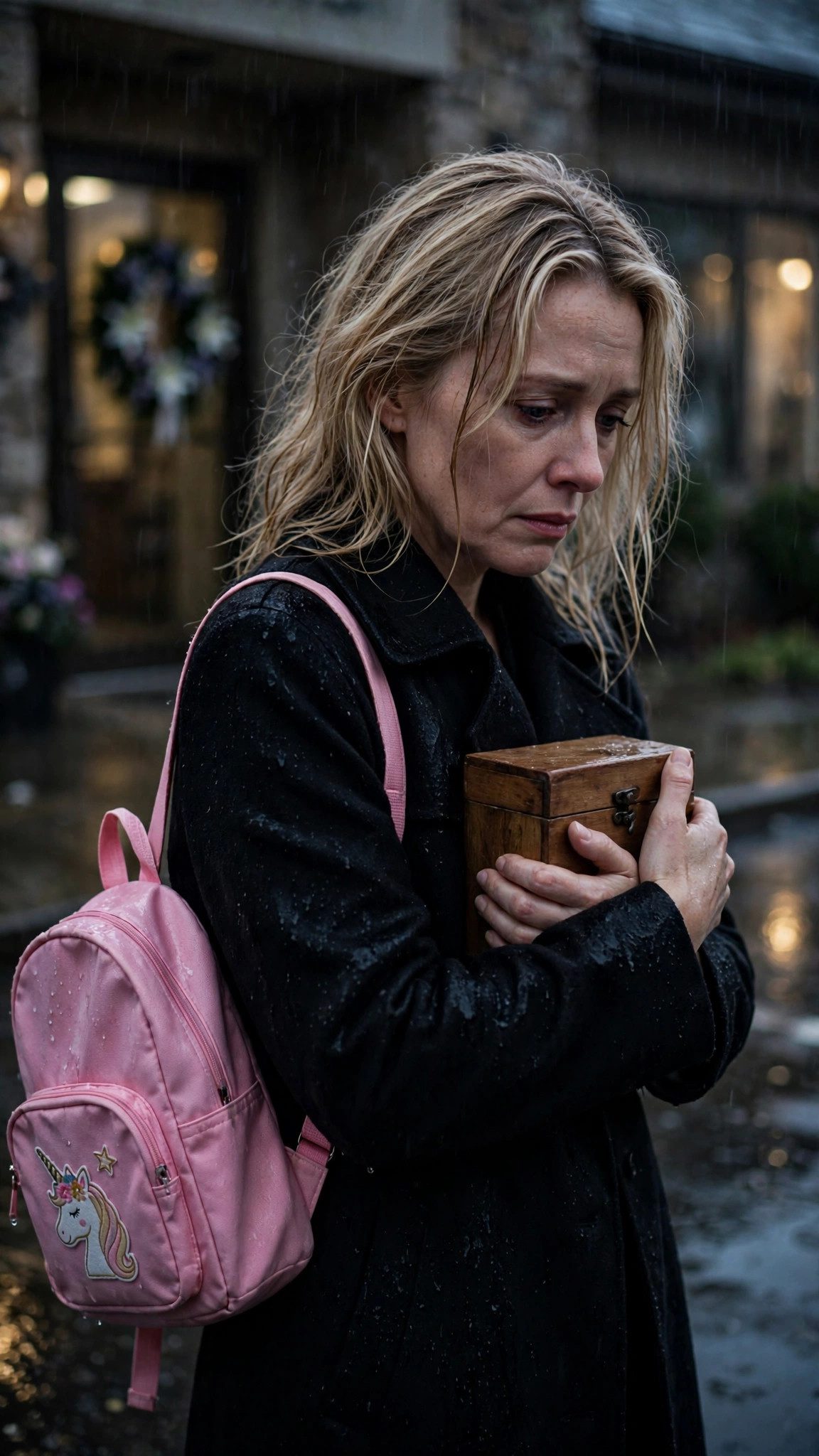
Frank's photographs arrived three days later, in a plain envelope with no return address. I spread them out on the cabin table, and I stared at them for a long time before I understood what I was looking at.
The photographs showed the underside of Adrian's SUV, the brake lines, the steering column, the tires. Frank had circled things in red marker. In one photograph, a brake line was cut — not torn, not worn, but cut, cleanly, with a tool. In another, a second line showed the same clean cut. Frank had written in the margin, in his careful block letters: "CLAIRE — THIS WAS DONE BY HAND. THIS WAS NO ACCIDENT. SOMEONE WANTED THIS CAR NOT TO STOP."
I sat down. My hands were shaking. Someone had cut the brake lines on my husband's SUV. Someone had wanted that car to crash. And my daughter had been in the back seat.
I called Frank. He answered on the first ring. "You saw them," he said. It was not a question.
"Who would do this?" I asked. "Who would cut brake lines?"
"A mechanic," Frank said. "Or someone who knows cars. Someone who had access to the SUV. Someone who knew when Adrian would be driving it, and where, and with whom."
"Vivian's husband," I said, and I did not know how I knew it, but I knew it. "Nicholas Cole. Vivian's husband."
Frank was quiet for a moment. "Claire," he said slowly, "Nicholas Cole owns a garage on the west side. He does all the maintenance on DeLuca's fleet. He had access to every car Adrian owns. And I have heard things about him. He found out about the affair six months ago. He beat a man half to death in a bar for looking at Vivian the wrong way. He is not a man who forgives."
I thanked Frank. I hung up. And then I called Detective Hale, and I told him what Frank had found, and there was a long silence on the other end of the line, and then he said, "Mrs. DeLuca, I need you to listen to me very carefully. Do not go anywhere. Do not talk to anyone. Nicholas Cole is dangerous. If he knows you know, he will come for you. Stay in that cabin. Lock the door. I am sending a car to you tonight."
But it was already too late.
I do not know how Nicholas found me. Perhaps Adrian's men found me first and sold the information. Perhaps Nicholas had been following Detective Hale. Perhaps he had simply been watching every road out of Chicago, the way a hunter watches a field. I only know that at sunset that evening, I heard a car on the dirt road, and I looked out the window, and I saw a man getting out of a black sedan, and I knew, before he even turned around, that he was the man who had killed my daughter.
He was tall, broad-shouldered, with dark hair going gray at the temples and hands that looked like they had spent a lifetime working on engines. He walked up to the cabin door and knocked, politely, the way a neighbor might knock, and he said, "Mrs. DeLuca? My name is Nicholas Cole. I think it is time we cleared the air, put all my cards on the table, and let you know the truth."
I did not open the door. I stood behind it with my back against the wood, my heart hammering, and I said, "Go away. I have nothing to say to you."
"I am not someone who can be controlled by threats," he said through the door, "and I am not going to pretend that I have not cut off all contact. I have never been able to do it. I do not want to go back to being forced to choose. So let me tell you the truth, Claire. Let me tell you the truth about what happened to your daughter."
I should not have opened the door. I know that now. But I needed the truth, and he was offering it, and I had spent weeks chasing it, and so I opened the door.
He came inside. He sat down at the table. He looked at Sophie's ashes on the windowsill, and for one moment his face changed, and I saw something there that looked almost like grief. Then it was gone.
"I cut the brakes," he said. "I will not lie to you. I cut the brakes on Adrian's SUV because I wanted Vivian dead. She was my wife. She betrayed me with your husband. She was going to leave me, take my money, disappear to Miami with him. So I cut the brakes. I thought she would die on that mountain road, and Adrian would die with her, and no one would ever know. I did not know Sophie was in the car. I swear to you, on everything I have, I did not know your daughter was in that car."
I stared at him. I could not speak. I could not breathe.
"And Vivian?" I whispered. "She survived the crash. Who strangled her?"
He looked down at his hands. "I did," he said. "She came home from the hospital with a broken arm and a story about how Adrian had saved her. She was going to tell the police about the brakes. She had figured it out. She said, 'Nicholas, I know what you did. I am going to the police.' So I went to her apartment that night, and I strangled her, and I took her phone, and I tore up a photograph, and I walked out. And I have lived with it every day since."
I stood up. My legs were shaking. "You killed my daughter," I said. "You killed Vivian. And now you have come here to kill me."
"No," he said. "I have come here to ask you to understand. I never meant for Sophie to die. She was just a little girl. I think about her every day. I see her face—"
"Do not say her name," I said. "Do not ever say her name."
He stood up too. He was bigger than me, stronger than me, and suddenly his face changed again, and the grief was gone, and what was left was fear — the fear of a man who has confessed to two murders and realizes he cannot leave a witness alive.
"You will pay for this," he said, and his voice was low and shaking. "I cannot let you leave here. I cannot let you tell anyone. I am sorry, Claire. I am truly sorry. But I cannot go to prison. I cannot."
He lunged at me. I do not remember deciding to run. I only remember my body moving, out the back door, into the trees, toward the cliff at the edge of the lake, because the cabin was at the top of a bluff and the cliff was the only direction that was not the road. He chased me. His footsteps crashed through the underbrush behind me. I could hear him breathing. I could hear him saying my name.
At the edge of the cliff, I turned. There was nowhere else to go. The lake was a hundred feet below, black and still. Nicholas came toward me with his hands out, and I saw in his eyes that he had already decided. He was going to push me off that cliff, and he was going to drive away, and no one would ever know.
I looked at him, and I thought about Sophie, and I thought about the apples, and I thought about the promise I had made — save me the biggest piece of pie — and something inside me, something that had been still and cold since the funeral, woke up and roared.
"No," I said. "Not me. Not this time."
He reached for me. I pushed him. I pushed him with everything I had — with nine years of love and seven years of motherhood and all the grief in the world — and he stumbled backward, and his foot slipped on the wet grass at the edge, and he grabbed at the air, and he fell.
I stood at the edge of the cliff and watched him fall. I heard him hit the rocks below. And then there was silence, and the lake, and the stars, and my own breathing, loud in my ears.
I went back to the cabin. I called Detective Hale. I told him everything. I told him about the brakes. I told him about Vivian. I told him about the cliff. And when he asked me, in a quiet voice, "Mrs. DeLuca, what happened to Nicholas Cole?" I said the words I had to say, the words that were true, even though they were the hardest words I had ever spoken.
"He is dead," I said. "Yes. I was the one who pushed him to the edge of the cliff."
There was a long silence. Then Detective Hale said, "Stay where you are, Mrs. DeLuca. I am coming. And Claire — you did what you had to do. A man who had already killed two people was trying to kill you. That is self-defense. Do you understand me? That is self-defense."
I understood. But understanding did not make it easier. I had pushed a man off a cliff, and he had died, and I had done it to save my own life, and I would carry that for the rest of mine, the way I carried everything else — the apples, the pie, the promise, the light.
That night, I sat by the window with Sophie's ashes, and I whispered, "I did it, baby. I found the man who killed you. And he will never hurt anyone again. Mama promises."
Nicholas Cole had not always been a killer. I learned that later, from Detective Hale, from the file he built, from the people who had known Nicholas before the affair broke him. He had been a good mechanic. He had been a good husband, once. He had married Vivian when she was twenty-two and he was twenty-four, and for ten years they had been happy, or as happy as people can be when money is tight and the work is hard and the winters are long.
Vivian had wanted more. She had always wanted more — more money, more excitement, more of the world than a garage on the west side could give her. She got a job at Adrian's restaurant because the tips were good. She met Adrian because he ate there every week. And somewhere along the way, she decided that Adrian DeLuca was her way out — out of the garage, out of the small life, into the golden one.
Nicholas found out the way husbands always find out. A text message left open on a phone. A receipt from a hotel. A smell on a collar that was not his. He confronted her, and she did not deny it. She said, "I am leaving you, Nicholas. I am going to Miami with Adrian. I am going to have a real life." And something inside him broke.
He did not break all at once. He broke slowly, over months, the way a beam breaks under too much weight — first a crack, then another, then a groan, then a collapse. He started drinking. He started following her. He started keeping a notebook of Adrian's movements, of the cars, of the times, of the places. And one night, in his garage, with a wrench in his hand and hatred in his heart, he looked at Adrian's SUV and he made a decision.
He would cut the brakes. He would wait for the airport run he knew was coming. And Adrian and Vivian would die together on a mountain road, and no one would ever know it was not an accident.
He did not know Sophie would be in the car. He could not have known, because Adrian had never taken Sophie on those trips before. That day was the first time. That day was the only time. And that is the terrible, senseless truth at the center of all of this: my daughter died because of a coincidence. Because her father chose that day, of all days, to use her as cover. Because Nicholas chose that day, of all days, to cut the brakes. Two men, two decisions, and a little girl in the back seat who never had a chance.
I think about that sometimes, in the quiet hours. I think about how fragile life is. How a single choice — a drive up a mountain, a cut in a brake line — can destroy everything. And I think about how I cannot change any of it. I cannot bring Sophie back. I cannot undo the crash. I cannot uncut the brakes. All I can do is what I did: tell the truth, and let the truth do its work.
Nicholas Cole died on the rocks below a cliff in Wisconsin. He died because he tried to kill me, and I pushed him away, and he fell. I do not celebrate his death. I do not mourn it either. He was a man who made terrible choices, and those choices killed my daughter, and killed his wife, and finally killed him. That is the story of Nicholas Cole. It is not a happy story. But it is a finished one. And finished is enough.
After Nicholas fell, I sat on the edge of the cliff for a long time. I did not go back to the cabin right away. I sat there with my legs hanging over the edge, looking down at the lake, and I thought about what I had just done.
I had pushed a man off a cliff. I had watched him fall. I had heard him hit the rocks. And I did not feel guilty. That frightened me more than anything else — not the pushing, not the falling, but the fact that I did not feel guilty. I felt relief. I felt a terrible, cold relief, like a door closing on a room I never wanted to enter again.
Was that wrong? Was I supposed to feel guilty? I had killed a man. He had killed my daughter, and he had killed his wife, and he had tried to kill me. And I had pushed him, and he had died. The law would call it self-defense. Detective Hale would call it self-defense. But what would Sophie call it? What would my little girl think of her mother, sitting on the edge of a cliff, having just killed a man?
I thought about that for a long time. And then I thought about Sophie's face, the way she looked at people as if she could see straight through to whatever was good in them. And I realized that Sophie would not have judged me. Sophie would have understood. Because Sophie knew what I knew: that sometimes, the only way to stop a bad man is to stop him. That sometimes, being good means being brave. That sometimes, a mother has to do terrible things to protect the people she loves — even if the person she is protecting is only herself, and the memory of a little girl who is gone.
I stood up. I brushed the dirt off my jeans. I walked back to the cabin, and I called Detective Hale, and I told him everything. And when he said, "Stay where you are, Mrs. DeLuca. I am coming," I felt something I had not felt in weeks. I felt safe. Not because the danger was over — it was not over, not yet — but because I had faced the danger, and I had survived it, and I had done what I had to do. And no one, not Adrian, not Nicholas, not anyone in the world, could ever take that away from me again.