The trial lasted six weeks. I testified on the third day.
I wore a navy dress, the one I had bought for Sophie's first day of school, because it was the only dress I owned that did not belong to the life I had lived with Adrian. I walked into the courtroom with Sophie's ashes in a small wooden box in my purse — not because I needed them there, but because I needed her with me, and she had always been with me, in every room, in every moment, since the day she was born.
Adrian was sitting at the defense table. He looked smaller than I remembered. His suit was still expensive, but it hung on him the way clothes hang on a man who has stopped eating. When he saw me, he stood up. The judge told him to sit down. He sat down, and he looked at me, and I looked at him, and for one moment, I saw the man I had married — the man on the rooftop in December, with the snow coming down and the whole city lit up below us — and I felt something I did not expect to feel.
Pity. Not love. Not forgiveness. Just pity, for a man who had everything and threw it away for a secret, and who was now going to spend the rest of his life paying for it.
The prosecutor asked me to tell the jury what happened. So I told them. I told them about the hospital call at 4:12. I told them about the funeral, and the nurse, and Vivian Cole, and the airport. I told them about the brake lines, and the photographs, and Nicholas Cole, and the cliff. I told them everything, and my voice did not shake, not once, because the truth does not shake. The truth stands still, and everything else falls down around it.
When I finished, the prosecutor asked me one last question. "Mrs. DeLuca," she said, "why did you come forward? Why did you not simply disappear and start a new life?"
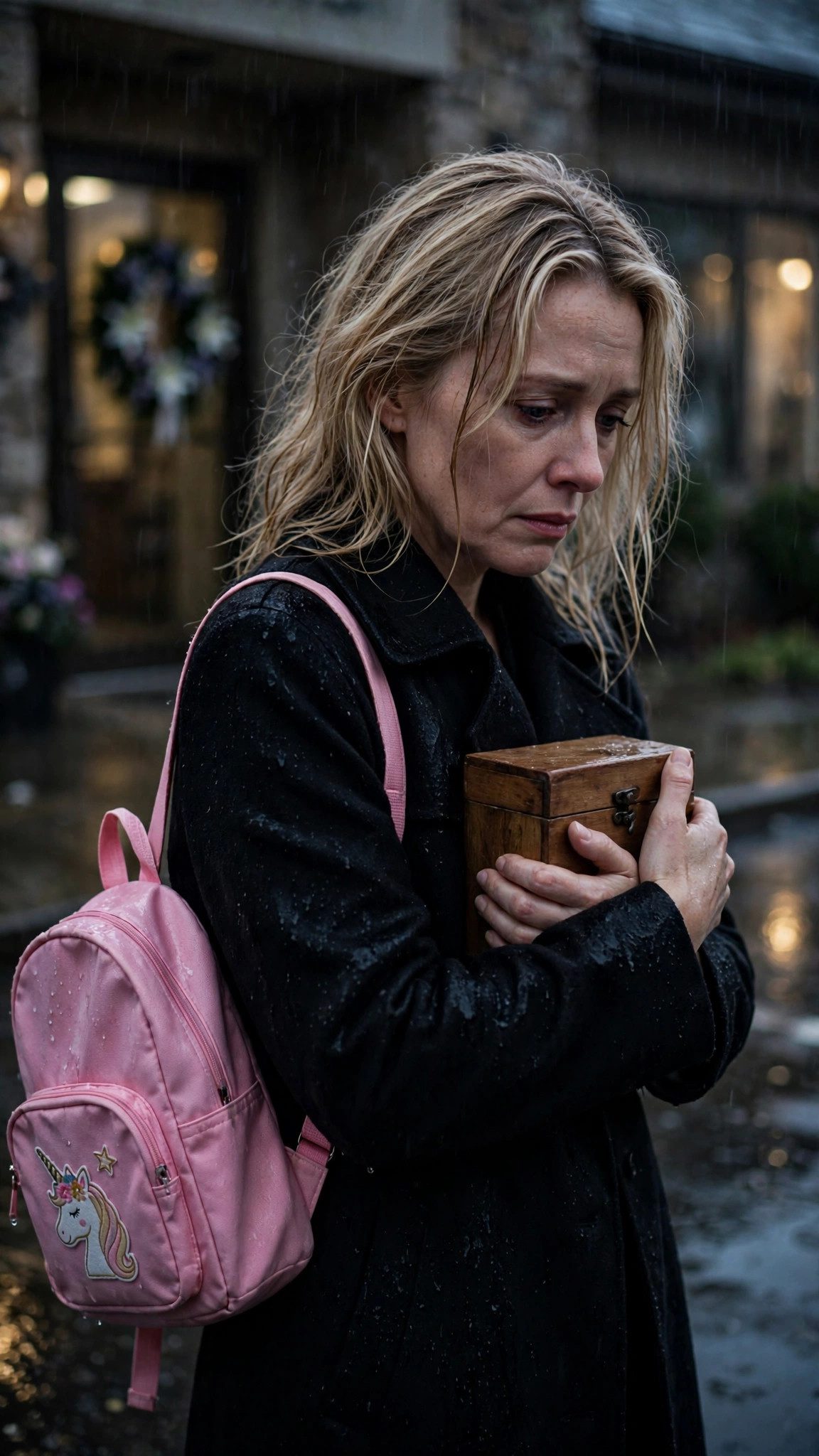
I looked at the jury. Twelve strangers, twelve ordinary people, and I said, "Because my daughter was seven years old. She had a loose tooth and a pink backpack with a unicorn patch sewn on crooked. She wanted an apple pie with a crisscross top. And she died because her father needed an alibi. If I had disappeared, then her death would have meant nothing. It would have been just another accident on a mountain road. And I could not let that happen. She deserved better than that. Every child deserves better than that."
The jury was out for nine hours. I sat in the hallway with Detective Hale, and we did not talk much, because there was nothing left to say. At 6:47 in the evening, the bailiff came out and said the jury had reached a verdict.
Guilty. On every count. Reckless driving causing death. Obstruction of justice. Conspiracy. Bribery.
Adrian was sentenced to twenty-two years in prison. He would be sixty-six when he got out, if he lived that long. He looked at me as they led him away, and he said, "Claire, I am sorry. I loved her. I loved Sophie. I want you to know that."
I did not answer him. I did not need to. I had already said everything I had to say, in that courtroom, to twelve strangers, and to the whole world.
After the trial, I did something I had been thinking about for a long time. I took the money from the divorce settlement — the money Adrian had tried to hide, the money Hale's investigators had found in accounts in the Cayman Islands — and I started a foundation. I called it Sophie's Light.
The foundation does two things. First, it pays for car safety inspections for families who cannot afford them — brake lines, tires, steering, all of it, free, no questions asked. Because if someone had inspected Adrian's SUV that morning, my daughter might still be alive. And second, it gives scholarships to little girls who want to be veterinarians, and ballerinas, and Presidents, in that order, because Sophie had wanted to be all three, and she saw no contradiction in any of it.
On the first anniversary of Sophie's death, I went back to the cabin in Cedar Falls. I took Sophie's ashes, and I took the unicorn backpack, and I took the photograph of her on her pink bicycle, and I scattered her ashes in the lake at sunrise, where the water was so still it looked like glass. I said, "You are free now, baby. You are light now. Shine wherever you want to shine."
And then I did something I had not done in a year. I made the apple pie. I peeled the apples. I made the dough. I did the crisscross top, the pretty one, exactly the way I had promised her. And when it came out of the oven, golden and steaming, I cut the biggest piece, and I put it on a plate, and I set it on the windowsill where the morning light could reach it.
"For you, Sophie," I said. "The biggest piece. Just like I promised."
Detective Hale came to the cabin that evening. He brought flowers — not roses, but white lilies, because he had noticed the small vase of lilies on my table and remembered. He sat with me on the porch, and we watched the sun go down over the lake, and we did not talk about the trial, or about Adrian, or about Nicholas. We talked about ordinary things. Books. The weather. The way the light looked on the water.
Marcus Hale was a good man. He was patient. He was kind. He had believed me when no one else did. He had built a case, brick by brick, until the truth stood on its own. And somewhere along the way, without either of us planning it, we had become something more than a detective and a witness. We had become two people who had walked through the dark together and come out the other side.
He did not propose that night. He did not need to. He took my hand, and I let him hold it, and that was enough. There would be time. There was a whole life ahead of us, and for the first time in a year, I was not afraid of it.
I am forty-four years old now. I am no longer the naive wife I used to be. I am not the woman who peeled apples in the sunlight and believed that the world was safe. I am a woman who has buried her daughter, and faced down a killer on the edge of a cliff, and stood in a courtroom and told the truth to twelve strangers.
But I am also a woman who makes apple pies with crisscross tops. I am a woman who runs a foundation in her daughter's name. I am a woman who sits on a porch in the evening and holds the hand of a good man and watches the light on the water.
Sophie was seven years old, blonde, and so full of light she could make an entire room smile without even trying. She is gone. But her light is not gone. It lives in every little girl who gets a scholarship in her name. It lives in every family whose car is safe because of her foundation. It lives in me, every morning, when I wake up and choose to live, and to love, and to keep going.
That is what my daughter gave me. Not just grief. Not just pain. Light. And I will carry that light for the rest of my life, and I will never, ever let it go out.
The foundation's first scholarship ceremony was held on a Saturday in June, in a small community center in Pilsen, not far from the bakery where I grew up. There were forty people there. Forty ordinary people, in folding chairs, drinking lemonade out of paper cups. And there were three little girls, standing in a row at the front of the room, each holding a certificate with Sophie's name on it.
The first girl was named Lily. She was eight years old. She wanted to be a veterinarian. She had a gap between her front teeth, and when she smiled, the whole room smiled with her. I looked at her, and I saw Sophie. Not her face — Lily did not look like Sophie — but her light. The same light. The same way of making a room smile without even trying.
I gave Lily her certificate, and I knelt down so I was at her eye level, and I said, "Lily, this scholarship is named for my daughter, Sophie. She wanted to be a veterinarian too. And a ballerina. And the President. She wanted to be all three, because she saw no contradiction in any of it. I think you will be a wonderful veterinarian. And I think Sophie would have liked you very much."
Lily hugged me. She hugged me hard, the way children hug, with her whole body, and I held her, and I closed my eyes, and for one moment, I could feel Sophie again. Not her weight. Not her warmth. But her light. Her light, shining through a little girl named Lily, in a community center in Pilsen, on a Saturday in June.
Marcus was there. He stood at the back of the room, watching, and when it was over, he came up to me and said, "You did a good thing today, Claire." I said, "We did a good thing." And he smiled, and he took my hand, and we walked out into the sunlight together.
We bought a house that autumn. A small house, with a garden, not far from the lake. I planted tomatoes and basil and roses, the way I had planted them on Astor Street, but this time the garden was mine. This time the house was mine. This time the life was mine, built by me, on my own terms, with no one else's secrets hiding in the walls.
Marcus proposed on a cold morning in December, by the lake, where the water was so still it looked like glass. He did not have a ring. He had a small wooden box, and inside it was a photograph of Sophie on her pink bicycle, and he said, "I cannot give you back what you lost, Claire. No one can. But I can promise you this: I will never lie to you. I will never use you. I will never make you choose between me and the truth. And I will love Sophie's memory the way you love it — as light, not as grief."
I said yes. Of course I said yes. What else do you say when a good man offers you honesty, and kindness, and a future?
We married in the spring, in a small ceremony by the lake, with Ruth from the cabin in the front row, and Frank the mechanic, and Detective Hale's partner, and Lily and the other scholarship girls throwing flower petals. I wore a simple white dress. I did not wear a veil. I did not need one. I had nothing to hide anymore.
That night, after the wedding, Marcus and I sat on the porch of our small house, and we watched the sun go down over the lake, and I thought about Sophie. I thought about her every day, and I always will. But the thought was different now. It was not a knife anymore. It was a light. A warm, steady light, shining in the corner of my heart, where she will live forever.
"Mama," I whispered, to no one, to everyone, to the lake and the stars and the evening air, "look at me. I am still here. I am happy. I kept my promise. I found the truth, and I told it, and I built something good out of it. And your light — your beautiful, impossible light — it is still shining. It will always shine. I promise you that. I promise you forever."
Marcus and I were married in the spring, but our life together began long before the wedding. It began in Hale's office, over a cold cup of coffee and a file thicker than a phone book. It began on the porch of a cabin in Cedar Falls, watching the sun go down over a lake. It began in a courtroom, where he sat behind me while I testified, close enough that I could feel him there, steady and solid, like a wall at my back.
He was not Adrian. He was the opposite of Adrian in every way that mattered. Adrian had been exciting. Marcus was steady. Adrian had been generous with money. Marcus was generous with time. Adrian had made me feel chosen. Marcus made me feel safe. And after everything I had been through, safe was the most beautiful word in the world.
We talked about Sophie often. Marcus never tried to make me stop talking about her. He never said, "It is time to move on," the way other people did. He said, "Tell me about her." And so I told him. I told him about the apple pie. I told him about the unicorn backpack. I told him about the loose tooth, and the pink bicycle, and the imaginary dog named Biscuit. I told him about the way she laughed, and the way she made friends with the mailman, and the way she gave her birthday money to a girl whose shoes had holes in them.
And Marcus listened. He listened the way a good man listens — with his whole heart, without interrupting, without trying to fix anything. And when I finished, he said, "She sounds like she was the best person in the world." And I said, "She was." And he said, "Then we will make sure the world never forgets her." And that was when I knew I loved him. Not because he was handsome, or kind, or brave — although he was all of those things — but because he loved my daughter, a little girl he had never met, simply because I loved her.
The foundation grew. In its second year, we gave out twelve scholarships. In its third year, twenty. In its fourth year, we opened a second office, in Milwaukee, and then a third, in Detroit. Every year, on Sophie's birthday, we held a ceremony, and I gave out the certificates, and I knelt down, and I told each little girl about Sophie, and about the apple pie, and about the unicorn backpack, and about the light.
And every year, on the anniversary of her death, I went back to the lake in Cedar Falls. I sat on the porch of the cabin — Ruth had left it to me in her will, along with the chickens and the jam jars — and I watched the sun go down, and I thought about my daughter. And I thought about how far I had come, from a woman peeling apples in a kitchen in Chicago, to a woman sitting on a porch in Wisconsin, holding the hand of a good man, with a foundation in her daughter's name and a life built on the truth.
Sophie would have liked that life. I know she would have. She would have liked the lake. She would have liked the chickens. She would have liked Marcus, who tells terrible jokes and laughs at his own punchlines. She would have liked Lily, and the other scholarship girls, and the community center in Pilsen, and the apple pies with the crisscross tops.
She is gone. But she is not gone. She is in the light on the water. She is in the laughter of little girls. She is in the smell of apples in the autumn. She is in my heart, every morning, when I wake up and choose to live.
And that, I have learned, is what love is. It is not a feeling. It is a choice. A choice you make every day, even when it hurts, even when it is hard, even when the person you love is gone. You choose to carry them. You choose to honor them. You choose to shine, because they shone, and because the world needs their light.
I choose Sophie. Every day. Forever.
The End.
THE END