The first time I spoke to Mr. Vale, I was holding my daughter too tightly and smiling too hard, and he looked at me like I was a problem he had already decided how to solve.
It was a private event, a Thursday, the kind of night when the dining room filled with men in tailored suits and women in gowns that cost more than my yearly rent. The restaurant had hired extra staff, and I was working the private dining area near the mahogany doors, moving between the tables with a tray of bread and a smile I had practiced in the mirror. Ellie was in her carrier behind the hostess stand, because Dora had called that morning to say she had a migraine, and Dora's migraines always smelled like the cheap wine she kept in her kitchen.
I had not planned to bring Ellie to work. I had never brought her to work. But that morning, when I went to drop her off, Dora's door had been locked, and through the thin wood I could hear the television blaring and a bottle rolling across the floor. I stood there for a long time with Ellie in my arms, listening, and then I turned around and carried her home, and I sat on the edge of my bed with her in my lap, and I thought about the rent, and the electricity bill, and the fact that Casa Vale paid more in one night than the diner paid in a week.
So I brought her. I tucked the carrier behind the hostess stand, in the alcove where the coats hung, and I covered it with the faded blue blanket, and I told myself it would be fine. She was eight months old. She slept most of the evening. Nobody would even know she was there.
Nobody, except Mr. Vale.
I was passing the counter near the private dining area when I noticed him watching me. He was sitting on one of the leather-covered chairs, alone, a glass of whiskey untouched on the table beside him. He was not eating. He was not talking to anyone. He was just watching the room, the way he always did, like the room belonged to him and he was taking inventory of everything in it. And then his eyes stopped on me, and then they moved, very slowly, down to the carrier in my arms.
Ellie had woken up. She was fussy, and she cried too loud, a thin, tired wail that cut through the low murmur of the dining room. I pulled her closer to my chest, and I held her close, and I smiled the way mothers smile when they are apologizing for something they have not done wrong.
He stood up. He walked toward me, slowly, and the whole room seemed to go quiet around him, the way rooms always did when he moved. Grant, who had been hovering near the bar, went pale and obedient in an instant, and I understood then what everyone had told me on my first day: that even Grant, who enjoyed humiliating everyone beneath him, became a different man whenever the owner entered the room.
Mr. Vale stopped in front of me. He looked down at Ellie. He did not lean over to help. He did not say a word. He just looked at her for a long time, and then he looked back at me, and his eyes were cold and green and unreadable.
"Are you bringing a baby to work now?" he asked.
My heart turned cold. I pulled Ellie closer to my chest, held her close, and smiled. "I'm so sorry," I said. "I brought her this week because her babysitter was drunk and nearly let her choke on a bottle. I didn't want to risk her life by leaving her with anyone else."
He didn't explain himself. He lowered his eyes when I looked at his face, and for a moment, something moved behind the coldness — something I could not name. Then it was gone, and he was just a man in a black suit again, and he turned and walked back to his chair, and the room started breathing again.
I stood there with Ellie in my arms, shaking, and I told myself that was the end of it. I told myself he would fire me in the morning. I told myself I would find another job, another restaurant, another city if I had to.
He did not fire me. He did not say another word to me for a week. But every night, I felt his eyes on me from across the dining room, and every night, I wondered what he was thinking.
I should explain about Grant, because Grant is the reason I learned how cruel a small man can be when he has a little power. Grant Hale was the floor manager, and he had been at Casa Vale for nine years, and he ran the floor like it was his own small kingdom. He had favorites, and he had targets, and I became a target the day I arrived, because I was young, and I was pretty in a way that made the male guests look twice, and because I did not laugh at his jokes.
He corrected me in front of guests. He gave me the worst tables, the ones near the kitchen doors where the draft came through, the ones with the demanding regulars who sent food back twice. He timed my breaks. He counted my steps. He once made me re-polish an entire set of wine glasses because he said he could see a smudge, and when I held one up to the light and showed him there was no smudge, he said, "Then polish it again, so you learn to see."
The worst day was the wallet. It was a Saturday, and the dining room was full, and a loud-mouthed guest at table four grabbed my wrist as I passed his table. He was drunk, red-faced, his tie loosened, and he held my hand up in the air like I was something he had caught.
"She took my wallet!" he shouted, and the whole table went silent, and every head in the room turned toward us.
"I didn't take anything," I said, and my voice was shaking, and I tried to pull my hand away, but he held it tighter.
Grant appeared instantly. He always appeared instantly when there was a scene to enjoy. He did not ask me what had happened. He did not ask the guest to let go of my wrist. He looked at me, and he said, loud enough for the whole room to hear, "Lena. Empty your pockets."
I did. I turned out my apron pockets in front of a room full of strangers. There was nothing in them but a pen, a crumpled order pad, and a hair tie. The guest's wallet was on the floor under his own chair, where it had fallen from his own jacket when he leaned back. The waiter at the next table picked it up and handed it to him without a word.
The same wallet belonged to the man after all. Grant did not apologize. He just looked at me, and he said, "Get back to work," and he walked away, and I stood there with my pockets turned inside out, and I felt the eyes of the whole room on me, and I wanted to disappear into the floor.
That night, after the last guest had gone, I was wiping down table four when I felt someone standing behind me. I turned around, and Mr. Vale was there, in his black suit, watching me. He had seen the whole thing. I knew he had seen it, because he had been standing near the mahogany doors when it happened, and he had not moved, and he had not said a word.
"You should have said something," he said quietly.
"To whom?" I asked. "To Grant? To the guest? To the whole room?"
"To me," he said.
I laughed, and it came out bitter. "You are the reason I still have a job," I said, and I meant it as a joke, but it did not sound like one. "Everyone says so. Mr. Vale is famously strict. You fire cooks for dropping a plate. You fire waiters for hesitating with an order. You fired one of your senior managers for laughing at the wrong moment during a quiet gala."
He did not smile. "I did," he said. "And I would do it again."
"Then why didn't you fire me?" I asked. "For bringing a baby to work. For making a scene. For embarrassing your restaurant."
He looked at me for a long time. His green eyes were steady, and for a moment, I thought I saw something in them that I had seen once before, on a terrace at the Plaza, thirteen months ago, in the eyes of a stranger who had touched my locket with one fingertip.
"I don't fire people for being mothers," he said. And then he turned and walked away, and I stood there with a cloth in my hand, staring after him, and my heart was beating so hard I thought it would crack my ribs.
The next morning, I went to see my lawyer. Andrea Hardin was a woman in her fifties with graying hair and a small office above a bakery, and she had helped me once before, when Ellie was born, when I needed to know what rights I had as a single mother with no father on the birth certificate. She had drawn up a letter for me then — a declaration, signed by me, stating that Ellie was my sole legal child, that no man could claim custody of her without a court order, that I had raised her alone and I intended to keep it that way. I had never used it. I had kept it folded in my apron pocket for three months, like a shield, for the day I might need it.
That morning, I took it out of my pocket, and I read it one more time, and then I went to the restaurant, and I waited until Mr. Vale was alone in the hallway near his office, and I held it out to him with both hands.
"I gave him a letter from my lawyer, Andrea Hardin, that I had already signed," I told him, and my voice was steady, even though my hands were shaking. "It says Ellie is mine. It says no one can take her from me. I don't know what you want from me, Mr. Vale. But I need you to know that."
He took the letter. He read it carefully, line by line, and his face did not change. Then he folded it, and he handed it back to me, and he said, "I don't want your daughter, Lena. I want you to be safe."
"Safe from what?" I asked.
He did not answer. He just looked at me, and then he looked at the locket at my throat, and then he turned and went into his office, and he closed the door, and I stood in the hallway with the letter in my hand, and I did not understand anything at all.
That was the week everything changed. That was the week Dora called to say she was sorry, and that she was going to a meeting, and that she would never drink again, and I believed her for exactly one day, until she missed her next shift and I found her asleep on her couch with a bottle on the floor. That was the week Grant started watching me more closely, timing my breaks down to the minute, writing notes on his clipboard whenever I so much as looked at my phone. That was the week I started noticing the small things about Mr. Vale — the way he always ate alone, the way he lived in the big apartment above the restaurant with no one in it but him, the way his silence always said he had more power than a voice did.
He wasn't a man who needed permission to do anything. He already had everything. And yet, every night, he sat alone in his dining room, watching a waitress carry plates, and I could not understand why.
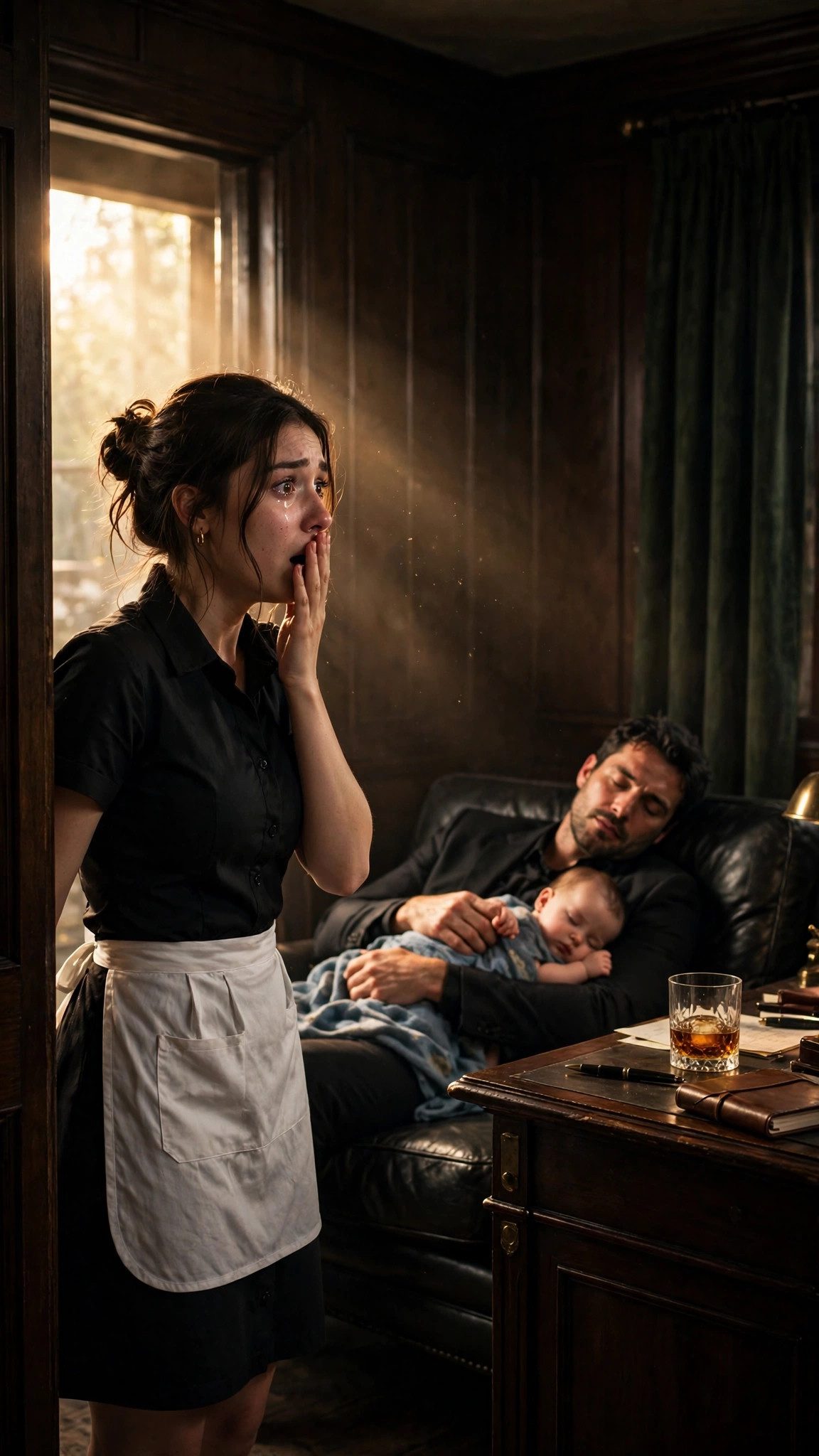
A week after I gave him the letter, he called me into his office. It was the first time I had ever been inside it. The room was dark wood and heavy curtains, with a black leather couch and a desk the size of a small boat, and a glass of whiskey on the desk that he never seemed to drink. He was standing by the window, looking out at the street, and when I came in, he turned around, and he held out a folder.
"This is my proposal," he said.
I opened it. I read it line by line, three times. It said that Mr. Vale would give me an entire year of free food, shelter, transportation, and unlimited childcare if I agreed to stay in his private basement office, where he did his business. It said Ellie would have a nurse, and a room of her own, and a doctor on call. It said I would keep my job, and my salary, and my tips. It said nothing about what he wanted in return, except for one line at the bottom, in his own handwriting: *I want you both safe. That is all.*
My supervisor was speechless. Even Grant was impressed, in his own bitter way, when he heard about it later — he could not understand why the most feared man in the city would offer a waitress a contract like that, and neither could I.
I did not sign it that day. I took the folder home, and I read it again, and I called Andrea, and Andrea said, "Lena, this is either the kindest thing a man has ever done for you, or the strangest. Read it again. Then read it a third time." And I did, and I still did not understand it, and I lay awake all night with Ellie asleep beside me, listening to her breathe, and wondering what kind of man offers a stranger a year of safety and asks for nothing in return.
The answer, I would learn much later, was a man who already knew the truth, and who did not know how to say it.