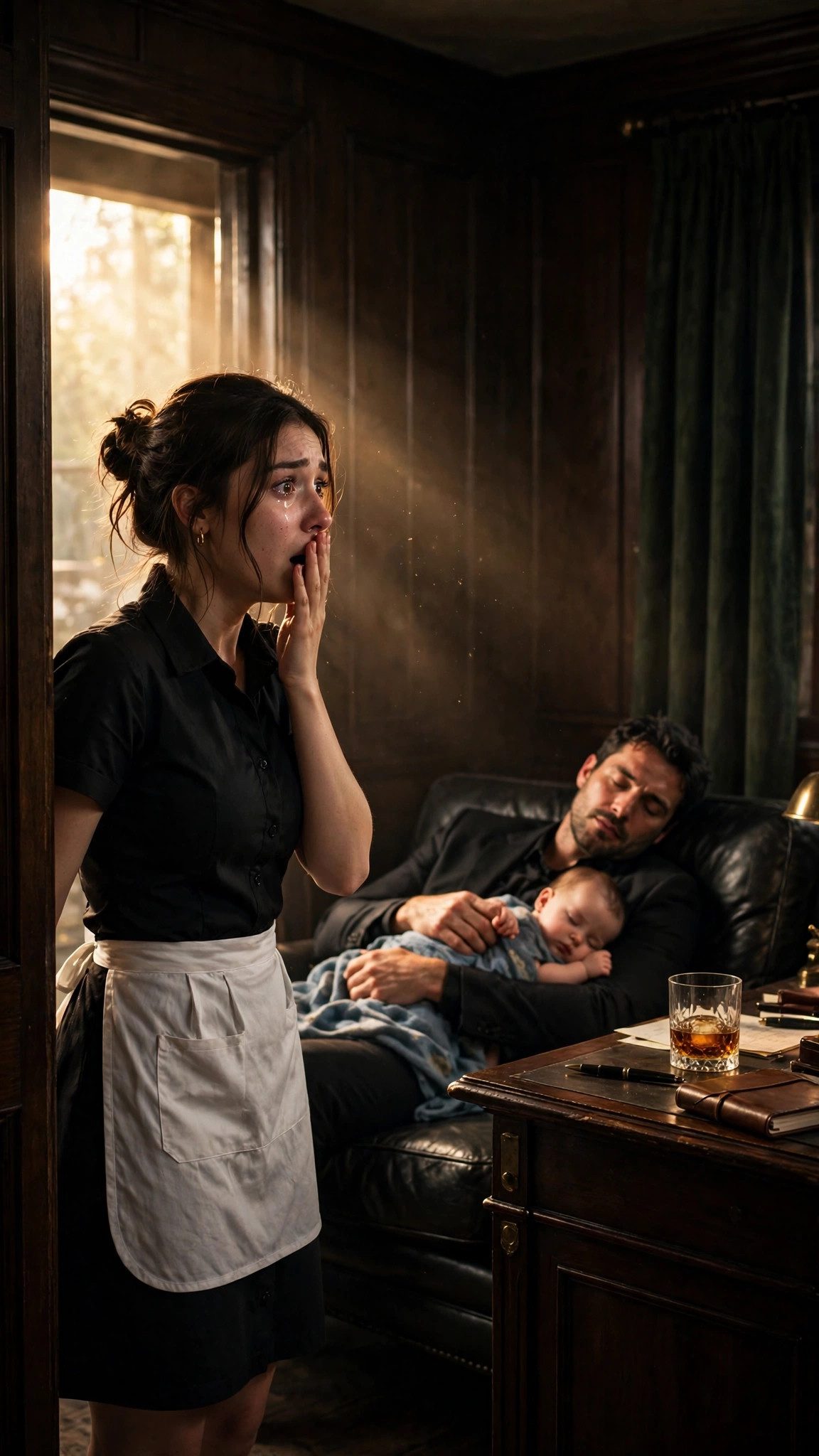
I did not get my baby back that night. Not right away. I got something else instead: the truth, told in pieces, in a dark office, while my daughter slept on the chest of the man who had been watching us for months.
Mr. Vale sat up very slowly, with Ellie still pressed against him, one big hand spread flat across her tiny back to hold her steady. He did not hand her to me. He did not let go. He just looked at me, standing in his doorway with my hands shaking, and he said, "She was crying. Mrs. Alvarez had gone home. I heard her from the hallway, and I came down to check, and she stopped crying when I picked her up. I sat down for a moment. I must have fallen asleep."
"For a moment," I said. "You fell asleep for a moment, with my daughter on your chest, in your office, behind a closed door."
"I know how it looks," he said.
"Do you?" I asked. "Do you know how it looks? Because it looks like the most feared man in the city took my baby without asking, and carried her down to his basement office, and fell asleep with her, and I had to search every room in this restaurant to find her."
He was quiet. Ellie made a small sound in her sleep, and his hand moved, gently, across her back, and I watched his fingers — long fingers, a man's fingers, careful in a way I had never seen a man's fingers be careful — and something in my chest cracked open.
"Give her to me," I said, and my voice was softer now, because I was not afraid anymore. I was just tired, and confused, and so angry I could barely see straight.
He stood up, slowly, holding Ellie against his shoulder, and he carried her across the room to me, and he placed her in my arms like she was made of glass. Her cheek was warm. Her blanket smelled like his shirt, like cedar and whiskey and something clean. Her tiny fist was still curled, and when I touched it with my fingertip, it opened, and then it closed again, around nothing.
"Thank you," I whispered, before I could stop myself. "For keeping her safe."
"I would never hurt her," he said. "I would never hurt either of you. I need you to believe that, Lena, even if you don't believe anything else I say tonight."
I carried Ellie upstairs. I laid her in her crib, under the silver stars. I sat in the rocking chair and I watched her sleep, and I thought about his face in the doorway, and the way he had looked at her, and the way his hand had moved across her back, and I thought about green eyes.
The next morning, I did not go downstairs. I stayed in the apartment with Ellie, and I waited for him to come and fire me. I waited for Grant to come and tell me to pack my things. I waited for the contract to be torn up and the year of safety to be over before it had even begun.
Nobody came. At noon, Mrs. Alvarez knocked on my door with a tray of soup and bread, and she said, "Mr. Vale says you may take the day off. He says Ellie needs her mother today." She said it like it was the most normal thing in the world. She did not ask me what had happened. She just set the tray down and left.
That afternoon, Tony came to see me. Tony was Mr. Vale's driver, a man in his fifties with a gray mustache and kind eyes, who had driven for the family for twenty years. He had always been polite to me, in the distant way that people who work for powerful men are polite to everyone. But that afternoon, he knocked on my door, and he asked if he could come in, and he sat down at my kitchen table, and he told me a story I had never heard.
"Mr. Vale was not always like this," Tony said. "He was not always cold. He was not always alone. When he was young, he was going to marry a girl from Brooklyn. Her name was Sofia. She was kind, and she laughed a lot, and she made him laugh, too, which was not an easy thing to do, even then. She died in a car accident, three weeks before the wedding. He buried her, and he buried the part of himself that laughed, and he has been alone ever since. He built this restaurant because Sofia loved to cook. He named it Casa Vale because Vale means valley, and Sofia used to say that love was a valley you walked into together. He has lived alone above it for eleven years."
Tony looked at me for a long time, and then he said, "I have worked for him for twenty years, Lena. I have never seen him look at anyone the way he looks at you. And I have never, not once, seen him hold a baby. Not until Ellie."
I did not know what to say. I thanked him, and he left, and I sat at the kitchen table with Ellie in my lap, and I thought about Sofia, and the valley, and the man who had built a restaurant out of grief, and I thought about the green eyes, and the locket, and the terrace at the Plaza.
That evening, when my shift started, I went downstairs, and Grant was waiting for me by the bar with his clipboard, and his smile was worse than usual.
"I heard about last night," he said. "I heard you made quite a scene. Running through the restaurant, shouting, searching rooms that aren't yours to search. Do you know what the guests thought? Do you know what Mr. Vale thought?"
"I don't care what you heard," I said.
"You should," Grant said. "Because I also heard that Mr. Vale carried your baby down to his office himself. I heard he held her for an hour. I heard he fell asleep with her. And I wonder, Lena, what kind of mother lets the most feared man in the city hold her baby for an hour?"
I walked past him. I did not answer. I went to my tables, and I worked, and I smiled at the guests, and I carried plates, and I tried not to think about Grant's words. But they stayed with me, like a stain, all evening.
In the days that followed, I began to see him differently — not as the feared man in the black suit, but as a man learning, clumsily and quietly, how to be near a child. In the late afternoons, before the dinner service, he would come to the nursery doorway and stand there, not coming in, just watching, while Mrs. Alvarez changed Ellie's clothes or fed her a bottle. Once, Ellie grabbed his finger through the bars of her crib, and he froze, like a man who had been handed something explosive, and then he laughed — a short, surprised sound, rusty from disuse — and Mrs. Alvarez and I looked at each other, and neither of us said a word.
Another afternoon, I found him in the small garden behind the restaurant, holding Ellie up so she could see the fountain. She was wearing a yellow sun hat that Mrs. Alvarez had knitted, and he was pointing at the water, and he was talking to her in a low voice, telling her about the fish, and the birds, and the way the light came through the leaves. He did not notice me standing in the doorway. He did not notice anything except her. And I stood there for a long time, watching the most feared man in the city explain a fountain to an eight-month-old baby, and I felt something in my chest shift, like a door opening that I had kept locked for a very long time.
I called Andrea that night. I told her about the photograph — no, the photograph had not happened yet. I told her about the basement office, and the note on the kitchen counter, and the wooden horse, and the humming in the hallway. I told her about Tony's story, about Sofia, about the valley. And then I told her the thing I had not said out loud to anyone, not even to myself.
"Andrea," I said, "I think he is her father."
Andrea was quiet for a long time. Then she said, "Lena. The green eyes. The gala. The locket. The contract. The nursery. A man does not do all of that for a stranger's baby. I have been waiting for you to say it."
"What do I do?" I asked.
"You do nothing," she said. "Not yet. You let him tell you. A man who has waited thirteen months to tell a woman the truth will tell it when he is ready, and if you force it out of him, you will get the words but not the man. And Lena — if he is her father, then you have rights, and he has rights, and Ellie has rights, and we will sort all of that out properly, with papers, and with a test, and with no one shouting in a hallway. Do you understand?"
"I understand," I said. And I did. But understanding did not stop me from lying awake that night, listening to Ellie breathe, and wondering what it would mean if the stranger from the terrace had been the owner of Casa Vale all along, and if the man who had been watching me for three months had known the truth from the very first day.
Over the next two weeks, something changed in the restaurant. It was small at first — a whisper here, a look there. The other waiters started watching me more closely. The hostess stopped saving my favorite station. The bartender, who had always been friendly, started serving my tables last. And Grant, who had always been cruel in small ways, became cruel in bigger ones. He gave me double sections. He changed my schedule without telling me. He wrote me up for being three minutes late, when I had been three minutes early.
And then, one Thursday, a man came into the restaurant with a camera. He was not a guest. He did not order anything. He sat at the bar and he drank sparkling water and he watched the room, and when Mr. Vale came downstairs with Ellie in his arms — because by then, it had become a habit, the two of them, him carrying her through the dining room in the late afternoon, showing her the chandeliers, letting her grab at his tie with her tiny fist — the man lifted his camera, and he took a photograph.
The photograph was in the newspaper the next morning. It showed Mr. Vale, in his black suit, holding a baby in a faded blue blanket, looking down at her with a face no one had ever seen on him before — soft, and wondering, and almost afraid. The headline said: "THE MOST FEARED MAN IN THE CITY HAS A SECRET BABY."
I read it in the kitchen, with Ellie in my lap, and my hands shook so badly I nearly dropped the paper. Mrs. Alvarez read it over my shoulder, and she said nothing, and then she went to the window and looked out at the street, and she said, "There is a man outside. He has been there since seven."
There was a reporter outside. And by noon, there were three. And by evening, there were cameras, and microphones, and a woman from a gossip website shouting questions at the door.
Grant, of course, was delighted. He stood in the dining room, in front of the staff, and he said, "Well. Now we all know. Our Lena has been keeping secrets. Our Lena has been playing a game, and the boss has been playing it with her." He said it with a smile. He said it like a joke. Nobody laughed.
That night, Mr. Vale called me into his office. He was standing by the window, looking out at the reporters on the street, and when I came in, he turned around, and his face was gray with exhaustion.
"I am sorry," he said. "This is my fault. The man with the camera — his name is Russo. Anthony Russo. He owns the restaurant across the street, and he has wanted this building for five years. He hired the photographer. He planted the story. He wants the landlord to think I am unstable, that I am distracted, that I am not fit to hold the lease. He wants me gone."
"Then tell them the truth," I said. "Tell them Ellie is not a secret. Tell them she is my daughter, and that you were helping me, and that there is nothing scandalous about it."
"I have told them nothing," he said, "because the truth is more complicated than that, Lena. And I have not told you the truth yet, either."
He looked at me then, and his green eyes were steady, and I saw it — I saw the thing I had been refusing to see for three months. I saw my daughter's eyes, looking back at me out of a man's face. I saw the terrace at the Plaza. I saw the locket. I saw the way he had touched it with one fingertip, thirteen months ago, and said, "Your mother had good taste."
"Say it," I whispered. "Whatever it is. Say it now."
He took a breath. He opened his mouth. And then, from upstairs, Ellie cried — a thin, tired wail — and he stopped, and he looked at the ceiling, and he said, "Not tonight. Not like this. Tomorrow, Lena. I promise you. Tomorrow, I will tell you everything."
I went upstairs. I picked up my daughter. I held her against my chest, and I looked into her green eyes, and I thought about the man downstairs, and the promise he had made, and I wondered if tomorrow would be the day my life changed forever.
I did not know then that tomorrow would be worse than I could have imagined. I did not know that Grant had already gone to Russo, and that Russo had already paid him, and that by morning, the story would not be about a photograph anymore. It would be about a mother who endangered her child, and a boss who covered it up, and a restaurant that was not safe for anyone.
I did not know any of that yet. All I knew was that my daughter had green eyes, and that the man downstairs had the same eyes, and that whatever happened tomorrow, I was not going to let anyone take her from me.