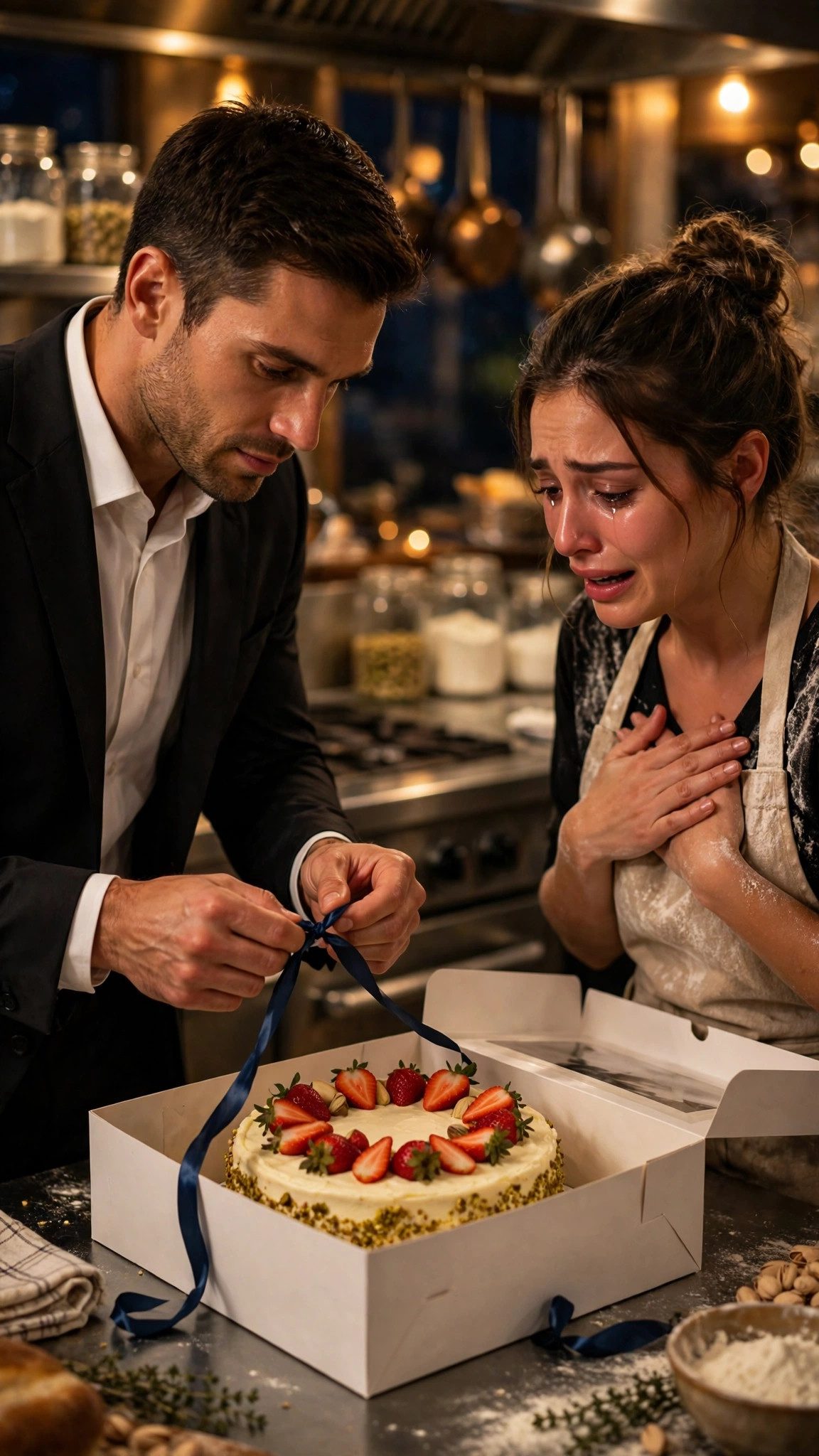
Bell's Bakery sat on a corner in Milwaukee where the morning light came in low and gold through the front windows, and for the first twenty-eight years of my life, that light was the most reliable thing in the world. My father, Thomas Bell, opened the shop at five every morning, and by six the whole street smelled like butter and yeast and sugar. He was a big man with flour permanently ground into the lines of his hands, and he sang while he worked, always off-key, always the same three songs, and he never once apologized for any of it.
"Flour-covered Sunday mornings," I told Adrian once, in that ninety-second conversation in January that I had already forgotten and he had not. I had not been lying. Sundays were the best days. Dad would lift me onto a stool so I could watch his hands, and he would let me arrange the strawberries on his birthday cakes, and when I put them in crooked circles he would laugh and say, "Perfect circles are for people who don't love you enough to be careless." He never measured anything. He said recipes were for people who didn't trust their hands, and his hands had never once let him down.
My mother worked the front of the shop, taking orders and remembering everyone's names and birthdays, and my older sister Claire worked the register after school, rolling her eyes at Dad's singing and sneaking cookies when she thought no one was looking. We were not rich. We were not important. But the bakery was warm, and the bread was good, and the whole neighborhood came through that door, and for a long time I believed that was how the whole world worked. You showed up. You worked hard. People loved you back.
I learned to bake standing on that stool. By the time I was twelve I could frost a cake without tearing the crumb. By sixteen I was running the ovens on Saturday mornings while Dad did the farmers' market. By twenty I had stopped pretending I wanted to do anything else with my life. Claire went off to college and then to Chicago, married a kind man named Daniel who sold insurance, and had a son named Noah who played soccer and forgot his cleats every single week. I stayed. I stayed because someone had to, and because I loved the work, and because Dad's hands were starting to slow down and his knees hurt in the winter and I could see the shop needed me.
Then, four years ago, on a Tuesday morning in February, my father didn't come downstairs.
I found him in the kitchen above the bakery, still in his apron, flour on his hands, a tray of rolls half-shaped on the counter beside him. The doctors said it was his heart. They said it was quick. They said he wouldn't have felt anything. I have spent four years trying to believe them, and I have never quite managed it.
We buried him on a cold, bright morning, and the whole neighborhood came, and the church smelled like lilies, and afterward I went back to the bakery and stood in the empty kitchen and listened to the ovens ticking as they cooled, and I understood, in a way I had never understood anything before, that a room can be full of everything your father loved and still feel completely empty.
Mom tried to keep the shop going. She really did. But her heart wasn't in the ovens, and the bills were, and within a year we had to sell. A developer bought the building. He promised to keep the bakery sign up, and he did not. The last time I drove past that corner, there was a phone repair shop where my father's ovens used to be, and I sat in my car for twenty minutes and cried, and then I drove back to Chicago and never went back.
Chicago was Claire's idea. "Come live near me," she said. "You need people. You need a fresh start." So I came, and I got a job at Sable, a fine-dining restaurant in River North where the lights are always low and the wine costs more than my first car, and I learned to make desserts for people who would never know my name. I told myself it was enough. I told myself the work was the work, wherever you did it, and that my father would have understood.
Most days, I almost believed it.
The truth is that I threw myself into other people's celebrations the way some people throw themselves into running or drinking or prayer. If someone in the restaurant needed a cake, I made it. If the owner, Mr. Cross, needed an anniversary cake for his wife, I stayed three hours late and made it perfect. If my sous-chef Carmen needed baby-shower pastries, I made them on my only day off that week, forty-eight tiny lemon tarts with sugared violets, and I delivered them myself in a paper bag so nobody would make a fuss. If Eddie, one of our dishwashers, mentioned that his daughter was turning seven and he couldn't afford a birthday cake, I made one on my day off, a pink strawberry cake with seven candles, and I left it at the back door with a card that said only "Happy birthday, princess."
I did not do it to be noticed. I did it because it was the only way I knew how to be useful, and because every cake I made for someone else was a small, quiet way of keeping my father's shop alive inside me, one oven at a time.
That was my life. That was all of it. Work. Cakes for other people. A small apartment above a laundromat where the radiators clanged all winter. Phone calls with my mother in Milwaukee, where her dishwasher leaked and her knees hurt and she pretended she was fine. Sunday dinners at Claire's when I could get away, where Noah showed me his soccer trophies and Daniel asked about work and Claire told me I needed to get out more, meet someone, live a little.
"I live plenty," I always said, and she always gave me a look that said she didn't believe me, and she was right, but I didn't know how to fix it.
Adrian Vale first came to Sable about six months before my birthday. I remember the night clearly, because Mr. Cross came into the kitchen himself, which he almost never did, and told us in a low voice that table twelve was Mr. Vale's table and that everything had to be perfect and that no one was to bother him.
I peeked through the kitchen doors, the way everyone did that first night. He sat with three men, all of them big and quiet and watchful, and he barely touched his food. He drank one glass of red wine. He did not order dessert. He did not smile. He looked like a man who had come to the restaurant the way other men go to church, out of habit and obligation and something that looked almost like grief.
After that, he came every Tuesday and Thursday, always at eight, always table twelve, always the same three men, always the same order. And I noticed something nobody else seemed to notice, or maybe nobody else cared enough to notice. He never ate dessert. Not once. The waiters would offer, and he would shake his head, and that was the end of it.
One Thursday in March, I did something I had never done before. I sent out a dessert he hadn't ordered. A small pistachio panna cotta, barely sweet, with a single crushed pistachio on top and a thin drizzle of honey. I told the waiter to say it was on the house, from the kitchen, and then I hid behind the ovens and waited, my heart pounding like I had done something criminal.
Through the kitchen doors, I watched him look at the plate for a long moment. I watched him take one bite. And then, very slowly, he ate the whole thing. He didn't smile. He didn't ask for the chef. He just set his spoon down, wiped his mouth, and went back to his conversation as if nothing had happened.
But the next Tuesday, when the waiter offered dessert, Adrian said, "Whatever the kitchen suggests." And the Tuesday after that, he said it again. And after a few weeks, I realized I was planning my whole week around Tuesdays and Thursdays, around what I could make that was barely sweet enough for a man who hated anything too sweet, and I told myself it was just professional pride. Just a chef who liked a challenge.
It was not just professional pride. I knew that, even then. I just didn't have a name for what it was, and I was too careful to go looking for one.
My sous-chef, Carmen, noticed before I did. Carmen is forty-one, with two kids and a laugh that can be heard from the dining room, and she has worked in kitchens since she was seventeen. She misses nothing. One Thursday, after I had spent forty minutes perfecting a honeyed fig tart that I had no earthly reason to perfect, she leaned against the counter and said, "You know who eats at table twelve tonight, don't you?"
"Mr. Vale," I said, very carefully not looking at her.
"Mr. Vale," she repeated. "The man who never orders dessert. The man you have been cooking for like he's a food critic with a gun to your head."
"I cook for everyone like that," I said.
"No, honey," Carmen said. "You cook for everyone like they're hungry. You cook for him like he matters."
I denied it, of course. I denied it to Carmen, and I denied it to myself, and I went right on doing it. I started paying attention to things I had never paid attention to before. The way he always arrived at eight, never early, never late. The way he sat with his back to the wall, facing the door, like a man who had learned the hard way never to sit with his back exposed. The way his men watched the room while he watched his wine, and the way they all went still when he lifted a hand, as if his smallest gesture were a command.
Mr. Cross warned me once, in his careful, roundabout way. He found me in the walk-in, checking the berries, and he said, "Ella, Mr. Vale is a good customer. A very good customer. But he is not a man to be curious about. The people who get curious about Adrian Vale tend to regret it." He said it kindly. He meant it kindly. I nodded, and I thanked him, and I went back to my station and spent the next hour thinking about nothing else.
The truth was that I had already started watching him back. I watched the way he ate the desserts I sent out, slowly, like a man tasting something he intended to remember. I watched the way he never once sent a plate back, never once complained, never once asked for anything more than what the kitchen suggested. And one night, in April, I watched him do something I could not forget. A waiter dropped a tray near his table, glasses shattering across the floor, and one of his men was on his feet in an instant, hand inside his jacket, and Adrian lifted two fingers, just two, and the man sat back down as if he had never moved. Calm. Controlled. Absolute. The dining room went back to its murmuring, and Adrian went back to his wine, and I stood behind the kitchen doors with my heart hammering and understood that I was looking at a man who could stop violence with a gesture, which meant he was also a man who could start it with one.
I should have been afraid. Part of me was afraid. But another part of me, a part I did not want to examine too closely, kept thinking about the way he had eaten that first panna cotta. Slowly. Carefully. Like it mattered.
Eddie's daughter's cake was the one that finally made me admit, at least to myself, that something had changed. Eddie is one of our dishwashers, a quiet man in his fifties with tired eyes and a daughter named Sofia who was turning seven. He mentioned it in passing one afternoon, the way tired fathers do, not asking for anything, just saying it out loud because it was on his mind. "She wants a pink cake," he said. "I can't swing it this month. Maybe next year." I went home that night and I couldn't sleep. I kept thinking about a seven-year-old girl who wouldn't get a birthday cake, and about my father, who had believed that every child deserved a cake on their birthday, no matter what. So the next day, on my only day off, I came in early and made a pink strawberry cake with seven candles, and I left it at the back door with a card that said only "Happy birthday, princess." Eddie found me later and tried to pay me, and I refused, and he hugged me so hard I thought my ribs would crack, and he said, "You don't know what this means." But I did know. I knew exactly what it meant, because I had been that girl once, and my father had never once let my birthday pass without a cake.
That was the truth of my life before my thirty-second birthday. A girl in a kitchen, making cakes for other people, invisible in the best way I knew how to be invisible, and a man at table twelve who never ordered dessert and never smiled, watching me work through the kitchen doors without me ever once seeing him do it.
I thought no one noticed me. I was wrong about that, too.