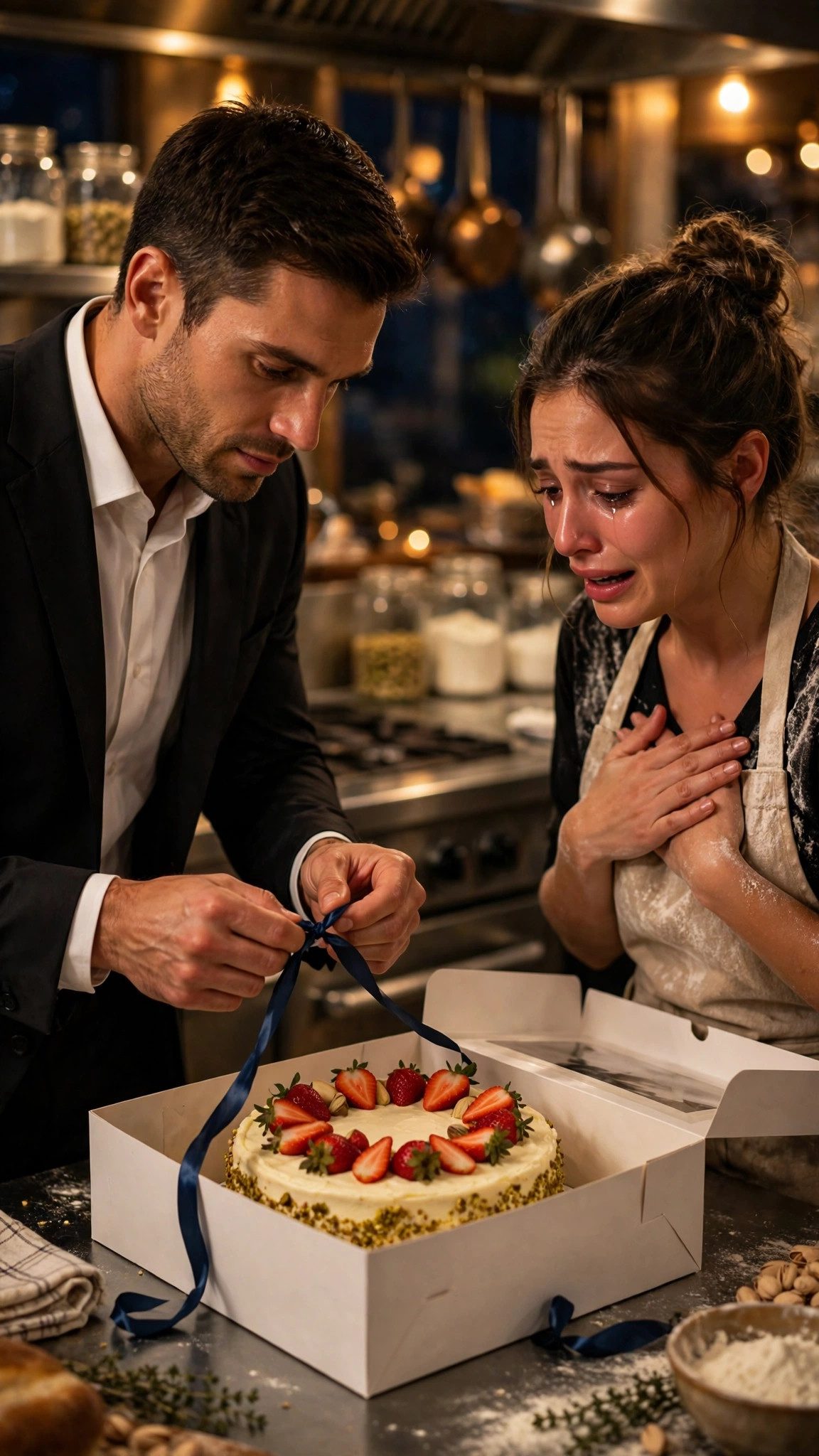
The car came at eleven the next night, exactly when Adrian said it would. Silas opened the door for me with a small, polite nod, and I slid into the back seat in the nicest dress I owned, a dark green thing I had bought on sale two years ago and never once worn, and I tried very hard not to look as terrified as I felt.
Adrian was waiting at a small restaurant on the lakefront, the kind of place with white tablecloths and candles and a view of the water going black beyond the windows. He stood when I walked in, and he pulled out my chair himself, and for one strange, suspended moment, it felt almost normal. Almost like an ordinary date. Almost like I was an ordinary woman and he was an ordinary man.
"You look beautiful," he said.
"Thank you," I said. "You look. . . like you always look."
"Like what?"
"Like a man who owns the room."
He almost smiled. It was the closest I had ever seen him come to one, a small, brief softening around his eyes. "I don't own this room," he said. "I just paid for it. There's a difference."
We ordered. He ordered for both of us without asking, and I was too nervous to mind. The food came, course after course, small and perfect and beautiful, and I ate it the way a pastry chef eats, slowly, paying attention, and he watched me the way he always watched me, quietly, without apology.
"Tell me about your father," he said, halfway through the main course.
I set my fork down. "What do you want to know?"
"Everything," he said. "Start at the beginning."
So I did. I told him about Bell's Bakery, and the morning light, and the flour on the floor, and Dad singing off-key. I told him about Sunday mornings on the stool, and the strawberries in crooked circles, and the way Dad never measured anything. I told him about the morning Dad didn't come downstairs, and the ambulance, and the church, and the empty kitchen, and the developer who bought the building and tore the sign down. I told him things I had never told anyone, not even Claire, because Claire had been there and already knew, and there was no one else left to tell.
He listened the way very few people listen. He didn't interrupt. He didn't look away. He didn't check his phone. He just listened, and when I finished, he was quiet for a long moment, and then he said, "Your father saved my life."
I stared at him. "What?"
"Your father saved my life," he repeated. "When I was seventeen years old, my father was murdered. Shot in his own office, in front of me. I ran. I had money in my pocket and nowhere to go, and I ended up in Milwaukee, because it was far enough away and nobody knew my name there. I was cold, and I was hungry, and I was angry at the whole world, and I walked past a bakery on a corner where the morning light came in low and gold, and your father was standing in the doorway, and he looked at me, and he said, 'You look hungry, son. Come inside.'"
My hands had gone still in my lap. The restaurant had gone quiet around us. The candles flickered, and the lake went black beyond the windows, and Adrian Vale sat across from me and told me a story I had never heard, about a winter when I was twelve years old and my father was still alive and I was arranging strawberries on a cake in the back room, completely unaware that the tall, angry boy sweeping the floors out front would one day walk into my kitchen carrying my father's cake.
"He gave me work," Adrian said. "Sweeping floors. Washing dishes. Carrying flour sacks. He paid me in cash and hot meals, and he never asked me where I came from or what I was running from. One night, after close, I asked him why. I asked him why he trusted a stranger, a boy with nothing, and he said, 'A man is measured by what he remembers, son. And by what he does when no one is watching. Remember that.'"
Adrian's voice was steady, but his hands were not. They were clasped on the table, knuckles white, and I understood, suddenly, that this was the most honest thing he had said to anyone in years.
"I stayed three months," he said. "Then my uncle found me, and I went back to Chicago, and I took over what was left of my father's business, and I became the man I am now. But I never forgot your father. I never forgot that bakery. And when I heard, years later, that he had died, and that the shop had been sold, I. . . I kept an eye on his family. On your mother. On your sister. On you."
My throat had closed. "You kept an eye on us?"
"From a distance," he said. "Your mother's dishwasher. I had it fixed, twice, through a repair company that doesn't exist. The roof on her house, after the storm two years ago. A man came, fixed it, left a bill marked paid. That was me. Claire's son, Noah, when he needed new cleats and a uniform for travel soccer. An envelope arrived at their door, no return address. That was me, too." He paused. "I told myself it was a debt. I told myself I was repaying what your father gave me. And for a long time, that was true."
"And then?" I whispered.
"And then I started coming to Sable," he said. "Because you were here. Because I wanted to see the girl who had grown up in that bakery, the girl who arranged strawberries in crooked circles and made birthday cakes for dishwashers' daughters. I told myself I was just checking on you. I told myself it was still a debt. But it wasn't a debt anymore. It hadn't been for a long time."
I sat there, trying to breathe, trying to take it all in. My father, who I had thought was just a baker on a corner in Milwaukee, had saved the life of the most feared man in Chicago. And that man had spent years quietly fixing our dishwasher and our roof and our soccer cleats, and then he had spent six months eating in my restaurant, watching me work, and he had never once said a word about any of it.
"Why didn't you tell me?" I asked. "Why didn't you just walk into my kitchen and tell me who you were?"
"Because I didn't know how," he said, simply. "Because men like me don't get to walk into a woman's life and announce that her dead father saved them. Because I was afraid that if I told you, you would look at me the way the rest of the world looks at me. And because, for the first time in my life, I wanted something I couldn't take."
"What did you want?" I asked.
He looked at me across the candles, grey eyes steady, and he said, "You."
The word hung in the air between us like smoke. I felt my heart pounding, and my hands shaking, and every sensible thought I had ever had leaving my head all at once. He wanted me. Adrian Vale, the man half of Chicago was afraid to discuss above a whisper, wanted me, a pastry chef from Milwaukee who made birthday cakes for dishwashers' daughters.
"I don't know what to say," I whispered.
"You don't have to say anything," he said. "I know who I am. I know what I am. I know the world I live in, and I know it is not a safe world. I will not lie to you about that. But I will tell you this. Your father gave a scared, angry boy a job and a warm meal and a reason to believe that good men still existed. I have spent twenty years trying to be worthy of that. I have not always succeeded. But I have never forgotten it. And I have never forgotten you."
After dinner, he walked me to the car, and Silas opened the door, and Adrian took my hand, very gently, like it was something breakable, and he pressed it to his lips. Not a kiss. Almost a kiss. A promise.
Before that, though, there had been dessert. Of course there had been dessert. The waiter brought out a small lemon tart, barely sweet, with a thin curl of candied lemon on top, and Adrian looked at it for a long moment before he touched it, the way he had looked at the panna cotta that first night in March.
"My mother made a lemon cake every year on her birthday," he said, very quietly, setting his fork down. "Not a tart. A cake. Three layers, lemon curd between them, raspberry filling, and she always put too much frosting on top, because she said a cake should look generous. She hated anything too sweet, same as me, but she loved lemon. She said lemon was honest. It didn't pretend to be something it wasn't."
He looked at the tart, and for a moment he wasn't in a restaurant on the lakefront at all. He was somewhere else, twenty years ago, in a kitchen I had never seen, watching a woman I had never met frost a cake with too much frosting.
"She used to let me lick the spoon," he said. "When I was small. Before my father decided I was old enough to learn the business. She would make the cake, and she would give me the spoon, and she would say, 'Taste it, Adrian. Tell me what it needs.' And I would taste it, and I would say, 'More lemon,' and she would laugh and add more lemon, and it was always perfect, every single time."
I watched him, and I thought about my own father, and about Sundays in Milwaukee, and about how strange it was that two people who had never met had both been raised by parents who believed that a cake could hold a whole childhood inside it.
"I'll make her cake," I said. "The lemon cake. Three layers, lemon curd, raspberry filling, too much frosting. I'll make it exactly the way she made it. You just have to tell me everything you remember about it, and I'll do the rest."
He nodded, slowly, and he told me. He told me about the frosting, and the way she always put the raspberries in a circle on top, and the way she always cut the first slice too big and then laughed and said, "Well, someone has to eat it." He told me about the birthday dinners, just the family, small and quiet, and about the way his mother would light the candles herself, even when his father said it was the birthday person's job, and about the way she always made a wish and never once told anyone what it was.
"She wished for us," he said. "Every year. She wished for her family to stay together. I think that was her wish. I never asked. I wish I had."
We sat there for a long time after the plates were cleared, talking about our parents, about the kitchens we had grown up in, about the recipes we had both inherited without ever writing them down. And somewhere between the lemon tart and the coffee, the distance between us got smaller, and the candlelight got warmer, and I realized that I was sitting across from a man who had lost his mother the way I had lost my father, and that grief was a language we both spoke fluently, even if we had never once spoken it out loud.
"Goodnight, Ella," he said, when we finally stood to leave.
"Goodnight, Adrian."
I rode home in silence, watching the city slide past the windows, and I thought about my father, and about a boy sweeping floors in a bakery in Milwaukee, and about a man who had spent twenty years trying to be worthy of a kindness he had received when he was seventeen. And I thought about the way he had looked at me across the candles, and I understood, with a clarity that scared me, that I was falling in love with him, and that there was nothing I could do to stop it, and that I didn't want to stop it.
When I got home, I stood in my kitchen for a long time, looking at the white bakery box in my refrigerator, and then I took out my phone and texted Claire.
"He knew Dad," I wrote. "He knew Dad, and Dad saved his life, and he's been watching over us for years. Claire, I think I'm falling in love with him."
She wrote back a minute later. "Then let yourself fall," she said. "Dad would want that. I want that. Just hold on tight."
I held on tight.
The next morning, I went to Sable early, before anyone else arrived, and I made the lemon cake. Three layers, lemon curd between them, raspberry filling, and too much frosting on top, exactly the way Adrian had described it. I put the raspberries in a circle, and I cut the first slice too big, and I laughed out loud, alone in the empty kitchen, because it felt like his mother was standing right there beside me, telling me to be generous.
When Adrian came that night, I brought the cake out to table twelve myself, and I set it down in front of him, and I watched him look at it for a long moment. He cut a slice, and he ate it slowly, and when he set his fork down, his eyes were wet.
"It tastes like hers," he said, very quietly. "Thank you, Ella. Thank you."
"You're welcome," I said. "It's what I do. I make cakes for people who need them. It's the only thing I know how to do."
"No," he said, and he took my hand across the table. "It's not the only thing you know how to do. It's just the thing you do best. And from now on, you're going to do it for the people who deserve it. Starting with me."