One year later, on the morning of my thirty-third birthday, I woke up in Milwaukee, in the small apartment above Bell's Bakery, to the smell of butter and yeast and sugar rising through the floorboards, and for one disorienting second I thought I was eight years old again, and my father was downstairs singing off-key, and the whole world was small and safe and sweet.
Then I opened my eyes, and I saw Adrian asleep beside me, dark hair falling across his forehead, one arm thrown across his eyes against the morning light, and I remembered that the world was not small anymore, and it was not always safe, but it was mine, and it was good.
We had reopened Bell's Bakery six months ago, on a cold, bright morning in April, and the whole neighborhood had come. Mom had cried. Claire had cried. Noah had eaten three cookies and pronounced the bakery "better than the phone repair shop," which was the highest praise he had ever given anything. Theo had come up from Chicago to help with the ovens, and Carmen had sent forty-eight lemon tarts with sugared violets, and Silas had stood by the door all day, quiet and watchful, making sure no one bothered us.
The line stretched around the corner before we even opened. Mrs. Kowalski, who had bought rye bread from Dad every Friday for thirty years, was first in line, and she hugged me so hard I thought my ribs would crack, and she said, "Your father would be so proud, Ella. So proud." Mr. Henderson, who used to come in for coffee and stay for two hours talking about baseball, bought a whole vanilla cake and told everyone within earshot that it tasted "just like Thomas's." A young mother I had never seen before came in with her daughter, who was seven and missing her two front teeth, and the girl pressed her nose against the glass case and pointed at the strawberry cake, and her mother bought her a slice, and I thought about Eddie's daughter, and about Sofia, and about all the small, ordinary birthdays that deserved a cake.
Adrian swept the floors that morning, the way he had done twenty years ago, when he was seventeen and angry and my father had given him a job. He didn't have to. He could have hired someone. He could have stood by the door like Silas. But he swept, slowly and carefully, and when Mrs. Kowalski asked him who he was, he said, "I'm the dishwasher," and she laughed and patted his arm and said, "Well, you're a very handsome dishwasher," and he smiled, a real smile, the kind I had only ever seen him give me.
At noon, the ovens broke. Just stopped, dead, in the middle of the lunch rush, and for one terrible second I thought the whole day was ruined. Then Adrian was under the counter with a wrench, and Theo was holding a flashlight, and Silas was standing by the door keeping the customers calm, and twenty minutes later the ovens roared back to life, and the whole bakery cheered, and I stood in the middle of it all with flour on my hands and tears in my eyes, thinking about my father, who had fixed his own ovens a hundred times, and who would have laughed at the whole scene.
"This is what he wanted," Mom said, appearing at my elbow with a tray of fresh rolls. "Not the money. Not the fame. Just this. A full bakery. People laughing. The smell of bread in the morning. He would have loved this day, Ella. He would have loved all of it."
I hugged her, and I didn't let go for a long time, and when I finally did, I went back to work, because the line was still out the door, and the cakes still needed frosting, and the strawberries still needed arranging in crooked circles.
I ran the bakery. That was the deal, and Adrian kept it. I decided the menu. I decided the hours. I decided who we hired and what we baked and how we did it. He fixed the roof. He fixed the ovens. He fixed the front door, which had stuck for twenty years, and he never once told me how to run my father's shop. He just showed up every morning at five, made the coffee, swept the floors, and washed the dishes, the way a boy had done twenty years ago, and he never once acted like it was beneath him.
Victor Kessler was gone. I don't know the details, and I don't want to know them. Adrian told me once, in a low voice, late at night, that Kessler had made a mistake. He had threatened the wrong woman, in the wrong restaurant, and the families had decided, together, that the docks would stay where they were. After that, Kessler left Chicago, and his name stopped coming up, and the black cars stopped parking across from my apartment, and I stopped dreaming about fire.
It wasn't perfect. Adrian's world never would be. There were still late-night phone calls. There were still men who came to the bakery and spoke to him in low voices in the back room. There were still nights when he came home with blood on his cuff and wouldn't tell me whose it was. But he never lied to me. Not once. Not about the danger, not about the business, not about anything. He told me the truth, even when the truth was hard, and I told him the truth, even when my truth was hard, and we did it together, the way we had promised.
That was the deal. That was the whole deal. Together, or not at all.
On my birthday, I worked the morning shift at the bakery, because that was what my father would have done. I frosted cakes. I arranged strawberries in crooked circles. I let a little girl named Sofia, who was seven and missing her two front teeth, help me press the pistachios onto the sides, and when she got them uneven, I laughed and said, "Perfect circles are for people who don't love you enough to be careless." She laughed, and her mother laughed, and for one bright, shining second, the bakery felt exactly the way it had felt when I was a girl on a stool, watching my father's hands like they were doing magic.
At noon, Claire arrived with Noah and Daniel, and Mom arrived with a casserole and a new dishwasher, which she insisted on telling everyone about at length. Theo arrived from Chicago with a box of parsley, for reasons no one could explain. Carmen called from Sable to sing happy birthday, off-key, at the top of her lungs. Silas stood by the door, quiet and watchful, and when I tried to thank him, he just nodded, once, and said, "Happy birthday, Ms. Bell."
That evening, after the bakery closed, Adrian asked me to come with him to Chicago. "There's something I need to show you," he said, and he wouldn't say anything else, no matter how many times I asked. So I got in the car, and Silas drove us through the dark, and two hours later we pulled up outside Sable, and the lights were low, and the dining room was empty, and the kitchen doors were standing open.
"Come on," Adrian said, and he took my hand, and he led me into the kitchen.
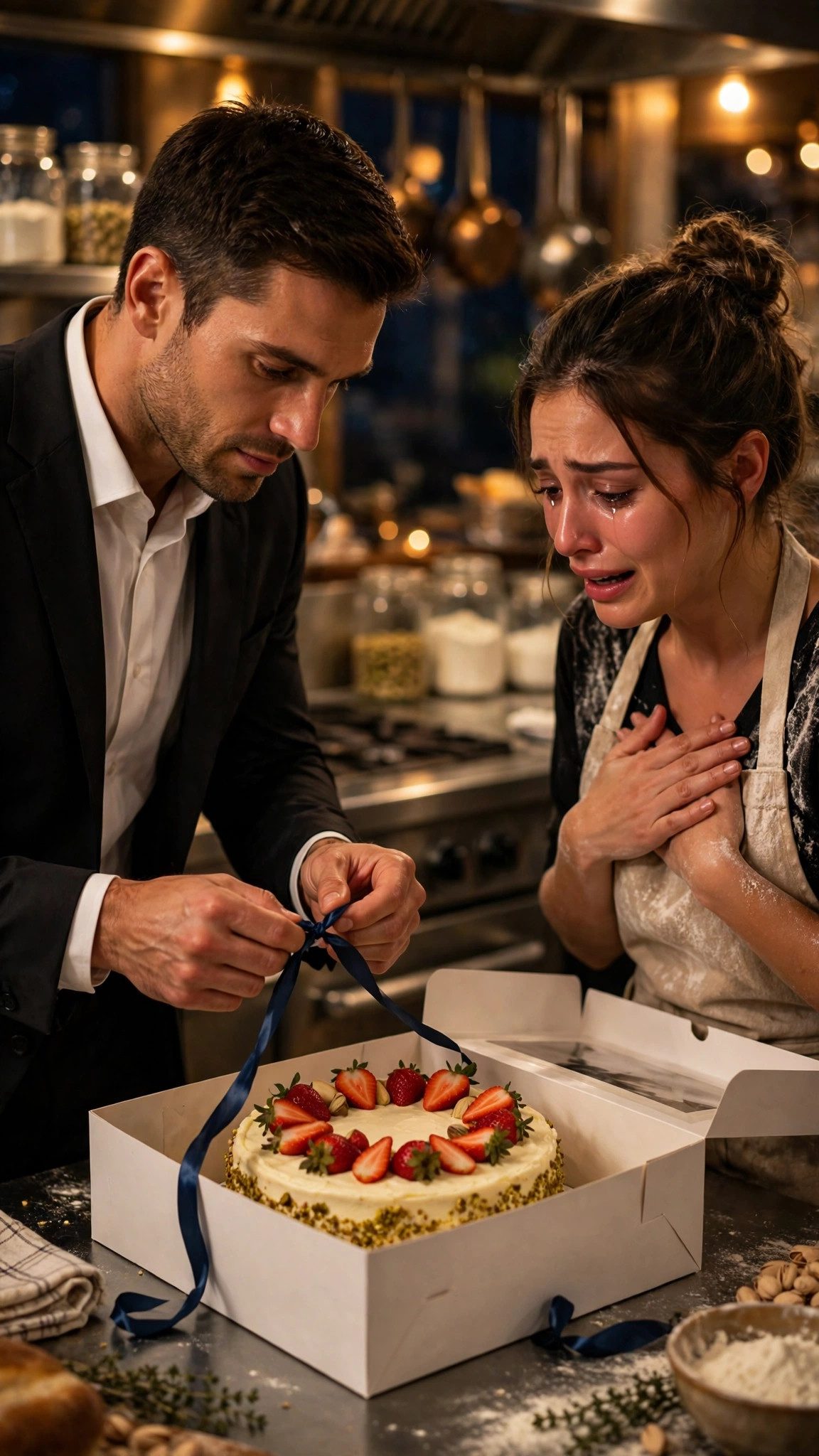
The kitchen was dark, except for one light over my old station. And on my station, sitting beneath the fluorescent lights, was a white bakery box tied with dark blue ribbon.
My heart stopped. My hands went cold. I looked at Adrian, and he looked at me, and he untied the ribbon, and he lifted the lid, and there it was.
Vanilla buttercream. Fresh strawberries arranged around the edge in crooked circles. Crushed pistachios pressed unevenly along the sides. And one candle beside the number thirty-three, written in chocolate.
It was my father's cake. Exactly. Again.
"How?" I whispered.
"I had the recipe," Adrian said, and this time, when he said it, I understood. He had always had the recipe. He had kept it for twenty years, the way he had kept everything my father gave him. He had kept it, and he had used it, and he had brought it back to me, not once, but every year, for as long as I would let him.
He took out the small silver lighter, and he held it out to me, and he said, "Light it. Make a wish first."
I laughed, and the laugh came out wet and shaky, exactly the way it had a year ago. "I'm thirty-three," I said. "I don't think wishes work anymore."
"Try," he said.
So I lit the candle, and I closed my eyes, and I wished for the one thing I had wanted all year without admitting it to anyone. I wished that this would last. That the bakery would last, and the mornings would last, and the man standing beside me would last, and that I would never again have to go back to being invisible.
And then I blew out the candle, and when I opened my eyes, Adrian Vale was down on one knee on the kitchen floor, holding a small black box, and inside the box was a ring, a simple gold band with a single diamond, and he was looking up at me with an expression I had never seen on his face before.
"Ella Bell," he said, and his voice was steady, but his hands were shaking, just slightly, and I understood, suddenly, that the most feared man in Chicago was nervous, that he was afraid, that he was doing the bravest thing he had ever done. "A year ago, I brought you a cake, and I asked you to let me notice you. Tonight, I am asking you to let me notice you for the rest of my life. I am asking you to marry me. I am asking you to let me spend every birthday, every morning, every flour-covered Sunday, standing beside you in whatever kitchen we are in. I know who I am. I know what I am. But I also know what your father taught me, twenty years ago, in a bakery in Milwaukee. A man is measured by what he remembers. I remember you. I have always remembered you. Will you marry me?"
I looked at him. I looked at the ring. I looked at the cake, with its crooked strawberries and its uneven pistachios and its chocolate thirty-three. And I thought about my father, and about a boy sweeping floors, and about a man who had spent twenty years trying to be worthy of a kindness, and about a girl who had spent three years making herself invisible, and about the morning I had finally let myself be seen.
"Yes," I said. "Yes. Yes, yes, yes."
He slid the ring onto my finger, and it fit perfectly, and he stood, and he took my face in his hands, very gently, like it was something breakable, and he kissed me, in the kitchen at Sable, beneath the fluorescent lights, with the smell of vanilla and butter and strawberries all around us.
Behind the kitchen doors, I heard someone cheer. Then someone else. Then the doors burst open, and Claire came running in, and Mom, and Noah, and Theo, and Carmen, and Silas, and all of them were laughing and crying and clapping, and Noah was shouting, "She said yes! She said yes!" and Claire was hugging me so hard I thought my ribs would crack, and Mom was crying into her apron, and Theo was already cutting the cake, and the whole kitchen was full of noise and light and love.
Adrian pulled me into the middle of the kitchen, right there between the ovens and the counters, and he put his arms around my waist, and he started to dance with me. There was no music. There was only the hum of the refrigerators and the clink of dishes and the sound of my family laughing around us, but he danced with me anyway, slow and careful, like we were the only two people in the world, and I laughed, and I cried, and I held onto him as tightly as I could.
"You're a terrible dancer," I whispered.
"I'm a terrible everything," he said, "except for loving you. I'm very good at that."
"Yes," I said, resting my head against his chest, listening to his heartbeat, steady and strong. "You are very good at that."
Later, much later, after everyone had gone home and the cake was gone and the kitchen was clean, Adrian and I stood at my old station, side by side, washing the last of the dishes. He dried. I washed. We didn't talk. We didn't need to. The work was the work, and we were doing it together, the way we had promised.
"Happy birthday, Ella," he said, quietly, and he kissed the top of my head, flour and all.
"Happy birthday to me," I said, and I laughed, and it wasn't the practiced laugh I had used for so many years. It was a real laugh, full and easy and free. "Everyone remembered this time."
"Everyone will always remember from now on," Adrian said. "I will make sure of it."
And he did. Every year after that, on October seventeenth, there was a cake. Vanilla buttercream. Strawberries in crooked circles. Crushed pistachios, pressed on unevenly, by hand. One candle. My age, written in chocolate, always with one number a little bit wrong, because perfect numbers are for people who don't love you enough to be careless.
And every year, I blew out the candle, and I wished for the same thing. Not to be noticed. Not anymore. I wished for mornings in the bakery, and flour on the floor, and a man who remembered everything I said, and a life that was mine, all mine, built with my own hands, in whatever kitchen I was in.
And every year, the wish came true.
The End.
THE END