The hospital smelled like bleach and cold air, and for the first three weeks after the explosion, that smell was the whole world.
I slept in a chair beside Matteo's bed. I did not go home. I did not change my clothes for the first four days, until Rosa came to the hospital with a bag and stood in the doorway with her arms crossed and told me, in the voice she had used on me since I was a boy stealing cookies from her kitchen, that if I did not shower and eat something, she would drag me out of that chair herself. Rosa had been my mother's housekeeper before she was mine. She was sixty-four years old and five feet tall, and she was the only person in the world who was not afraid of me.
Matteo was in a coma for six days. The doctors said the blast had thrown him against the inside of the car door, and the impact had damaged his spinal cord at the eighth thoracic vertebra. T8. I learned that number the way a man learns a prison sentence: by repeating it until it stops sounding like a word and starts sounding like a fact. T8. T8. Below T8, nothing. His legs would never move again. His body would never feel the grass under his feet, or the cold of a swimming pool, or the weight of his own weight. He would live the rest of his life in a wheelchair, and he was eight years old.
On the sixth day, he opened his eyes.
I was sitting in the chair, holding his hand, and his eyelids fluttered, and then his eyes were open, dark and unfocused, staring at the ceiling. A nurse came running. A doctor came running. Machines beeped. And I leaned over the bed and said his name, and his eyes moved toward my voice, and for one shining second I thought everything was going to be all right.
"Matteo," I said. "It's Dad. I'm here. You're all right."
He looked at me. His mouth moved. No sound came out.
"Can you hear me?" I asked. "Blink if you can hear me."
He blinked.
"Do you know who I am?" I asked.
He blinked again.
"Can you say my name?" I asked. "Can you say 'Dad'?"
His mouth moved again. His lips shaped the word. I could see it, the way his tongue pressed against his teeth, the way his jaw worked. But no sound came out, and after a moment his mouth closed, and he turned his face toward the window, and he did not look at me again for the rest of the day.
The doctors told me not to worry. Trauma, they said. Shock. His body had been through something terrible, and his mind was protecting itself. The words would come back. Give it time.
I gave it time. I gave it weeks. I gave it months. The words never came back.
Elena's funeral was on a gray Tuesday, eleven days after the explosion. It rained the whole time, a thin, cold rain that got into your collar and stayed there. I stood under a black umbrella at the cemetery in Lake Forest, holding Matteo's hand — his wheelchair had not arrived yet, so he was in a hospital transport chair, wrapped in blankets — and I listened to the priest say words about eternal rest and God's mercy, and I thought about how Elena would have hated this. She would have hated the gray, and the rain, and the formality of it all. Elena had been a woman who laughed too loud at dinner parties and danced barefoot in the kitchen and put too much garlic in everything she cooked. She would have wanted music. She would have wanted flowers, bright ones, not the white lilies that covered her coffin like snow.
Half the city came to that funeral. Men I did business with, men I had fought with, men who owed me money and men I owed money to, all standing in the rain in their black suits, all of them careful not to look at me for too long. In my world, a man's wife is not supposed to die in a car bomb. A man's wife is supposed to be safe, untouchable, protected by the weight of his name. Elena's death was not just a loss. It was a message. Someone had reached past all my guards, past all my money, past all my power, and put a bomb under my wife's car, and everyone standing in that cemetery knew it.
I did not cry at the funeral. I did not cry at the hospital. I did not cry when the police told me they had no leads, or when the detectives told me the bomb had been professionally made, or when Gabe told me that three of my men had been asking questions all over the city and had found nothing. I did not cry at all, for months, until one night, about four months after the explosion, I was sitting alone in my study, and I picked up Elena's photograph from the desk — the one of her laughing on a beach in Amalfi, her hair blowing across her face — and something inside me broke open, and I cried for an hour, silently, with my face in my hands, like a child.
Matteo did not cry either. Not at the funeral. Not in the hospital. Not ever. The silence had taken everything from him, even his tears, for a long time. The first time I saw him cry was six months after the explosion, and it was because Anna, the physical therapist, had told him his mother would be proud of him. He cried silently, the tears running down his face while his mouth stayed closed, and I understood then that the silence was not emptiness. It was a room full of sound, locked from the inside.
Dr. Marcus Hale was the third specialist I hired. The first two had been polite and useless, full of theories and timelines and percentages. Dr. Hale was different. He was sixty years old, with white hair and a voice like gravel, and the first thing he said to me was, "Stop asking him to talk."
"I beg your pardon?" I said.
"Stop asking him to talk," he repeated. "Every time you ask, you remind him that he can't. You turn his silence into a failure. He already knows he can't talk. He lives inside that failure every minute of every day. What he needs from you is not a question. What he needs is a place where the silence is safe."
"How do I do that?" I asked.
"You sit with him," Dr. Hale said. "You read to him. You tell him about your day. You let him know that you are not waiting for him to perform. And you wait."
"How long?" I asked.
"As long as it takes," he said. "It took my own son three years."
I stared at him. "Your son?"
"He was nine when his mother died," Dr. Hale said. "A car accident. Not a bomb. But the silence was the same. Three years, Mr. Rossi. And then one morning he walked into the kitchen and asked me what was for breakfast, as if he had never stopped talking at all."
"Did you do anything special?" I asked. "Was there a treatment? A moment?"
Dr. Hale shook his head. "There was a girl," he said. "A neighbor's daughter, about his age. She came to the house every day after school, and she sat with him, and she talked to him about her dolls and her homework, and she never once asked him to answer. She just… kept him company. I think that was it. He needed someone who was not waiting for him to be fixed. Someone who liked him the way he was."
I thought about that conversation for a long time afterwards. I thought about it when I sat with Matteo in the evenings, reading him stories about knights and dragons, telling him about my day at the office in a voice that tried very hard to sound normal. I thought about it when I watched him at his physical therapy, working his arms on the parallel bars, his face set in a concentration so fierce it broke my heart. I thought about it when Rosa brought him his dinner and he ate it in silence, staring out the window at the garden.
The house changed after Elena died. It got quieter, not just because Matteo did not speak, but because the whole building seemed to be holding its breath. Rosa kept the kitchen running, and Gabe kept the gates manned, and the men came and went with their reports, but the life had gone out of the place. Elena had been the life. She had filled the rooms with music and flowers and the smell of her cooking. Without her, the house was just walls and furniture.
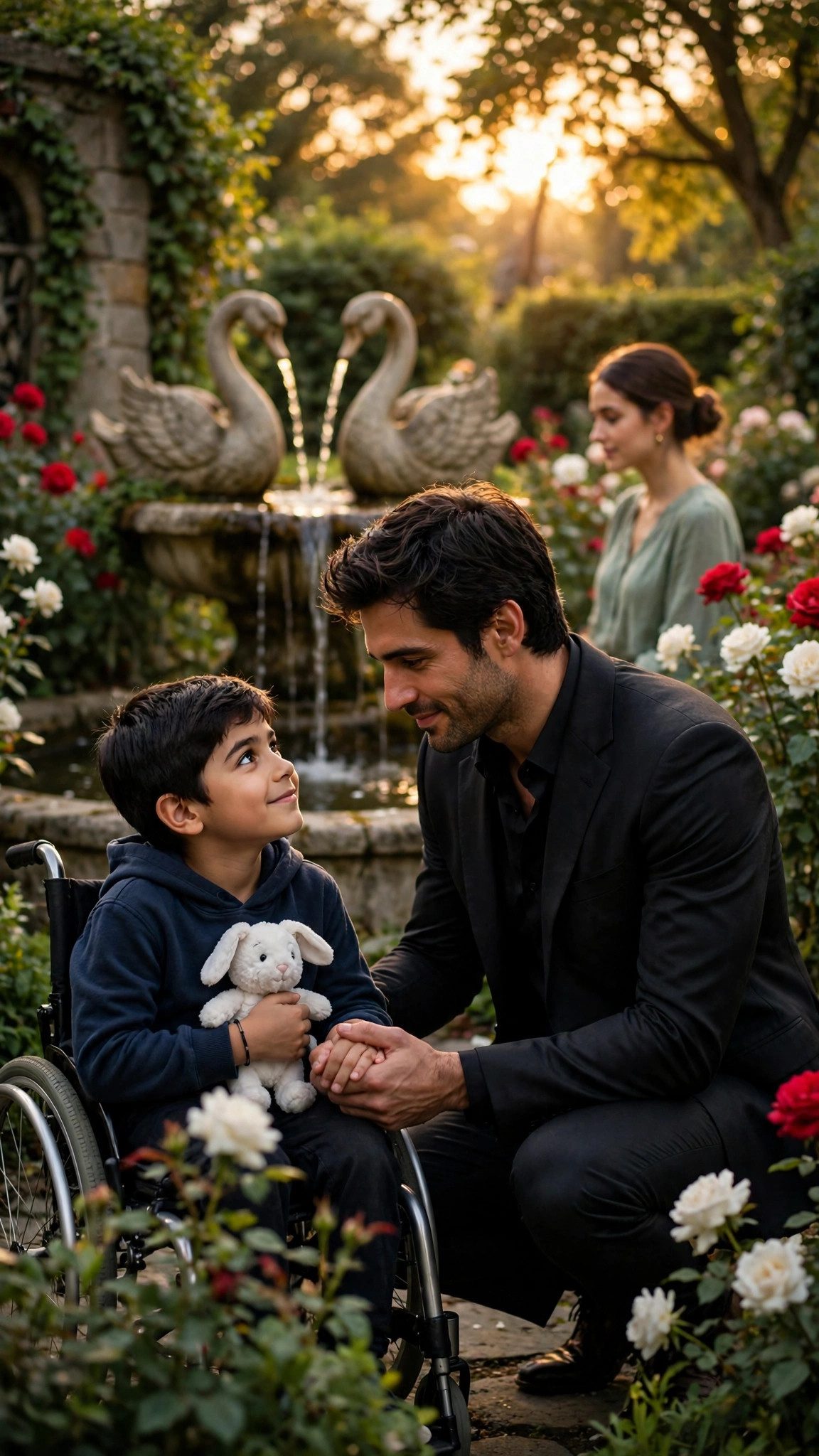
I kept the fountain running. I told Gabe to make sure of it, no matter what. The fountain was in the garden behind the house, a stone basin with two carved swans, and Elena had found it at an estate sale in Lake Forest five years earlier and had fallen in love with it at first sight. It leaked. The pump was always breaking. She had spent a fortune having it repaired, and she had planted roses all around it, red and white, and in the summer she used to sit beside it in the afternoons with a book, and Matteo would chase butterflies around the rose bushes, laughing, his little legs carrying him in circles until he fell down dizzy and she would scoop him up and spin him around.
After she died, I could not bear to look at the garden. But I could not bear to let the fountain stop, either. As long as the water was moving, it felt as if some part of her was still there, still keeping time. So every morning, Gabe checked the pump, and every evening, the water kept falling over the stone swans, and I told myself that was enough. It was not enough. But it was something.
The memorial was eleven months after the explosion. The city held a small ceremony at the site — a plaque, a few speeches, a moment of silence. I did not want to go. I had avoided the place where it happened, taking different routes through the city, the way you avoid a street where you were once mugged. But Rosa told me I should go, and Dr. Hale told me Matteo should go, and so on a cold morning in September, Gabe drove us there, and we stood in a small crowd of people I mostly did not know, listening to a priest I did not know say words I did not hear.
That was where I met Lucia Moretti.
She was standing a little apart from the crowd, a young woman in a dark coat, holding a single white rose. She was twenty-six, with brown hair pulled back in a low knot and a face that was pale and tired, the face of someone who has not slept well in a long time. She was looking at the plaque, and her lips were moving, as if she were saying something to someone who was not there.
After the ceremony, I found myself walking toward her. I did not plan it. I do not know what I intended to say. But she looked up, and her eyes were brown and clear, and she said, "You must be Matteo's father."
"I am," I said. "Vincent Rossi."
"I know," she said. "My parents were in the car behind yours. The escort car. They were killed in the blast, too. My father was driving. My mother was beside him."
I stared at her. I had known, in the abstract, that other people had died that day. The police report had mentioned it: two people in the following vehicle, killed instantly. But I had never thought about them as people. I had never thought about the fact that they had a daughter, standing here in a dark coat with a white rose, just as alone as I was.
"I'm sorry," I said. It was the first time I had said those words to anyone about that day, and they felt thin and useless in my mouth.
"So am I," she said. She looked down at Matteo, who was sitting in his wheelchair beside me, his white rabbit in his lap, staring at the plaque with an expression I could not read. "He doesn't speak," she said. It was not a question.
"No," I said. "Not since the explosion."
She nodded, as if that made sense to her. Then she knelt down in front of Matteo's chair, right there on the cold sidewalk, her coat pooling around her knees, and she looked him in the eyes, and she said, "Hello, Matteo. My name is Lucia. My mama and papa died in the same bad thing that hurt you. I don't talk about it much, either."
Matteo looked at her. His eyes moved, just a little, and for a second I thought I saw something flicker in them. Not hope. Not yet. But attention. The way a locked door rattles, just once, when someone knocks on it from the other side.
"Do you like rabbits?" Lucia asked him. She pointed at the white rabbit in his lap. "I had one like that when I was little. His name was Snowball. He went everywhere with me."
Matteo's fingers tightened on the rabbit. He did not answer. He never answered. But he did not look away from her, and that was more than he gave most people.
Lucia stood up. She handed me the white rose. "For your wife," she said. "I bring one every year. I thought you might like to have it."
I took the rose. I did not know what to say. I thanked her, and she nodded, and she walked away down the sidewalk, and I stood there holding a white rose in a city that had taken everything from both of us, and I watched her go, and I thought about what Dr. Hale had said about his son and the neighbor's girl.
Someone who was not waiting for him to be fixed. Someone who liked him the way he was.
Three weeks later, on the recommendation of a doctor I trusted — Dr. Alan Pierce, who had treated Matteo in the hospital and who had known Elena's family for years — I hired Clara Hayes.
Dr. Pierce told me she was the best pediatric home caregiver he had ever worked with. He told me she was patient, and warm, and experienced with trauma cases. He told me Matteo would be lucky to have her. He gave me two references, both families in Winnetka, both of whom spoke about her the way people speak about a saint.
She came to the house for an interview on a Tuesday afternoon. She was thirty-two, with dark hair that fell to her shoulders and a soft voice and a smile that reached her eyes. She wore a gray dress and a red scarf, and when she sat down across from me in the study, she folded her hands in her lap and told me about her work, and about her belief that every child had a voice, even the ones who could not speak, and about her mother, who had worked in cartography, drawing maps, and her father, who had run his own business laying cables, and how she had grown up believing that the world was held together by invisible lines, and that her job was to help children find their way along them.
It was a strange thing to say. I remember thinking it was strange, even then. But she said it with such sincerity, such warmth, that I thought it was simply the way she was — a woman who thought in metaphors, who saw the world in soft shapes. And she looked so much like Elena — the same dark hair, the same way of tilting her head when she listened, the same softness in her voice — that some part of me, the part that had been grieving for eleven months, simply surrendered.
I hired her on the spot.
Rosa said she seemed like a good girl. Gabe said nothing, which for Gabe meant he was watching. Dr. Hale, when I told him, said only, "Watch your son. He will tell you the truth, even if he cannot speak it."
I did not understand what he meant. Not then.
Three months later, I would understand it perfectly. I would understand it at eleven forty-seven at night, sitting in my study with earbuds in my ears, listening to my son cry through a hidden microphone, and hearing the voice of the woman I had trusted say, "Get your hands off me. I didn't do anything."
But that night was still in the future. On the day I hired Clara Hayes, all I knew was that my house had been silent for eleven months, and a kind woman with dark hair and a soft voice had walked through my front door, and I had wanted, more than anything in the world, to believe that she was the answer.
I was wrong. And my son paid the price for my mistake.