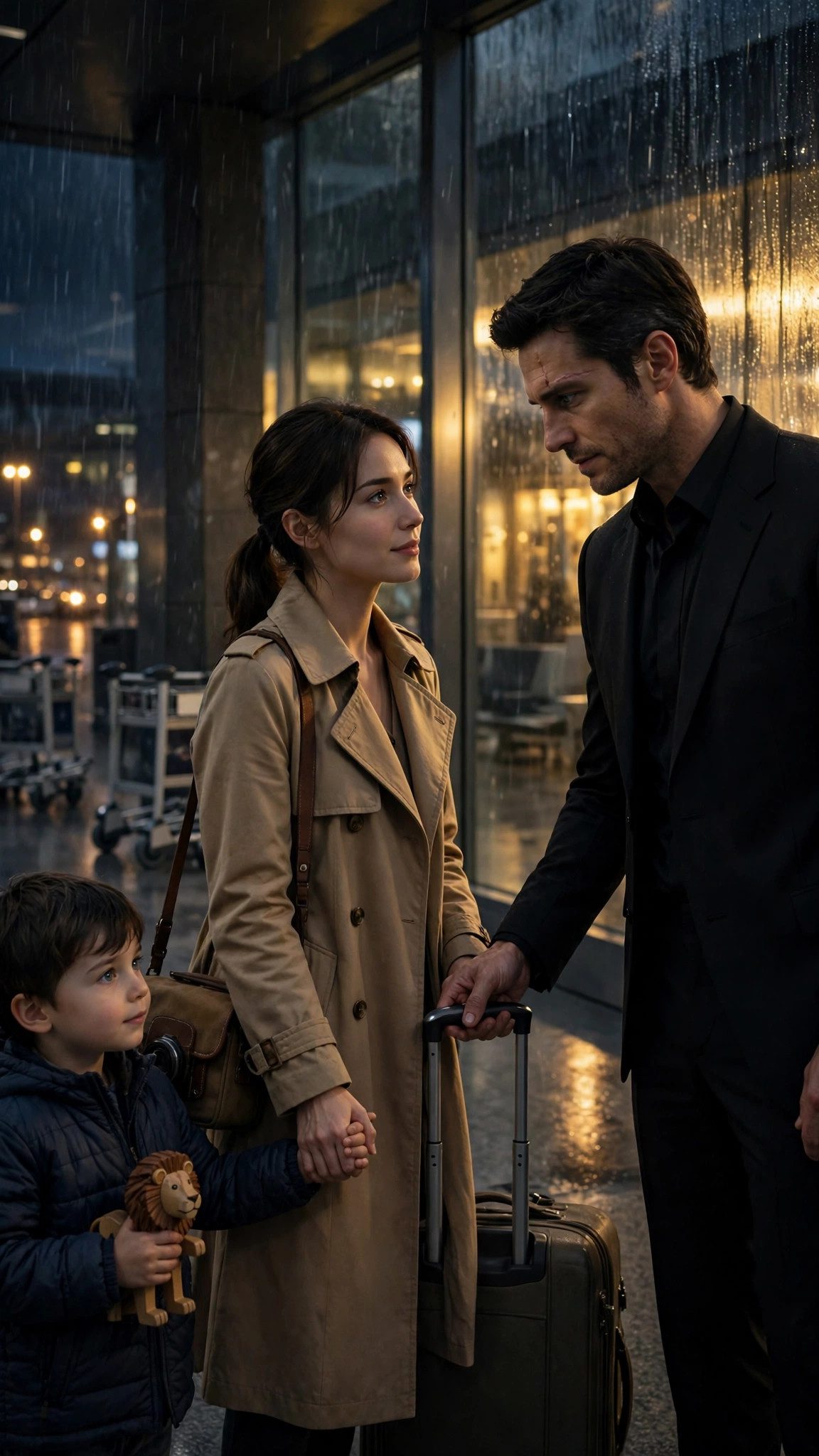
Victoria came to the hotel the next morning at nine o'clock, and I knew it was her before I opened the door, because she has always knocked the same way, three sharp raps, like a woman who expects the world to answer promptly.
She stood in the hallway in a grey suit with her hair in its smooth knot, and she looked at me, and then she looked past me at Leo, who was sitting on the bed eating toast with jam on his chin, and her face did something I had never seen it do before. It broke. Not dramatically, not the way faces break in movies, but quietly, the way ice breaks on a lake in spring, a thin crack running through something that has been frozen for a very long time.
"Hello, Elena," she said.
"Hello, Victoria," I said.
We stood there for a moment, two sisters who had not spoken in three years, in a hotel hallway in Chicago, with a little boy eating toast between us, and then Victoria stepped forward and put her arms around me, and I put my arms around her, and we held each other the way we had held each other when we were girls, when our father was still alive and our mother still made soup on Sundays, and neither of us said anything for a long time, because there are some apologies that can only be made with your arms.
"He told you," Victoria said finally, stepping back and wiping her eyes with the back of her hand, a gesture so un-Victoria-like that I almost laughed. "Dante told you everything."
"He told me you knew," I said. "He told me you told him to come to the airport."
"I did," she said. "I told him to go. I have been telling him to go for a year."
She came into the room and sat down on the edge of the bed, and Leo looked up at her with jam on his chin and said, "Are you my auntie?"
Victoria's breath caught. "Yes," she said. "Yes, I am your auntie. I'm Victoria. And you must be Leo."
"I am Leo," he said, very seriously. "I am almost three. I have a lion. His name is Leo too."
"That's a very good name for a lion," Victoria said, and her voice shook, just slightly.
I sat down across from her, and for a while we just looked at each other, and I saw my sister properly for the first time in years, not the perfect Mrs. Moretti from the newspapers, but the woman underneath, tired around the eyes, thinner than I remembered, with a small scar on her wrist I had never noticed before, from a kitchen accident when she was sixteen, I suddenly remembered, when she had been trying to make our mother's soup and had cut herself on the lid.
"You knew about me and Dante," I said. It was not a question.
"Yes," Victoria said. "I knew before I married him. I knew the whole time."
"How?"
"Because I'm your sister," she said simply. "Because I watched you for eight years, coming home late with your camera bag and a look on your face that I had never seen before, and I knew. And because Dante came to me, before the wedding, and he told me himself. He sat in my office, in the chair across from my desk, and he said, 'Victoria, I need to tell you something before you agree to this marriage, because it would not be fair otherwise.' And he told me about you. All of it. Eight years. And he told me that he loved you, and that he would marry me anyway, because the family needed the docks and Carter Freight needed the money, and he asked me if I could live with that."
"What did you say?" I asked.
"I said yes," Victoria said. "And I have spent three years wondering if I said yes for the right reasons."
She told me the truth then, the whole of it, in that hotel room with Leo eating toast between us, and it was a different story from the one I had told myself for three years.
Carter Freight had been dying. Our father had been the one who held the clients with his handshake, and without him the contracts had drifted away, and by the time Dante proposed the alliance, the company was three months from bankruptcy. Victoria had been working sixteen hours a day, and it had not been enough, and she had been lying awake at night wondering how she was going to tell the forty-seven families who depended on Carter Freight that there would be no more paychecks.
The marriage was a rescue, not a romance. Dante would put money into Carter Freight, and the Moretti family would get the Carter docks, and the company would survive, and the families would keep their jobs. It was business, and Victoria was good at business, and she had agreed to it the way she agreed to everything: calmly, and completely, and without letting anyone see what it cost her.
"What did it cost you?" I asked.
"Everything I didn't know I wanted," she said. "I thought I wanted to be Mrs. Moretti. I thought I wanted the house, and the name, and the place at the table. And for a while, I did. But a marriage that is only business is a very lonely place to live, Elena. Dante was kind to me. He was respectful. He was never cruel. But he was never mine. His heart was somewhere else, and I knew where, and every time he looked at me, I could see him looking past me, and after a while I stopped wanting him to look at me at all."
"Then why did you stay?" I asked.
"Because of the company," she said. "Because of the forty-seven families. Because I had made a promise, and I am a woman who keeps her promises. And because, if I am honest, I was afraid. Afraid that if I left, I would have nothing. No husband. No company. No family. Just a woman in a grey suit with a smooth knot in her hair and no one to go home to."
She looked at Leo then, and her eyes filled with tears again.
"And then Dante came to me a year ago, with a photograph of a little boy in a park in Geneva, and he told me he had a son, and he told me the son was yours, and do you know what I felt, Elena? Not anger. Not jealousy. Relief. Because for the first time in three years, something in that house was real. A child. A little boy with Dante's eyes and your smile. And I understood, in that moment, that I had been protecting the wrong thing. I had been protecting a marriage that was never a marriage, and I had been letting my sister raise her son alone in a foreign country, and I had been calling that loyalty, when it was really just fear."
She had done something then that I did not know about, something she had never told Dante. She had gone to her lawyer, and she had signed the divorce papers, and she had made an agreement with Dante: she would take Carter Freight back, free and clear, with enough money to rebuild it on her own terms, and he would take nothing from her, and they would tell the world that the marriage had run its course, and no one would ever know that it had never truly begun.
And then she had done something else. She had found out about the man in Geneva, Paolo, and she had begun paying for Leo's security herself, quietly, through a trust she had set up in her own name, because she had decided that if Dante was too much of a coward to go to Geneva, then she would at least make sure the boy was safe.
"Paolo," I said. "Dante said Paolo stopped reporting three weeks ago. Dante thinks he's dead."
Victoria went very still. "Paolo is not dead," she said. "Or at least, he wasn't dead two weeks ago. He called me, Elena. He called me from a pay phone in Geneva, and he said someone had been asking questions about the boy, someone who was not Dante's man, and he said he was going to move you and Leo to a safe house, and then the line went dead, and I have not heard from him since."
"Who was asking questions?" I asked.
"I don't know," Victoria said. "But Dante is right about one thing. There is a man inside his organization who has been selling information. And I think I know who it is."
"Who?"
"Adrian Voss," she said. "Dante's consigliere. His closest advisor. The man who sits at his right hand at every meeting. I have watched him for a year, Elena. I have watched him take calls in the hallway, and I have watched him leave meetings early, and I have watched the way he looks at Dante when Dante isn't looking, like a man waiting for his turn. And three weeks ago, I saw him in the parking garage with a man I recognized from the newspapers, a Castellano man, and they were not shaking hands like strangers."
Vincent Castellano. The head of the rival family. The man who had wanted the Moretti docks for twenty years.
"Castellano wants the docks," Victoria said. "And now he knows about Leo, and a son is a weakness, and Castellano collects weaknesses. If he can take Leo, he can take Dante. And if he can take Dante, he can take everything."
I looked at my sister, this woman I had resented for three years, this woman I had blamed for taking the only man I had ever loved, and I understood, finally, that she had never taken anything from me. She had given everything she had, her name, her freedom, her life, to save our father's company, and she had done it knowing that the man she was marrying loved her little sister, and she had done it anyway, because that is what older sisters do.
"I'm sorry," I said. "I'm sorry I blamed you. I'm sorry I left. I'm sorry I didn't tell you about Leo."
"Don't be sorry," Victoria said, and she reached across the bed and took my hand, and her hand was warm and steady, the way it had always been when we were girls. "You did what you had to do. And I did what I had to do. And now we are here, and our son, our nephew, is eating toast with jam on his chin, and there is a man out there who wants to hurt him, and we are going to stop him. Together. The way sisters should have done it from the beginning."
Victoria reached into her bag then, and took out a small photograph album, old and worn, the one our mother had kept on the shelf in the living room, and she opened it on the bed between us, and we looked at the photographs together, the two of us and Leo leaning over to see, and for a while the hotel room felt like the house we had grown up in.
There was our father, young and strong, standing in front of the first Carter Freight truck, with his arm around our mother, both of them laughing. There was Victoria at sixteen, in her school uniform, holding a trophy for debate. There was me at ten, with a camera almost as big as my head, taking a photograph of a pigeon in the park. There was our mother in the kitchen, flour on her hands, making soup on a Sunday, with the light coming through the window the way it used to.
"Do you remember the day Dad died?" Victoria asked quietly.
"I remember the phone call," I said. "I was at a banquet, photographing a wedding, and my phone rang, and it was you, and you said, 'Elena, come home. Dad is gone.'"
"I was with him," Victoria said. "I was in his office, and he was at his desk, and he looked up at me, and he said, 'Victoria, take care of your sister. She is stronger than she looks, but she feels everything twice as hard as other people, and the world will try to use that against her. Take care of her.' And then he was gone. And I have spent six years trying to take care of you, Elena, and I have done it badly, and I am sorry."
"You took care of me the only way you knew how," I said. "You married a man you didn't love to save our father's company. You gave up your life for forty-seven families. You don't owe me an apology, Victoria. I owe you one."
She closed the album, and she looked at me, and her eyes were clear and steady, the way they had always been when she had made up her mind about something.
"Then let's stop owing each other apologies," she said, "and start over. As sisters. As family. For Leo."
Leo looked up from his toast, jam on his nose now, and said, "Auntie Victoria, do you want some toast?"
Victoria laughed, and it was the first real laugh I had heard from her in years, and she said, "Yes, Leo. I would love some toast."
Victoria took the toast, and she ate it, sitting on the edge of the hotel bed in her grey suit, with jam on her fingers, and I thought about how strange and wonderful it was to see my perfect sister eating toast on a hotel bed like an ordinary person. She told us then about the gallery, the little one she had been dreaming about in Milan, in a narrow street near the Duomo, with white walls and a window that caught the afternoon light, and how she had already found the space, and already signed the papers, and how she was going to fill it with paintings by women who had been told, the way she had been told, that their lives belonged to other people.
"I am going to paint again," she said. "I have not painted since I was a girl, but I am going to paint again, and I am going to show my work in my own gallery, and no one is going to tell me what to hang on my own walls. Not a husband. Not a board. Not anyone."
"Good," I said. "It's about time."
And in that moment, in a hotel room in Chicago, with my sister and my son, I felt something I had not felt in three years. I felt like I was home.