The first time Vittorio Moretti asked me about a grandson, Isabel and I had been married for eleven months, and we were sitting at his table in Brooklyn with the good plates out and the candles lit, and he said it the way other men ask about the weather.
"A man builds an empire for his sons," my father said, carving the roast. "Without a son, an empire is just a pile of money waiting to be divided by strangers."
Isabel smiled, the way she did when she was deciding whether a man was rude or merely old. "Then it's fortunate Alexander married a woman and not a broodmare, Vittorio."
My father laughed, because he liked spirit in small doses. "Spirit is good. Spirit and a son would be better."
I laughed too. We all laughed. It was a joke then. It stayed a joke for another year, and then it stopped being a joke, and none of us could say exactly when the change had happened, only that one Sunday the question was no longer a toast and had become an audit.
Isabel never blamed me for my father's obsession. That was the worst of it. She blamed him, and she blamed the family, and she blamed the whole rotting architecture of men who measured their lives in sons, but she never once looked at me and said this was my fault. She should have. It would have been easier if she had. Instead she carried it the way she carried everything, quietly and alone, and I let her, because I had been raised to believe that a man's problems were solved by other men in rooms like the one I was sitting in now, and a woman's pain was a private matter that would resolve itself if you gave it enough time and enough money.
We tried. God, we tried. There were clinics on the Upper East Side with waiting rooms like hotel lobbies, and specialists with calm voices and framed diplomas who told us to relax, as if relaxation were a thing you could schedule between a sit-down with the Genovese people and a shipment coming through the docks. Isabel kept charts. She kept temperatures. She kept a small notebook by the bed with dates and times written in her neat hand, and every month she would turn a page and draw a small line through another hope, and I would watch her do it from the doorway and say nothing, because I did not know what to say to a woman who was grieving a child who had never existed.
The treatments came next. Injections in the morning, her hands steady even when mine would have shaken. Hormones that made her cry at commercials and then apologize for crying. A folder that grew thicker every month, full of printouts and consent forms and numbers that meant nothing to me and everything to her. I went to the appointments when I could. More often I sent the car and told myself the business could not wait, and the business, which had waited for no man in fifty years, became my excuse for everything.
My father retired the year we started the treatments. He handed me the family in a ceremony that was mostly theater — a dinner, a toast, a ring moved from his finger to mine — and then he stayed. Retired dons do not leave. They sit in the back of rooms and offer opinions. They call capos on private lines. They ask questions that are not questions. Vittorio asked about the treatments the way other men ask about the stock market, and when the months kept passing, his questions turned into statements, and his statements turned into a single sentence he repeated until it lived in my head rent-free: a Moretti without an heir is a Moretti already finished.
I began to hear it in my own voice. I began to say it to myself in the car, in the shower, in the dark at three in the morning while Isabel slept beside me with her hand curled near her face. I began to believe it. That was my failure, and I know that now, but knowing it now does not change what I said on the night the rain came down over Manhattan and Isabel stood barefoot by the fire with the folder in her hands.
She had asked me to keep trying. She had used the word "us." She had said, "We can keep trying, Alexander, if we do it together." And I had answered her with my father's sentence, dressed up in my own voice, and I had watched her face go pale, and I had watched her ask me the question I could not answer — if I had already given you a child, would you still speak to me this way? — and I had said nothing, because the honest answer was that I did not know, and the dishonest answer would have been another wound, and so I chose silence, which was the worst wound of all.
She left before sunrise. She took one bag and her mother's necklace and the coat she is wearing now, and she left a note on the kitchen counter in her neat hand. It said, "I love you. That is why I cannot stay and be measured." I read it eleven times. I still have it. It is in the top drawer of my desk, under the gun I have not fired in four years, and some nights I take it out and read it again, trying to find the sentence where she stopped loving me. It is not there. It was never there. That is what I could not understand for six months: she left because she loved me, and she loved me too much to let me keep turning her into a failure.
The morning after she left, Marcus found me in my office with the bourbon bottle open and the note in my hand.
"Let her go," he said. "Give her a week. She'll call."
She did not call. A week became a month. A month became three. My men checked the galleries, the hotels, the friends she had kept from before me. Her phone went dead. Her bank accounts went quiet. The credit cards I had given her were never used again. It was as if Isabel Marchetti had stepped out of my life and into a life that had no room in it for Alexander Moretti, and the precision of it — the clean, total absence — drove me slowly mad, because I had spent my life believing that every person could be found, every door could be opened, every problem had a price. Isabel had no price. She had simply decided, and her decision was a wall I could not climb.
Vittorio came to see me in the third month. He sat in my office and looked at the empty chair where Isabel used to sit when she brought me lunch on Fridays, and he said, "A wife who leaves is a wife who was never truly yours. Sign the papers. Take back the name. Find a woman who understands what this family requires."
I told him to get out of my office. It was the first time I had ever spoken to my father that way, and he looked at me for a long moment, and then he left without another word, and I knew he would not forget it. Vittorio Moretti forgets nothing. He keeps his grievances the way other men keep photographs, carefully, in order, waiting for the right moment to take them out and look at them.
By the sixth month, I had stopped sleeping. I signed the divorce papers in my head a hundred times and could not sign them on paper. Marcus drew them up anyway, because that is what a consigliere does: he prepares for the war his boss cannot admit he is losing. The settlement was generous in the way that only guilty men are generous. She would surrender every claim, and in return she would receive enough money to live quietly for the rest of her life, far from my name. It was a clean ending. It was the kind of ending my father approved of. It was the kind of ending that would have let me tell myself I had done the honorable thing.
And then, on a Tuesday morning in October, Marcus called me and said three words I had stopped expecting to hear.
"She's coming in."
"Coming where?" I asked.
"Here," he said. "To the chamber. She called my office herself. She wants to sign. She wants it finished."
I should have asked why. I should have asked what had changed. I should have heard something in Marcus's voice, some hesitation, some warning. But all I heard was relief, and relief is a deafening thing. I told him to convene the council. I told him to bring the papers. I put on my best suit and I walked into that chamber like a man walking to his own execution, and I sat down across from an empty chair, and I waited.
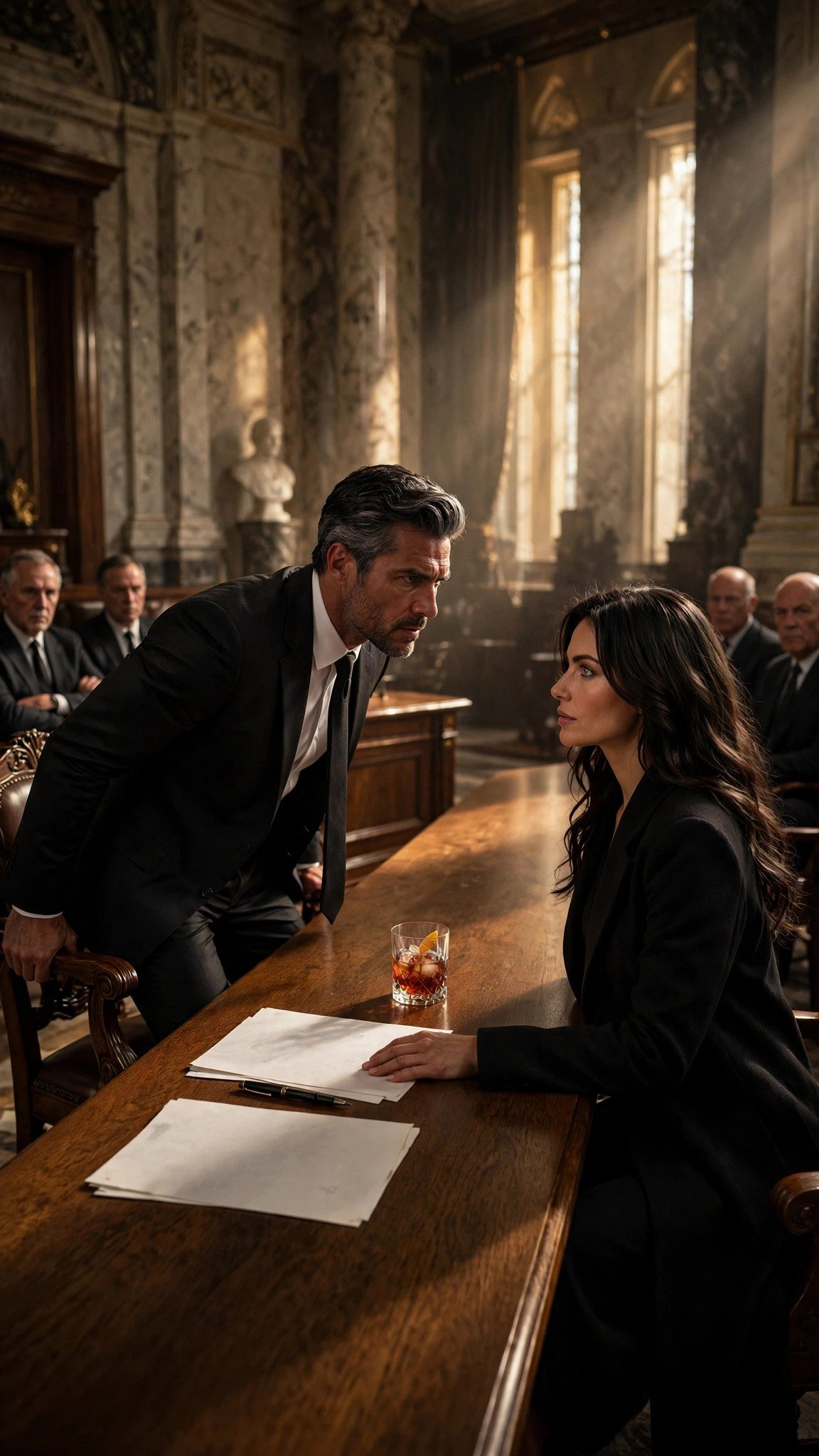
Then the doors opened, and Isabel walked in wearing a long black coat, and she did not take it off, and she sat down across from me with a calm I had never seen in her before, and I understood, too late, that the woman across the table was not the woman I had married. The woman I had married had loved me. The woman across the table had survived me. There is a difference, and the difference is everything.
Marcus read the final clause aloud. Isabel moved her hand onto the table. Her coat shifted. And I saw the curve that had not been there before, and my pulse stopped, and every cruel word I had ever thrown at her came back to me at once, and I understood, in a single terrible second, what she had been carrying all this time — not just a child, but the truth that I had destroyed our marriage trying to secure the very thing that had already been growing inside her.
"Take off the coat," I said, and my voice did not sound like my own.
—
In the fourth month, Marcus brought me a report that was three pages long and said nothing. No credit card activity. No phone activity. No airline tickets, no hotel registrations, no gallery openings, no forwarding address. It was as if she had been erased by a professional, and for one wild afternoon I wondered if she had hired someone — one of my own kind, a man who knew how to make a person disappear — and the thought made me laugh out loud in my empty office, because Isabel Marchetti, who cried at commercials and argued about paintings, had out-disappeared every man I had ever paid to disappear someone.
"She planned it," Marcus said, watching me read the empty report. "She planned it for weeks, maybe months. The bag was packed before the fight, Alexander. The note was written before the fight. She was already leaving. The fight was just the door she walked out of."
I did not want to believe him. I wanted to believe the fight had driven her away, because a fight can be apologized for. A plan cannot. A plan means she sat in our kitchen in the quiet hours and thought about her life without me, and decided it was better. A plan means she had already grieved us before I ever opened my mouth that night, and I had simply given her the excuse she was waiting for.
I drove past her gallery one night in the fifth month. It was closed, the windows dark, a small sign in the door saying the curator was on leave. Her replacement was a young woman with short hair who did not know my name, and when I asked after Isabel, she said, "She left suddenly. A family matter, I think. She sent a lovely letter." I stood on that sidewalk for a long time, looking at the dark windows, remembering the opening night when the crowd had spilled out onto this same sidewalk with their cheap wine, and I thought about how much of my wife's life I had never really seen, because I had been too busy standing in the corner in my expensive suit, believing that being present was the same as being there.
There was one night, near the end of the fifth month, when I almost called her mother's sister in Savannah. Her aunt Rosa, a woman I had met twice, who made a shrimp pasta better than mine and who had looked at me at the wedding with the open skepticism of a woman who had buried a sister and raised a niece and did not trust easily. I had her number in my phone. I sat with it on the screen for twenty minutes, my thumb over the call button, and I did not press it. I told myself it was pride. It was not pride. It was fear — fear that Rosa would answer and tell me Isabel was fine, and happy, and better off without me, and that she would say it in the tone of a woman delivering a verdict. I could survive a rival telling me I was finished. I could not survive her aunt telling me I had never been enough.
So I did what men in my position always do when they cannot face the truth: I turned it into paperwork. I told Marcus to draw up the divorce. I told him to make it generous, because generosity is the last refuge of a man who has nothing else to offer. I told him to make it clean, because clean endings are the only kind my father respects. And I told myself, every night for a month, that when she signed it, I would finally be able to sleep.
I did not sleep. I signed the papers in my head a hundred times, and each time, in my head, she was the one holding the pen, and I was the one watching, and I could not make myself look away.