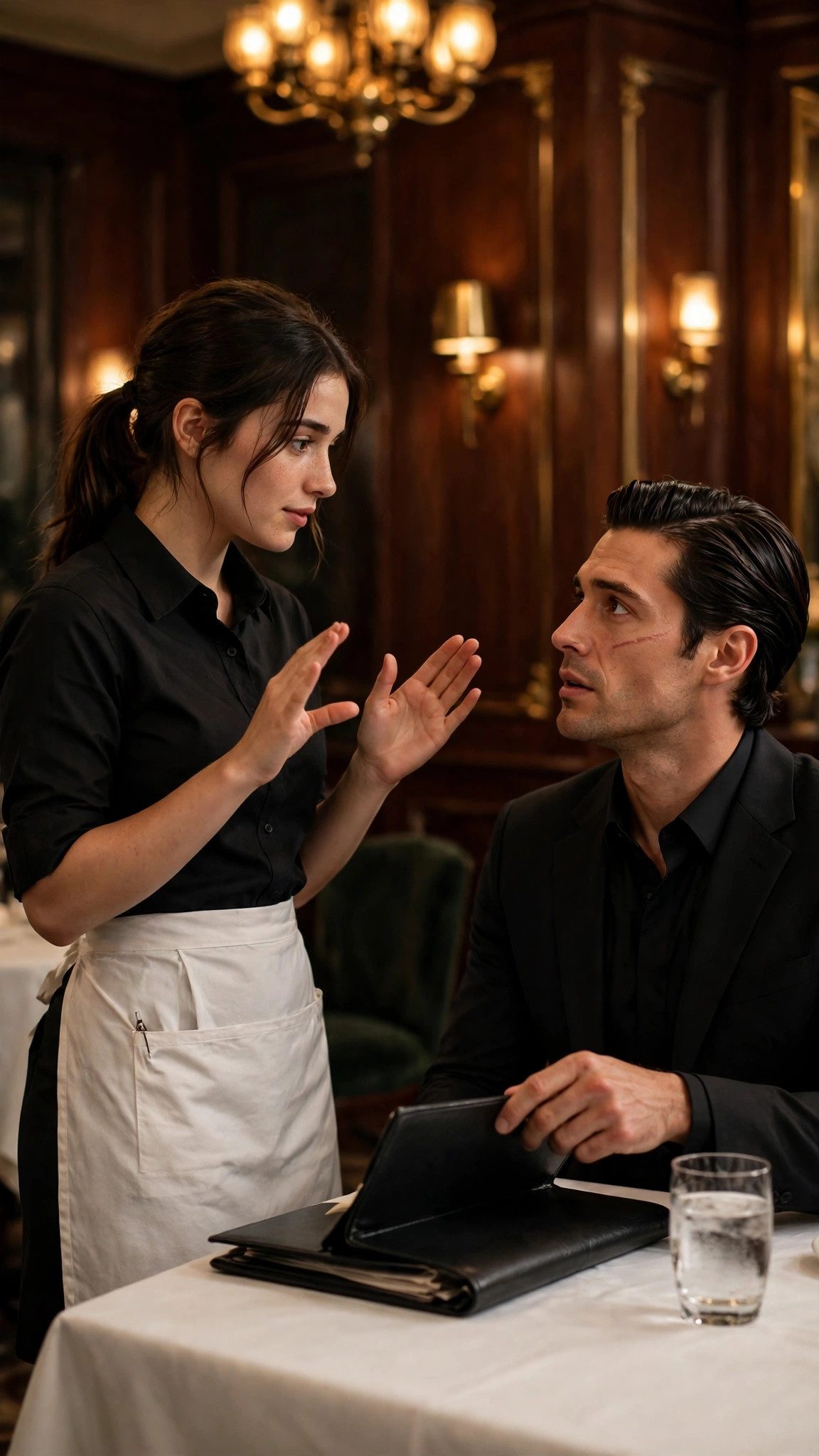
Salvatore Marquetti had not always been silent. That was the first thing people got wrong about him, and it was the mistake that shaped everything else.
He had been born into noise. His father, Enrico Marquetti, had run the West Side with a voice that could fill a room and a laugh that could fill a street, and young Salvatore had grown up in a house where the television was always on, where the radio played in the kitchen, where men argued about football and freight routes at the dinner table in voices that rose and fell like weather. He had been a loud child, by all accounts. He had talked too much. His mother used to say that he had been born mid-sentence and had never stopped since.
That ended on a Tuesday in November, six years before the night Tessa walked into his private dining room.
The bomb had been planted under his father's car. It was meant for Enrico. It was meant to send a message to every family on the West Side that the Castellanos were done waiting for territory. What the men who planted it did not know — what nobody knew — was that Salvatore had borrowed his father's car that morning to drive to a meeting at the docks, and that Enrico had taken Salvatore's car instead, because his own was in the shop.
Salvatore was standing on the sidewalk outside the docks office when it happened. He was forty feet away. He remembers the flash first, a white-orange bloom that seemed to swallow the whole street, and then the sound, a sound so enormous it did not feel like a sound at all, but like a hand closing around his head and squeezing. He remembers being thrown backward. He remembers the pavement hitting his back. He remembers opening his eyes and seeing the sky, gray and ordinary, and thinking, very clearly, that the world had gone wrong somehow, because the sky should not look that ordinary after something like that.
He could not hear the sirens. He could not hear the shouting. He could not hear his own breathing. He could hear nothing at all.
The doctors told him later that the blast had ruptured both eardrums and damaged the nerves beyond repair. They used words like "profound" and "bilateral" and "permanent," and he nodded the way his father used to nod when he understood something terrible, and then he went home and did not speak to anyone for three days.
His father was dead. His mother had died years earlier, of cancer, quietly, in a white room. His uncles wanted to take over the family. His rivals were already moving. And Salvatore Marquetti, thirty-three years old, the heir to half the West Side, could not hear a single word anyone said to him.
He had two choices. He could tell the truth and watch his family's empire collapse, because in his world, a boss who could not hear was a boss who could not survive. A boss who could not hear a whisper in a crowded room could not hear a betrayal being planned. A boss who could not hear a gun cocking behind him was already dead. Or he could lie, and lie completely, and never let a single person outside his inner circle know.
He chose the lie.
It was not easy. It was the hardest thing he had ever done, and he had done hard things. He learned to read lips, which meant learning to watch people's mouths the way other men watched their hands. He learned to position himself in rooms so that he could see every face, so that no one could speak behind him. He learned to nod at the right moments, to smile at the right moments, to answer questions he had only half understood with answers vague enough to pass. He learned to eat alone, because eating alone meant no one expected him to follow a conversation. He learned to arrive late and leave early, because the less time he spent in a room, the less chance someone would notice.
And he learned sign language. That was the secret inside the secret. A retired teacher named Mrs. Antonia Reyes, seventy-two years old, with white hair and hands that moved like birds, came to his house twice a week for a year, and she taught him American Sign Language in a room with the curtains drawn, and she never told a soul. She was the only person in the world, outside his three men, who knew. When she died, two years later, he paid for her funeral himself and stood at the back of the church, and he was the only person there who signed his goodbye.
His three men knew because they had to know. Rocco Bellini, his driver and bodyguard, a man the size of a door, who had pulled him out of the wreckage on the day of the bomb and carried him to the ambulance. Dante Falco, his enforcer, who had been his best friend since they were boys stealing cigarettes behind the church. Marco Santoro, his consigliere, who had taught him to read lips in the first three months, sitting across from him at a kitchen table, mouthing words slowly until Salvatore could follow.
They were the only ones. Not his uncles. Not his cousins. Not the men who worked for him. Not the women he had dated, briefly, before the bomb, and not at all after it. Especially not his rivals.
Vincent Castellano, the head of the family that had planted the bomb, had spent six years trying to find a weakness in Salvatore Marquetti, and Salvatore had spent six years making sure there was nothing to find. He was careful. He was disciplined. He was, by every measure that mattered in his world, untouchable.
But he was also alone in a way that had nothing to do with power and everything to do with silence. He could sit in a room full of people who loved him — and there were people who loved him, in their rough and complicated way — and feel as if he were behind glass. He could watch their mouths move and understand their words and still feel as if he were watching a film with the sound turned off. He could not hear music. He could not hear laughter. He could not hear the rain on the roof of his house, or the voice of the woman he had once thought he might marry, telling him she was leaving because he had become a stranger to her.
He had not heard that last part, of course. He had read it on her lips, in the doorway of his apartment, on a Tuesday in March, and he had nodded, and she had cried, and he had let her go, because what else could he do? He could not explain. He could not tell her the truth. The truth was a secret that kept him alive.
So he ate alone at Bellini House every Thursday night, because Bellini House was the one restaurant in Chicago where the staff was trained to leave a man alone, and the private dining room was the one room where he could sit in silence without anyone thinking it was strange. He ordered the same thing every week. He read his papers. He ignored the servers, not because he was cruel, but because ignoring them was easier than pretending to hear them.
And then, on a Thursday night in October, a waitress walked into his private dining room, and she did something no one had done in six years.
She raised her hands, and she spoke to him in his secret language, and for the first time since the bomb, Salvatore Marquetti did not feel alone.
He did not know, in that moment, that his life was about to change. He only knew that a woman he had never met had just done the most intimate thing anyone had ever done for him: she had learned his language before she ever knew he needed it. She had learned it for her brother. She had learned it out of love. And she had just offered it to him, freely, in a room full of people who had wanted to watch him humiliate her.
He smiled at her. He had not smiled like that — a real smile, small and careful and entirely unguarded — in six years. And when he saw the faces at the service door, when he understood what had been done to her, and what had been done to him, he made a decision that would have frightened him if he had stopped to think about it.
He decided that Tessa Hayes was going to be his. Not in the way his world usually meant that word. Not as property. Not as a possession. As a person. As the one person in Chicago who could talk to him without pretending.
He decided that he would protect her, the way no one had ever protected him. He decided that the men who had laughed at her would never laugh again. And he decided, quietly, in the part of himself that had been silent for six years, that he was done eating alone.
But deciding and doing were two different things, and Salvatore had spent six years learning that lesson in every room he entered. The morning after the night in the private dining room, he woke up in his house on the lake, and for the first time in years, he did not dread the day ahead. He dreaded it a little less, which was not the same thing, but it was a start.
He had a meeting that morning with his uncles. His father's two brothers, Aldo and Franco, were men in their sixties who had never forgiven Salvatore for inheriting the family instead of them, and who had spent six years looking for a reason to take it from him. They came to his office once a month, always together, always with the same polite smiles and the same sharp questions, and Salvatore had learned to sit across from them with his face arranged in the expression of a man who was listening very carefully, while in truth he was reading their lips and hoping they did not notice how hard he was working.
That morning, Aldo leaned forward and said, "The Castellanos are moving on the docks again. We need to answer them. We need to answer them loudly."
Salvatore watched his uncle's mouth. He caught "Castellanos," "docks," "answer," "loudly." He nodded, slowly, the way he always nodded, and said, "We'll answer them. In our own time."
Franco frowned. "Your father would have answered them already."
Salvatore felt the familiar cold settle in his chest. His father would have answered them already. His father could hear. His father could sit in a room and hear a whisper from across the table and know exactly what it meant. Salvatore could not. He could only watch mouths move and pray he had not missed the one word that mattered.
"We'll answer them," he repeated, and he stood up, ending the meeting, because standing up was the one thing he could always do when he did not know what else to say.
After his uncles left, Marco came in, and Marco was the only person in the world, besides Rocco and Dante, who knew the truth, and Marco did not pretend otherwise. He closed the door and said, "They're testing you. They've been testing you for six years. They'll keep testing you until the day you die or the day they do."
"I know," Salvatore signed, because with Marco, he did not have to speak aloud. "Let them test me. I have survived worse than my uncles."
Marco sat down across from him and folded his hands. "The girl," he said. "Tessa. What are you going to do about her?"
Salvatore was quiet for a long time. He looked out the window at the lake, gray and flat under a gray sky, and he thought about the night before, about the way her hands had moved through the air, about the way she had looked at him — not at his suit, not at his scar, not at his reputation, but at him.
"I'm going to keep her," he signed at last. "I'm going to keep her close. I'm going to make sure no one ever laughs at her again. And I'm going to make sure no one ever finds out what she knows."
"That's dangerous," Marco said. "The more people who know, the more people who can be used against you."
"She's not a weakness," Salvatore signed, and his hands were very still, which was how Marco knew he was serious. "She's the first person in six years who has made me feel like a man instead of a secret. I'm not going to give that up. Not for my uncles. Not for Castellano. Not for anyone."
Marco nodded slowly. He had known Salvatore since they were boys. He had taught him to read lips. He had sat across from him at a kitchen table for three months, mouthing words until Salvatore could follow. He had watched him become the most feared man in Chicago while living in a silence no one else could imagine. And he had never once seen him look the way he looked now, talking about a waitress from Bellini House.
"Then we protect her," Marco said. "Rocco will drive her. Dante will watch the restaurant. And if Brett opens his mouth again, I'll handle it myself."
Salvatore nodded. He thought about Mrs. Antonia Reyes, the retired teacher who had taught him sign language in a room with the curtains drawn, and who had died two years ago, and who had told him, on their last lesson together, "One day, Mr. Marquetti, you will meet someone who speaks your language, and you will not have to hide anymore. When that day comes, do not be afraid. Be grateful."
He had not believed her. He had thought she was being kind, the way old women are kind to lonely men. But now, sitting in his office with the lake gray outside his window, he thought about Tessa's hands moving through the golden light of the private dining room, and he thought about the way she had smiled at him, not because he was powerful, but because she recognized something in him, and he understood, finally, what Mrs. Reyes had meant.
He was not afraid. He was grateful. And gratitude, he was learning, was a far more dangerous feeling than fear, because it made a man want things he had trained himself not to want: a home, a family, a future, a woman who could speak to him without pretending.
He picked up his phone and texted Rocco. One line: "Pick her up on Thursday. Every Thursday."
Then he went back to work, and he read his papers, and he answered his uncles' questions, and he did all the things a man in his position was supposed to do. But all day long, in the back of his mind, behind the freight routes and the warehouse schedules and the men who wanted him dead, there was a pair of hands moving through golden light, and a smile that was small and careful and real, and the memory of a voice he had not heard in six years, saying, in the only language that mattered, "Hi. My name is Tessa."