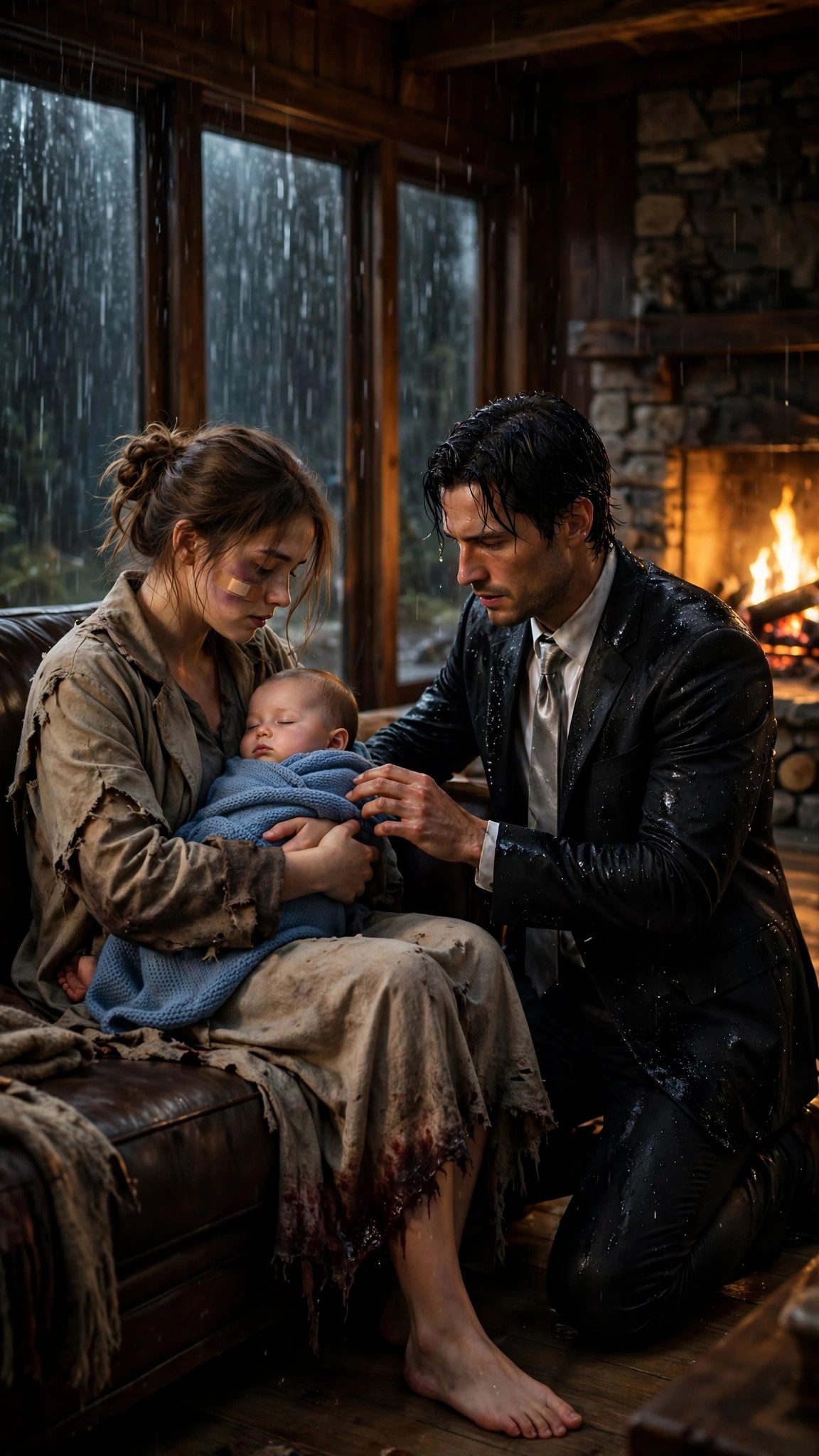
Blood had dried almost black along the hem of my torn beige coat, one shoe was gone, and my swollen face still burned where they had hit me — but none of that mattered, because the six-month-old baby sleeping against my chest was alive.
I had no idea that when Gabriel Kane finally walked through the safe-house door, the most feared man in Chicago would stop cold at the sight of me holding the child he had spent three terrifying hours trying to find.
My name is Claire Bennett, and I had never belonged anywhere near Gabriel Kane's world.
For two years, I worked quietly in the accounting division of companies he secretly controlled. Most people saw me as harmless — a soft-spoken woman in cardigans and sensible shoes who apologized when someone else bumped into her. Gabriel knew better.
The first time I entered his office, a senior manager had spent nearly an hour explaining how almost two million dollars had somehow "disappeared" from a construction subsidiary. I waited until he finished, slid a folder across Gabriel's desk, and said, "The money didn't disappear. Someone split it into seventeen smaller payments because they assumed nobody checks invoices under one hundred twenty thousand." I named the thief. I was right.
Gabriel promoted me within a week, though I never understood why he also moved my office into one of his most secure buildings. I thought he valued my work. I didn't know he had been watching me far more closely than that.
That night, none of it mattered.
My car had broken down before a downtown meeting, so one of Gabriel's drivers offered me a ride in the convoy. I should have known something was wrong when the GPS signal cut out. Fully loaded SUVs boxed us in beneath the Lower Wacker Drive tunnel. Men came from both sides. Gunfire cracked through the tunnel. Then someone grabbed baby Eli Kane.
They took me with him.
I got caught in the ambush by trying to protect Eli. They took us to an abandoned shipping warehouse near Hammond and zip-tied my hands while Eli screamed. In that moment, he panicked and demanded he be shut up. Here was the moment I understood what it meant to lose everything.
They are not taking this baby.
The zip ties were loose enough for me to work one hand free. When the guard stepped inside, I hit him with a fire extinguisher. Hard. I stole his key card, grabbed Eli, and ran through a service corridor while alarms screamed behind me. I slid into a maintenance drainage, making sure that the kidnapper didn't find them. Eli cried all the way. I hid them under the cabin until I could hear the helicopter. They were looking for a man named Asher.
Then I found the local surveillance camera. When I finally made it to the nearest exit, I reached Gabriel's Lincoln Park safe house. Then my body finally gave out.
The next thing I vaguely remembered was warmth, rain pounding against the windows, and Eli's tiny fingers curled into my coat collar as if he was afraid I'd disappear next. Somewhere nearby, a man whispered, "Don't wake her." Another voice answered, low and lethal. "What did you say?"
Even half-conscious, I knew that voice. Gabriel.
His security captain, Mason, didn't back down. "I said don't wake her, boss. Doctor says she's been through enough today."
Footsteps came closer. Then silence. I didn't open my eyes, but I felt someone kneel beside the sofa. A finger touched Eli's cheek. For one strange second, the room seemed to stop breathing.
I knew Gabriel's older brother and sister-in-law had died eleven months earlier. Eli was all Gabriel had left. His brother had never gotten a chance to see his nephew. Tonight, someone had gotten through Gabriel's security, slipped past his drivers, and taken his nephew. And I had brought him back.
Mason's voice came quietly from across the room. "She drove twenty-eight miles like that."
Gabriel said nothing. Then I heard him ask, almost too softly to recognize, "With those injuries?"
My eyelids finally fluttered open. Gabriel Kane was on one knee beside me, soaked from the storm, his black hair dripping rain onto his silver tie. But he wasn't looking at Eli anymore. He was looking at me. And the expression on the face of Chicago's most dangerous man made my heart stop.
That was how it started. But to understand why a woman like me ended up on a sofa in a mafia safe house with a baby that wasn't mine and the most feared man in Chicago kneeling in front of me, you have to go back to the beginning. Not to the tunnel. Not even to the morning my car broke down. You have to go back two years, to a grey Tuesday in an office nobody important ever visited, when I walked into a room full of men who thought numbers were boring and proved that numbers never lie.
I was twenty-seven then, and I had spent my whole life being the quiet one. I grew up in a small house in Evanston with a mother who taught piano and a father who fixed other people's cars and told me that the loudest person in the room is usually the one with the least to say. I learned to listen. I learned to watch. I learned that if you sit still long enough, people forget you are there, and when people forget you are there, they say the truth out loud.
I studied accounting because numbers made sense in a way people never did. Numbers did not flatter you. They did not lie to your face and steal from you behind your back. They added up, or they didn't, and when they didn't, there was always a reason. I liked reasons. I liked finding them.
My first job after college was at a mid-sized firm downtown, auditing freight companies. It was dull and honest work, and I was good at it in the way that quiet people are good at things nobody notices until something goes wrong. Then one afternoon, a recruiter called with an offer that paid almost twice what I was making, for a position in the accounting division of a holding company called Kane Meridian Group. I had never heard of it. I took the interview because the money would let my mother retire her piano students a year early, and I took the job because the man who interviewed me looked at my work the way my father used to look at an engine — like he could hear what was wrong with it before he opened the hood.
I did not know then that Kane Meridian was one of a dozen companies Gabriel Kane controlled, or that Gabriel Kane was the man the newspapers called the most feared in Chicago and never photographed. I did not know that the quiet office on the fourteenth floor, with its grey carpet and its humming fluorescent lights, sat inside one of the most secure buildings in the city. I only knew that my desk had a window, that my supervisor left me alone, and that the ledgers they gave me were messier than any I had ever seen.
Messy ledgers are a gift to a person like me. Most people see a mess. I see a map.
For the first year, I did ordinary work. I reconciled accounts. I flagged duplicate payments. I caught a vendor overcharging us by eleven thousand dollars over six months, and I wrote it up in a memo so plain and so polite that nobody could argue with it. My supervisor, a tired man named Harold Finch who had worked for the company for thirty years, read my memo twice and said, "Huh." Then he started giving me the files nobody else wanted. The files with the gaps. The files where the numbers almost added up, but not quite.
I liked those files best. A gap is a question, and I have never been able to leave a question unanswered.
It was a Thursday in October, eighteen months into the job, when Harold put a thick folder on my desk and said the construction subsidiary was missing almost two million dollars and nobody could find it. The subsidiary's senior manager, a loud man named Peter Aldous, had already spent an hour in a meeting explaining that the money had simply disappeared — market conditions, bad quarter, accounting error, nobody's fault, certainly not his. The meeting had ended with everyone nodding, because it is easier to nod than to ask a second question.
Harold didn't nod. He put the folder on my desk and said, "Take a look. Quietly."
I took the folder home that night. I spread the invoices across my kitchen table. I made tea I forgot to drink. And somewhere around midnight, I saw it — not one big theft, but seventeen small ones, each just under one hundred twenty thousand dollars, each routed through a different vendor name, each approved by the same signature. Someone had split the money into pieces small enough to slip under the review threshold, because they assumed nobody checks invoices under one hundred twenty thousand.
I checked invoices under one hundred twenty thousand. That was my whole job, as far as I was concerned.
The next morning I walked into Gabriel Kane's office for the first time. I had never met him. I had heard his name the way you hear a storm warning — from other people, in lowered voices, with a glance toward the door. Peter Aldous was already there, mid-sentence, explaining again how the money had disappeared. He stopped when I came in, the way a man stops when a waitress walks into a board meeting. He looked at my cardigan. He looked at my sensible shoes. He smiled the way men smile when they think a woman is about to apologize for being in the room.
I did not apologize. I waited until he finished. Then I slid my folder across Gabriel's desk and said, "The money didn't disappear. Someone split it into seventeen smaller payments because they assumed nobody checks invoices under one hundred twenty thousand."
The room went quiet. Gabriel Kane looked at me for a long time. He was younger than I expected — thirty-six, maybe thirty-seven — with black hair, grey eyes, and a face that gave away nothing at all. He opened my folder. He read the first page. He read the second. Then he looked up at Peter Aldous, and something in his expression made Aldous take a step backward.
"Is this true?" Gabriel asked him.
Aldous opened his mouth. Closed it. Opened it again. "There may have been some — irregularities — in the approval process —"
"You're fired," Gabriel said. He said it the way another man might say "the meeting is over." Then he turned back to me. "What's your name?"
"Claire Bennett," I said.
"You're promoted, Miss Bennett. Effective immediately." He stood up. The meeting was over. As I left, I heard him say to someone behind me, "Move her office. Fourteenth floor, east wing. The secure one."
I thought he valued my work. I didn't know he had been watching me far more closely than that.
I found out later, in pieces, the way you find out most things about Gabriel Kane — from other people, in lowered voices, when they thought I wasn't listening. He had been watching me for months before that meeting. Not because of the money. Because of the way I worked. Because I came in early and stayed late and never once asked for anything. Because I noticed things. Because I was the only person in the building who had ever looked at him the way you look at a problem you intend to solve, instead of the way you look at a man you intend to survive.
He moved my office into the secure wing because he wanted me close. He told himself it was about the work. Men like Gabriel Kane are very good at telling themselves stories. But the truth was simpler than that, and I would not understand it until much later, on a rainy night in a safe house, with a baby asleep on my chest and his hand reaching for mine.
The truth was that Gabriel Kane had been alone for a very long time, and he had just met the first person in years who was not afraid of him — because she had been too busy reading his numbers to notice she was supposed to be.
That was the beginning. The tunnel came later. The warehouse came later. The blood on my coat came later. But the story really started in that office, with seventeen small payments and a man who looked at me like I was the first honest thing he had seen in years.
I just didn't know it yet.
What I knew, in those first months after the promotion, was smaller and simpler. I knew my mother called every Sunday and asked if I was eating properly, and I lied and said yes, and she pretended to believe me. I knew my apartment in Evanston had a radiator that clanged at three in the morning and a window that looked out over a maple tree I had watched change color for two autumns. I knew I took the same bus every morning, sat in the same seat, and read the same kind of novels — the ones where the quiet girl turns out to be the one who saw everything.
I knew Gabriel Kane's name appeared in my inbox more often after the promotion. Not from him directly — never from him directly. From Harold, forwarding requests. From security, asking me to verify a signature. From a driver named Eddie, who started waiting by the elevator on the days I worked late, holding an umbrella he insisted I take, as if rain were a problem a woman in a cardigan could not solve on her own. I thought it was the company's way. I thought powerful men simply had more umbrellas.
And I knew, without quite knowing how I knew, that the building had changed around me. The guards at the east wing door learned my name. The woman at the front desk started saving the good parking validation for me. Once, when a delivery man raised his voice at me in the lobby because I had signed for the wrong box, a man I had never seen before appeared at my elbow and said, very quietly, "Is there a problem here?" The delivery man apologized three times and left. I never saw that man again, but I saw the shape of it — the invisible hand, arranging the world so that nothing touched me.
I should have asked questions. I should have wondered why a man like Gabriel Kane would spend that kind of attention on an accountant. But I was twenty-seven, and good at numbers, and terrible at understanding that I mattered to anyone. My mother had spent my whole childhood telling me I was too quiet for my own good. I believed her. I believed that the world belonged to loud people, and my job was to sit in the corner and add things up correctly.
So when my car broke down on the morning of the downtown meeting — the old sedan coughing once, twice, and dying at a red light on Division Street, steam curling up from under the hood like a sigh — I did what I always did. I called the office, apologized for something that wasn't my fault, and started walking toward the bus stop with my folder under my arm. I had taken four steps when a black town car pulled up beside me, and Eddie rolled down the window and said, "Miss Bennett. Get in. The convoy's leaving in ten minutes, and Mr. Kane's drivers don't wait for anyone."
I got in. I thanked him. I apologized for the trouble. And as the car pulled into traffic, I looked out at the city going past — the grey buildings, the grey sky, the ordinary morning — and I thought about how strange it was that my life, which had always been so small and so quiet, had somehow ended up inside a convoy of black SUVs, heading downtown with men who carried guns under their jackets.
That was the morning everything changed. I just didn't know it yet.