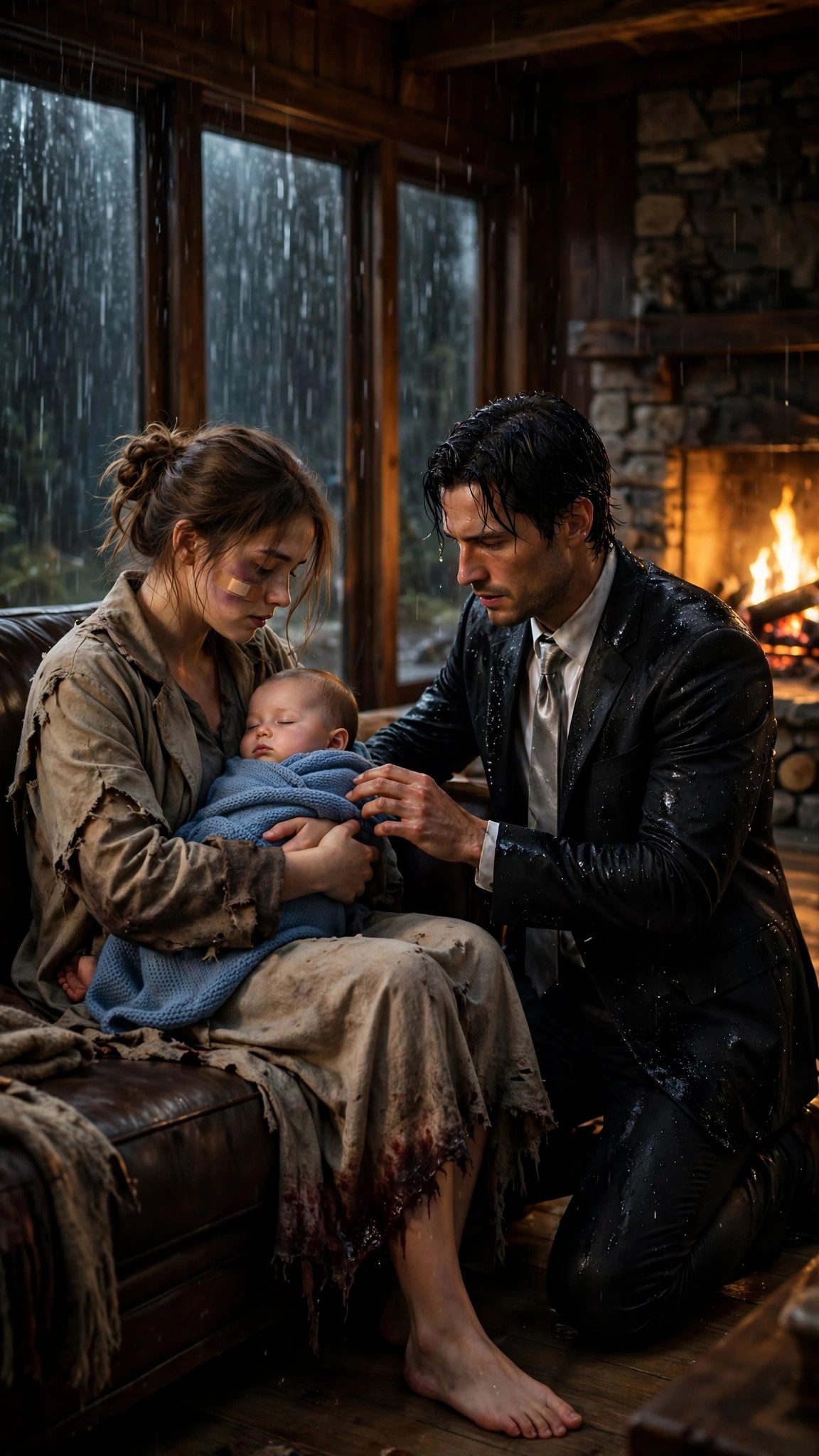
The house healed me slowly, the way houses do when they are full of people who care about you and don't know how to say it.
Dr. Reyes came every other day. She changed my bandages, checked my ribs, told me my wrist was healing "adequately" — which, from Dr. Reyes, was practically a compliment — and warned me, every single time, not to lift anything heavier than a teacup. I obeyed her, mostly. I lifted Eli anyway, because Eli did not weigh more than a teacup in my heart, even if he weighed considerably more than one in my arms, and because every time I tried to put him down, he grabbed my finger and held on, and I had learned by then that when Eli Kane grabs your finger, you stay.
Rosa fed me. Rosa fed everyone, all the time, as if food were the answer to every question and the cure for every wound. She made soup. She made bread. She made a chicken dish I had never heard of, with lemons and rosemary, that tasted like someone's grandmother had been cooking it for a hundred years. She put a plate in front of me three times a day and stood there with her hands on her hips until I ate it all, and when I tried to thank her, she waved me away and said, "Eat. Thanking is for people who have time. You need to heal."
Mason guarded me. Mason guarded everyone, all the time, as if danger were a weather condition that might change at any moment. He checked the locks twice a day. He walked the garden at night. He stood in the hallway outside my room until I told him, firmly, that I did not need a man standing outside my bedroom door, and he said, "Yes, you do, Miss Bennett. You just don't know it yet," and he stayed. I got used to his footsteps. I got used to the sound of him clearing his throat before he knocked. I got used to the fact that the most dangerous house in Chicago was also the safest place I had ever been.
And Gabriel — Gabriel courted me the way a man like Gabriel Kane courts a woman. Which is to say, awkwardly, and with great seriousness, and without ever once saying what he meant.
He brought me books. Not flowers — books. He noticed, somehow, that I read novels on the bus, and he started leaving them on the table beside my bed: old paperbacks, mostly, with cracked spines and pencilled notes in the margins. I asked him once where he got them, and he said, "Daniel's library," in a voice that told me not to ask again, and I understood that he was giving me something he had never given anyone. His brother's books. His brother's words. His brother's quiet.
He brought me tea. Not the tea Rosa made — his own tea, made the way he made his coffee, black with one sugar, in the chipped mug he had owned for a decade. He brought it to me in the morning, before his meetings, and he stood in the doorway of my room, holding the mug like it was a peace offering, and he said, "I made too much," which was a lie, because he had made exactly one cup, for me, and we both knew it.
He brought me Eli. Every evening, after his work was done, he brought Eli to my room, and he sat on the floor — the most feared man in Chicago, sitting on the floor in his shirtsleeves — and he watched me hold his nephew, and he watched Eli hold my finger, and he didn't say anything at all. He just sat there, and watched, and sometimes he smiled, a small, private smile, the smile of a man who has found something he thought he had lost forever.
It took me weeks to understand what he was doing. I was twenty-nine, and good at numbers, and terrible at understanding that I mattered to anyone. But one evening, when Eli had fallen asleep on my chest and Gabriel was sitting on the floor watching us, I looked at him, and I said, "You're not just bringing me books, are you?"
"No," he said. He didn't look away. "I'm not."
"And you're not just bringing me tea."
"No," he said. "I'm not."
"Then what are you doing?" I asked.
He was quiet for a long time. The room was warm. The lamps were low. Eli was asleep, his fist curled in my coat — a new coat, this one, soft grey wool, that Rosa had bought for me because my beige one was ruined, and that I wore everywhere because it was the first thing anyone had bought me in years.
"I'm trying to tell you something," Gabriel said, finally. "And I'm very bad at it. Men like me — we don't learn how to say things. We learn how to do things. We learn how to protect, and how to provide, and how to stand in a doorway so nothing gets past. But we don't learn how to say —" He stopped. He looked at Eli, asleep on my chest. He looked at me. "I don't know how to say it. So I'll say it the way I know how. You saved my nephew. You saved my family. You brought him home. And I want you to stay. Not as an employee. Not as a guest. As —" He stopped again. He took a breath. "As the woman who brought my family home. As the woman who is my family now. If you'll have me."
I didn't answer right away. I couldn't. My throat was closed, and my eyes were burning, and Eli was asleep on my chest, and the most feared man in Chicago was sitting on the floor in front of me, asking me to stay, and I was thinking about how small my life had been — the bus, the invoices, the cardigans, the apologies — and how, in the space of a few weeks, it had become something I didn't recognize. Something bigger. Something that had a baby in it, and a house in it, and a man in it who brought me books and made me tea and sat on the floor and watched me hold his nephew like it was the most important thing in the world.
"I don't know how to be in your world," I said, finally. "I don't know about convoys and safe houses and men with guns. I know about invoices. I know about numbers. I don't know how to be the woman in a mafia boss's house."
"You already are," Gabriel said. "You've been her since the night you hit a man with a fire extinguisher and drove twenty-eight miles with three broken ribs. You just didn't know it yet."
Twenty-eight miles. That was the distance from the warehouse to the safe house. Twenty-eight miles of rain and cold and fear, with a baby crying against my chest and my body giving out a mile at a time. I had driven those twenty-eight miles without thinking about it, because there was a baby who needed to get home, and I was the only one who could take him there.
And now Gabriel was telling me that those twenty-eight miles had been the beginning of something — not the end of something. That the woman who drove them was not the same woman who had gotten into Eddie's car that morning, apologizing for the trouble. That she was someone else now. Someone who mattered. Someone who belonged.
"I'll stay," I said. "But on one condition."
"Anything," Gabriel said.
"I want to keep working," I said. "I want my office. I want my numbers. I don't want to be a woman who sits in a house and waits for a man to come home. I want to be the woman who finds the thieves and names them and hands you the folder. That's who I am. That's what I do."
Gabriel smiled. It was the first real smile I had ever seen on his face — not the small, private one, not the careful one, but a wide, genuine smile, the smile of a man who has just heard exactly what he wanted to hear.
"Done," he said. "Your office is yours. Your numbers are yours. And if anyone in this building ever makes you feel like you are less than what you are, you tell me, and I will deal with it." He paused. "But Claire —"
"Yes?"
"You don't have to apologize anymore," he said. "Not to me. Not to anyone in this house. You saved my family. You don't owe anyone an apology for the rest of your life."
I laughed. I actually laughed, out loud, in a room with a baby asleep on my chest and a mafia boss sitting on the floor, and the laugh surprised me, because it had been so long since I had laughed like that — freely, without apologizing for it first.
"All right," I said. "No more apologies."
"Good," Gabriel said. He stood up. He came to the chair. He knelt beside me, the way he had knelt beside the sofa on the first night, and he put his hand over mine — my good hand, the one that wasn't splinted anymore — and he said, very quietly, "Then stay. Stay, and let me love you the way you deserve to be loved. Slowly. Properly. Like a man who has finally learned what home means."
Three weeks after I said I would stay, I went back to work.
It was strange, going back to the fourteenth floor, to my desk with the lake view, to the grey carpet and the humming lights. Harold Finch stood up when I came in, which he had never done before, and he said, "Miss Bennett," in a voice that suggested I had been promoted again without anyone telling me. The guards at the east wing door nodded at me. The woman at the front desk smiled. And on my desk, in the middle of my keyboard, someone had left a small stack of files — the files with the gaps, the files nobody else wanted — with a note on top in handwriting I recognized.
"Welcome back. — G."
I sat down. I opened the first file. And for the first time in weeks, I felt like myself again — not the woman in the safe house, not the woman with the stitches and the splint, but the woman who read invoices and found the truth in them. I worked all morning. I found a duplicate payment by eleven. I found a vendor overcharging us by nine thousand dollars by noon. I wrote it up in a memo so plain and so polite that nobody could argue with it, and I sent it upstairs, and an hour later Gabriel came down to my office himself — not summoned, not announced, just there, standing in my doorway in his black suit with his silver tie — and he said, "Good catch," and then he said, "Come to dinner tonight. At the house. Rosa is making the chicken with lemons. Eli has learned a new trick, and he won't show it to anyone but you."
I went to dinner. Eli's new trick was clapping — two small hands coming together, once, twice, with enormous concentration, followed by a look of such pride that the whole table laughed. Gabriel laughed. Mason laughed. Rosa laughed, and then she pretended she hadn't, and went back to the kitchen to get more bread. And I sat there, at a table in a house that wasn't mine, eating chicken with lemons, watching a baby learn to clap, and I thought: this is what a family looks like. Not the loud kind. Not the perfect kind. Just this — a table, and food, and people who show up, and a baby who has just discovered his hands.
A week later, Gabriel took me to the cemetery.
It was a Sunday, grey and quiet, and the cemetery was on a hill outside the city, with old trees and stones that had been there longer than any of us. Gabriel drove himself — no convoy, no guards, just the two of us in a black car, with Eli asleep in the back seat in his car seat, the way ordinary families drive to ordinary places on ordinary Sundays.
He parked by the gate. He got out. He opened my door. And we walked together, between the stones, to a plot under a maple tree, where two headstones stood side by side: Daniel Kane, and Anna Kane. Beloved brother. Beloved wife. The dates were too close together. The stone was too new. Someone had left fresh flowers — white roses, in a glass jar — and I knew, without asking, that Gabriel had been the one who left them, every Sunday, for eleven months.
"I come here every week," he said. He was standing with his hands in his pockets, looking at the stones the way a man looks at something he still can't believe is real. "I tell Daniel about the business. I tell Anna about Eli. I tell them both that I'm sorry. And then I go home, and I work until midnight, and that's how I talk about it. That's how I've always talked about it."
He was quiet for a moment. The wind moved through the maple tree. Eli made a small sound in his sleep.
"But today," Gabriel said, "I wanted to tell them something different. I wanted to tell them about you." He turned to me. "I wanted to tell my brother that the woman who saved his son is standing here, next to me. And I wanted to tell Anna that her baby is safe, and loved, and learning to clap, and that the woman who brought him home is going to be the one who teaches him how to be brave — because she already taught me."
I didn't say anything. I couldn't. I took his hand — his hand, rough and scarred and warm — and I held it, and we stood there together under the maple tree, with Eli asleep in the back seat and the white roses bright against the grey stone, and I understood that Gabriel Kane had just done the bravest thing he had ever done. Not facing Asher. Not facing his enemies. Facing his grief, in front of someone else, and letting her see it.
On the drive home, Eli woke up, and Gabriel handed him back to me, and Eli grabbed my finger, and Gabriel looked at us in the rearview mirror, and he smiled — the wide, genuine smile, the one I had seen only once before — and he said, "You know what Daniel would have said, if he could see this?"
"What?" I asked.
"He would have said, 'It's about time, little brother. It's about time you let someone take care of you for a change.'"
And I laughed, and Gabriel laughed, and Eli laughed — a small, bubbling laugh, like water coming up from a spring — and the car carried us home through the grey afternoon, toward the house with the warm lamps and the piano in the corner and the nursery on the top floor, toward the family we were becoming, one mile at a time.
And I said yes. I said yes, because how could I say anything else? I said yes, because the baby on my chest was asleep, and the man in front of me was kneeling, and the house around us was warm, and for the first time in my life, I understood what it meant to belong somewhere — not because someone had invited me, but because I had earned my place there, twenty-eight miles at a time.