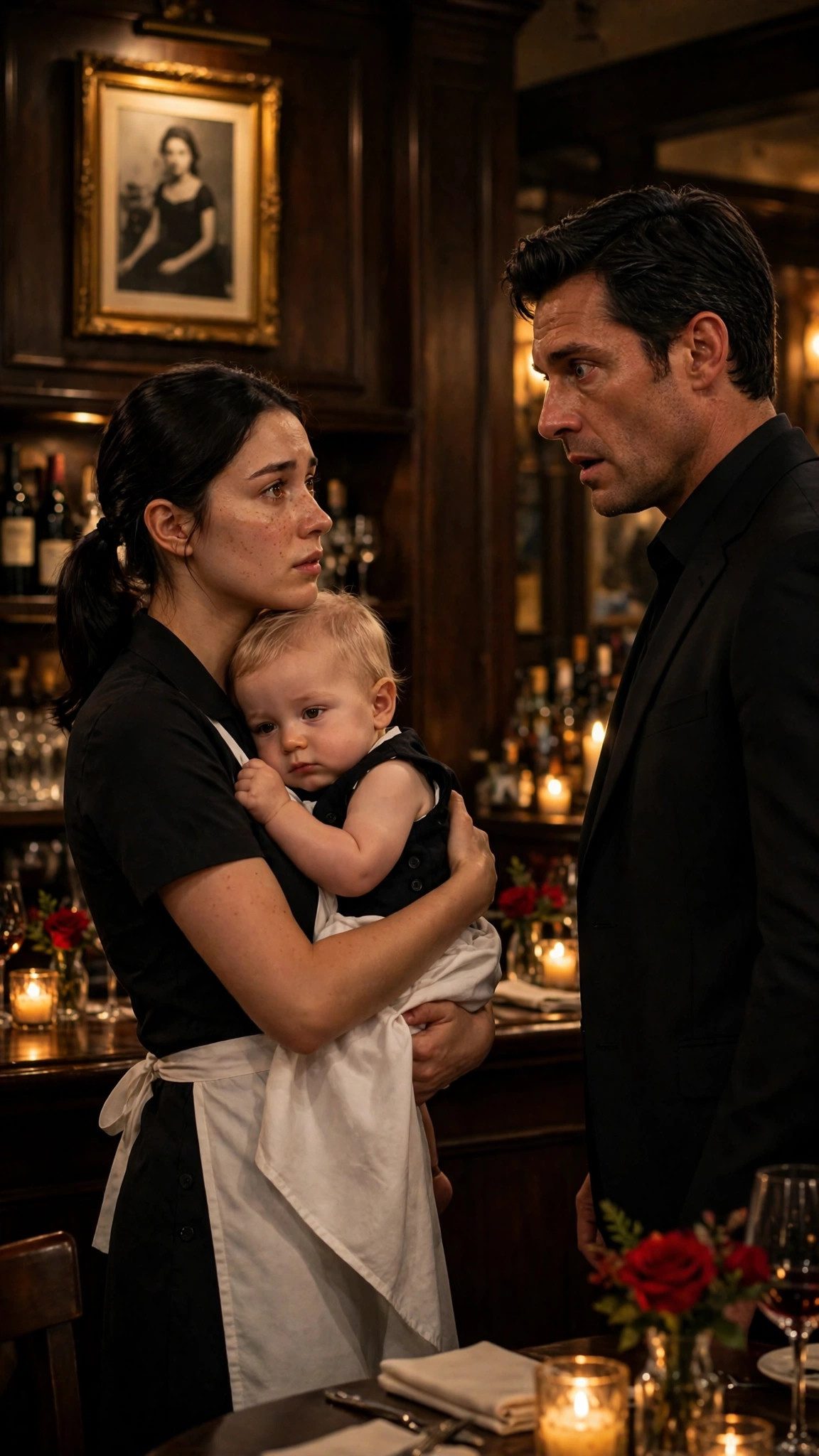
My name is Elina Valdez, and until that night, the biggest danger in my life was missing rent.
I was halfway through another miserable double shift at Ristorante Orelio when the entire dining room suddenly went silent. Not the polite quiet of people enjoying their food. The other kind. The kind where fifty conversations stop in the same second, like someone cut the power to the whole room.
Two men in black suits entered first. They scanned the room the way soldiers check a rooftop, slow and thorough, and I watched our hostess take a step backward without even realizing she was doing it. Then he stepped in.
A tall man in an expensive dark suit appeared in the middle of the room carrying a baby.
It was the first time I had seen him in person, but his face was the one every waitress in Chicago traded like a warning. Adrian Romano. The name alone could empty a bar. People said he owned half the city and buried the other half. People said he had not smiled since his wife died. People said a lot of things, and standing there with a tray balanced on my shoulder, I believed every single one of them.
The baby could not have been more than nine months old. Blonde hair, serious grey eyes, a tiny black vest over a white shirt, like a miniature version of the man holding him. He looked around the room with the calm, assessing stare of someone much older, and then his gaze found me.
My manager, Tony, appeared at my elbow so fast I nearly dropped the tray. "Do not make a mistake tonight, Elina," he whispered. "That is table twelve. You take it. You smile. You do not speak unless he speaks to you. Do you understand me?"
I understood that my rent was due in four days and I had exactly one hundred and twelve dollars in my bank account. I understood that Tony only gave the good tables to girls he liked, and he had never liked me. I understood that this was not a good table. This was a test, or a punishment, and either way I could not afford to fail it.
"Yes," I said.
I walked to table twelve with my order pad shaking in my hand, and I barely finished introducing myself before the baby stared at me.
Then he reached.
Not casually. Desperately. His little arms stretched toward me while his father tried to pull him back, and when the man tightened his hold, the baby began to cry. Not the tired cry of a hungry infant. A raw, frightened sound, like something inside him had finally broken open.
A chill moved through me. These were not ordinary details. A baby who rejected everyone, reaching for a stranger in a restaurant. A man the whole city feared, holding his son like the child might shatter. I backed away, planning to apologize for distracting the baby and escape politely before whatever this was became my problem.
Then the mafia boss's expression changed.
For one second, I saw something I did not expect. Panic. Real, unguarded panic on the face of Adrian Romano, and it frightened me more than his reputation ever had.
He turned to his men and spoke quietly, too low for me to hear. They stood and moved into the private dining area without a word, like furniture being rearranged. When they were gone, he looked directly at me.
"Hold him."
I stared at him. "Excuse me?"
"My son." His voice was low and rough, like a man who had not slept properly in months. "Hold him."
Every survival instinct I had told me this was a terrible idea. Hold the baby of the most dangerous man in Chicago. Hold him in front of a room full of witnesses. Hold him and become, in whatever way these people counted such things, involved.
But the child would not release me. His arms were still stretched toward me, his small fingers opening and closing, and his crying had sharpened into something desperate.
So I took him.
The instant his body touched mine, he melted against my chest. No crying. No fear. Just a deep little sigh, as though he had finally found something he had been searching for, and then his whole small weight settled into me like he belonged there.
The dining room had gone so quiet I could hear the ice shifting in someone's glass.
The mafia boss stared at us like he had seen a ghost.
"He won't let anyone hold him," he murmured. "Not the nannies. Not my sister. Nobody."
I swallowed. My heart was beating so hard I was certain the baby could feel it. "Then why me?"
His eyes hardened, but underneath the hardness there was something else. Something broken. "Only his mother could calm him like that."
My stomach turned cold.
Before I could answer, something behind him caught my attention. An old photograph hung beside the bar. I had walked past it hundreds of times in the two years I had worked at Orelio. I had never truly looked at it.
A young woman stood in the picture wearing a black dress. Dark hair framed her face. She had a small dimple in her left cheek. My dimple. My eyes. My smile. Almost my face.
The baby curled closer against me, his warm cheek pressed to my collarbone, his tiny fist curled into the fabric of my apron.
His father slowly followed my stare toward the photograph.
And for the first time that night, the most dangerous man in the room looked frightened.
Because the woman in that picture was not me.
But she could have been my twin.
And judging by his face, he knew exactly who she was.
"What is your name?" he asked. His voice had dropped even lower, and I realized the whole dining room was still watching us. Fifty people pretending not to stare at a waitress holding a mafia boss's baby.
"Elina," I said. "Elina Valdez."
Something moved behind his eyes at the name. Not recognition. Something closer to pain.
"Valdez," he repeated, very quietly, like he was tasting a word he had not said in a long time.
The baby had gone completely still against my chest. His breathing had slowed. One small hand had come to rest over my heart, and I could feel his fingers curl and uncurl in his sleep. He had fallen asleep. Just like that. In the arms of a stranger, in the middle of a crowded restaurant, the baby who rejected everyone had fallen asleep.
"I don't understand," I whispered.
"Neither do I," he said. "And I do not like things I do not understand."
He reached into his jacket and took out a plain white card. No name on it. Only a phone number, written in dark ink in a careful hand. He held it out to me, and I stood there stupidly, the baby asleep on my chest, until Tony appeared at my side and took the card for me like I was a child who could not be trusted with sharp objects.
"Mr. Romano," Tony said, bowing so low I thought he might fall over. "Please, forgive us, the girl is new, she did not mean to—"
"She did nothing wrong." Adrian Romano did not look at Tony. He was still looking at me. At my face. At the dimple in my left cheek, I realized, because his gaze kept returning to it like a man checking a wound. "Tomorrow. Ten in the morning. Bring her to the house."
Tony went pale. "Of course, Mr. Romano. Of course. Ten in the morning."
"No," Adrian said. "Not you. Her." He looked at me again. "Come yourself. If you do not come, I will send a car. It is better if you come yourself."
It was not a request. It was not quite a threat either. It was something in between, delivered in the calm voice of a man who was used to the world rearranging itself around his words.
Then, gently, so gently it shocked me, he reached out and lifted the baby from my arms. Matteo did not wake. He only made a small sound in his sleep and turned his face toward his father's chest, and Adrian Romano held his son with both arms, the way a man holds the only thing he has left.
He looked at the photograph behind the bar one more time. Then he looked at me.
"Ten in the morning," he said. And he walked out of the restaurant with his men falling in around him, and the baby asleep against his shoulder, and the whole dining room exhaled at once like a held breath finally released.
I stood there with my empty hands and my racing heart and Tony's furious whisper in my ear. "What did you do, Elina? What did you do?"
"I didn't do anything," I said. It was the truth. I had done nothing at all, and somehow that was the problem.
Tony shoved the white card into my apron pocket. "Ten in the morning. You heard him. You go, you smile, you do whatever he asks, and you do not make trouble for this restaurant. Do you understand me?"
I nodded, because my throat had closed and I could not speak.
The rest of the shift passed in a blur. I carried plates I did not remember picking up. I smiled at customers whose faces I did not see. Every time I passed the bar, my eyes went to the photograph, and every time, the woman in the black dress looked back at me with my own face.
Dark hair. Brown eyes. A small dimple in her left cheek. My dimple. My eyes. My smile.
I had walked past that photograph hundreds of times. Two years of double shifts, two years of carrying trays past that wall, and I had never once truly looked at it. Now I could not look away.
At midnight, when the last customer left and the chairs were going up on the tables, I stopped in front of it. The photograph was old, the edges softened with age, the glass dusty. The woman in it could not have been older than twenty-five. She wore a black dress and a thin gold chain, and she was laughing at something outside the frame, her head thrown back, her whole face lit up with joy.
She looked happy. She looked alive. She looked like me on the rare days when I forgot to be tired.
"Her name was Sofia," a voice said behind me, and I jumped so hard I nearly knocked a glass off the bar.
Old Mr. Orelio stood in the doorway of his office, leaning on his cane. He was seventy-eight years old and had owned this restaurant for forty years, and he looked at the photograph the way other men looked at church.
"She used to sing here," he said. "Friday nights. She had a voice like warm honey, and when she sang, the whole room would go quiet, just like tonight. She was the most beautiful thing this restaurant ever held."
"Who was she?" I asked.
Mr. Orelio was quiet for a long moment. "The wife of Adrian Romano," he said at last. "The mother of that baby. She died seven months ago." He looked at me then, really looked at me, and his old eyes narrowed. "You have her face, child. The same face. I have been watching you work here for two years, and I never saw it until tonight, when I saw you holding her son."
My knees went weak. I put a hand on the bar to steady myself.
"That's impossible," I said. "I don't have a sister. I don't have anyone. My mother died when I was three. My grandmother raised me, and she died two years ago. There is no one else. There has never been anyone else."
Mr. Orelio nodded slowly, like a man who had heard those words before and had learned not to argue with them. "Then the world is a stranger place than I thought," he said. "Go home, Elina. Sleep. Tomorrow will be a long day."
I walked home through streets that smelled of rain and garbage and fried food from the late-night carts, and all the way home I thought about the baby's weight against my chest. The deep little sigh he had made when he found me. The way his fist had curled into my apron like he was afraid I would disappear.
I thought about the woman in the photograph, laughing at something I could not see.
And I thought about the way Adrian Romano had looked at me. Not like a man looking at a waitress. Like a man looking at a ghost.
My apartment was cold when I got in. The radiator had been broken since November, and the landlord had stopped pretending he would fix it. I stood under the hot water in the shower until it ran cold, and then I sat on my bed in my towel and took the white card out of my apron pocket.
A phone number. Nothing else. I turned it over. On the back, in the same careful hand, someone had written an address.
I knew that address. Everyone in Chicago knew that address. A house on a hill behind iron gates, where the most feared man in the city lived with a baby who would not let anyone hold him.
Ten in the morning. I would go, because I had no choice. Because men like Adrian Romano did not make requests, and because waitresses who missed rent did not say no to the most powerful man in Chicago.
But as I lay in the dark, listening to the radiator clank and the city hum outside my window, one thought kept turning over and over in my mind, and I could not make it stop.
The baby had reached for me. Not for his father. Not for his aunt. Not for any of the nannies who had tried and failed for seven months.
He had reached for me.
And his mother, dead seven months, had my face.
Somewhere between exhaustion and fear, I fell asleep, and I dreamed of a woman in a black dress singing in a restaurant that smelled of garlic and red wine, and a baby in a tiny black vest reaching for me with both arms, and a man with grey eyes whispering, "Only his mother could do that."
I woke before dawn with the card still clutched in my hand and the feeling, deep in my chest, that my life had already changed, and there was no going back to the girl who had only ever worried about rent.