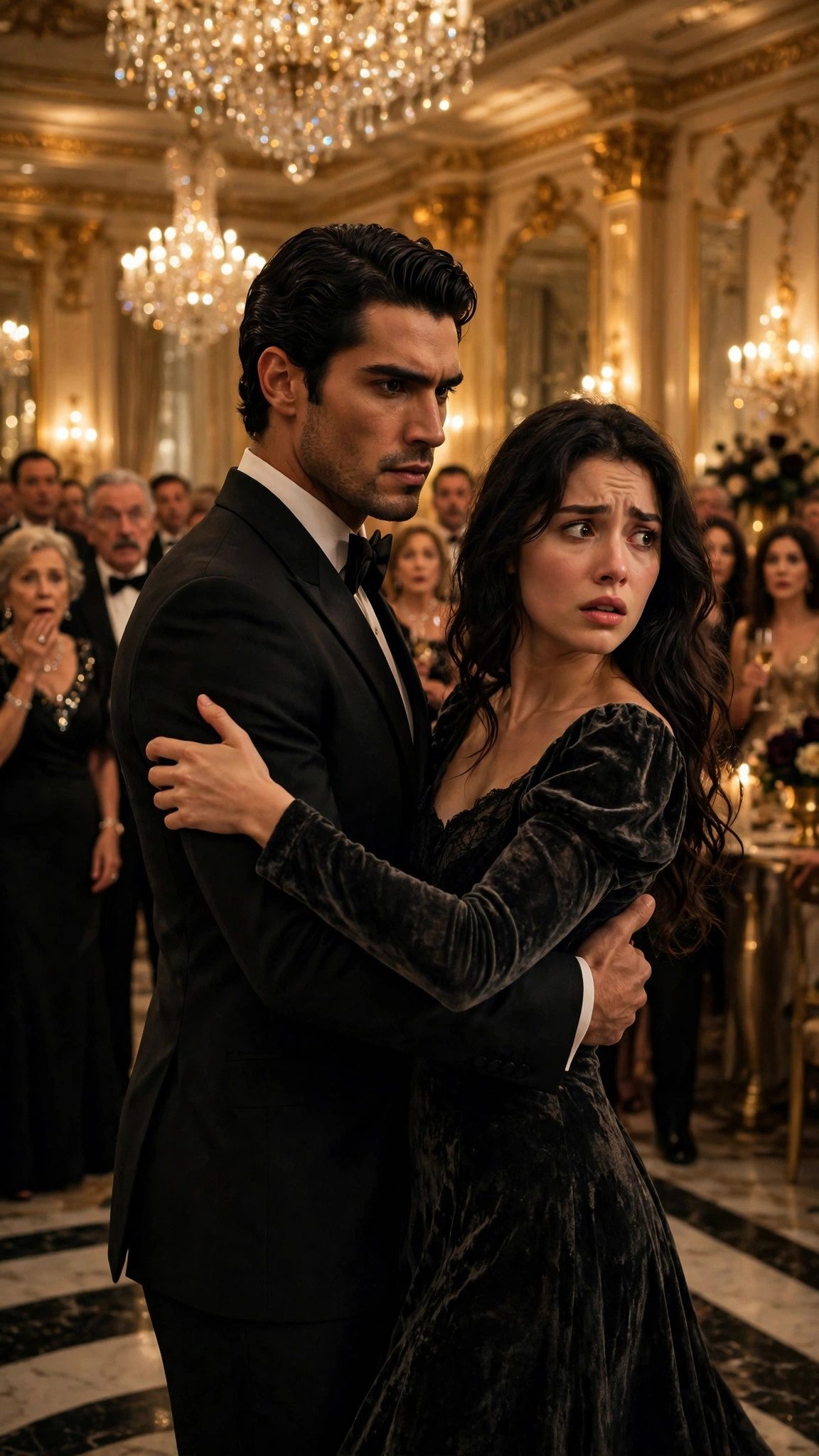
The most feared mafia boss in New York asked me to marry him in front of four hundred people, and everyone in the ballroom laughed because they thought he was humiliating me.
They were wrong. He was not humiliating me. He was claiming me, and by the next morning, a diamond ring arrived at my apartment beside proof that my brother's four-hundred-thousand-dollar debt had vanished.
My name is Josephine Gallagher. I am twenty-six years old, a Juilliard dropout, and on December 14, 2018, I was sitting at a grand piano in the Pierre Hotel wearing a faded black velvet dress, playing Chopin for people who did not hear a single note.
The gala was officially a charity event for pediatric hospitals. Crystal chandeliers, white roses, men in tuxedos who smiled with their mouths and not their eyes. Everyone in that glittering ballroom knew the truth: the Valenti crime family had gathered beneath the chandeliers to conduct business no invitation would ever mention. I was not a guest. I was furniture that could play the piano.
I had three rules. Do not make eye contact. Do not stop playing. Never speak to Carmine Valenti.
Carmine was thirty-four, dressed in a flawless black tuxedo, and terrifying precisely because he never needed to raise his voice. Three years earlier, he had taken control of the family after a bloody internal war, and the FBI still could not connect him to a single crime. He stood in a circle of men near the bar, a glass of bourbon in his hand, and the whole room bent around him the way iron filings bend around a magnet.
I kept my eyes fixed on the keys and played on. Chopin, then lighter music as the night grew louder and the bourbon flowed. I tried to disappear into the background, the way I always did. I was good at disappearing. I had been disappearing for years.
Then Carmine left his circle of men and walked directly toward my piano.
The ballroom fell silent. Conversations stopped mid-sentence. Even the waiters froze. I felt his shadow fall across the keys before I saw him, and my fingers stumbled on a note for the first time in my life.
"Chopin is too depressing for a party, don't you think, Ms. Gallagher?" he asked.
Hearing my name in his voice sent ice through me. He knew my name. Of course he knew my name. He knew everything about everyone in his orbit. That was the point of him.
"What would you prefer, Mr. Valenti?" I asked, and my voice sounded steadier than I felt.
He studied my worn dress and frightened face with a dangerous smile. "Play a waltz and dance it with me."
My hands froze above the keys. "I can't play and dance at the same time."
"I already have the music ready," he said. "All you have to do is stand up and dance with the devil."
Then he raised his voice so everyone could hear. "If you dance this waltz with me, Josephine, I'll marry you."
The room erupted in forced laughter. His underboss, Lorenzo Ricci, a broad man with silver at his temples, joked that Carmine had finally lost his mind, and the laughter spread like a wave, relieved and cruel at once. They thought it was a joke. A rich man amusing himself with the piano girl.
My brother's life depended on my answer.
Liam owed four hundred thousand dollars to a loan shark tied to the Valenti syndicate. I had agreed to perform at their private events, slowly paying interest on a debt I could never realistically erase, to keep my brother from disappearing into the East River. If I refused Carmine Valenti in front of his entire family, Liam would not survive the week. If I accepted, I did not know what would happen to me. But I knew what would happen to Liam if I said no.
I stood and stepped onto the marble floor.
Shostakovich's Waltz No. 2 filled the ballroom as Carmine took my hand and pulled me close. His grip was firm and warm, and his other hand settled at my waist with a certainty that made my breath catch. We moved beneath the chandeliers while everyone watched. To them, it looked romantic. To me, it felt like walking a tightrope over an open grave.
"You're shaking," he whispered near my ear.
"My brother owes you four hundred thousand dollars," I replied, and I did not know where the courage came from. "If I step on your foot, will you kill him tonight?"
His hand tightened at my waist. "If you step on my foot, I'll marry you tomorrow instead of waiting."
I almost laughed. It came out as a gasp. "That's not an answer."
"It is the only answer you need," he said. "Dance, Josephine."
So I danced. I had not danced since I was sixteen, since my mother was still alive and my father still tuned pianos in our little apartment in Queens and the world still made sense. But my body remembered what my mind had forgotten, and Carmine Valenti led like a man who had been born to lead, turning me through the light and the music and the watching eyes, and for three minutes I forgot to be afraid.
When the music ended, Carmine released me and bowed. "A deal is a deal," he announced to the room. "Expect my ring in the morning."
I assumed it was another cruel joke. Men like Carmine Valenti did not marry piano girls in faded dresses. Men like him married daughters of other powerful men, women with names that opened doors. I went home that night on the subway, my dress damp with sweat beneath my coat, and I told myself it was over, that I had survived another evening, that Liam was safe for one more day.
At exactly nine the next morning, someone knocked on my apartment door.
Lorenzo Ricci stood in my hallway carrying a black velvet box and a thick envelope. He did not smile. He did not apologize for the hour. He simply held them out to me and said, "Mr. Valenti keeps his word, Ms. Gallagher."
Then I opened the ring box. A diamond the size of a small flame caught the morning light, and beneath it lay a handwritten card in a bold, slanted hand.
Dinner. My estate. Eight o'clock. Come alone.
I should explain how I got there. Not to the apartment, with a diamond ring burning a hole in my palm. To the piano. To the debt. To the night a mafia boss asked a girl nobody noticed to dance, in front of everyone, as if she mattered.
My father, Daniel Gallagher, tuned pianos for a living. He had hands that could coax a dead instrument back to life, and he taught me to play before I could read. My mother, Anne, sang in the church choir and laughed at his terrible jokes and kept our little apartment in Queens full of secondhand sheet music and the smell of fresh bread. I was the girl with the gift, the teachers said. Juilliard at eighteen, a scholarship, a future.
Then my mother died when I was seventeen. An aneurysm, sudden and unfair, gone between one breath and the next. My father never recovered. He kept tuning pianos and drinking whiskey and telling me to practice, but the light went out of him, and two years ago, his heart gave out in the middle of a customer's living room, his hands still on the keys.
Liam was twenty-four when our mother died, and he took it hardest of all. He had always been the charming one, the reckless one, the boy who could talk anyone into anything and believed his luck would never run out. After our father died, the luck ran out. He started gambling to pay the rent, then gambling to pay the gambling debts, then borrowing to pay both. By the time I found out, he owed money to men whose names I was afraid to say out loud.
Nico Falco was the worst of them. A loan shark with a soft voice and dead eyes, who worked for the Valenti syndicate and collected their debts with a smile. Liam owed him four hundred thousand dollars. Falco came to our apartment one rainy Tuesday in October and laid out my options with the politeness of a funeral director. Liam could pay, which he could not. Liam could run, which would last about a week. Or I could play the piano at Valenti family events, and every performance would count against the interest, and Liam would stay alive as long as I kept showing up and kept playing and kept my eyes on the keys.
I agreed. What else could I do? He was my brother. He was all I had left.
So I dropped out of Juilliard in my final year, gave up the scholarship and the recitals and the future, and I became the girl at the piano in rooms full of dangerous men. I wore the same faded black velvet dress to every event because it was the only dress I owned that looked like it belonged in a ballroom. I learned the rules and I obeyed them. Do not make eye contact. Do not stop playing. Never speak to Carmine Valenti.
I broke the third rule the night he spoke to me first. I broke all of them by the time the waltz ended.
That morning, after Lorenzo left, I sat on my narrow bed with the ring box open on my lap and the envelope unopened beside me. The diamond threw rainbows across my cracked ceiling. I thought about my mother, who had wanted me to play concert halls. I thought about my father, who had wanted me to be brave. I thought about Liam, asleep on my couch more nights than not, a grown man who still flinched at loud noises and called me Jo when he was scared.
Then I opened the envelope.
Inside were papers. Loan documents, stamped in red. PAID IN FULL. And a single sheet of heavy cream paper, the same bold handwriting as the card.
The debt is gone. Your brother is safe. The rest is up to you. — C.
I read it three times. The debt is gone. Four hundred thousand dollars, gone, because I had danced one waltz. I should have felt relief. Instead I felt something colder and stranger: the ground shifting under my feet, the sense that the life I had been living — the piano, the rules, the fear — had ended the moment Carmine Valenti crossed the ballroom floor.
Liam came home just after noon, and I heard him before I saw him, the way I always did — the heavy tread on the stairs, the key fumbling in the lock, the long sigh as he dropped his jacket on the floor. He froze in the doorway when he saw me sitting on the bed with the ring box open.
"Jo," he said. "What is that?"
I closed the box gently and set it aside. "Sit down, Liam."
He sat on the floor across from me, the way he used to when we were children and our mother was telling us a story. He was twenty-nine years old, tall and broad-shouldered, with our father's dark hair and our mother's green eyes, and he looked like a man who had been running for a very long time.
"Carmine Valenti asked me to marry him last night," I said. "In front of everyone. As a joke, I thought. This morning his underboss brought me this ring. And the debt papers. Stamped paid."
Liam stared at me. "The debt is gone? All of it?"
"All of it. You're safe."
He covered his face with his hands, and his shoulders shook. I had not seen my brother cry since our mother's funeral. I went to him and put my arms around him, and he held on to me like he was drowning.
"I'm sorry, Jo," he whispered. "I'm so sorry. I never meant for any of this to touch you. I thought I could win it back. I thought I could fix it myself."
"I know," I said. "I know."
We sat like that for a long time, on the worn rug in the middle of our tiny apartment, while the city moved on outside the window. When he finally pulled away, his eyes were red, but his voice was steady.
"Don't marry him, Jo. Not for me. I'll disappear. I'll go to California, to Canada, anywhere. I'll work on a fishing boat. I'll change my name. Don't sell yourself to that man because of my mistakes."
"Liam," I said. "He didn't buy me. He made a promise in front of four hundred people, and he kept it. I danced one waltz. That's all. I haven't agreed to anything else. He invited me to dinner tonight, and I'm going, because I need to know what he actually wants. And because if I don't go, he'll come looking, and men like Carmine Valenti don't like to be ignored."
"Then I'm coming with you," Liam said.
"No. The card said come alone. And if anything goes wrong, I need you alive and free, not sitting in his dining room. Stay here. Lock the door. If I don't call you by midnight, you go to the police and you tell them everything."
He wanted to argue. I could see it in his face. But he knew me, and he knew that when I made up my mind, it stayed made. He nodded slowly.
"Jo," he said. "Whatever he wants — you don't owe him anything. You already paid enough. You gave up Juilliard for me. You gave up everything for me."
"I didn't give up anything," I told him, and it was almost true. "I played the piano. That's what I do. Now go make coffee. I need to think."
He went to the tiny kitchen, and I sat with the ring box in my hands, turning it over and over, watching the diamond catch the light. I thought about what my father used to say when a piano was beyond repair: sometimes you don't fix the instrument, you learn to play a different song.
At seven o'clock that evening, I put on the faded black velvet dress again, because it was the only dress I owned. I pinned my long dark hair up the way my mother used to wear hers. I looked at myself in the cracked mirror above my sink and barely recognized the woman staring back. Her eyes were frightened. But her chin was up.
Dinner. His estate. Eight o'clock. Come alone.
I had no idea what waited for me at the end of that road. I only knew that my brother was safe, that the debt was gone, and that the most feared man in New York had kept his word to a girl nobody noticed.