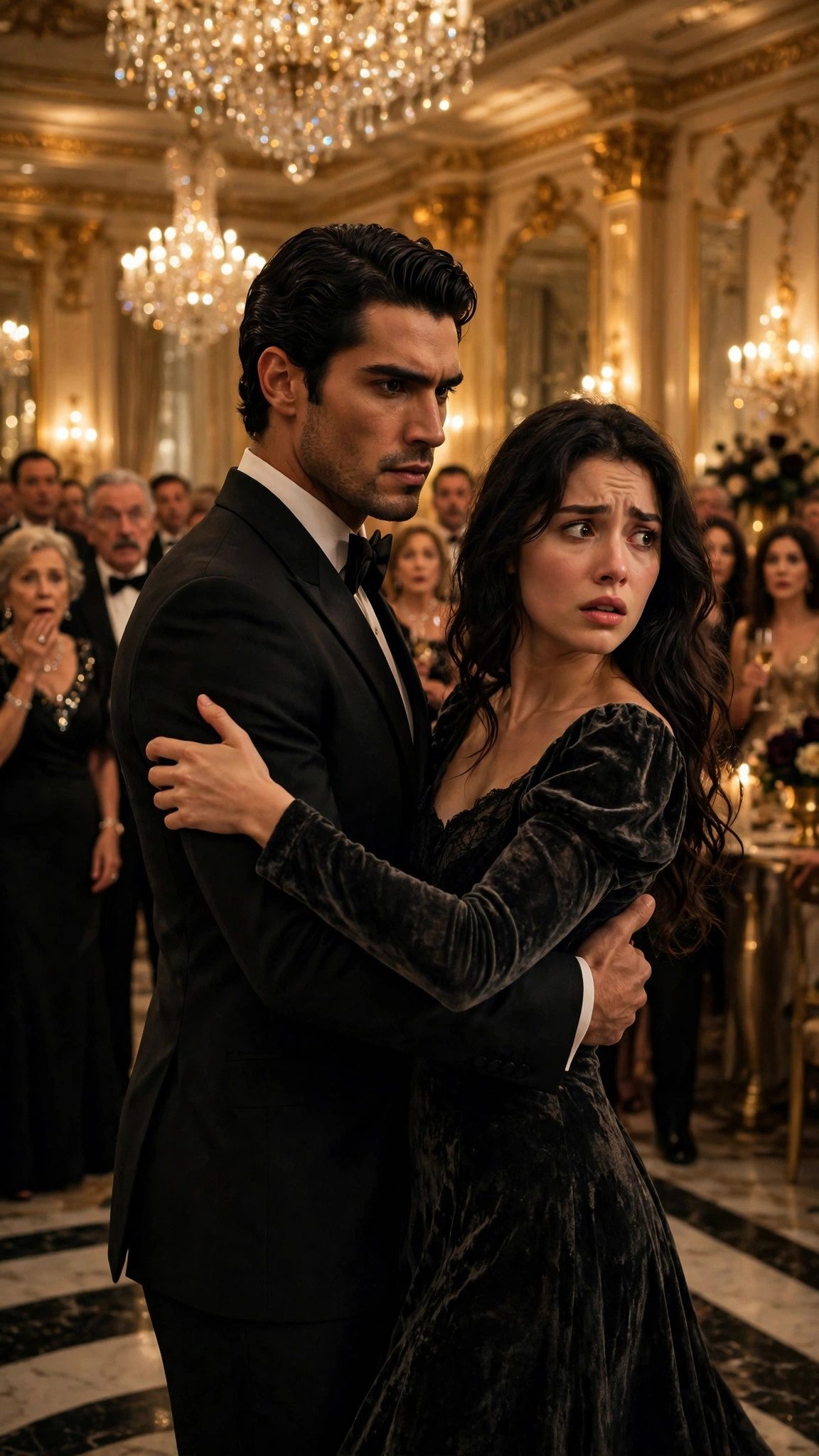
The car came for me at half past seven.
It was black and long and silent, with a driver who opened the door without a word and did not look at my dress. I slid into the leather seat and watched Queens fall away behind me, the bodegas and the laundry lines and the little apartment where I had grown up giving way to bridges and then to Manhattan and then to roads I had never traveled, lined with stone walls and bare winter trees.
I had time to think. I had too much time to think.
I thought about Juilliard first, because that was where the story really began — not at the gala, not at the piano in the Pierre Hotel, but in a practice room on the fourth floor of a building on Broadway, where I was eighteen years old and certain that the world belonged to people who could play Chopin the way I could.
I had won the scholarship when I was seventeen. My mother cried when the letter came. My father tuned the old upright in our living room until it sounded like a concert grand, and he told everyone in the neighborhood that his daughter was going to play Carnegie Hall. For three years, I believed him. I practiced six hours a day. I played recitals. My teachers said I had the touch, the thing you cannot teach, the thing that makes an audience hold its breath.
Then my mother died, and everything changed. Not all at once. Grief is not a storm. It is a slow leak. My father stopped eating properly. He stopped sleeping. He kept tuning pianos because his hands did not know what else to do, but the music went out of our apartment like air out of a tire. Liam left home at twenty-one, swearing he would make money and come back and take care of us all. He came back two years later with a nice suit and a nicer watch and a story about a business opportunity that I did not believe for a single second.
My father died in the spring of my third year at Juilliard. A customer called me from his living room, her voice shaking, and said my father had collapsed beside the piano. By the time I got there, it was over. A heart attack, the doctors said. His heart had simply stopped, the way a piano string snaps when the tension finally becomes too much.
I buried him next to my mother in a cemetery in Queens, under a plain stone with both their names on it. Liam paid for the funeral with money I did not ask about. I should have asked. That is the thing I will regret for the rest of my life. I should have asked where the money came from.
I went back to Juilliard because I did not know what else to do. I played my final-year recital with a hole in my chest the size of a fist, and my teachers told me it was the most honest performance I had ever given. Grief, it turned out, was good for the music and terrible for everything else.
Then, in October of my final year, Nico Falco came to my practice room.
I had never met him before. He was a small man with a soft voice and dead eyes, wearing a coat that cost more than my father's piano. He waited until I finished playing, and then he applauded, slowly, the way a man applauds when he is not enjoying the music but appreciating its value.
"Your brother owes my employers four hundred thousand dollars, Ms. Gallagher," he said. "He borrowed it to cover his gambling debts, and then he borrowed more to cover the borrowing, and now the interest alone is more than he will earn in a year. He has two weeks to pay, or my employers will collect from him in other ways."
I told him I had no money. I told him I was a student. I told him to leave me alone. He smiled and handed me a card with an address on it, and he told me that the Valenti family had need of a pianist for their private events, and that every performance would count against the interest, and that as long as I played, my brother would stay alive.
"And if I refuse?" I asked.
"Then your brother will be found in the East River by the end of the month," Falco said, "and no one will be surprised, because gamblers drown all the time."
I went to Liam that night. He was living in a furnished room above a bar in Hell's Kitchen, and he looked ten years older than his age. He did not deny anything. He sat on the edge of his unmade bed and told me the whole story, how it had started with poker, how the wins had felt like proof that he was special, how the losses had felt like accidents, how he had borrowed from Falco because Falco was the only man who would lend to him, and how the debt had grown like a living thing while he slept.
"I was going to win it back," he said. "I was so close, Jo. One good night, and I could have paid it all."
"There is no good night," I told him. "There never was."
I dropped out of Juilliard the next week. I gave up the scholarship and the recital hall and the future my father had dreamed about, and I went to work for the Valenti family. The first event was a birthday dinner in a private room at a restaurant in Little Italy. I wore my faded black velvet dress, and I played for three hours while men in expensive suits talked about things I was not supposed to hear, and nobody looked at me once. That was the night I made my rules. Do not make eye contact. Do not stop playing. Never speak to Carmine Valenti.
I did not know then that Carmine Valenti had already noticed me.
I learned that much later, from Lorenzo, on a night when the bourbon had loosened his tongue. Three years ago, Carmine's father, old Roberto Valenti, had died, and the family had hired a pianist for the funeral. A young woman from Juilliard, the agency said. She played Chopin in a small chapel in Brooklyn while the most dangerous men in New York stood with their heads bowed, and for ten minutes, nobody thought about money or territory or revenge. Carmine never forgot it. He asked the agency for her name. Josephine Gallagher. He kept it in the back of his mind like a man keeps a song he heard once and cannot get out of his head.
When he took control of the family after the war, he put her name on the roster for his private events. He never spoke to her. He never looked at her directly. He simply listened, night after night, while she played in the corner of rooms full of men who would have killed each other over a parking space.
He had his reasons for the silence, and they had nothing to do with me. They had to do with his uncle.
Salvatore Valenti was sixty-three years old, Carmine's father's younger brother, and he had expected to inherit the family when Roberto died. He had spent thirty years as the second man, the one who did the dirty work and never got the credit, and he believed the seat was his by right. When the family council chose Carmine instead — younger, colder, smarter, the son Roberto had trained since boyhood — Salvatore smiled and congratulated his nephew and went home to plan his revenge.
The war lasted eight months. It was not a war of gunfire in the streets. The Valenti family did not work that way. It was a war of warehouses burning in the night, of shipments disappearing, of men changing sides in the dark. Three of Carmine's closest friends died. Salvatore's eldest son, Marco, was shot in the leg and walked with a limp ever after. In the end, Carmine won, because he was willing to do the one thing Salvatore was not: he was willing to lose money to win loyalty. He paid his men's families. He kept his word. He never raised his voice.
But the victory came with a condition, written into the family charter by Carmine's grandfather seventy years earlier. The head of the Valenti family had to be married by his thirty-fifth birthday, or control of the family trust — the money, the properties, the legitimate businesses that laundered everything else — would pass to the eldest Valenti male. That was Salvatore.
Carmine's thirty-fifth birthday was January 20, 2019. Five weeks after the gala.
He had five weeks to find a wife, or his uncle would take everything he had bled for.
He could have married the daughter of any family in New York. There were women whose fathers would have paid for the privilege. But a wife from a rival family would have been a spy in his house, a hostage to her father's ambitions. A wife from his own family would have tied him to Salvatore's bloodline. He needed a woman with no connections, no family to use her, no reason to betray him — and he needed her quickly.
He needed a woman he already trusted.
And the only woman in New York he trusted was the girl at the piano who had never once looked up from the keys.
The first time I played at the Pierre Hotel, I nearly ran away.
It was a Valenti event, a dinner for fifty men in a private ballroom, and I arrived two hours early because I was terrified of being late. The piano was a Steinway grand, black and gleaming, and I sat down and played scales to warm up, and the sound filled the empty room like water filling a glass. For a few minutes, I forgot where I was. I forgot about Falco and the debt and Liam's face when he told me the truth. I just played.
Then the room began to fill, and I remembered. I lowered my eyes to the keys and I did not lift them again for three hours.
That was how it went, event after event. A wedding in Long Island. A christening in Brooklyn. A dinner in a restaurant with no name on the door. I played, and the men talked, and the women in their glittering dresses pretended not to notice the girl in the faded dress. Once, a woman in diamonds leaned close to her husband and whispered, loud enough for me to hear, "Who is the piano girl? She plays like an angel." Her husband said, "She's nobody. Don't look at her." I kept playing. I had learned that being nobody was the safest thing a girl could be in those rooms.
But Carmine Valenti was not like the others. I learned that slowly, the way you learn the weather in a new city — not all at once, but day by day, until you know it in your bones.
The other bosses shouted. Carmine never raised his voice. The other bosses surrounded themselves with men who flattered them. Carmine surrounded himself with men who told him the truth, and he paid them well for it. The other bosses took what they wanted. Carmine waited. I watched him at those events, always from the corner of my eye, always careful never to be caught watching, and I saw a man who treated waiters with the same courtesy he treated his underboss, a man who remembered the names of his drivers' children, a man who once sent a bottle of wine to a rival's table with a note that said, "For your mother's birthday. No hard feelings."
That did not make him good. I knew that. Men like Carmine Valenti did not become good by being polite. But it made him different, and different was enough to keep me from hating him, which was more than I could say for most of the men in those rooms.
There was one night, a few months before the gala, when I saw something that stayed with me. It was a dinner at a house in Staten Island, and I was playing in the corner, and an old woman came into the room — small, white-haired, leaning on a cane. The whole room went quiet. Carmine stood up, crossed the room, and took her arm, and he bent down and kissed her cheek, and he called her Mama, and his voice was softer than I had ever heard it. She was Rosa Valenti, his mother, the widow of Roberto, and she looked at her son the way my mother used to look at me — with love, and with worry, and with the knowledge that the world was going to hurt him.
"Are you eating enough, Carmine?" she asked, loud enough for the room to hear. "You look thin."
"I eat, Mama," he said.
"You work too much," she said. "A man needs a wife. A man needs a family. Your father would want that."
Carmine smiled and guided her to a chair. "One day, Mama," he said. "One day."
I never forgot that moment. It was the first time I saw the man behind the name, the boy who still wanted his mother to be proud of him. It was also the first time I understood that Carmine Valenti was lonely, in the way that only a man at the top of a mountain can be lonely — surrounded by people, and completely alone.
That was what I did not know, sitting in the back of that black car on the night of December 15, watching the stone walls slide past the window. I thought I was going to dinner with a man who had bought me as a joke. I did not know I was going to dinner with a man who had been listening to me play for months, who had chosen me the way a man chooses the one honest thing in a dishonest world.
The car turned through iron gates and climbed a long drive lined with bare trees. The estate rose out of the dark like something from a dream — a great stone house with warm light in every window, gardens gone to sleep for the winter, a fountain frozen in mid-splash. A man in a dark suit opened my door. Lorenzo Ricci waited on the steps, his hands folded in front of him.
"Ms. Gallagher," he said. "Mr. Valenti is waiting in the dining room."
I climbed the steps on shaking legs, my faded dress whispering around my ankles, and I walked into the house of the devil to find out what he wanted from me.