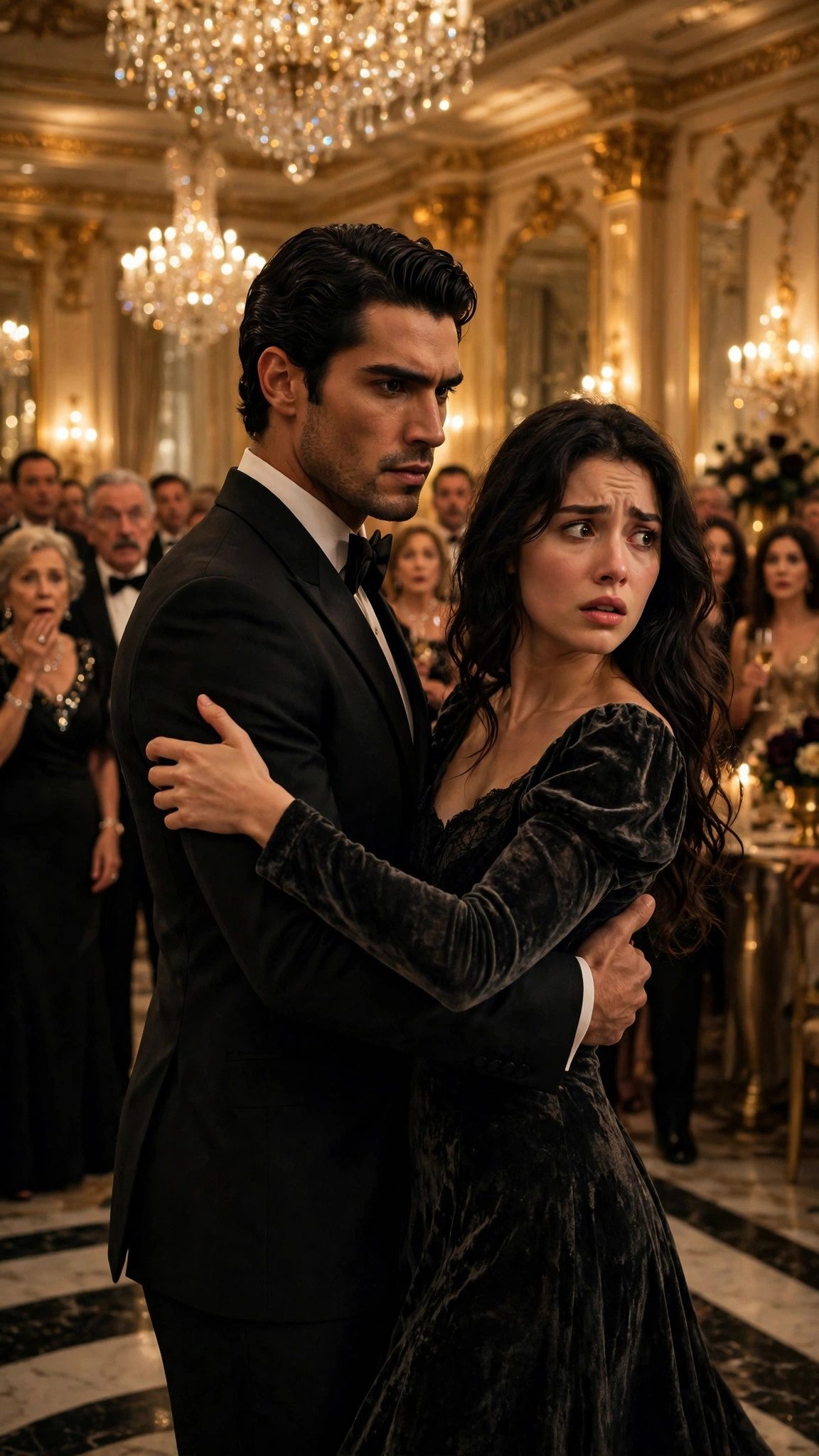
The dining room was the most beautiful room I had ever seen, and I hated it on sight.
It was long and low-ceilinged, paneled in dark wood, lit by candles in silver holders and a fire crackling in a stone fireplace. A table set for two stood near the windows, white cloth, crystal glasses, a single vase of white roses. Beyond the windows, the gardens lay in darkness. Carmine Valenti stood beside the table in a dark suit, no tie, his collar open at the throat, and he looked less like a mafia boss and more like a man waiting for a train that might never come.
"Josephine," he said. "Thank you for coming."
"I didn't have much choice," I said, and immediately regretted it. But he smiled, a small, real smile that changed his whole face.
"No," he agreed. "You didn't. Sit down, please."
A waiter in a black jacket poured wine into my glass and stepped back into the shadows. Carmine watched me the way a man watches a wild animal he is trying not to frighten.
"You're wondering why I did it," he said. "Why I proposed to you in front of four hundred people."
"I assumed it was a joke," I said. "A cruel one."
"It wasn't a joke. It was a necessity." He picked up his glass and set it down again without drinking. "My grandfather wrote our family charter seventy years ago. The head of the Valenti family must be married by his thirty-fifth birthday, or control of the family trust passes to the eldest Valenti male. That is my uncle Salvatore. My birthday is January twentieth. I have five weeks."
I stared at him. "You need a wife in five weeks."
"I need a wife I can trust in five weeks. There is a difference." He leaned forward, his dark eyes fixed on mine. "I could marry the daughter of any family in this city. Her father would use her to spy on me. Her brothers would use her to threaten me. I would spend my marriage wondering which pillow held the knife. I need a woman with no connections, no ambitions inside my world, and no reason to betray me. I need a woman who has already proven she can keep a secret and pay a debt that isn't hers."
"Me," I said.
"You," he said. "I have listened to you play for months, Josephine. You never look up. You never gossip. You never take a coin that isn't yours. You gave up Juilliard for your brother, and you never once complained where anyone could hear it. That is a rare thing in my world. Honesty is rarer than diamonds."
"So you want to marry me," I said slowly, "because I'm honest and nobody would miss me."
"I want to marry you because you are the only person in New York who owes me nothing and wants nothing from me," he said. "And because when you played at my father's funeral three years ago, you made four hundred killers weep, and I have never forgotten it."
My breath caught. "That was you? You were there?"
"I was in the front row," he said. "You played Chopin, and for ten minutes, I remembered that my father used to sing to me when I was a boy. I had forgotten that until I heard you play."
The waiter returned with the first course, and for a while we ate in silence. The food was extraordinary — I barely tasted it. My mind was racing. A contract marriage. Five weeks. A mafia boss who needed a wife the way other men needed a loan.
"What exactly are you offering?" I asked at last.
"A marriage," Carmine said. "A real marriage, on paper, in a church, in front of witnesses. One year. At the end of the year, if you want to leave, you leave, with enough money to live anywhere in the world and never play another note for a room full of criminals. Your brother is already safe. The debt is gone, and it stays gone, whatever you decide. If you stay, we will discuss it then."
"And if I refuse?"
"Then the debt stays gone, and you go home, and I find another wife before January twentieth." He said it flatly, without threat. "I am not buying you, Josephine. I am asking you. There is a difference, and I need you to understand it."
I looked at him for a long moment. In the candlelight, he did not look like a monster. He looked like a man carrying a weight that was slowly crushing him, a man who had run out of good choices and was trying to pick the least bad one.
"Why me?" I whispered. "Why not someone beautiful? Someone rich?"
"You are beautiful," he said, and the simplicity of it stopped my heart. "And you are rich in the only way that matters to me. You have nothing to gain from me, and that makes you the safest person I know."
Before I could answer, something moved outside the window.
It was small — a shadow shifting between the bare trees in the garden, there and gone in the space of a breath. But I had spent three years learning to notice things without seeming to notice them, and my body reacted before my mind caught up. My hand tightened on my wine glass.
"Mr. Valenti," I said quietly. "There is a man in your garden."
Carmine did not turn around. He did not even blink. He simply set down his fork and said, in a voice so calm it frightened me more than shouting would have, "Lorenzo."
Lorenzo Ricci materialized from the doorway as if he had been waiting there all along. "Yes, boss."
"Josephine saw something in the garden. Check the terrace doors. Quietly."
Lorenzo nodded and disappeared. Carmine reached across the table and took my hand. His palm was warm and dry, and his grip was steady.
"Tell me exactly what you saw," he said.
"A shadow between the trees, by the fountain. It moved toward the house. It might have been nothing. It might have been an animal."
"It wasn't an animal," he said. "Animals don't walk on two legs."
At that moment, the waiter stepped forward to refill my glass, and I saw it — his hand shaking, just slightly, and the small dark bottle in his jacket pocket, the kind of bottle that holds poison, not wine. He reached for Carmine's glass, and I did what I had never done in my life. I broke a rule.
"Don't drink that!" I cried, and I knocked Carmine's glass off the table. It shattered on the wooden floor, red wine spreading like blood.
The waiter froze. Carmine moved faster than I had ever seen a man move. He was on his feet, his hand around the waiter's wrist, and the little bottle fell to the floor and rolled across the wood. Lorenzo came back through the door at a run, two men behind him, and the dining room exploded into motion — shouting, the crash of a chair, the waiter struggling, Lorenzo pinning him to the floor.
"Who sent you?" Carmine asked, his voice still quiet, still calm, and that was the most terrifying thing of all.
The waiter spat on the floor. "Your uncle sends his regards," he said. "The old man says a dead nephew can't get married."
Carmine looked at Lorenzo. "Take him to the cellar. Find out everything. And find the man in the garden."
Lorenzo dragged the waiter away. The two other men went out through the terrace doors with guns drawn. The fire crackled. The candles burned. The white roses stood untouched in their vase, and I sat at the table with wine on my dress and my heart hammering against my ribs.
"I'm sorry," Carmine said, sitting down again as if nothing had happened. "That was Salvatore. He has been trying to kill me for three years. He heard about the gala, about the proposal, and he decided to finish it tonight, before I could marry anyone."
"You knew he would try," I said.
"I knew he would try eventually. I did not know he would try tonight." He looked at the broken glass on the floor. "You saved my life, Josephine. If you hadn't been watching the garden, if you hadn't seen the waiter's hand shaking — I would have drunk that wine."
"I didn't save your life," I said. "I just knocked over a glass."
"You saw what my own men missed," he said. "That is why I need you. Not just for the charter. For this. For the things I cannot see."
He stood and came around the table, and he knelt beside my chair — Carmine Valenti, the most feared man in New York, on his knees in a dining room with broken glass on the floor — and he took my hand in both of his.
"I'm not asking you to love me," he said. "I'm asking you to marry me, and to watch my back the way you watched that garden tonight, and to let me protect you and your brother for as long as you will let me. One year. That is all I ask."
I looked down at him, at the man who had never raised his voice, who had knelt in his own dining room to ask a piano girl for her hand, and I thought about my mother and my father and Liam asleep on my couch, and I thought about the way he had looked at me across the ballroom as if I were the only honest thing in the room.
"Yes," I said.
He closed his eyes, just for a second, as if he had been holding his breath for three years and had finally been allowed to breathe.
"Yes," I said again. "I'll marry you."
Outside, in the garden, his men found the second assassin hiding behind the frozen fountain, and they took him away into the dark. Inside, Carmine Valenti rose to his feet and kissed my hand, and the candles burned lower, and the fire crackled, and my life changed forever.
But the night was not over.
Lorenzo came back into the dining room with snow on his shoulders and a grim look on his face. "The man in the garden is one of Salvatore's," he said. "He had a rifle and a photograph of Mr. Valenti. He says Salvatore paid him fifty thousand dollars. The waiter says the same. They were supposed to kill you tonight, boss, before the wedding could happen."
"Thank you, Lorenzo," Carmine said. "Double the guards. No one comes through those gates tonight without my word."
When Lorenzo left, Carmine turned to me. "Come with me," he said. "There is something I want to show you."
He led me through the dark house, past rooms full of paintings and books, to a door at the end of a long hallway. He opened it, and I gasped.
It was a music room. A grand piano stood in the center, black and gleaming, beneath a chandelier that threw soft light across polished wood floors. Shelves of sheet music lined the walls. A violin rested in an open case on a table. The room smelled of lemon polish and old paper, and it was the most beautiful room I had ever seen in my life.
"My father's piano," Carmine said. "He bought it for my mother on their wedding day. No one has played it since he died. I keep it tuned. I don't know why."
I walked to the piano and laid my hand on the keys, the way a person touches something sacred. "It's a Steinway," I whispered. "A model D. The same kind I played at Juilliard."
"Play something," he said.
I sat down on the bench, and for a moment, I hesitated. This was not a ballroom full of criminals. This was a quiet room in a house in the dark, and the man listening was the man I had just agreed to marry. I closed my eyes, and I played the first thing that came into my head — not Chopin, not the waltz, but a simple melody my father used to play on Sunday mornings, a folk tune from the old country that my mother used to hum while she made bread.
When I finished, the room was silent. Carmine stood by the window with his back to me, and his shoulders were shaking, just slightly. I did not say anything. I understood. Some music reaches the places where words cannot go.
"Thank you," he said at last, without turning around. "My father used to play that song. I had forgotten it until tonight."
He turned then, and his eyes were wet, and he did not try to hide it. "You asked me why I chose you, Josephine. That is why. You remember the songs everyone else has forgotten."
He walked me to the door himself, past the guards and the dark gardens, and he put me in the black car with his own hands, the way a man puts something precious into a box.
"Lorenzo will bring the papers tomorrow," he said. "A lawyer will explain everything. If you change your mind, you tell me, and it is over. No debt. No threats. I give you my word."
I looked at him through the car window, at the most feared man in New York standing in the snow in his shirtsleeves, and I believed him. I did not know why. I only knew that in the space of one evening, I had seen him kneel, and weep, and keep his word, and that was more than most men showed in a lifetime.
"Goodnight, Carmine," I said.
"Goodnight, Josephine," he said, and the car pulled away into the dark, carrying me home to a life that no longer existed.
I did not sleep that night. I sat by my window with the ring box in my lap and watched the city wake up, and I thought about the music room, and the broken wine glass, and the way Carmine Valenti had knelt on his own dining room floor. I thought about my father, who had always said that a person's true character shows not in what they take, but in what they protect. Carmine had protected his men, his mother, and now, for reasons I did not yet understand, he had chosen to protect me. I did not know if I was making the bravest decision of my life or the most foolish one. I only knew there was no going back.