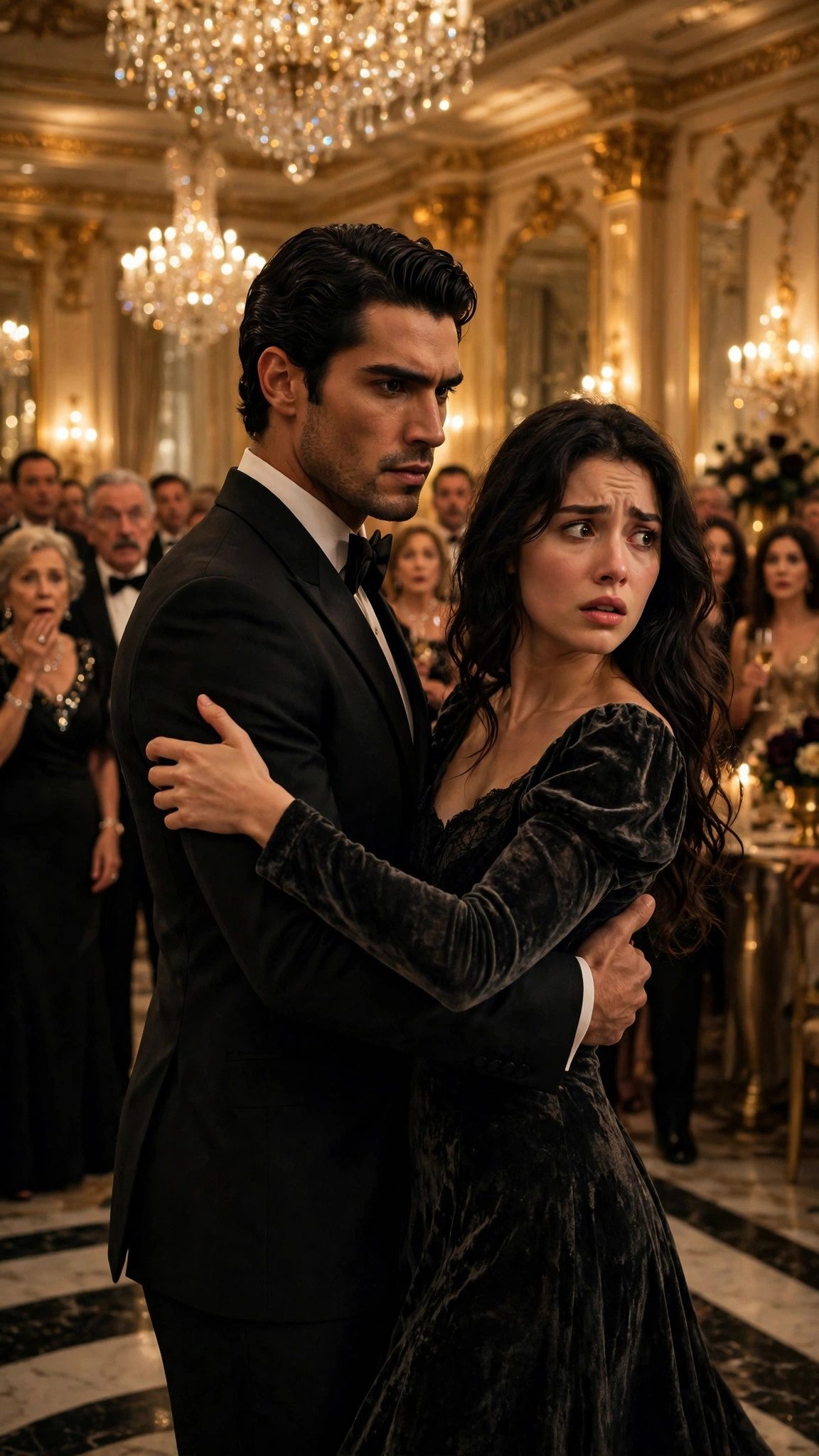
The first three weeks of my marriage were the strangest weeks of my life.
Carmine and I lived in the same house and ate at the same table and passed each other in hallways like polite strangers. He was gone most days before I woke up and came home most nights after I had gone to bed. He left notes for me on the dining room table — short, practical notes in his bold handwriting. "The piano tuner comes Tuesday." "Rosa is having lunch here on Thursday. She would like you to join us." "I had the library restocked with sheet music. Take whatever you like."
I spent my days in the music room. I played for hours, sometimes until my fingers ached, and I discovered something I had forgotten: music is different when no one is paying you to play it. When you play for yourself, the notes belong to you. I played Chopin, and Bach, and the folk tunes my father used to play on Sunday mornings, and sometimes I played the waltz — Shostakovich's Waltz No. 2 — and I thought about the night I had danced with the devil in front of four hundred people, and I wondered what would have happened if I had said no.
Liam came to see me twice a week. Carmine had found him a job at a piano shop in Brooklyn, tuning instruments the way our father had taught us both, and Liam was sober for the first time in years. He looked younger. He laughed more. He told me about the customers and the pianos and the old upright he was restoring for a school in Queens, and I thought: this is what Carmine bought with four hundred thousand dollars. Not a wife. A second chance for my brother.
Carmine and I were not in love. I knew that. He knew that. But something was growing between us, quietly, the way a plant grows in a dark room toward a window. He started coming home earlier. He started sitting in the doorway of the music room while I played, a glass of bourbon in his hand, saying nothing, just listening. One night, he brought me a stack of sheet music he had found in an old shop in Manhattan — first editions, rare pieces, things I had only read about in books.
"I thought you might like these," he said, setting them on the piano.
I stared at the top sheet — a first edition of a Chopin nocturne, worth more than my apartment. "Carmine, this is too much. This must have cost a fortune."
"Money is the one thing I have too much of," he said. "And you are the one person in this house who knows what to do with beautiful things."
That night, I played the nocturne for him, and when I finished, he was standing by the window with his back to me, and I remembered the night in the music room when his shoulders had shaken. I did not say anything. I just played another piece, and another, and he stayed until midnight, listening in the dark.
It was the closest we had ever been. And it was about to be torn apart.
On the twenty-third day of my marriage, Liam did not come home from the piano shop.
I called him at six. No answer. I called again at seven. No answer. At eight, I called the shop, and the owner said Liam had left at five, as usual, and had seemed fine. At nine, I called Carmine, and for the first time since our wedding, I heard fear in his voice.
"Stay in the house, Josephine," he said. "Don't go out. I'm coming home."
But before he could get there, my phone rang. A number I did not recognize. An old man's voice, smooth and cold, like a knife wrapped in velvet.
"Mrs. Valenti," he said. "How lovely to speak to my nephew's wife at last. This is Salvatore Valenti. Your brother is my guest. He is unharmed, and he will stay unharmed, as long as you do exactly what I tell you."
My hands went numb. "What do you want?"
"Come to my club on Mulberry Street. Alone. No Carmine. No Lorenzo. No police. If I see one of my nephew's men, your brother's body will be found in the river by morning. If you come alone, and you listen to what I have to say, Liam will walk out of here with you tonight."
"How do I know he's alive?"
"Put him on," Salvatore said, and then Liam's voice came through the phone, shaking and fast. "Jo, don't come. It's a trap. Don't —" And then the phone was taken away, and Salvatore was back.
"You heard him. He's alive. For now. One hour, Mrs. Valenti. Don't be late."
The line went dead.
I stood in the hallway with the phone in my hand, and my whole body was shaking. I thought about calling Carmine. I thought about telling Lorenzo. But Salvatore had been very clear: if he saw one of Carmine's men, Liam would die. And I knew, the way I had always known things about dangerous men, that Salvatore Valenti was not bluffing. He had already tried to kill Carmine twice. He would not hesitate to kill my brother.
So I did the only thing I could do. I put on my coat, I walked out of the house through the garden gate, where the guards never looked, and I took a taxi to Mulberry Street. Alone.
Salvatore's club was a dark, low building with no sign on the door. A man with a scar through his eyebrow opened it and looked me up and down.
"Mrs. Valenti," he said. "The old man is waiting."
He led me down a narrow hallway to a back room, and there was Salvatore Valenti, sitting behind a desk like a king on a throne. He was sixty-three years old, with white hair and a face like carved stone, and he smiled at me the way a cat smiles at a mouse.
"Sit down, my dear," he said. "Would you like a drink?"
"No," I said. "Where is my brother?"
"Safe. For now." He folded his hands on the desk. "Let me tell you a story, Mrs. Valenti. Three years ago, my nephew took something that belonged to me. The family. The seat. The trust. He took it with smiles and promises, and the council chose him because he was young and handsome and my brother's son. I have waited three years to take it back. And you, my dear, are going to help me."
"Why would I help you?"
"Because your brother's life depends on it." He leaned forward. "Tomorrow, there is a family council. The council will vote on whether my nephew's marriage is valid under the charter. If you stand before that council and tell them the truth — that the marriage is a sham, that Carmine paid for you, that you are a piano girl he bought to keep his seat — the council will annul the marriage, and the trust will pass to me, as it should have three years ago. And your brother will walk free."
"And if I refuse?"
"Then your brother dies tonight, and you go back to your apartment in Queens, and you spend the rest of your life wondering if you could have saved him." He smiled. "It is a simple choice, my dear. Your brother, or your husband. You cannot have both."
I looked at him for a long moment, and something inside me went very still. I thought about Nico Falco, and the four hundred thousand dollars, and the way my brother had looked when he told me the truth in his furnished room above a bar. I thought about the waiter with the poison, and the man in the garden with the rifle. And I understood, all at once, something I should have understood months ago.
"You made Liam borrow the money," I said.
Salvatore's smile faltered, just slightly. "I don't know what you mean."
"Yes, you do," I said, and my voice was steady now, steadier than it had ever been. "Nico Falco works for you. He always has. You told him to lend my brother money he could never repay. You told him to come to my practice room at Juilliard. You put me on that piano roster so that Carmine would see me, so that he would choose me, so that you would have a wife you could control — a girl with a brother you could threaten. The debt was never about Liam. It was about Carmine. It was always about Carmine."
Salvatore stared at me, and for a moment, the mask slipped, and I saw the rage underneath — the rage of a man who had waited thirty years for a seat that was never his.
"You are cleverer than I thought, piano girl," he said softly. "It doesn't matter. Clever girls die just as easily as stupid ones. The council meets tomorrow. You will do as I say, or your brother dies tonight."
"No," I said.
He blinked. "What did you say?"
"I said no." I stood up, and my hands were shaking, but my voice was clear. "You made my brother borrow that money. You used him. You used me. And you tried to kill my husband — twice. I will not help you. I will not lie to the council. And if you hurt my brother, I will tell Carmine everything, and he will burn this club to the ground with you inside it."
Salvatore's face went white with fury. "You stupid little —"
The door burst open.
Carmine Valenti stood in the doorway, Lorenzo behind him, and half a dozen of his men filling the hallway. His suit was dark, his face was calm, and his eyes were colder than I had ever seen them.
"Uncle," he said quietly. "Let my wife's brother go. Now."
Salvatore rose to his feet. "You followed her. You were told to come alone."
"My wife does not go anywhere alone," Carmine said. "Not anymore. I have had a man watching her since the day we married. Did you really think I would let her walk into a trap unprotected?"
He looked at me, and his eyes softened, just for a moment. "Are you all right, Josephine?"
"I'm all right," I said. "Liam is in the back. I heard him."
Carmine nodded to Lorenzo, and Lorenzo and his men went down the hallway. A moment later, there was shouting, and then Liam's voice, and then Lorenzo came back with my brother, pale and shaking but alive, and I ran to him and held him so tightly I thought I might never let go.
Salvatore watched it all, and his face was the face of a man watching his whole life collapse.
"You heard her, Uncle," Carmine said. "She knows about Falco. She knows about the debt. She knows about the poison and the rifle. And now my men know, too. The council meets tomorrow, and this time, it will not be my marriage they are voting on. It will be yours."
He took my hand, and he took Liam's arm, and we walked out of that dark club into the cold night air, and I had never been so glad to see the sky in my life.
The black car was waiting at the curb, and Lorenzo put Liam in the back seat with a blanket and a bottle of water, and my brother drank like a man who had been in the desert. He kept saying, "I'm sorry, Jo. I'm sorry. I didn't tell them anything. I swear I didn't tell them anything."
"You have nothing to be sorry for," I told him, holding his hand. "You did nothing wrong. None of this was your fault."
But I knew, and Liam knew, that it had started with him — with a poker game and a loan and a man with dead eyes. And I knew something else, too: that Salvatore had chosen Liam not because my brother was weak, but because he was mine. Because Salvatore had understood, long before I did, that the way to hurt Carmine Valenti was through the people he loved.
In the front seat, Carmine sat in silence, staring out at the dark streets. When we reached the estate, he helped Liam inside and told the housekeeper to make him soup and to put him in the blue guest room, the one with the view of the garden. Then he turned to me, and for the first time since I had met him, he looked unsure of himself.
"I owe you an apology," he said. "I had a man watching you. Since the day we married. I told myself it was for your protection, and it was — but it was also because I did not trust you. Not fully. Not yet. I am sorry, Josephine."
I looked at him for a long moment. "You had me followed, and that man saved my brother's life tonight. If you hadn't had me followed, I would have walked into that club alone, and Salvatore would have killed Liam, and probably me as well. So I don't know whether to be angry with you or grateful."
"Be both," he said. "You have every right to be both."
We stood in the hallway, in the quiet house, with the fire crackling in the next room, and I realized something that frightened me more than Salvatore's threats ever had.
I loved him.
Not the way a girl loves a hero in a story. Not the way a wife loves a husband she chose freely on a summer day. I loved him the way a person loves someone they have watched carefully for months — the way he treated his mother, the way he remembered his drivers' children's names, the way he knelt on a dining room floor, the way he listened to me play in the dark. I loved him because he had kept his word when he had no reason to, and because he had protected my brother when he owed us nothing, and because he had just walked into a trap to save me, without hesitation, without a second thought.
"I need to tell you something," I said, and my voice was shaking. "Tonight, in that club, Salvatore asked me to choose. My brother, or my husband. And I chose — I chose you. I chose to stand by you, even if it cost me Liam. I didn't know I was going to do that until I did it. But I did it, Carmine. I chose you."
He stared at me, and his face changed, the way it had changed at the altar when he saw me walking down the aisle. The cold mask fell away, and underneath it was a man who looked as frightened as I felt.
"Josephine," he said, and his voice was rough. "Do you know what you just said?"
"I know," I said. "And I need you to know that I didn't say it because of the contract, or the money, or the debt. I said it because it's true. I chose you."
He took a step toward me, and then another, and then he was standing in front of me, close enough that I could feel the warmth coming off his skin, and he reached up and touched my face with one hand, gently, the way you touch something fragile.
"Then I choose you, too," he whispered. "Not for the charter. Not for the trust. Not for any reason except this one: you are the only honest thing in my world, and I will spend the rest of my life trying to deserve you."
And he kissed me — not the way a man kisses a contract, but the way a man kisses a woman he loves, slowly and carefully, as if he were afraid she might disappear. And I kissed him back, and the house was quiet, and the fire crackled, and outside, the snow began to fall over the dark gardens, covering everything in white.
Behind us, Salvatore Valenti sat alone at his desk, staring at the empty doorway, a man who had waited thirty years for a throne and had just lost it to a piano girl who refused to lie.