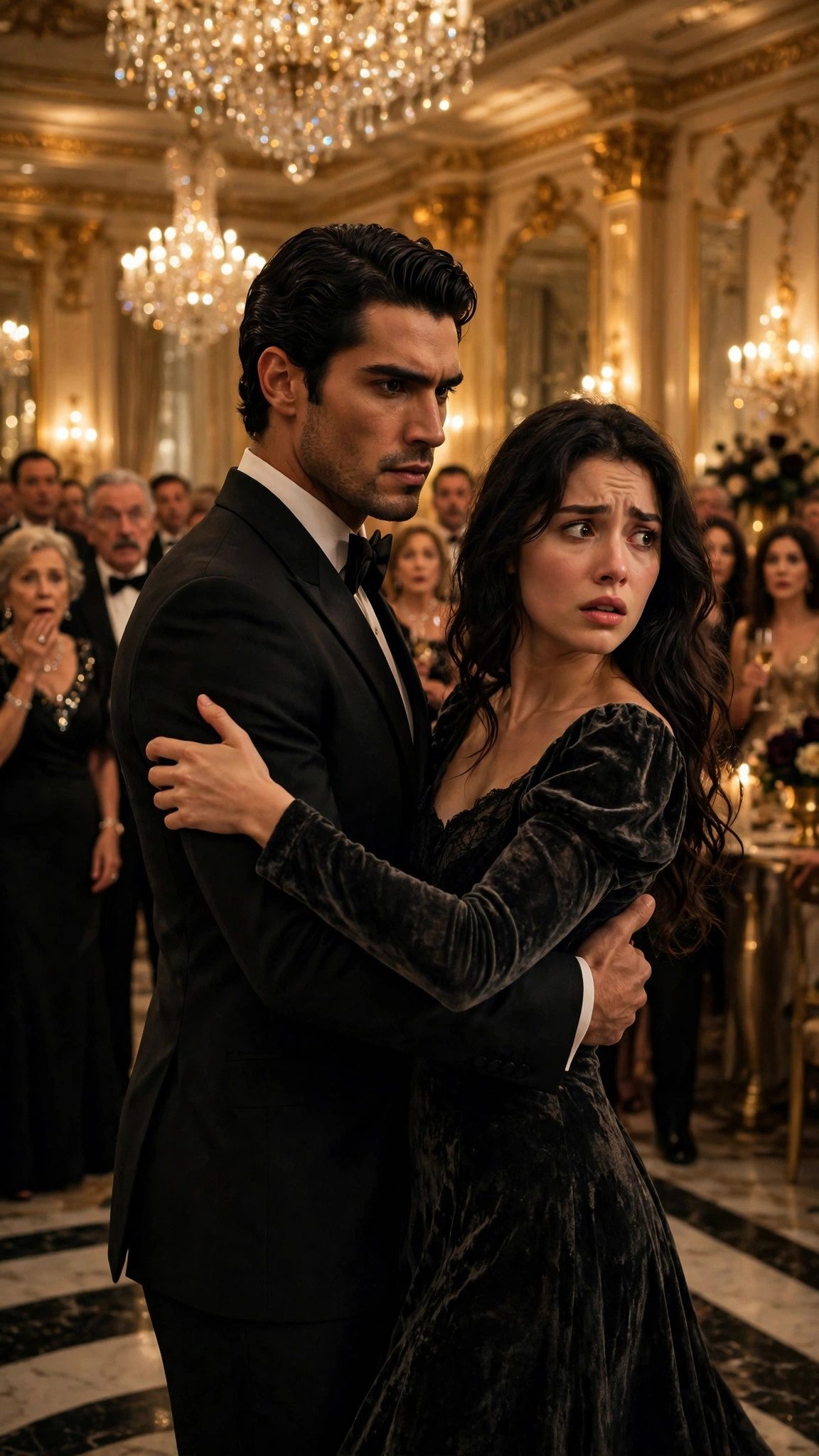
The lawyer came the next morning, exactly as Carmine had promised.
His name was Anthony Greco, and he was a small, precise man with silver-rimmed glasses and a leather briefcase that had seen better decades. He laid the papers out on my kitchen table — the same table where Liam and I had eaten cereal as children — and he explained them in a voice as dry as old paper.
A marriage contract. One year. At the end of the year, either party could walk away, and I would receive two million dollars and a house in my name, anywhere I chose. During the year, I would live at the Valenti estate. I would attend family events as Carmine's wife. I would not speak to the press, the police, or the FBI about anything I saw or heard. In return, Carmine would protect me and my brother, and the debt would remain gone forever.
"Two million dollars," I said, staring at the number.
"Mr. Valenti is generous," Greco said. "He is also careful. Everything is in writing. Nothing is hidden. If you sign, you are his wife in the eyes of the law and the church. If you do not sign, you walk away, and nothing changes. The debt is gone either way."
Liam stood in the doorway, listening, his arms crossed. When Greco left, he came and sat across from me.
"Two million dollars," he said. "Jo, that's — that's a fortune."
"It's a price tag," I said. "And I haven't decided yet."
"You already said yes."
"I said yes to dinner. I said yes to a man on his knees in a dining room. I haven't signed anything." I pushed the papers aside. "I need to think, Liam. This is my life. Not a song I play for someone else's party."
He nodded, and he did something he had not done in years. He made me breakfast — burnt toast and weak coffee, the way our father used to make it on Sunday mornings — and he sat with me while I thought.
What I thought about, mostly, was the music room. The way Carmine had stood by the window with his shoulders shaking. The way he had said, "You remember the songs everyone else has forgotten." I thought about the waiter with the poison, and the man in the garden with the rifle, and the fact that Carmine Valenti lived in a world where people tried to kill him at dinner. If I married him, that world would become my world. If I refused him, he would marry someone else, and Salvatore would still try to kill him, and I would go back to playing the piano in rooms full of dangerous men, waiting for the day Falco found a new reason to come after my brother.
There was no safe choice. There never had been. There was only the choice that let me sleep at night.
I signed the papers that afternoon.
Three days later, a woman came to my apartment while I was alone. She was in her forties, with short dark hair and a navy coat and the kind of shoes that meant she walked a great deal. She showed me a badge, and my stomach dropped through the floor.
"Special Agent Sarah Whitfield, FBI," she said. "May I come in, Ms. Gallagher?"
I let her in because I did not know how to refuse an FBI agent. She sat on my couch and looked around my apartment — the cracked mirror, the secondhand piano, the stack of sheet music on the windowsill — and she smiled the way a teacher smiles at a promising student.
"We know about the gala, Ms. Gallagher," she said. "We know about the proposal. We know about the ring and the dinner and the contract. We have been watching Carmine Valenti for six years, and you are the first crack we have ever seen in his armor."
"I'm not a crack," I said. "I'm a piano player."
"You are about to become his wife," Whitfield said. "And wives hear things. Wives see things. A wife can testify about what she sees in her own home, and no one can stop her. Do you understand what I'm offering you?"
"I understand that you're asking me to spy on my husband."
"I'm asking you to help us put a murderer in prison," she said. "Carmine Valenti has ordered the deaths of at least eleven men. We have the bodies. We don't have the proof. You could give us the proof."
I thought about the man in the garden with the rifle. I thought about the waiter with the poison. I thought about Carmine kneeling on his dining room floor. And I thought about something else — something Whitfield did not know, and something I was not going to tell her.
"I don't know anything about murders," I said. "I play the piano."
Whitfield leaned forward. "Your brother's debt is gone, Ms. Gallagher. But debts have a way of coming back. If you help us, we can protect Liam. Witness protection. A new life. A clean start, far away from New York, far away from the Valentis. All you have to do is wear a wire, just once, at a family dinner. Just let us hear what they say when they think no one is listening."
It was a good offer. It was the kind of offer a smart girl would take. Witness protection. A new life. Freedom from the Valenti family forever.
But I remembered what my father used to say: a person's true character shows not in what they take, but in what they protect. Whitfield was asking me to betray a man who had kept his word to me, who had paid my brother's debt without being asked, who had knelt in his own dining room and asked me — asked me, not ordered me — to marry him.
"No," I said. "I won't do it."
Whitfield studied me for a long moment. "You know what he is, don't you? You know what that family does."
"I know what he is," I said. "And I know what you are, too. You're asking me to lie to my husband's face and wear a wire to his dinner table. I won't do that to anyone. Not even to a man the FBI wants in prison."
She stood up and handed me a card. "If you change your mind, call me. Day or night. And Ms. Gallagher — be careful. The Valenti family eats girls like you for breakfast."
After she left, I sat on my couch for a long time, holding her card in my hand. Then I tore it in half and threw it in the trash. I did not tell Carmine about the visit. Not because I was hiding it from him, but because I did not want him to know how close the FBI had come to turning me. Some things, I was learning, you keep to yourself — not as a secret, but as a choice.
The wedding was arranged for December 29, two weeks after the gala. Small, Carmine insisted. Private. A church in Brooklyn, the same chapel where he had buried his father. His mother, Rosa, would be there. Lorenzo would stand as his witness. Liam would walk me down the aisle.
Rosa Valenti came to see me the week before the wedding. She arrived at my apartment without warning, leaning on her cane, her white hair pinned up in a neat bun, her eyes sharp as needles. She looked at my faded dress, at my cracked mirror, at my secondhand piano, and she nodded slowly, as if she had expected exactly what she found.
"So," she said. "You are the piano girl."
"Yes, ma'am," I said.
"My son told me about you. He told me you saved his life at dinner." She sat down on my couch without being invited. "Do you love him?"
The question caught me off guard. "I — I don't know him well enough to love him. Not yet."
"Good," Rosa said. "An honest answer. The last girl who wanted to marry my son told me she loved him before she had even met him. She wanted the money. You are not lying to me, and that is worth more than love. Love can be learned. Honesty cannot be taught."
She reached into her bag and took out a small velvet box. Inside was a gold necklace with a tiny piano charm, no bigger than my thumbnail.
"My husband gave me this on our wedding day," she said. "He said a woman should always carry a reminder of who she was before she became someone's wife. I want you to have it."
I stared at the necklace. "Mrs. Valenti, I can't accept this. It's too precious."
"You can, and you will," she said, and she fastened it around my neck with hands that trembled only slightly. "You are marrying my son, and that makes you my daughter. Daughters do not argue with their mothers. Now, tell me about your mother. Carmine says she sang in a church choir."
I told her. I told her about my mother's voice, and my father's hands, and the apartment in Queens, and the bread on Sunday mornings. Rosa listened the way only a mother listens, and when I finished, she patted my hand and said, "Good. You come from good people. That matters more than money."
When she left, I stood at my window and watched her climb into a black car, and I touched the little gold piano at my throat, and I cried for the first time since my father died — not from fear, but from the strange, unexpected feeling of being welcomed into a family.
The wedding day came cold and bright, the sky over Brooklyn a hard, clean blue. Liam walked me down the aisle in a suit Carmine had bought him, and he whispered, "You look beautiful, Jo," and I whispered back, "Don't cry, or I'll cry, and then the photographs will be ruined."
Carmine stood at the altar in a black suit, and when he saw me, his face changed — the cold mask fell away, and for a moment he was just a man, looking at a woman walking toward him, and his eyes were wet.
The priest spoke the words. I said, "I do." Carmine said, "I do." He slid the diamond ring onto my finger, and I slid a plain gold band onto his, and the small chapel rang with the sound of a handful of people applauding — Lorenzo, Rosa, Liam, and a few of Carmine's men who had tears in their eyes and did not care who saw them.
As we walked back down the aisle, husband and wife, Carmine leaned close and whispered, "Thank you."
"For what?" I asked.
"For saying yes," he said. "For trusting me. I won't forget it."
Outside the chapel, the winter sun was shining, and a black car waited to take us to the estate, to our new life, to whatever came next. I held Carmine's hand, and I felt the gold band on his finger, and I thought about my mother and my father, and I hoped, wherever they were, they could see me — not as a piano girl in a faded dress, but as a woman who had chosen her own path, even when the path led straight into the lion's den.
I was Josephine Valenti now. And whatever came next, I would face it as his wife.
The reception was held at the estate, in the great dining room where Carmine had proposed the contract and where I had knocked over his wine glass. The same candles burned in their silver holders. The same white roses stood in their vase. But this time, the table was set for thirty people, and the room was full of laughter, and Lorenzo was telling a story about Carmine as a boy that made even Rosa laugh until she wiped her eyes.
Halfway through the dinner, a waiter I had never seen before came in carrying a long black box. He set it down in front of me and stepped back. The room went quiet.
Inside the box, on a bed of black velvet, lay a single black rose. Its stem had been cut cleanly, and its petals were perfect, and it was the most beautiful and most terrible thing I had ever seen. Beneath it lay a card in an old man's handwriting.
Enjoy the honeymoon. It won't last. — S.
Carmine picked up the card and read it, and his face went very still. He looked at Lorenzo, and Lorenzo nodded and left the room without a word. Rosa put her hand over mine.
"Don't be afraid, child," she said. "My brother-in-law has been sending black roses to this family for thirty years. He sent one to my husband on our wedding day. Roberto laughed and threw it in the fire. That is what we do with Salvatore's roses."
Carmine took the box, walked to the fireplace, and threw it in, rose and card and all. The flames caught the black petals, and they curled and blackened and were gone. He came back to the table, took my hand, and said, loud enough for the whole room to hear, "My wife is not afraid of flowers. And neither am I."
The room erupted in applause, and the dinner went on, and the wine flowed, and for the rest of the evening, nobody mentioned Salvatore Valenti again.
That night, Carmine showed me to my rooms — a suite at the end of the east wing, with a bedroom, a sitting room, and a view of the gardens. He stood in the doorway, his hands in his pockets, and he looked uncomfortable for the first time since I had met him.
"This is yours," he said. "Your own rooms. Your own space. I won't come in unless you invite me. I meant what I said at dinner — this is a marriage on paper, and I will not take anything from you that you do not freely give. Not your time. Not your trust. Not anything else."
I looked at him, at the man who had just thrown his uncle's threat into the fire, and I felt something shift inside me — not love, not yet, but respect, and something warmer underneath it, something I was not ready to name.
"Thank you," I said. "For the rooms. For the necklace — your mother gave me her piano charm. And for keeping your word about my brother."
"Your brother is family now," Carmine said. "Family protects family. That is the only rule that matters in this house."
He left me alone then, and I stood in my beautiful new rooms in my wedding dress, touching the little gold piano at my throat, and I looked out at the dark gardens where a man with a rifle had hidden two weeks before, and I thought about how strange life was — that a girl from Queens who played the piano for criminals could end up here, in a house full of light, married to a man the whole city feared, and feel, for the first time in years, almost safe.
Almost. Because somewhere out there, Salvatore Valenti was still alive, and he had just told me, in his own way, that my honeymoon would not last.
I went to bed that night with the door locked and the ring on my finger, and I dreamed of black roses burning in a fireplace, and of Chopin, and of a waltz that never seemed to end.