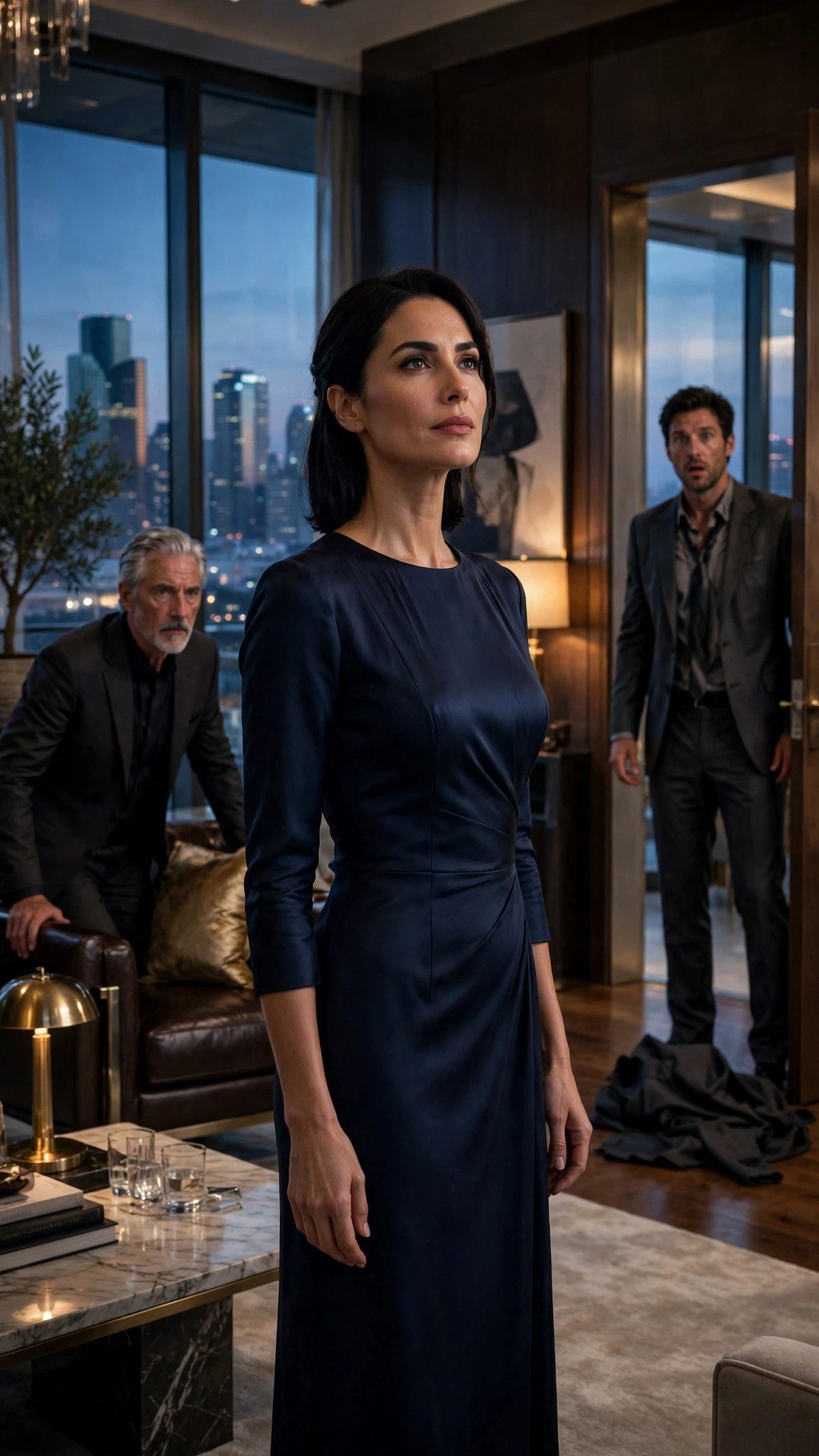
Damian told Luke the story slowly, the way a man tells a story he has rehearsed in his head for thirty years, waiting for the one person who needs to hear it.
He told him about the night Helena came to him in their kitchen, in the house where Luke had grown up, and told him that the FBI had been asking questions, and that they needed to move money, and that she had a plan. He told him about the morning he was arrested, in front of his own house, while nine-year-old Luke watched from the upstairs window. He told him about the trial, and the sentence, and the fourteen years in a federal prison in Oklahoma, where the only thing he owned was a photograph of a boy on a bicycle and a stack of letters he wrote every year on his son's birthday, letters that Helena never delivered.
"I wrote to you every year," Damian said. "Fourteen letters. One for every birthday I missed. I sent them to your mother. She kept them in a box in her closet. Your father — your wife's father — found copies of them years later, when he was building his case. He brought them to me in prison. He was the first person in fourteen years who told me that my son was alive and well and had grown into a man."
Luke was silent for a long time. He stared at the floor. His hands were clasped together so tightly that his knuckles had gone white.
"She told me you left us," he said finally. "She told me you walked out one morning and never looked back. She told me you chose your business over your family. She told me that every time I asked about you. Every birthday. Every Christmas. Every time I saw a father and son together and wondered what it felt like."
"I know," Damian said. "She told me, in prison, through my lawyer, that if I ever tried to contact you, she would tell you worse things. She said she would tell you I was a murderer. She said she would tell you I had tried to kill you. She is a woman who understands that a lie, told to a child, becomes a truth that the child carries for the rest of his life."
"Why didn't you fight her?" Luke asked. "Why didn't you come for me when you got out?"
"Because I had nothing," Damian said. "No money. No proof. No one who would stand beside me and say: this man is telling the truth. Your mother had spent thirty years building a life on top of her lie, and she had you, and she had her money, and she had her lawyers. And I had a photograph and fourteen letters. I needed more than that. I needed someone like Lauren. Someone who had found the proof on her own. Someone who was brave enough to use it."
Luke looked at me then, and for the first time in twelve years, I saw something in his eyes that I had not seen since our wedding day. It was not love. It was too early for love, and too late for the kind of love we had once pretended to have. It was respect. It was the look of a man who is seeing his wife clearly for the first time, and realizing that she is not the quiet, ordinary woman his mother described, but a woman who had outmaneuvered them all.
"I'm sorry," Luke said. "Lauren, I'm sorry. For Jennifer. For the lies. For all of it. I don't know if sorry is enough. I don't know if anything is enough. But I'm sorry."
I nodded. I did not forgive him. Not yet. Forgiveness was a road, and we were standing at the very beginning of it, and I did not know if we would ever reach the end.
But I said, "Thank you for saying it. That's a start."
At nine o'clock that morning, Helena arrived.
She did not knock. She could not knock, because the locks had been changed. She rang the bell, and she rang it again, and she called Luke's phone, and when I opened the door, she pushed past me into the living room, her face flushed, her hair disheveled, her composure gone.
"Luke," she said, "whatever this woman has told you, it is a lie. She is mentally unstable. She has been unstable since her wedding day. Everyone knows it. I have photographs—"
"Stop," Luke said. He stood up. He was six feet four inches tall, and for the first time in his life, he was standing up to his mother. "Stop, Mother. I have seen the immunity agreement. I have seen your signature. I have seen the bank statements. I have seen the mechanic's notebook. I have seen the letters my father wrote to me that you never gave me. So stop. Just stop."
Helena stared at him. Her mouth opened. No sound came out.
"Did you kill Senator Ellis?" Luke asked. His voice was quiet. It was the quietest I had ever heard it. "Did you have his brakes cut because he found out what you did?"
Helena's eyes went to Damian, and then to me, and then back to Luke, and for a moment, I saw the calculation happening behind her eyes. She was deciding whether to deny it, whether to cry, whether to blame someone else. She had spent thirty years deciding things like that, and she was very good at it.
But this time, there was nowhere left to go. The proof was on the table. Her son was standing in front of her. Her husband was sitting in the armchair she had once forbidden him to sit in. And the FBI was already on its way.
"Your father was going to destroy this family," Helena said finally, and her voice was cold and flat, like a woman reading a statement she has rehearsed. "He was going to take everything I had built. He was going to tell the FBI about the money, about the ledger, about all of it. And your father-in-law was going to help him. Daniel Ellis was a self-righteous old man who didn't understand how the world works. He was going to ruin us all."
"So you had him killed," Luke said.
"I protected this family," Helena said. "I have always protected this family. Everything I did, I did for you. For us. Your father was a criminal, Luke. He was going to prison whether I helped the FBI or not. I simply made sure that when he fell, we didn't fall with him. And Daniel Ellis—" she paused, and her eyes flicked to me, and there was something in them that was almost like regret, almost like a crack in the wall. "Daniel Ellis was going to take you down with him. I couldn't let that happen. You were my son. You were all I had."
"You had a son," Damian said, standing up slowly, "and you turned him into a weapon. You taught him to hate his father. You taught him to lie to his wife. You taught him that love is something you earn by obeying. And you killed a good man because he found out the truth about you. That is not protection, Helena. That is not love. That is what you did to a nine-year-old boy, and it is what you did to this family, and it ends today."
At that moment, there was a knock at the door.
Agent Paul Whitfield stood in the hallway with two other agents, and he held up a warrant, and he said, "Helena Cross, you are under arrest for the murder of Senator Daniel Ellis, and for conspiracy, money laundering, and obstruction of justice."
Helena did not struggle. She did not cry. She stood very still in the middle of my living room, and she looked at Luke, and she said, in a voice that was almost gentle, "Luke, darling, tell them. Tell them I did it all for you."
Luke looked at his mother for a long time. Then he said, "No, Mother. You did it for yourself. And I am going to tell them the truth."
He turned to Agent Whitfield. "I will testify," he said. "About the money. About the company. About everything my mother used me for. I want it on the record that I am cooperating fully."
Agent Whitfield nodded. The other agents stepped forward and took Helena's arms, gently, the way agents take the arms of a woman who is not going to run.
As they led her toward the door, Helena turned back to me, and her eyes were bright with something I had never seen in them before. Not anger. Not cruelty. Fear. Real fear, the fear of a woman who has just understood that the world she built has finally fallen down around her.
"You think you've won," she said to me. "But you haven't. You have a husband who cheated on you with your own sister. You have a sister who betrayed you. You have nothing."
"No," I said. "I have the truth. I have my father's name. I have my freedom. And I have a man sitting in that chair who waited thirty years for his son to know who he really is. That's more than you ever had, Helena. You had lies. And lies don't last."
They took her away. The elevator doors closed. The apartment was quiet.
Agent Whitfield came to see me the next morning, before Helena's arraignment, and he sat at my kitchen table with a notebook of his own, and he asked me to tell him everything, from the beginning.
I told him about the immunity agreement. I told him about the bank statements. I told him about Roy Delgado's notebook. I told him about the 237 insults, and the gold hoops, and the lipstick, and the photographs Helena had taken of my sister. I told him about the campaign to destroy my reputation, and about the letter from Luke's lawyer, and about the night my father drove to meet him at a diner and never arrived.
Agent Whitfield wrote it all down, carefully, the way my father used to write things down, and when I finished, he looked up at me and said, "Mrs. Morgan, your father was building this case for three years. He did good work. And you finished it. I want you to know that when this goes to trial, your father's name will be cleared, and Helena Cross will answer for what she did to him."
"Thank you," I said. "That's all I ever wanted. Not revenge. Just the truth, on the record, where no one can take it back."
That Sunday, Luke had his first dinner with his father.
They met at a small restaurant in the Heights, a quiet place with white tablecloths and no one who knew them, and Damian told me about it afterward, his voice rough with an emotion he was trying very hard to control.
"He asked me about the bicycle," Damian said. "The photograph. He wanted to know if I remembered the day it was taken. I told him I did. I told him it was the summer before they took me away, and that I had spent three weeks building that bicycle from parts, and that he had ridden it into a hedge on the first day and laughed so hard he couldn't breathe. He laughed when I told him that. He actually laughed. And then he asked me about the letters, and I told him I had written one every year, and he asked me if I still had them, and I said yes, and he said, 'Can I read them? All of them? I want to know what my father was thinking, all those years.'"
Damian paused, and he looked out my balcony window at the city, and he said, "Thirty years, Lauren. Thirty years I waited to hear my son ask me that question. And it was your father's file that made it possible. It was your courage that made it possible. I will never forget that."
Jennifer arrived an hour later. She stood in the doorway, pale and shaking, and she looked at Luke, and she looked at Damian, and she looked at me, and she said, "Lauren, I chose you. Whatever happens next, I chose you. I'm sorry. I'm so sorry. I was weak, and I was lonely, and I let Helena use me, and I let Luke use me, and I betrayed the only person who ever really loved me. If you never forgive me, I understand. But I chose you."
I looked at my little sister, the girl I had given gold hoops to for her sixteenth birthday, the girl who had laughed too loudly at my husband's jokes and then hated herself for it, and I thought about my father, and about the kind of family he had wanted us to be.
"Come here," I said, and I opened my arms, and Jennifer ran to me, and I held her while she cried, and Luke stood in the corner of the room, watching us, and Damian stood by the window, watching the city, and for the first time in a very long time, the people in that apartment were telling each other the truth.
It was not a happy moment. It was not a celebration. It was the beginning of something hard and long and uncertain.
In the weeks that followed, Luke moved out of the penthouse and into a small apartment of his own, and he hired his own lawyer, and he opened his company's books to the FBI without being asked, and he spent long evenings with Damian's accountants, tracing every dollar Helena had laundered through his business, until the full picture was clear. He told me once, over coffee, that it felt like cleaning out a house after a flood: you find things you forgot you owned, and you throw away things you should have thrown away years ago, and when you're done, the rooms are empty, but they're yours again.
But it was honest. And after twelve years of lies, honesty felt like the beginning of freedom.