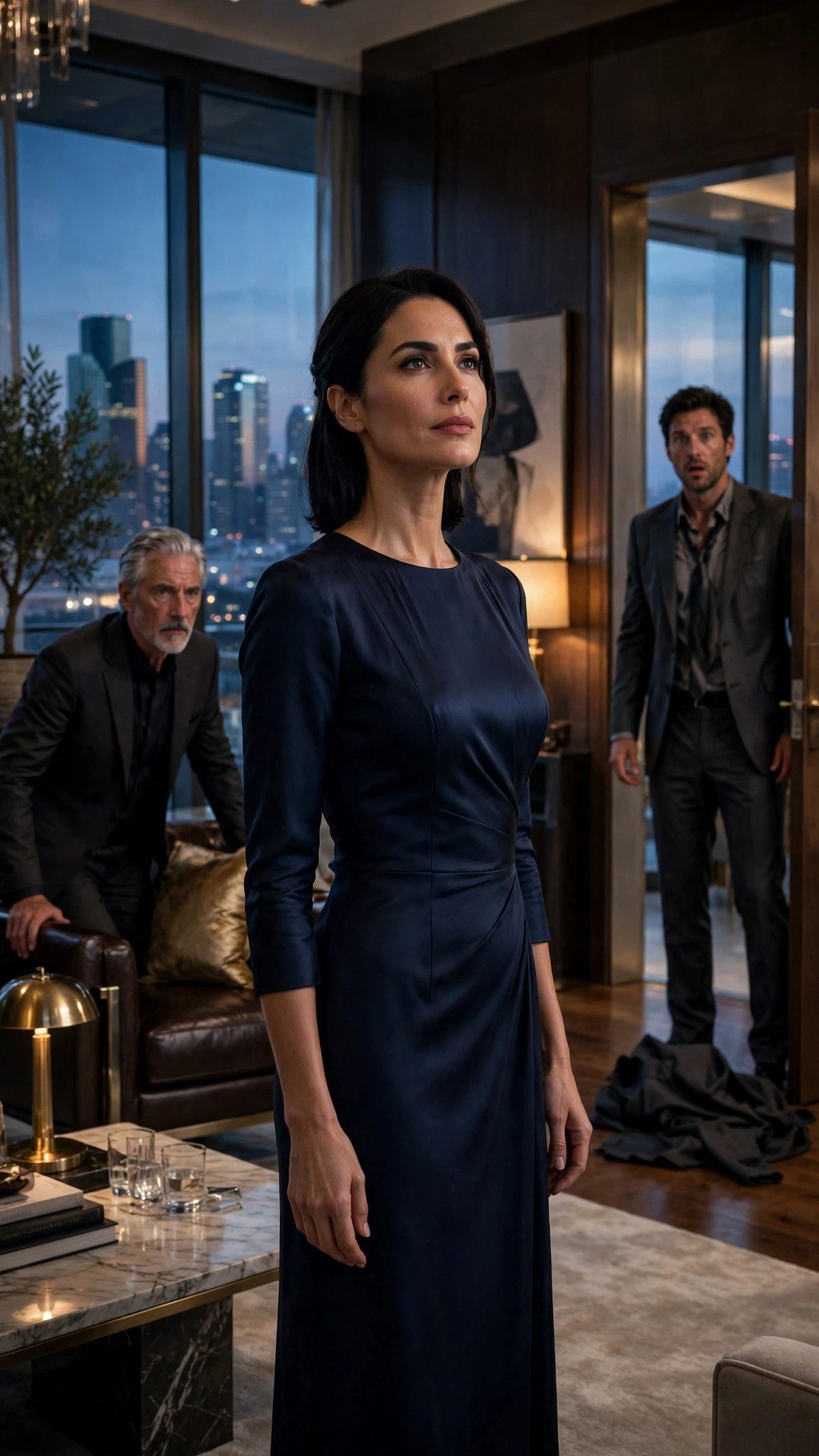
The day I sold the house, I stood in the empty living room for an hour, listening to the silence.
The house had been my father's house first. I had grown up in it. I had learned to ride a bicycle in its driveway. I had celebrated birthdays in its garden. I had sat in its study and listened to my father read the newspaper aloud, doing all the voices, making me laugh until my stomach hurt.
And then I had married Luke, and the house had become ours, and slowly, year by year, Helena had filled it with her opinions and her furniture and her rules, until it stopped feeling like my father's house and started feeling like a showroom for a life I had never wanted.
Selling it felt like cutting a rope. It felt like stepping off a cliff and discovering, halfway down, that I had wings.
The young couple who bought it loved the garden. The woman was pregnant, and she stood in the kitchen with her hand on her belly and said, "Our baby will grow up here," and I smiled, because that was a good reason for a house to exist. A house should hold a family that loves each other. It should not hold a woman who is being erased, one insult at a time.
I signed the papers on a Tuesday morning. By Tuesday afternoon, the money was in my new account. By Wednesday, I had closed every joint account Luke and I shared. By Thursday, Damian's lawyers had removed my name from every document in Luke's company. By Friday, the locks on the penthouse had been changed, and two of Damian's men were standing in the hallway downstairs, polite and unobtrusive, in suits that fit them well and eyes that missed nothing.
Luke noticed nothing. Luke never noticed anything. He came home on Friday night at nine o'clock, smelling of Jennifer's perfume, and he kissed my forehead, and he asked me what was for dinner, and I told him I had ordered takeout, and he said, "Good, I'm tired," and he went to bed without asking a single question about the locks, or the accounts, or the fact that the house he had lived in for twelve years no longer belonged to us.
On Wednesday morning, I went to the bank to close our joint accounts. The manager, a man named Mr. Patel who had known my father for twenty years, looked at the paperwork, looked at me, and said, very quietly, "Mrs. Morgan, are you certain? These accounts have been open a long time."
"I'm certain," I said. "My father taught me to keep my own name on my own accounts. I'm finally doing what he told me to do."
Mr. Patel nodded. He stamped the papers. He moved the money into an account that only I could access, an account Helena knew nothing about, and as he handed me the receipt, he said, "Your father was a good man, Mrs. Morgan. He spoke of you often. He said you were the strongest person in your family. I believe he was right."
I thanked him, and I walked out of that bank with my father's words in my ears and a receipt in my handbag, and I felt, for the first time in years, like a woman who owned her own life.
That afternoon, I packed a small bag. Not suitcases — I was not leaving. I was staying, in the apartment that was now mine alone, behind locks that only I controlled. But I packed the things that mattered: my father's photograph, the leather notebook, the file folder, and the gold hoops I had given Jennifer for her sixteenth birthday, which I had taken back from my nightstand the day Helena tried to steal them. I set the bag by the front door, where I could see it, where I would know, every time I walked past it, that I was ready.
Damian's men arrived at noon on Friday, quiet and polite, in suits that fit them well. They changed the locks in twenty minutes. They tested the new keys twice. One of them, a young man named Marcus with kind eyes, said to me, "Mrs. Morgan, Mr. Cross told us to make sure you feel safe. If anyone comes to this door who shouldn't be here, you call us. Day or night."
"Thank you, Marcus," I said. "I feel safe. For the first time in a very long time, I feel safe."
On Saturday, Helena came to the apartment. She arrived at three o'clock, as she always did, with her driver waiting downstairs. She put her key in the lock. The key did not turn.
She tried again. She knocked. She rang the bell. She called Luke on her phone, and I could hear her voice through the door, sharp and rising.
"Luke, the locks have been changed. What is the meaning of this?"
I opened the door. I stood in the doorway, wearing a new dress and a new perfume, and I looked at my mother-in-law, and I smiled the way a woman smiles when she has finally stopped being afraid.
"Hello, Helena," I said. "The locks were changed this morning. You'll need to call before you visit from now on. Actually, you won't need to call at all. You're not welcome here anymore."
Helena's face went white, and then red, and then white again.
"You ungrateful little—" she began.
"Two hundred and thirty-seven times," I said. "That's how many times you insulted me. I kept count. I wrote them all down. Every date. Every place. Every word. And I want you to know that I am done counting. From now on, I will be doing something else."
"What could you possibly do?" Helena said, and her voice was shaking now, with anger or with fear, I couldn't tell which. "You are nothing. You are a politician's daughter with a dead father and a husband who doesn't love you."
"My father is dead," I said, "because you had him killed. And my husband doesn't love me because you taught him that love is something a mother gives and a wife earns. And I am not nothing, Helena. I am the woman who found your immunity agreement. I am the woman who found the mechanic's notebook. I am the woman who found Damian Cross."
At the sound of Damian's name, Helena's face changed. The anger drained out of it. The color drained out of it. For the first time in twelve years, I saw Helena Cross look afraid.
"You don't know what you're talking about," she whispered.
"I know exactly what I'm talking about," I said. "And so does the FBI. Agent Paul Whitfield has a copy of everything. My father's file. The immunity agreement. The mechanic's statement. Frank Calloway's testimony. All of it. The only reason you are not in handcuffs right now is that Agent Whitfield wants to hear what you say when your son learns the truth. So I suggest you go home, Helena. Get some rest. You're going to need it."
Helena stared at me for a long moment. Then she turned and walked to the elevator, her heels clicking on the marble floor, her driver holding the door for her, and I watched her go, and I felt nothing at all like triumph.
I felt the strange, hollow quiet of a woman who has finally stopped waiting to be rescued.
That night, I called Jennifer. I told her to come to the apartment the next morning. I told her it was time to choose a side.
And then I sat in the living room with Damian Cross, and we waited.
Damian sat in Luke's armchair. He wore a dark suit and a white shirt, and he held a glass of water in his hands, and he looked at the photograph on the mantel — a photograph of Luke and me on our wedding day — and he said, very quietly, "He looks happy in this photograph. I hope he remembers how that felt. He's going to need to."
"What if he doesn't believe you?" I asked.
"Then he doesn't believe me," Damian said. "But he will believe the paperwork. And he will believe his mother's face when she hears what I have to say. A man can lie to his son for thirty years, Lauren. But a mother cannot hide her guilt from her son when the truth is standing in front of him."
At 4:48 in the morning, the front door opened.
Luke walked in, smelling of Jennifer's perfume and expensive whiskey, expecting to find divorce papers waiting for him on the kitchen table.
Instead, he found our living room changed.
The apartment smelled like my new perfume.
And seated in his armchair was a man he'd only seen in framed photos, a man he had never once met during the twelve years of our marriage.
Luke dropped his coat on the floor.
"Who the hell is that?"
"This is Damian Cross," I replied calmly.
"Your real father."
I watched the remaining warmth drain from Luke's face.
Because Damian wasn't merely the man who had abandoned Luke as a child.
Damian Cross was one of Houston's most powerful syndicate bosses, a man feared for his intelligence and his ability to make rivals disappear without a trace.
And it was because of Damian that Luke had never once felt he had a father.
Luke took a small step backward.
I said, "He came because I invited him.
"And because he wants to talk to you about your mother."
For the first time in my life, I witnessed Luke Morgan feel genuine fear.
"You're lying," Luke said. His voice was shaking. "My father is dead. My mother told me he left us. He abandoned us. He—"
"He never left you," Damian said, and he stood up slowly from the armchair, unfolding himself to his full height, and for a moment, standing there in my living room, he looked so much like Luke that I had to catch my breath. Same jaw. Same eyes. Same way of standing, as if the room belonged to him. "I was taken from you, son. Your mother took my ledger to the FBI when you were nine years old. She traded me for her freedom and a fortune. And then she told you I didn't love you."
"That's a lie," Luke said, but his voice was weaker now.
"Is it?" Damian said. He took a folder from his briefcase and held it out. "This is a copy of the immunity agreement. Your mother's signature is on the last page. This is a copy of the bank statements showing where the money went. And this—" he held up a photograph, a photograph of a nine-year-old boy on a bicycle, grinning at the camera. "This is you. The day before they took me away. I kept this photograph in my cell for fourteen years, Luke. Fourteen years. I looked at it every single night."
Luke stared at the photograph. His hands were shaking. He reached for it, and then he stopped, and his hand fell to his side.
"Why are you here?" he whispered. "Why now?"
"Because your wife found the truth," Damian said. "And because your mother killed her father to protect her lie. And because I have spent thirty years waiting for someone brave enough to stand beside me and say it out loud. Lauren is that person. The question is, Luke, are you?"
Luke looked at me. His eyes were wide and lost, like a child's eyes, like the eyes of a nine-year-old boy who has just been told that everything he believed about his family was a lie.
"Lauren," he said. "Is it true? Did my mother—did she kill your father?"
I looked at my husband, the man I had married at twenty-two, the man who had betrayed me with my own sister, the man who had tried to convince the world that I was mentally unstable, and I felt something I had not expected to feel.
I felt pity.
"Yes," I said. "It's true. Your father can prove it. And the FBI already has the proof. Your mother is going to be arrested, Luke. Not because I want revenge. Because she murdered my father. And because she stole your father from you when you were nine years old. And because if no one stops her, she will keep doing it, to you, to Jennifer, to anyone who gets in her way."
Luke sank into a chair. He put his face in his hands. He sat there for a long time, and Damian and I stood in the silence of that living room, and the city was quiet outside the windows, and the only sound was the ticking of the clock on the mantel.
And then Luke looked up, and his eyes were wet, and he said, in a voice I had never heard from him before, a voice that was not cold or commanding or distant, but young and broken and real:
"Tell me everything. Tell me all of it. I want to know what she did to me when I was a kid. I want to know what she did to your father. I want to know all of it."
And Damian Cross, the man who had waited thirty years for his son to ask him that question, sat down across from him, and began to tell him the truth.
He began with the kitchen, and the ledger, and the morning of the arrest, and as he spoke, I watched Luke's face change. I watched the coldness leave it. I watched the suspicion leave it. I watched a man who had spent his whole life believing he was unloved begin, slowly, to understand that he had been loved all along, by a father who wrote him letters from a prison cell, and by a wife who had risked everything to bring them together.
And I stood by the window, watching the sun come up over Houston, and I thought about my father, and his file folder, and his handwriting, and I thought: Dad, I came to the study first. I did what you told me to do. And now the truth is finally coming out.