I met Valerie Bennett on a Tuesday in October, in the waiting room of a free clinic on the west side of the city, and I was bleeding.
Not badly. A knife had found the meat of my forearm during a disagreement in a warehouse that no longer exists, and my driver, a young man named Peter who had been with me less than a month, had driven me to the nearest place with a light on. I had told him to take me to our own doctor. He had panicked and taken me to a clinic with plastic chairs and a coffee machine that had not worked since spring.
Valerie was twenty-six years old. She wore pale blue scrubs and her long brown hair was tied back in a knot that was coming loose. She took one look at my arm, one look at my face, and she did not flinch. She had seen worse, she told me later, on nights when the city brought its wounded to her door and asked no questions.
"You need stitches," she said. "Eight, maybe ten. Sit down."
"I don't sit in waiting rooms," I told her.
"Then you'll bleed on my floor," she said, "and I'll have to mop it, and I hate mopping. Sit down."
I sat down. I was thirty-three years old, already my father's right hand, already a man other men crossed the street to avoid, and I sat down in a plastic chair in a free clinic because a nurse with tired eyes told me to, and for the first time in my adult life I did what someone told me without calculating the cost.
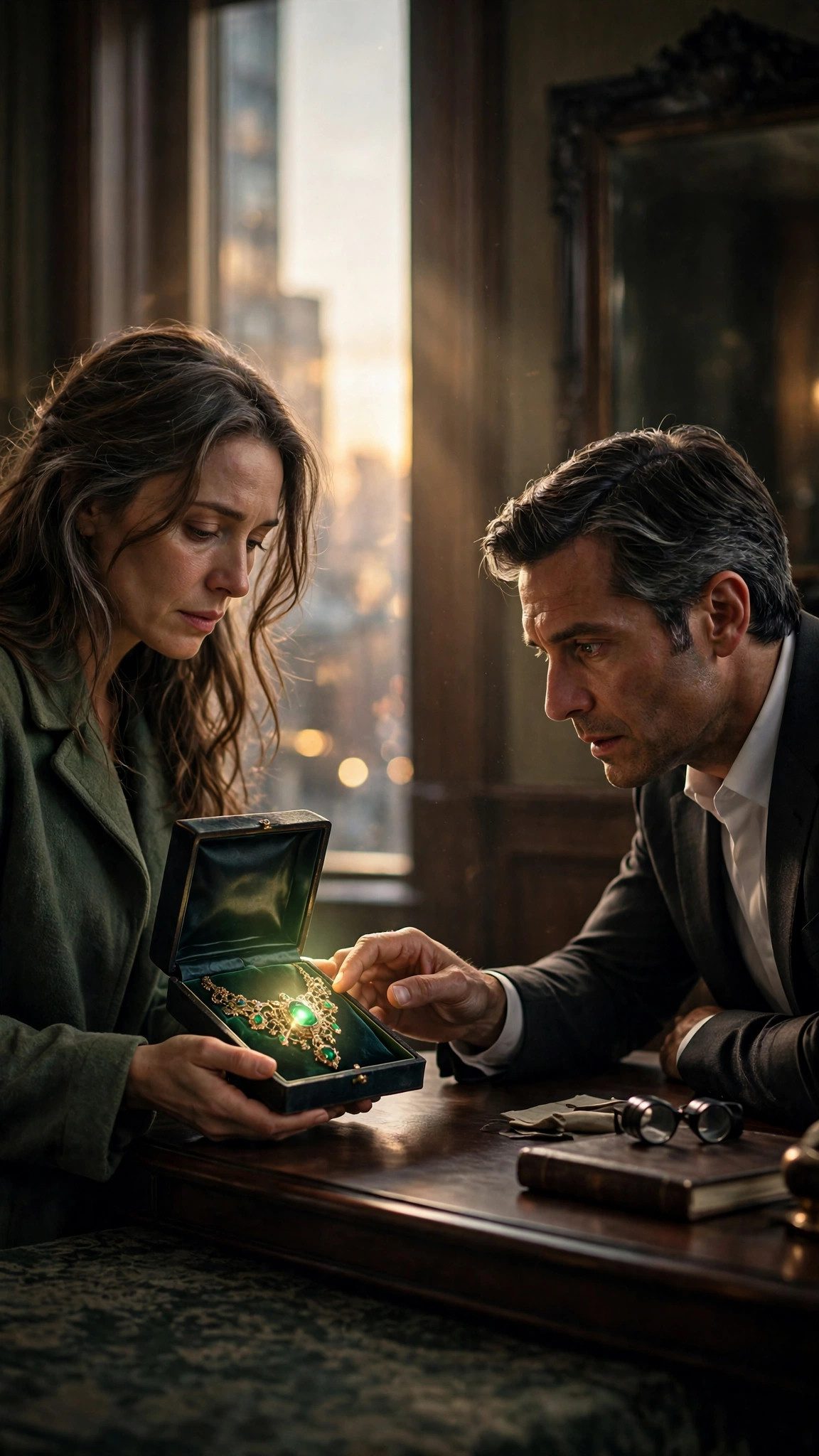
She stitched my arm with hands that never shook. While she worked, she talked — not to me, really, but to the room, the way people talk when silence feels heavier than speech. She told me about her grandmother, Rose, who had raised her after her own mother went to work double shifts at a laundry. She told me about the necklace her grandmother kept in a velvet box at the back of a drawer, a 1921 emerald and gold necklace that Rose had worn exactly twice in her life: once on her wedding day, and once on the day her husband came home from the war.
"She says it isn't jewelry," Valerie said, tying off the last stitch. "She says it's a promise. I never understood what she meant."
I understood even less then. I understood only that her voice was warm and tired and that I wanted to hear it again.
I came back the next week to have the stitches removed. I came back the week after that with a cut on my knuckle that did not need a doctor at all. By the third week, she was waiting for me with two cups of coffee from the machine that still did not work — she had brought a thermos from home — and by the fifth week, I was walking her home through streets my father would have forbidden me to walk, carrying her bag, listening to her talk about her patients and her mother and her grandmother's garden.
Her mother, Margaret Ellis, was a laundry worker with hands red from hot water and a laugh that filled a room. Her grandmother, Rose Bennett, was eighty-one, sharp as a razor, with white hair pinned in a knot and eyes that missed nothing. Rose took one look at me the first time Valerie brought me to Sunday dinner and said, "You have your grandfather's eyes, young man. He had kind eyes too, before the world taught him to hide them."
I did not know then what she meant. I thought it was the kind of thing old women say to be polite.
Valerie and I fell in love the way people fall in love when neither of them is looking for it — slowly, then all at once. She taught me how to make soup from almost nothing. I taught her how to drive a car with a manual transmission in an empty parking lot at midnight, and she laughed so hard she cried when she stalled it for the sixth time. She told me about the boys who had asked her to dances in high school and the scholarship she had given up to help her mother. I told her nothing about my family. That was the first lie, and like most first lies, it made every lie after it easier.
For six months, I lived two lives. In one, I was Nathaniel Cain, heir to the Cain family, sitting in rooms where men decided who lived and who lost everything. In the other, I was just Nathaniel, a man who carried groceries up four flights of stairs and fixed a leaking faucet with a wrench he had to borrow from a neighbor because he had never fixed anything in his life.
My father, Victor Cain, found out in April. I do not know who told him. In my family, someone always tells. He summoned me to his office on the top floor of the building where, twelve years later, I would stand behind one-way glass and watch the woman I loved try to sell her grandmother's jewel.
"You will end it," my father said. He did not raise his voice. My father never raised his voice. That was what made him terrifying.
"She is a nurse, Father. She has nothing to do with our business."
"Her grandmother is Rose Bennett," he said, and the name fell between us like a stone into still water. "Do you know who Rose Bennett was, Nathaniel? She was the woman your grandfather Elias loved before he married your grandmother. He gave her a necklace in 1921 — an emerald and gold necklace from the family collection. He promised her a life. Then he did his duty, married into the family, and left her with a jewel and a broken heart. That necklace is Cain property, stolen by sentiment, and it has been a shame on this family for ninety years."
I stared at him. "Rose Bennett is an eighty-one-year-old woman who raised Valerie on a laundry worker's wages. The necklace is hers."
"The necklace is ours," my father said. "And the girl is a reminder. You will go to her, and you will take back what belongs to this family, and you will end this before it costs us more than it already has. If you refuse, I will send men who will not be gentle, and I will make certain that Valerie Bennett and her family lose everything they have — her mother's job, her grandmother's apartment, the clinic where she works. Do you understand me?"
I understood him perfectly. That was the worst of it. I understood that he was not bluffing, and I understood that the choice he offered me was not a choice at all.
That night, I went to Valerie's apartment. It rained the way it rains when the sky has been holding it back all day. She opened the door in her green coat — new then, the color of spring leaves — with a chipped blue mug in her hands, and she smiled at me the way she always smiled, like I was the best part of her day.
"Will you come back tomorrow?" she asked.
I told her yes. I kissed her forehead. I held her for a long time, memorizing the way she fit against my chest, the smell of her hair, the sound of her breathing. And then I walked down four flights of stairs and out into the rain, and I never went back.
I told myself I was protecting her. I told myself that a clean break was kinder than the truth. I told myself that my father would leave her alone if I disappeared quietly, and that the necklace — the jewel my grandfather had given her grandmother out of love — would stay where it belonged, with the woman who had kept it safe for ninety years.
I never told my father that I had not taken the necklace. He assumed I had failed, or that I had chosen to leave it as a final mercy. He never asked, and I never offered. It was the one act of defiance I allowed myself, and I buried it under twelve years of empire-building, telling myself it did not matter.
But it mattered. It mattered every single day, in every room where I stood behind glass and watched other people's lives, unable to live my own. It mattered in the way I never married, never let anyone close, never allowed myself to want anything the way I had once wanted a life with Valerie Bennett in a small apartment with a leaking faucet and a woman who laughed when she stalled a car.
On the morning of the appraisal, Marcus had come to my office with a file and a face I had not seen on him in twenty years.
"Mr. Cain," he had said, "a woman named Valerie Bennett has requested an appraisal of a 1921 emerald and gold necklace. She needs one thousand dollars for her mother's chemotherapy. She does not know the value of what she holds. She does not know who owns this building. She does not know you are here."
I had looked at the file for a long time. Her name, written in Marcus's careful hand. Her address. The hospital where her mother lay. The electricity bill, marked for disconnection.
"Set the appraisal for today," I had said. "I will watch from behind the glass."
Marcus had nodded, but his eyes had held a question he did not ask. Twelve years ago, Marcus had driven me home from Valerie's apartment in the rain. He had sat in the car outside her building for an hour while I tried to stop shaking. He had never once mentioned that night, and he had never once asked me why I left her. That was Marcus. He knew everything, and he waited for me to be ready to know it too.
There were Sundays, too — Sunday dinners at Rose's apartment, where the table was too small for four people and the food was always too much. Rose cooked the way women of her generation cooked: without recipes, without measuring, with a wooden spoon and a lifetime of practice. She made soup that could cure anything, or so Valerie claimed, and bread that Nathaniel ate until he was ashamed of himself, and a lemon cake that Rose served with a small, proud smile, as if the cake were a member of the family.
At those dinners, Rose would watch Nathaniel the way old women watch young men they are deciding whether to trust — not with suspicion, but with attention. She asked him questions no one else had ever asked him: what he read, what he believed, whether he was happy. He did not know how to answer the last one. No one had ever asked him if he was happy. He told her the truth, which was that he did not know, and Rose nodded as if he had said something wise.
"Your grandfather had the same look," she said one Sunday, refilling his cup. "Elias. He would sit at this very table and stare out the window like the answer was out there somewhere. He never found it, my boy. Don't be like him. Don't spend your life looking out the window."
Nathaniel did not ask who Elias was. He assumed Elias was Rose's late husband, the man who had come home from the war. He was wrong, and it would take him twelve years to learn how wrong he was.
There was also the parking lot — the empty lot behind the clinic where, on a cold night in November, Nathaniel taught Valerie to drive a car with a manual transmission. She stalled it six times, and each time she laughed harder, until she was crying with laughter, and he was laughing too, and the car was full of the sound of two people who had forgotten, for a little while, that the world was a hard place. On the seventh try, she got it right, and she drove in a slow, triumphant circle around the empty lot, and he cheered from the passenger seat like she had won a race.
"You did it," he said, when she finally stopped the car and turned off the engine.
"I did it," she said, breathless, her hands still on the wheel. "I actually did it."
He kissed her then — not the careful kiss of a man who is afraid, but the real kiss of a man who has stopped being afraid, at least for one night, in an empty parking lot, with a woman who laughs when she stalls a car.
There were other nights, too. Nights when Valerie worked late at the clinic and Nathaniel waited outside with coffee, and they walked home together through streets his father would have forbidden him to walk, past shops with their shutters down and windows lit gold. Nights when Margaret, Valerie's mother, invited him to stay for dinner, and he sat at their small kitchen table eating stew out of a chipped bowl, and Margaret told him stories about the laundry, and about raising Valerie alone after her husband died, and about Rose, who had raised them both with an iron will and a soft heart.
"I don't know what you do for a living, Nathaniel," Margaret said to him once, in the kitchen, while Valerie was in the other room. "And I don't ask, because Valerie is happy, and that is enough for me. But I will tell you one thing, and I want you to remember it. My daughter has a heart like her grandmother. She loves completely, or not at all. If you are going to love her, love her completely. And if you are going to leave her, leave her cleanly, and do not come back to pick at the wound."
He promised her he would love Valerie completely. It was the second lie he told, and like the first, it made every lie after it easier — until the night his father summoned him, and the lies ran out, and all that was left was the truth he was too afraid to speak.
Now, standing behind the glass, watching the door open and a stranger walk in claiming the necklace belonged to his wife's family, I finally understood what Marcus had been waiting for me to see. The document he slid across the desk was not just a piece of paper. It was the truth my father had hidden from me for twelve years — and it was the reason Valerie Bennett was standing in that room, holding her grandmother's jewel, with a man who wanted to take it from her.