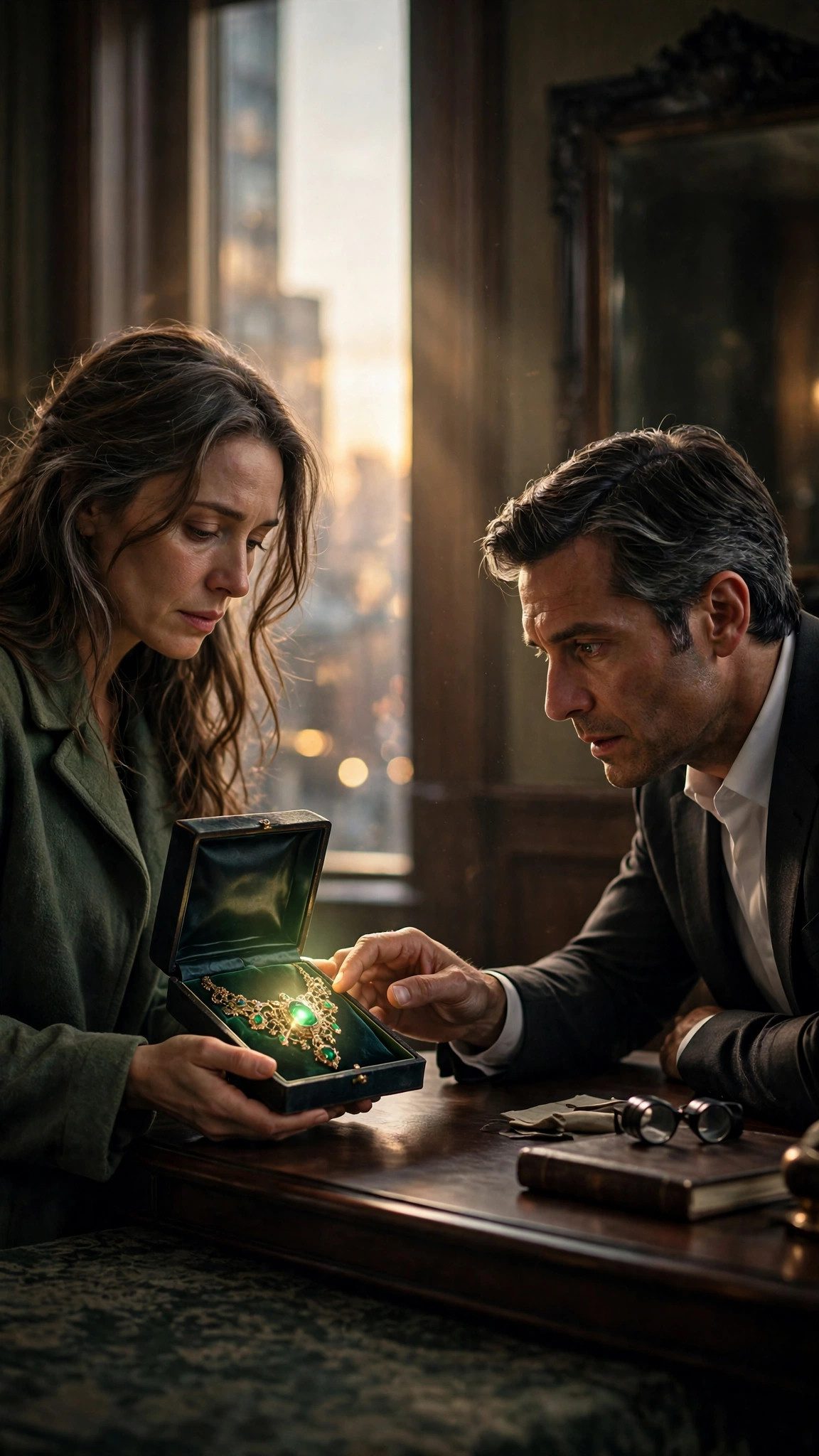
The appraisal room on the fourteenth floor was the quietest room Valerie had ever been in.
It was not large — a table, four chairs, a window that looked out over the city, and a mirror on one wall that she did not know was glass. The carpet was thick enough to swallow footsteps. The air smelled faintly of lemon and old wood, and there was a painting on the far wall — a small seascape, all grey and gold — that Valerie found herself staring at while she waited, because looking at the painting was easier than looking at the mirror on the opposite wall. The mirror bothered her. It was too clean, too dark, and she had the strangest feeling that someone was standing behind it, watching her. She told herself she was being foolish. She told herself that appraisal rooms have mirrors, and that tired women imagine things. But the feeling did not go away. It sat with her, quiet and certain, the way her grandmother used to sit with her in the kitchen — present, and patient, and waiting for her to notice.
She noticed the desk, too. It was old, dark wood, polished to a shine, and there were no papers on it except a single leather folder, closed, and a pen laid perfectly straight beside it. Everything in the room was perfectly straight, perfectly quiet, perfectly still — and Valerie, in her faded green coat, felt like the only crooked, noisy, living thing in it. She straightened her shoulders. She folded her hands in her lap. She waited, the way Rose had taught her to wait: like she belonged there, even when the world told her she did not. The air smelled faintly of lemon and old wood. A man with grey hair and a dark suit stood when she entered, and his eyes were kind in a way that surprised her. She had expected a man in a suit to look at her green coat and see a poor woman. Marcus Hale looked at her the way a doctor looks at a patient: carefully, and without judgment.
"Mrs. Bennett," he said. "Please, sit down. Would you like tea?"
"No, thank you," Valerie said. She sat down and placed her bag on the table and took out the velvet box with both hands, the way you carry something that might break. "I was hoping you could assess this. It belonged to my grandmother."
Marcus opened the box. For a moment, he said nothing at all. Then he lifted the necklace out with gloved hands, and the emeralds caught the light from the window, and Valerie saw his expression change — not greed, not excitement, but something closer to reverence, the way a man looks at something he has heard about but never expected to see.
"It is a 1921 emerald and gold necklace," he said quietly. "A rare piece. From a personal collection. One of a kind."
Valerie nodded. She had heard her grandmother say those words, in that order, a hundred times. "My grandmother wore it twice in her life," she said. "Once on her wedding day, and once on the day her husband came home from the war."
"And you have never worn it?"
"I never had a reason to," Valerie said. "My grandmother said it belonged to the woman who wore it with a full heart. My heart has not been full for a long time."
Marcus looked at her for a long moment, and Valerie had the strange feeling that he was not seeing her at all, but someone else — someone he had known a long time ago, someone who had worn a green coat and carried herself the same way.
"Tell me why you are selling it," he said gently.
Valerie told him plainly. She told him about her mother's medical bills, and the chemotherapy, and the electricity, and the one thousand dollars she needed before Friday. She did not cry. She had cried all her tears years ago, in kitchens and hospital corridors, and there were none left for a stranger in a quiet room. Her voice did not falter, but her hands shook whenever she mentioned the necklace, and she pressed them flat against the table to make them stop.
Behind the one-way glass, Nathaniel Cain watched her hands shake, and he felt something in his chest crack open that had been sealed shut for twelve years.
Marcus set the necklace down carefully and folded his hands. He reached into his jacket pocket and took out a small jeweler's loupe, and he held it to his eye, and he examined the necklace the way a man examines something he has waited a lifetime to see. He studied the emeralds first — deep green, flawless, each one set in gold that had been worked by a master, nearly a century ago. Then he turned the clasp over, and he found the hallmark: a tiny stamp, worn nearly smooth by time, marking the year 1921 and the maker, a Paris house that had closed its doors before Valerie was born. He checked the links, one by one, and the setting of each stone, and the weight of the piece in his gloved palm. When he finally set the loupe down, his hands were steady, but his voice was softer than it had been, as if the jewel had reminded him of something he had almost forgotten. "Mrs. Bennett," he said, "I must be honest with you. This necklace is worth a great deal more than one thousand dollars. A great deal more. If you sell it to the first buyer who offers you what you ask, you will be cheated out of a fortune. Do you understand what I am telling you?"
Valerie stared at him. "How much more?"
"Nearly two hundred thousand dollars," Marcus said. "Perhaps more, at auction."
The room went very quiet. Valerie looked down at the necklace, and then at Marcus, and then at the window, where the city glittered in the late afternoon sun. Two hundred thousand dollars. It was a number so large it did not feel real. It was more money than she had earned in her entire life. It would pay for her mother's chemotherapy ten times over. It would pay the electricity, and the rent, and the debts, and it would leave enough to start over — a small house, a garden, a life without fear.
"I don't understand," she whispered. "My grandmother kept it in a drawer. She said it was a promise, not a fortune."
"Sometimes," Marcus said softly, "a promise is a fortune."
Valerie moved toward the window, and the city light touched the grey threads in her long brown hair. She pressed her forehead against the cool glass and closed her eyes, and for a moment she allowed herself to imagine it — a life without bills on the kitchen table, a mother who could breathe without pain, a future that did not feel like a slow drowning. Then she opened her eyes, and the city was still there, and the necklace was still on the table, and the one thousand dollars she needed was still the only thing that mattered.
"I only need one thousand," she said, turning back to Marcus. "I don't want a fortune. I want my mother's medicine. Can you give me one thousand dollars for it, today?"
Marcus opened his mouth to answer, and at that exact moment, the appraisal room door opened, and a man walked in who changed everything.
He was tall, broad-shouldered, with dark hair going grey at the temples and a suit that cost more than Valerie's yearly salary. His smile was cold and practiced, the smile of a man accustomed to walking into rooms and taking what he wanted. Two men in dark suits waited in the hallway behind him, and Valerie understood, without being told, that they were not there to admire the view.
"Excuse me," the man said, his voice cutting through the quiet like a blade. "I am here about the necklace. It belongs to my wife's family."
Valerie froze. "I beg your pardon?"
"My wife is Bianca Bennett Castellano," the man said, stepping closer to the table. "Rose Bennett was her great-aunt. That necklace was left to my wife's branch of the family, and this woman has no right to sell it. I am Vincent Castellano, and I have come to claim what is mine."
His voice grew sharp as his eyes fell on the necklace, and his hand moved toward it the way a man reaches for something he already considers his own. Valerie's hand shot out — not to grab the necklace, but to cover it, to protect it, the way a mother covers a child. Her fingers closed over the velvet box, and she pulled it toward her, and for a moment the three of them stood frozen around the table: the widow in the faded green coat, the advisor with his hands flat on the wood, and the stranger with his cold smile and his casual certainty.
"That necklace belongs to my family," Castellano said again, slower this time, as if Valerie were a child who had not understood him the first time. "My wife's grandmother and Rose Bennett were sisters. The necklace passed to my wife. You are holding stolen property, Mrs. Bennett."
"It is not stolen," Valerie said, and her voice was steady now, the way it had been steady when she told Marcus about the chemotherapy. "My grandmother left it to me. I have her letter. I have kept it in the box for three years."
"A letter," Castellano said, and he laughed — a short, ugly sound. "A letter anyone could write. My wife has documents. My wife has lawyers. My wife has the law on her side. Give me the necklace, Mrs. Bennett, before this becomes unpleasant for you and for your mother."
The mention of her mother was deliberate. Valerie saw it in his eyes — he knew about the hospital, and the bills, and the chemotherapy. He knew exactly where to press. Her hands began to shake again, and she pressed them flat against the table, and she looked at Marcus, silently begging him for help.
Behind the one-way glass, Nathaniel Cain felt his pulse quicken, and the memories of his final night with Valerie came crashing back with a force that nearly doubled him over. Twelve years ago, his father had ordered him to take the necklace from her. He had refused — had walked away instead, leaving the jewel where it belonged. Now another man stood in that room, demanding the same thing his father had demanded, and this time there was no glass between Nathaniel and the choice. Only a door.
Marcus looked toward the glass, his face suddenly pale, and slid one final document across the desk — a document he had kept in his briefcase for twelve years, waiting for the day it would be needed.
Marcus had met Rose Bennett on a rainy afternoon in 1998, in the law offices on the ninth floor of this very building. She was eighty-one years old, with white hair pinned in a knot and eyes that missed nothing, and she had walked in without an appointment and asked for a man she could trust with a secret.
"I am told you are an honest man, Mr. Hale," she had said, sitting down across from his desk without waiting to be invited. "I need an honest man. I need a will, and I need a letter kept safe, and I need someone who will still be alive and still be honest when the day comes that they are needed."
Marcus had been forty years old then, already the Cain family's advisor, already a man who knew where the bodies were buried — sometimes literally. He had looked at the old woman across his desk, and he had seen something he rarely saw in his line of work: a person with nothing to gain and everything to protect.
"Tell me about the necklace," he had said.
Rose had told him. She told him about Elias Cain, and the summer of 1921, and the gift, and the letter, and the life the world had not allowed them to live. She told him about her marriage to a good man who had come home from the war, and the daughter she had raised, and the granddaughter who would one day hold the necklace in her hands. She told him that men would come for it — men who wanted it for money, or for pride, or for power — and that when they came, someone honest had to be standing between them and Valerie.
"Why me?" Marcus had asked.
"Because you are the only honest man in a dishonest building," Rose had said, with the bluntness of a woman who had lived eighty-one years and had no time left for flattery. "And because you have kind eyes, Mr. Hale. I trust kind eyes. My granddaughter has kind eyes too. It is a family trait, and it is rarer than emeralds."
Marcus had drawn up the will that afternoon, and he had sealed the letter, and he had kept them both in his briefcase — not in a safe, not in a vault, but in his briefcase, where he could reach them at a moment's notice — for twenty-eight years. He had carried them to meetings, and to funerals, and to hospital rooms. He had carried them on the night he drove Nathaniel home from Valerie's apartment in the rain, twelve years ago, and he had said nothing, because Rose had told him to wait, and Marcus Hale was a man who kept his promises, even when keeping them cost him sleep.
He had watched Nathaniel build an empire on top of a wound. He had watched Victor Cain die, and he had watched the son dismantle the father's work, piece by piece, in silence. And he had waited, for twenty-eight years, for the day when a widow in a faded green coat would walk into the appraisal room with a velvet box in her hands, and a man would come to take it from her, and the truth would finally be needed.
That day was today.
Valerie stared at the document on the desk. Castellano stared at it. And behind the glass, Nathaniel Cain reached for the door handle, because twelve years of silence was finally, completely over.