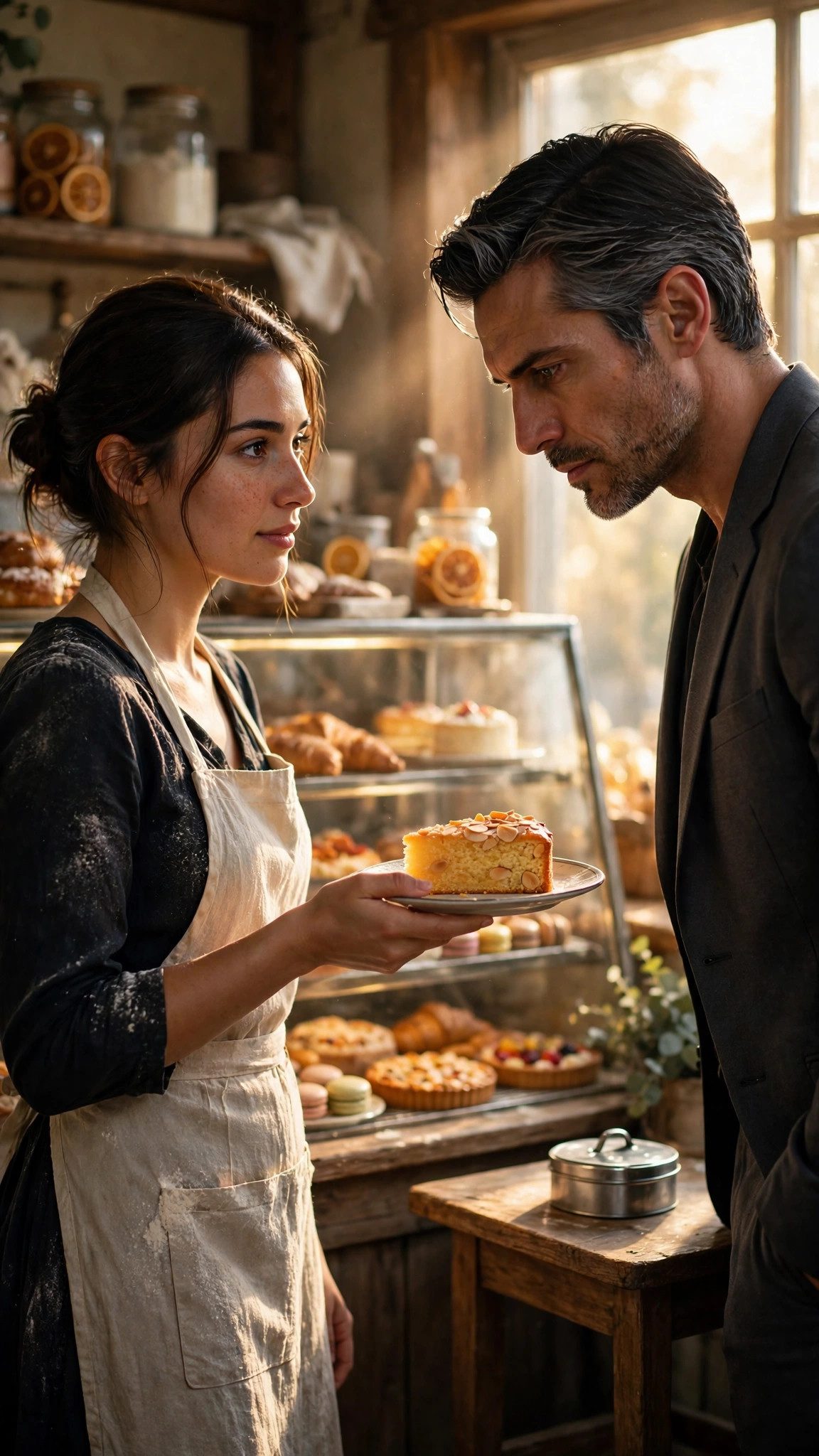
That night, I could not sleep. I went downstairs to the bakery in the dark, and I opened the tin box, and I took out the recipe card for the orange almond cake, and I looked at it for a long time, the way you look at something you thought you knew and suddenly do not.
Caterina Moretti. The name was there at the bottom, in Rosa's handwriting, in blue ink. And underneath it, in even smaller writing, words I had never noticed before, because I had always been looking at the recipe and never at the margins: "For the medicine. Forgive me."
For the medicine. Forgive me.
I sat down on the flour sack in the corner, the same flour sack I used to sit on when I was a little girl, and I understood, all at once, what Rosa had never told me. My mother had been sick since Palermo. The doctors had wanted money before they would look at her. Rosa had sold the recipe to Vittorio Moretti to pay for my mother's medicine. She had not sold it because she was greedy, or because she was weak. She had sold it because she was a mother, and her daughter was dying, and a mother will give away anything, even the most precious thing she owns, to save her child.
And the medicine had not worked. My mother had died anyway, first slowly in Palermo, and then finally in Chicago, when I was nine years old. And Rosa had carried the guilt of that sale for the rest of her life, and she had written "forgive me" on the back of a recipe card, because she did not know who else to ask.
I cried that night, in the dark, in my dead grandmother's bakery, holding the recipe card in both hands. I cried for Rosa, and I cried for my mother, and I cried for Caterina Moretti, who had died asking for a slice of cake, and I cried for Adrien, who had spent three years eating a cake that tasted like grief. And I cried for myself, because I had spent my whole life believing that the recipe was a simple thing, a gift passed from mother to daughter, and it had never been simple at all. It had been bought and sold and stolen and kept and hidden, and it had cost my family almost everything, and it had still survived, because Rosa had been clever enough and stubborn enough to keep the real secret in her hands and not on any piece of paper.
The next morning, Adrien came to the bakery, and I told him I needed time. I told him I needed to think. I told him that everything had happened too fast, and that I did not know what was real anymore, and that I needed him to leave me alone for a little while.
He looked at me, and he nodded, and he said, "Take all the time you need, Lucia. I will be here when you are ready. I have waited three years. I can wait longer."
But he did not leave. He went to the little table by the window, and he sat down, and he ordered one slice of cake, and he ate it, slowly, the way a man eats something he has been waiting for, and then he left exact change on the table, and he walked out the door. And the next morning, he did the same thing. And the morning after that. He never pushed. He never demanded. He only came, and he sat, and he ate his one slice of cake, and he left.
On the third morning, an old man came into the bakery, a man I had never seen before, with silver hair and a quiet way of moving, like a man who had spent his whole life learning not to be noticed. He ordered a coffee, and he sat at the counter, and he watched me work for a long time, and then he said, "You must be Lucia. Rosa's granddaughter. You have her hands."
"Who are you?" I asked.
"My name is Asher Romano," he said. "I taught Adrien everything he knows, except the things that matter, which he taught himself. And I have come to tell you a story, because Adrien will not tell it himself. He is too proud. And you deserve to hear it."
Asher told me that he had been in the room in Palermo, a long time ago, when Vittorio Moretti put the envelope on the table in front of Rosa Benedetti. He told me that Vittorio had not been cruel about it. He had been businesslike, the way he was about everything. He had wanted the recipe, and he had paid for it, and he had believed that was the end of it. But Asher had seen Rosa's face when she signed the paper, and he had seen the way her hands shook, and he had known, even then, that she had not given him everything.
"Your grandmother was the bravest woman I ever met," Asher said. "She sold a piece of paper to save her daughter, and she kept the truth in her hands. And Vittorio knew. I think he always knew. He ate the cake for thirty years, and it was never quite right, never quite the way his mother made it, because the spoonful of orange blossom water was missing, and he knew it was missing, and he knew why. And he respected her for it. He never went after her. He never tried to take the rest. He let her go to America, and he let her open her bakery, and he told his son, on his deathbed, that the recipe had never really been his, and that if Adrien ever found the woman who baked the only real one, he should protect her with his life."
Asher finished his coffee, and he stood up, and he left exact change on the counter, and at the door he turned back, and he said, "Adrien is not his father, Lucia. His father bought a recipe. Adrien wants to earn one. There is a difference, and it is the only difference that matters."
That afternoon, Adrien came back, and he was carrying a leather folder, and he set it down on the counter, and he opened it, and inside was the paper Rosa had signed in Palermo, a long time ago, the paper that said the recipe belonged to the Moretti family. And beside it, there was another paper, a new one, already signed by Adrien, and already witnessed, and already stamped by a lawyer.
"This is the paper my father made your grandmother sign," Adrien said. "And this is the paper that ends it. I am returning the recipe to you, Lucia. All rights, all claims, all of it, forever. The recipe belongs to the Benedetti family, and it always did. My father was wrong to buy it, and I am righting it. And I am also returning something else."
He reached into his jacket, and he pulled out a small, yellowed card, and he set it down on the counter, very gently, like it was made of glass. It was a recipe card, written in blue ink, in Italian, in Rosa's handwriting. It was the card Rosa had given to Vittorio Moretti, a long time ago, in a kitchen in Palermo. And at the bottom, in smaller writing, were the words: "For the medicine. Forgive me."
"I found it in my father's safe," Adrien said, and his voice was rough, like a man who had not slept. "I have kept it for three years, since my grandmother died. I looked at it every night, and I could not understand why it tasted wrong, why the cake was never right. Now I understand. The card was never the recipe. You are the recipe, Lucia. You and your hands, and your memory, and the spoonful of orange blossom water that your grandmother never wrote down. I am giving the card back to you, because it was never mine to keep."
And then he did something I had never seen him do. He took the paper Rosa had signed, the paper that said the recipe belonged to his family, and he tore it in half. And then he tore it in half again. And he let the pieces fall on the counter, next to the pieces of Castellano's check, and he said, "As for the building, I have bought it. Not from Castellano. From Frank Deluca, before Castellano's sale was ever recorded. My lawyers found that the sale was made under a false name, through a company that does not legally exist, and Frank has signed a statement saying he was threatened into it. The building is mine now, Lucia. And I am giving you a lease for ninety-nine years, for one dollar a year, and the lease says that no one can ever take this bakery from you, not Castellano, not the Morettis, not anyone. It is yours. It has always been yours."
I stood there, looking at the torn paper, and the recipe card, and the lease, and I did not know what to say. I had spent my whole life believing that powerful men only ever took things. And here was the most powerful man in Chicago, giving things back.
"Why?" I whispered. "Why would you do all of this for me?"
He looked at me, and for the first time since I had met him, he did not look like a mafia boss at all. He looked like a man who was afraid of the answer to his own question.
"Because," he said, "three years ago, my grandmother died asking for a slice of cake, and I never brought her one. And for three years, I have been coming to your bakery every morning, eating one slice of cake, and every bite tasted like her, and every bite tasted like the thing I failed to do. And then I met you, Lucia, and you looked at me, and you asked me if the cake was good enough, and nobody has ever asked me that before. Nobody has ever cared whether something was good enough for me. They only care whether I am pleased. You cared whether the cake was good. And that is why I will do anything for you. Because you are the only person in this world who has ever asked me a question and waited for the answer."
I reached across the counter, and I took his hand, and his hand was warm, and it was shaking, just a little, and I said, "Then ask me the question you really came here to ask, Adrien. Not about the cake. The real one."
He held my hand, and he looked at me, and he said, "Stay. Bake the cake every morning. And let me sit at the window table and watch you work. For the rest of our lives."
And I said yes.
The next morning, before dawn, I went to the cemetery where Rosa is buried, and where my mother is buried beside her, in the quiet part of the cemetery under the old oak tree. I brought two slices of orange almond cake, wrapped in white paper, and I set one on each grave, and I sat down on the cold grass, and I told them everything. I told my mother about Adrien, and about the bakery, and about Castellano, and about the recipe card with the words "for the medicine" written on the back. I told Rosa that I understood now, that I forgave her, that there was nothing to forgive, because a mother who sells a recipe to save her daughter has not failed. She has loved, in the only way she knew how.
Adrien waited for me at the cemetery gate, standing beside the black car, with his hands in his pockets, and he did not come in, because he said the cemetery was for family, and he was not family yet. But when I came out, with tears on my face and cake crumbs on my coat, he opened the car door for me, and he drove me back to the bakery, and he did not ask me what I had said to them, and I was grateful, because some things are too heavy to carry out loud, and he understood that, because he had carried his own heavy things for three years.
That afternoon, we signed the lease together, at the little table by the window, with Priya as our witness and Asher Romano looking on, and the lease said ninety-nine years, and one dollar a year, and it said that no one could ever take the bakery from me, not Castellano, not the Morettis, not anyone. I signed my name, Lucia Benedetti, in the same careful handwriting Rosa had taught me when I was a little girl, and Adrien signed his, and Asher stamped it, and Priya cried, and Mrs. Delgado brought a bottle of sparkling wine, and old Mr. Okafor raised his glass, and he said, "To Rosa. To Caterina. To the only real one." And we all drank, and the bakery smelled like oranges, and for the first time in weeks, I felt like I could breathe.
Later, when everyone had gone home, Adrien stayed, and he helped me clean the ovens, and he was terrible at it, and he got flour all over his charcoal suit, and he laughed, and I laughed, and we stood in the kitchen together, with the ovens cooling and the last of the light coming through the window, and he said, "Lucia, I want you to know something. My father bought a recipe. I am not my father. I will never buy anything from you. I will only ever ask. And if you ever say no, I will respect it. That is my promise to you, and it is the only promise that matters."
I looked at him, with flour on his suit and a smudge of chocolate on his cheek, and I thought about the first morning he had walked through my door, with his men and his guns and his silence, and how frightened I had been, and how far we had come, and I said, "I know, Adrien. I know you are not your father. Your father bought a recipe. You returned one. There is a difference, and it is the only difference that matters."
And then I took his hand, and I led him upstairs to my apartment, and I showed him the tin box, and I opened it, and I showed him all of Rosa's recipe cards, every one of them, written in blue ink, in Italian, on cards that were yellowed at the edges and stained with vanilla. And I showed him the card for the orange almond cake, with Caterina Moretti's name on it, and the words "for the medicine" on the back, and I said, "This is my family, Adrien. All of it. The recipe, and the box, and the bakery, and the women who made it all. And now it is yours too, if you want it. Not because you bought it. Because you earned it."
He held the card very carefully, like it was made of glass, and he looked at it for a long time, and then he looked at me, and he said, "I want it, Lucia. I want all of it. I want the bakery, and the box, and the recipe, and you. I want all of it, for the rest of our lives."