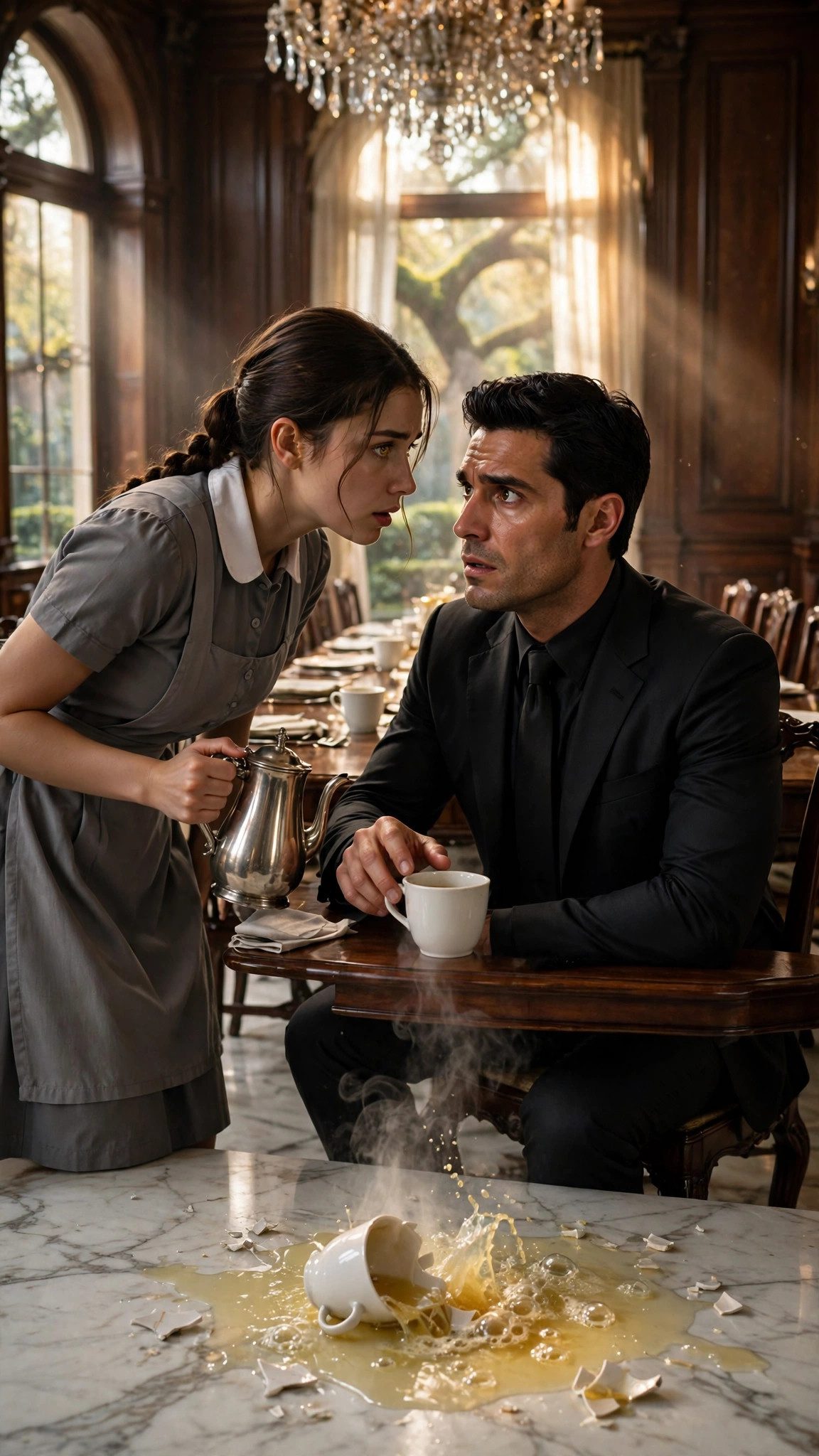
The morning they tried to kill me with a cup of coffee, I was reading about my own enemy in the newspaper and thinking about nothing at all.
It was July 25th, and the heat had already settled over New Orleans like a wet blanket by seven in the morning. I sat at the far end of my long dining room table in the Garden District mansion my father had built with money nobody in this city asked too many questions about, and I drank the same stale coffee I drank every morning, from the same white cup, with the same spoonful of honey that never quite dissolved. Benny Romano, my security chief, stood at my elbow with a folder under his arm and talked about territory the way other men talked about the weather, and I listened with half an ear because I had heard it all before. The docks were quiet. The French Quarter was quiet. Commissioner Del Rio was making noise about a new antidrug campaign in the papers, and that was noise too, the kind that faded by the weekend.
"Del Rio's people stopped two of our trucks on the river road," Benny said. "They let them go. No charges. He just wants us to know he's watching."
"Let him watch," I said, and turned the page.
The girl poured more coffee, and that was when I noticed her hand.
She stood beside me for less than a second, the way the maids always did, gray uniform, dark hair pulled back, eyes down. But her hand did not shake. Every other person in this house trembled a little when they came near me. The guards, the chefs, the drivers, the men who had worked for my family for twenty years — they all had the same careful stillness around me, the stillness of people who know what I am and what I can order done with a nod. This girl's hand was still the way a surgeon's hand is still. Steady because she had decided to be steady, not because she was afraid.
I looked up. She was already moving away, tray balanced, back straight, and I realized with a small shock that I had seen her a hundred times and never once actually seen her. Three years she had been moving through my house like a shadow. Three years of trays and folded towels and doors closing softly behind her, and I did not know her name.
"Wait," I said.
She stopped. She did not turn around at first. Then she turned, slowly, and looked at me directly, and that was the second shock, because nobody looked at me directly. Not my men. Not my enemies, when they could help it. Not the women who had shared my bed. This girl looked at me the way you would look at a stranger on a streetcar, with calm, unhurried interest, as if she did not know I ran this city.
"Your coffee tastes like it has been poisoned," she whispered.
She did not say it like a joke. She did not say it like a challenge. She said it the way you would tell a man it was going to rain, as a simple fact that had nothing to do with her and everything to do with him.
My hand froze over the cup.
Twelve years I had spent protecting myself from every assassin in the Gulf South. I was armed at all times. I slept with a pistol in the drawer beside my bed and a second one taped under the headboard. My food was tasted. My cars were swept. My enemies had tried bullets and bombs and knives and once, memorably, a woman with a garrote wire hidden in her hair at a charity gala. I did not expect danger to arrive through a coffee cup, in my own dining room, on a Tuesday morning, poured by a girl in a gray uniform.
The cup was still warm in my hand. I lifted it to my lips, slowly, the way you lift something you are suddenly not sure you should be holding at all.
"Carmine," the girl said.
That caught me off guard more than the word poison had. The staff never called me by my first name. They called me Mr. Orsini, or sir, or boss, or nothing at all. My own mother had called me Carmine. My father had called me son. Nobody else had used my name in fourteen years.
"I wouldn't drink that," she said.
The cup fell. I do not remember dropping it. One moment it was in my hand and the next it was shattering on the white marble floor, and I was on my feet with my chair overturned behind me and Benny's men moving toward the doors with their hands inside their jackets, and the coffee was spreading across the marble in a pale, steaming pool that hissed and bubbled and ate at the stone like something alive.
The coffee contained acid. Not poison. Acid. If I had drunk it, my throat would have been burned beyond saving, and I would have died choking on my own blood in my own dining room while my security chief watched.
Benny stared at the hissing pool. He was fifty-two years old, built like a bank vault, and I had never seen him frightened. He was frightened now.
"What did you say?" he said to the girl. "How did you know?"
The girl looked at him calmly, the way she had looked at me, and I understood then that her calm was not an act. She was not a woman pretending to be brave. She was a woman who had already decided what she was willing to lose.
"I've been watching the coffee since the morning, Mr. Romano," she said. "My job is to look after the people in this house, and I pay attention to the people who have been coming in and out of this place. I know how they behave."
She held me in her gaze, and her eyes were hazel, I noticed, with gold in them, and there was a small white scar on her left wrist that I had never noticed because I had never looked.
"That latte came from a kitchen packet with a note written on the money," she said. "If you open it, you can see for yourself. It was taken from the chef's room."
The silence in the dining room was so complete I could hear the air conditioner humming in the wall and the ice settling in the water pitcher on the sideboard.
Benny signaled his men with two fingers, and they moved toward the kitchen, quiet and fast, the way they had been trained. I stood there in my own dining room, my shirt spattered with coffee, staring at the girl who had just saved my life without asking for anything in return.
"I didn't save you for me," she said, and her voice dropped until it was almost a whisper, and she stepped closer to me, close enough that I could smell soap and clean cotton and nothing else. "I saved you for her."
"For who?" I said.
She reached into her apron and pulled out a small square of paper, folded seven times, soft with age at the creases, with two words written in faded ink on the corner.
October 14.
"My aunt Maureen told me to give this to you," she said. "She said it was a letter for your mother, and I was to give it to you when you turned eighteen. But I never had a reason to give it away. Not until today."
My throat tightened. I took the paper from her with fingers that were not steady, and I unfolded it once, twice, and saw my mother's handwriting, and my mother's name at the bottom, and the date written at the top in her careful, looping script.
"Your mom was a good woman," the girl said. "If I hadn't saved you today, she wouldn't have been the only one."
I looked up at her. The dining room was empty now except for the two of us and the hissing pool on the floor and the smell of burned stone.
"Who are you?" I said.
"My name is Violet," she said. "Violet Delacroix. And I have been waiting three years for you to notice me."
"Violet," I repeated, and the name felt strange in my mouth, like a word in a language I had forgotten I knew. "Why now? Why today?"
"Because today they finally tried," she said. "And because my mother is gone, and my aunt is gone, and your mother is gone, and there is nobody left to carry this except you and me."
"Maureen," I said, and the name came back to me from a long way off, like a voice from another room. "Aunt Maureen. She worked in this house when I was a boy. She made the soup my mother liked. She left when I was — I don't remember. I was young."
"She left because she had to raise me," Violet said. "My mother died when I was four years old. A fever, in the winter. Maureen took me in and raised me in a little house on the edge of the Ninth Ward, and she worked here in the daytime and came home to me at night, and she never once told me to be afraid of this house. She told me to watch it. She told me to learn the people in it, the way they moved, the way they behaved, because one day the people in this house would need someone who was paying attention."
"And your father?" I said.
Her face changed then, just slightly, the way a window changes when a cloud passes over the sun. "My father was a driver," she said. "He drove for your father. He was a boy who made a choice one night, fourteen years ago, and that choice killed your father, and it broke my father's heart, and it broke my aunt's heart, and it has been breaking mine for as long as I can remember. Maureen brought me to work in this house three years ago because she said our family owed yours a debt, and the only way to pay a debt like that is to be the person standing between you and the dark when it comes back."
I stared at her. Fourteen years. The night my father died. I had been nineteen years old, and I had spent every day since then believing I knew exactly what had happened that night. I had believed it was the Castellanos. I had believed it was a rival family, an ambush on the river road, a thing done by men I could name and hate and one day kill. I had never once considered that the betrayal had come from inside my own house, from a driver, from a boy who had eaten at my father's table.
"Your father betrayed mine," I said, and my voice sounded strange to me, flat and far away.
"Yes," Violet said. She did not look away. She did not apologize for him, and she did not defend him. "And before my mother died, she whispered one final instruction to me. She always said, 'Tell him to find the letter.' She wanted you to know that your mother didn't leave you alone forever. That is why I am still here, Mr. Orsini. That is why I have been following you with my eyes for three years, learning your coffee and your mornings and the faces of the people who come in and out of this house. I have been looking for you, in my own way, for as long as I have been here. And today, finally, you looked back."
I looked down at the folded letter in my hand. My mother's handwriting. October 14. Fourteen years old, folded seven times, carried in a maid's apron pocket through three years of mornings, waiting for the day I would finally notice the girl who carried it.
"I'm sorry," I said softly. Of all the things I have said in my life, that one hurt me the most, because I did not know who I was apologizing to. To her. To her father. To my father. To my mother. To myself, for three years of walking past a woman who had been standing guard over my life without my knowledge.
"Don't be," she said. "Be careful instead. The people who did this today have been planning it for years, and they are not finished."
Before I could answer, the door to the kitchen burst open and Benny came through it at a run, his face white under his tan, his pistol in his hand, which I had seen exactly twice in twelve years.
"Boss," he said, and his voice was wrong, tight and high. "The chef's room is empty. Marcel is running. And we found something else."
"What?"
"Clara," Benny said. "Your maid Clara. We found her in the pantry with a gun pressed against her own ribs and a knife in her hand, smiling like she was at a party. She's been planning this for years, boss. For two nights she has been putting something in your coffee."
I looked down at the folded letter in my hand. October 14. My mother's handwriting. A date fourteen years old.
"And one more thing," Benny said. "There was a note on the pantry door. Four words. It said, 'Follow the blood trail.'"
I folded the letter again, carefully, seven times, the way it had been folded when she gave it to me, and I put it in my inside jacket pocket, over my heart.
"Then we follow it," I said.
Behind me, the coffee kept hissing on the marble, eating its slow yellow hole in the floor of the house my father had built, and the girl named Violet stood in the doorway of my dining room with her hands folded in front of her apron, watching me, waiting, the way she had been watching me for three years.
I had spent twelve years believing I was the most protected man in New Orleans. I had been wrong about that. I had also been wrong about who was protecting me.
That was the morning I learned my life had been saved by a maid I had never bothered to learn the name of. It was not the last thing she would save.