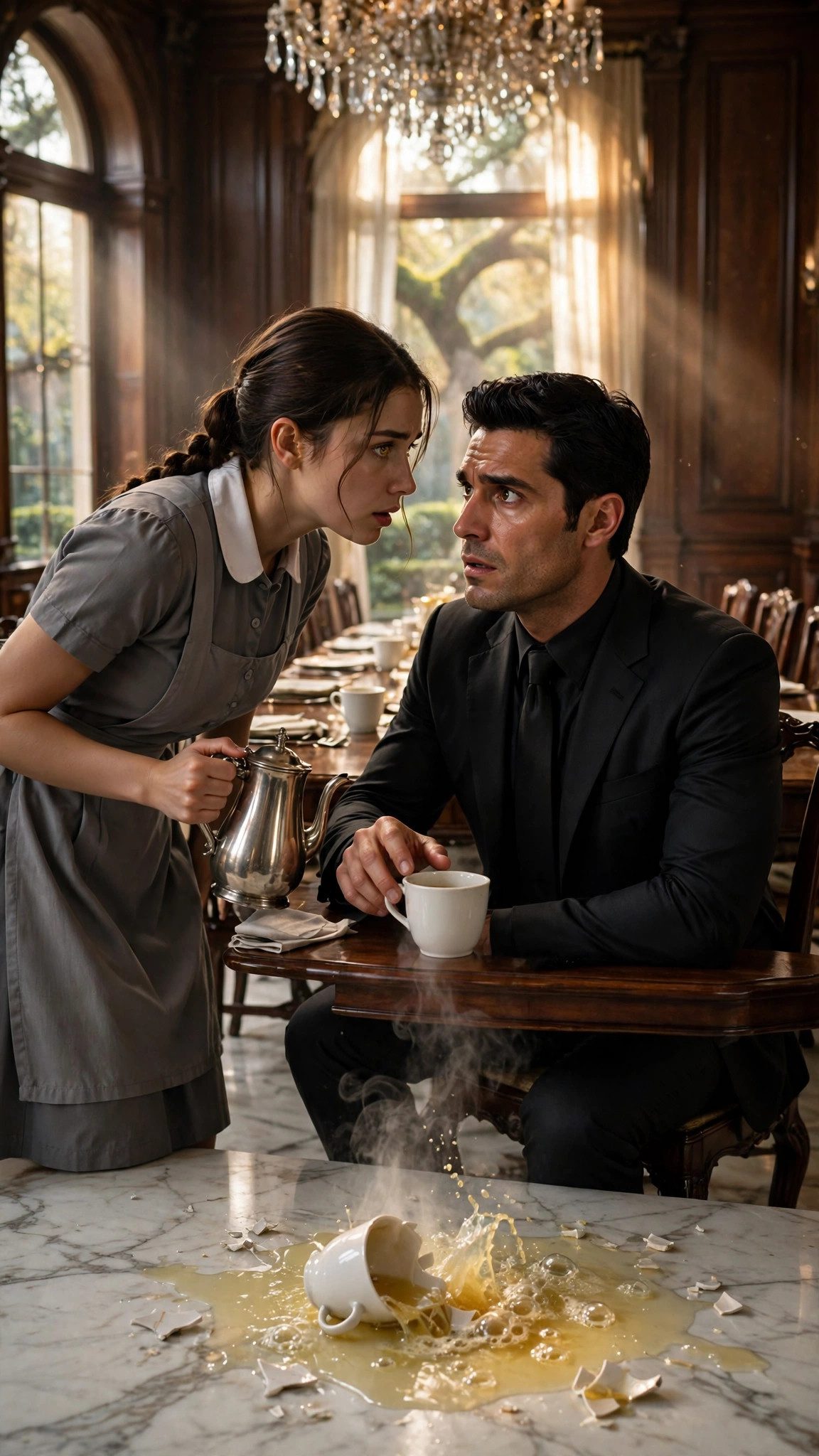
One year later, on the morning of July 25th, I woke up in the house my father had built, and I poured my own coffee, and I carried it to the dining room myself, and I sat down at the long table, and I waited for the woman I loved to come down the stairs.
The house was different now. It was not a fortress anymore. It was a home.
The guards still stood at the doors, because some things do not change in New Orleans, but they stood there as men I knew by name, with families I knew by name, and they ate breakfast at the staff table with the maids and the cooks and the drivers, and once a week I ate with them, because a man who does not know the names of the people in his house does not deserve the house.
The hidden room behind the wine cellar was sealed up, and a small brass plaque had been set into the wall beside it. It said: "For Elena and Salvatore Orsini, and for Maureen Delacroix, who kept watch." The box of my mother's letters was back on the shelf in the library, where it belonged, and Elena's gold bangle lay on the table beneath her portrait, catching the light, and every morning I uncovered the portrait and said good morning to my mother, the way I should have been doing for fourteen years.
Castellano was convicted in the spring. The trial lasted three weeks, and Clara testified, and Henri testified, and Agent Reyes laid out the ledger and my father's letter and my mother's letter, page by page, name by name, and the jury took less than a day to find him guilty on every count. He will spend the rest of his life in a federal prison in Louisiana, an old man in a cell, with nothing to do but think about the river he killed for and never got to keep.
Clara was sentenced to eight years, with credit for her cooperation, and she writes to me once a month from the prison kitchen where she works now, and her letters are short and careful, and they always end the same way: "I am sorry I tried to kill you, and I am not sorry I tried, and both of those things are true at the same time." I write back. I tell her about the house, and about the garden, and I tell her that her father is not forgotten, and that the war that killed him is over, and that she is free to stop fighting it now.
Henri died in the winter, peacefully, in his sleep, in the minimum-security facility where he was serving his sentence, with the photograph of his wife Colette on the table beside his bed. I paid for his funeral, and I stood at his grave with Violet, and I told him, out loud, in the quiet of the cemetery, that he was forgiven, and that his wife's six years were worth the price he paid, and that no one in my house would ever speak his name with anger again.
Marcel is in prison too, and he does not write, and I do not write to him, and that is the end of his story.
But this is not a story about them. This is a story about a maid in a gray uniform, and a cup of coffee, and a letter folded seven times.
Violet came down the stairs that morning in a blue dress that was not a uniform, with her dark hair loose around her shoulders instead of pulled back, and the small white scar on her left wrist catching the light, and she sat down across from me at the long table, and I poured her coffee, and she poured mine, and we drank it together, the way we had done every morning for a year.
"You are thinking about something," she said.
"I am thinking about the first morning," I said. "July 25th, a year ago. You stood beside me for less than a second, and I noticed your hand, and you told me my coffee tasted like it had been poisoned, and you saved my life, and you gave me my mother's letter, and you changed everything."
"I am thinking about it too," she said. "I am thinking about the three years before that morning, when I carried your mother's letter in my apron pocket and watched your house and waited for the day you would finally notice me. And I am thinking about Maureen, and my mother, and your mother, and how all three of them were standing behind me that morning, even though they were gone, guiding me to the moment when I would save you."
I reached across the table and took her hand. Her hand was steady, the way it had always been steady, and I held it, and I looked at her, and I said the thing I had been practicing for a month, in the library, in front of my mother's portrait, until I could say it without my voice shaking.
"Violet Delacroix," I said, "will you marry me?"
She stared at me. Then she laughed, a real laugh, the kind that fills a room, and tears ran down her face, and she said, "Yes. Yes, of course, yes. I have been waiting three years for you to notice me, and a year for you to ask me, and the answer has always been yes."
I took a small box out of my pocket, and inside it was a ring, simple and gold, with a single stone, and I put it on her finger, and it fit, because I had measured it in secret with a piece of string while she slept, the way a man does when he is planning something properly.
We were married in the garden, under the oak tree, on a warm evening in August, with white jasmine on every table and candles in every window of the house, and Benny gave a toast that made half the guests cry, and Agent Reyes came, in a suit that did not quite fit, and he danced with the cook, and the staff of the house sat at the head table as guests of honor, because they were family now, all of them, and that was the point.
Violet wore white, and I wore black, and when the priest asked if I took this woman to be my wife, I said yes, and I thought about my father, and my mother, and Maureen, and Thomas, and all the people who had loved each other so hard that it had broken them and saved them in the same breath, and I thought about the letter folded seven times, and the passport that had never been used, and the bangle on the table beneath my mother's portrait, and I understood that I was standing in the middle of a story that had started fourteen years ago, on a river road, with a driver who chose his baby, and that it had ended here, in a garden, under an oak tree, with a maid who had saved my life becoming the woman who would share it.
The wedding itself was the kind of evening people in New Orleans talk about for years afterward. The garden was strung with lights, and the oak tree was wrapped in white jasmine, and the tables were set with my mother's china, which had been in boxes in the attic for fourteen years, and which Violet had unpacked and washed herself, plate by plate, humming a song her aunt used to hum while she worked.
Benny gave the toast. He stood up with his glass in his hand, and he looked out at the garden full of people, and he said, "I have known Carmine Orsini since he was nineteen years old and angry at the whole world, and I have watched him become the hardest man in this city, and I have watched him become, in the last year, something I never thought I would see. A happy man. And I want to tell you all that the reason for that is sitting right here, in a white dress, and her name is Violet, and she is the bravest person I have ever met, because she walked into a dining room full of men with guns carrying nothing but a tray and a tape recorder, and she told the truth, and she did not flinch. To Violet, who saved him. And to Carmine, who finally learned how to see."
The guests stood and cheered, and Violet cried, and I cried, and Benny pretended he had something in his eye, and the band played, and we danced our first dance under the oak tree, to a slow song that nobody remembered the name of, and the whole garden seemed to hold its breath.
For our honeymoon, we did not go to Paris or Rome or any of the places a man like me is supposed to go. We drove down to a small house on the Gulf Coast, a white house with blue shutters that my mother had loved, and we stayed there for a week, and we cooked our own meals, and we walked on the beach in the mornings, and we talked, really talked, for the first time, about everything.
Violet told me about the little house in the Ninth Ward, and about Maureen's soup, and about the nights when she was small and afraid of the dark, and Maureen would sit on the edge of her bed and tell her stories about her mother, a woman who had laughed easily and loved fiercely and died too young of a winter fever. She told me about the day Maureen gave her the folded letter, and about the three years she carried it in her apron pocket, and about the mornings she stood in my dining room pouring coffee for a man who did not know her name, and how she had almost given up, more than once, and how something always stopped her.
"I used to stand in the hallway outside your office," she said, on the third night, sitting on the porch with her feet in my lap and the Gulf wind in her hair, "and I used to listen to you talking on the telephone, and I used to think, he sounds so lonely. He sounds like a man in a house full of people who is completely alone. And I used to think, if he would only look up, if he would only see me, I could tell him he is not alone. And then the morning came when you did look up, and I told you about the coffee, and everything changed."
"I was lonely," I said. "I had been lonely for fourteen years, and I did not know it, because I had mistaken being feared for being loved, and being obeyed for being known. You knew me, Violet. You knew my coffee and my mornings and my habits, and you knew me, before I knew you. That is a strange and wonderful thing, and I am grateful for it every day."
When we came home, Violet took over the running of the house, not as a maid, but as its mistress, and she did it the way she did everything: quietly, carefully, and with attention to the people in it. She raised the staff's wages. She gave every member of staff a day off each month, paid, to do whatever they liked. She turned the old servants' quarters, the rooms that had been boarded up for twenty years, into a library, with books on every shelf and comfortable chairs and a kettle that was always on, and she told the staff that the library was theirs, and that they could read there whenever they liked, and that no one in this house would ever be invisible again.
She also started a fund, in Maureen's name, for the children of the people who worked in the house, to pay for their schooling and their books, and the first child it helped was the daughter of one of the drivers, a bright girl named Rosa, who wanted to be a doctor, and who is going to be one, because Violet Delacroix does not forget a promise, and she does not forget a debt.
And me? I still run the family. I still sit at the long table and take Benny's folder and listen to the territory reports. But I do it differently now. I listen more, and I order less, and I ask the people around the table what they think, and sometimes I even take their advice, which shocks Benny every single time. The docks are mine, and the Quarter is at peace, and Commissioner Del Rio has stopped making noise in the papers, because a city that is at peace does not need a man like Del Rio to make speeches about it.
After the wedding, I framed my mother's letter, the October 14 letter, in glass, and I hung it on the library wall beside her portrait, and beside it I hung the passport, the dark blue passport in Maureen Delacroix's name, unburned and unstamped, as a reminder that the women of this family protect each other, even when the men are killing each other, and that mercy is not weakness, and that the truth, once found, cannot be un-found.
And every morning, Violet and I pour our own coffee, and we drink it together at the long table in the dining room, and the house is quiet, and the marble floors shine, and the portraits on the walls look down at us with their flat, painted patience, and I think, sometimes, that they are smiling.
Three years passed before I truly noticed the quiet maid who moved through my mansion like a shadow. It took a cup of poisoned coffee to make me see her. It took a letter folded seven times to make me understand her. And it took a year of mornings, drinking coffee together at the long table, to make me love her the way she deserved to be loved.
She saved my life on July 25th. She saved my family, and my father's name, and my mother's memory. But the truest thing I can say about Violet Delacroix, the maid who saved my life, is this: she did not just save me from dying. She saved me from living the rest of my life without ever truly seeing the people around me. And that is a harder thing to save a man from, and a better thing, and I will spend the rest of my life being grateful for it.
The End.
THE END