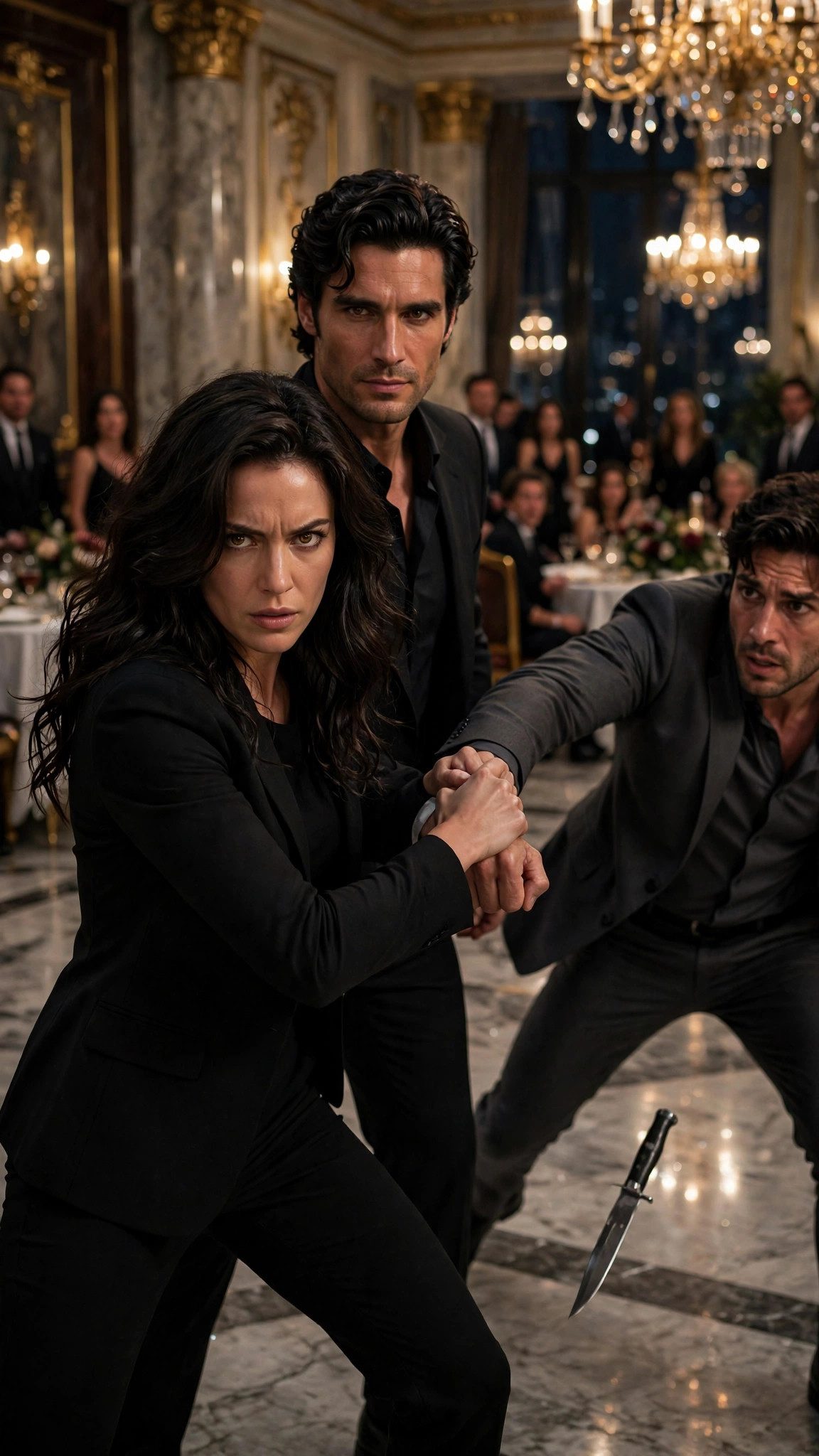
The second week, the sabotage stopped being small.
It started on a Tuesday, with a phone call at three in the morning. I was asleep in the small room they had given me on the second floor — a plain room, a narrow bed, a window that looked out over the garden — when Enzo knocked on my door and said, "Get up. There's trouble at the docks."
I was dressed in ninety seconds. Army habit. Leo was already in the hall, pulling on his jacket, his face calm in the way it always was when things were going wrong, which was to say, completely still.
"Warehouse 4," he said. "Fire. The night crew got out. The shipment is gone."
We drove to Pier 9 through empty streets, the city dark and wet, and by the time we got there the fire trucks were already gone and the warehouse was a black skeleton against the sky, smoke still rising from the ruins in thin gray ribbons. The night foreman, a man named Sal with soot on his face and tears in his eyes, told us what had happened: the fire had started in the back, near the fuel drums, at just past two in the morning. The sprinklers had not worked. The alarm had not sounded. Someone had cut the wires.
"Who knew the shipment was here?" Leo asked.
"Me," Sal said. "The crew. And Mr. Marco. He was here yesterday afternoon, checking the manifests."
Leo did not say anything. He walked through the ruins in his good suit, stepping carefully over the fallen beams, and he looked at the place where the fuel drums had been, and at the cut wires hanging from the wall, and at the scorch marks climbing up the back of the building like black fingers. Then he came back to where Enzo and I were standing, and he said, "Quinn. With me."
We drove to a diner on the edge of the docks, the kind of place that never closed, and Leo ordered coffee for both of us, and we sat in a booth by the window while the sky turned gray over the water.
"Tell me what you're thinking," he said.
I thought about the notebook in my pocket. The truck. The camera. The meeting. The sedan. The warehouse shift. And now this.
"I'm thinking that someone inside this family is burning it down one piece at a time," I said. "And I'm thinking that every piece that's been touched is a piece Marco controls. The trucks. The cameras. The warehouse. The routes."
"Marco controls the docks because I gave him the docks," Leo said. "He has run them for twenty years. If he wanted to burn a warehouse, he wouldn't need to cut wires. He could just order it done."
"Unless he needs it to look like someone else did it," I said. "Unless he needs you to look at the Castellanos, or the Morettis, or anyone except him."
Leo wrapped his hands around his coffee cup and stared out the window at the river. "The Castellanos," he said, slowly. "Vincent Castellano. He has wanted the docks for ten years. He has tried to take them three times. Each time, Marco was the one who stopped him."
"Or each time, Marco was the one who let him get close enough to make it look real," I said.
Leo looked at me then, and his eyes were very dark. "That is a dangerous thing to say, Quinn."
"I know," I said. "But you asked me what I'm thinking."
He was quiet for a long time. Then he said, "My father trusted Marco with his life. I have trusted Marco with mine. If you are wrong about him, you will have destroyed a twenty-year friendship for nothing. If you are right about him —" He stopped. He did not finish the sentence. He did not have to.
"If I'm right," I said, "then the next fire won't be a warehouse."
That night, I started a second notebook. The first one was for facts: dates, times, names, plates. The second one was for the pattern. I sat in my room and laid it all out, the way I had been trained to lay out an enemy's movements on a map: the late truck, the angled camera, the moved meeting, the gray sedan, the warehouse shift, the fire. Each one alone was nothing. Together, they were a road. And the road led to one place.
Someone was testing the fences. Someone was finding the blind spots. Someone was getting ready to move, and when they moved, it would not be a warehouse. It would be Leo.
The next day, the convoy was hit.
Three trucks, carrying goods from the port to a warehouse upstate, were ambushed on a stretch of highway twenty miles outside the city. Two cars boxed them in, and four men with bats and crowbars smashed the windows and dragged the drivers out onto the asphalt. It was supposed to be a robbery. But they did not take the goods. They took the manifests — the papers that said where the trucks had come from and where they were going — and they left the cargo sitting in the road, untouched.
Leo called me into the study that evening, and Marco was already there, standing by the fireplace with his hands behind his back, his face a careful mask of concern.
"Quinn," Leo said. "You were at the docks this morning. Tell me what you saw."
"I saw three trucks that left on time and never arrived," I said. "I saw drivers who said the men knew exactly which truck carried the manifests. And I saw that the only people who knew the convoy's route were in this room."
Marco's eyes flicked toward me, cold and flat. "Are you accusing someone, Miss Quinn?"
"I'm stating facts," I said.
"The facts are that the Castellanos have been hitting our convoys for years," Marco said. "The facts are that Vincent Castellano has put a price on Leo's head twice in the last five years. The facts are that a woman who has been here for two weeks does not know this family well enough to point fingers."
"The facts are that the men who hit the convoy didn't take the cargo," I said. "Robbers take cargo. These men took paper. Paper that tells them where our trucks go, and when, and who drives them. That's not a robbery, Mr. Marco. That's reconnaissance. And the only way they knew which truck to hit is if someone told them."
The room went very quiet. Leo looked at Marco. Marco looked at me. And for one long moment, nobody said anything at all.
Then Leo said, "Marco. Leave us."
Marco left. The door closed behind him with a soft click, and Leo stood at the window with his back to me, the way he had stood on the first day I met him, looking out at the garden.
"Do you have proof?" he asked.
"No," I said. "Not yet."
"Then get me proof," he said. "Because if you are right, I need to know before he moves. And if you are wrong, I need to know that too, before I destroy a man who has been loyal to my family for twenty years."
"I'll get you proof," I said.
That night, I did something I had never done before in my life. I followed a man.
Marco left the estate at eleven, in his own car, alone. I followed him in Enzo's car, keeping three cars back, lights off on the empty streets, the way the Army had taught me to follow a man who did not want to be followed. He drove to the south side of the city, to a neighborhood of narrow streets and shuttered shops, and he parked outside a warehouse with no sign on the door. He went inside. He was there for forty minutes. When he came out, he was carrying nothing, and his face was calm, and he drove home the long way, as if he had all the time in the world.
I waited until his car was gone, and then I walked around the warehouse, looking for a name, a number, anything. There was nothing. Just a blank door and a blank wall and a loading dock that had not been used in years. But in the dust by the door, I saw tire tracks — fresh ones, from more than one vehicle — and a cigarette butt, still warm, and a matchbook from a restaurant I recognized. The restaurant was on Castellano territory.
I put the matchbook in my pocket. It was not proof. But it was a thread, and I had learned, a long time ago, that if you pull a thread hard enough, the whole coat comes apart.
When I got home, it was past two in the morning, and Leo was still awake, sitting in the study with a glass of whiskey he had not touched.
"Well?" he said.
I put the matchbook on his desk. "He went to a warehouse on the south side. No name on the door. He was there for forty minutes. This was outside."
Leo picked up the matchbook and turned it over in his fingers. The name on it was printed in gold letters. He read it, and his face did not change, but something in his eyes went very still.
"Vincent Castellano owns that restaurant," he said.
"I know," I said.
He put the matchbook down, very carefully, in the center of the desk, and he looked at me for a long time.
"Quinn," he said, "do you know what happens to people who betray this family?"
"Yes," I said.
"Then you understand what you are asking me to do," he said. "You are asking me to believe that the man who carried my father's coffin is selling my family to the man who has tried to kill me three times."
"I'm asking you to believe the pattern," I said. "The truck. The camera. The meeting. The sedan. The warehouse. The convoy. The matchbook. None of them is proof. All of them together are a road. And the road leads to Marco."
Leo stood up and walked to the window, and for a long time he did not speak. When he finally turned around, his face was the face of a man who had made a decision he did not want to make.
"Then we follow the road," he said. "And we see where it ends."
The next morning, I went to the county records office with Enzo, and we asked, politely, who owned the warehouse on the south side with no sign on the door. The clerk, a tired woman with reading glasses on a chain, typed for a while and then told us the building was owned by a holding company called Lakeshore Properties. The holding company was registered to a law firm downtown. The law firm would not say who its client was.
"It doesn't matter," Enzo said on the drive home. "We know enough."
"We know a matchbook," I said. "A matchbook isn't proof."
"It's enough for Leo," Enzo said. "He's been watching Marco for a week now. I can see it in his face. He's waiting for the moment when the pattern becomes a fact."
That afternoon, Marco found me in the hallway outside Leo's study, and he stopped in front of me, and he looked at me the way a man looks at a dog that has started growling at him.
"You've been following me," he said. It was not a question.
"I follow everyone," I said. "It's my job."
"You follow me again," he said, very quietly, "and you'll find out what happens to people who don't know their place in this house."
"And what is my place, Mr. Marco?" I asked.
"Outside," he said. "You were hired from outside. You will always be from outside. Men like Leo don't keep outsiders close for long. They use them, and then they forget them. Remember that."
He walked away, and I stood in the hallway, and my hands were shaking — not from fear, but from anger, the hot clean kind that makes your vision go sharp. I had been threatened by better men than Marco, in worse places than a hallway, and I had learned a long time ago that a man who threatens you in private is a man who is afraid of what you know.
That evening, Leo called the whole household together in the grand hall — the captains, the drivers, the men who worked the docks, the women who ran the kitchens — and he stood on the steps at the far end of the room, under the golden chandeliers, and he said, in a voice that carried to every corner, "From tonight, Quinn speaks for me. When she gives an order about my safety, it is my order. When she asks a question, you answer it as if I asked it. Is that understood?"
The room was silent. Every face turned toward me, standing at the foot of the steps in my black blazer, and I felt the weight of forty pairs of eyes. Marco was standing near the back, and his face was perfectly still, and his hands were folded in front of him, and he looked like a man carved out of stone.
"Understood," the room said, almost as one.
Afterward, Leo found me in the garden, where I had gone to be alone for a minute, and he stood beside me without speaking for a while, looking out at the dark beyond the walls.
"You know what you've just done?" he said at last.
"I know what you've just done," I said. "You've painted a target on my back."
"Yes," he said. "I have. And I'm sorry for it. But if Marco is what you say he is, then he was already coming for you. At least now the whole house knows whose side you're on."
"And whose side is that?" I asked.
"Mine," he said simply. "Yours. Ours."
We stood there in the dark, and the city hummed beyond the walls, and I thought about the road I had laid out in my notebook, and about the place where it ended. I did not know what Marco was planning. But I knew he was running out of time, and a man who is running out of time is the most dangerous kind of man there is.
The next move would be his. And it would not be a warehouse.