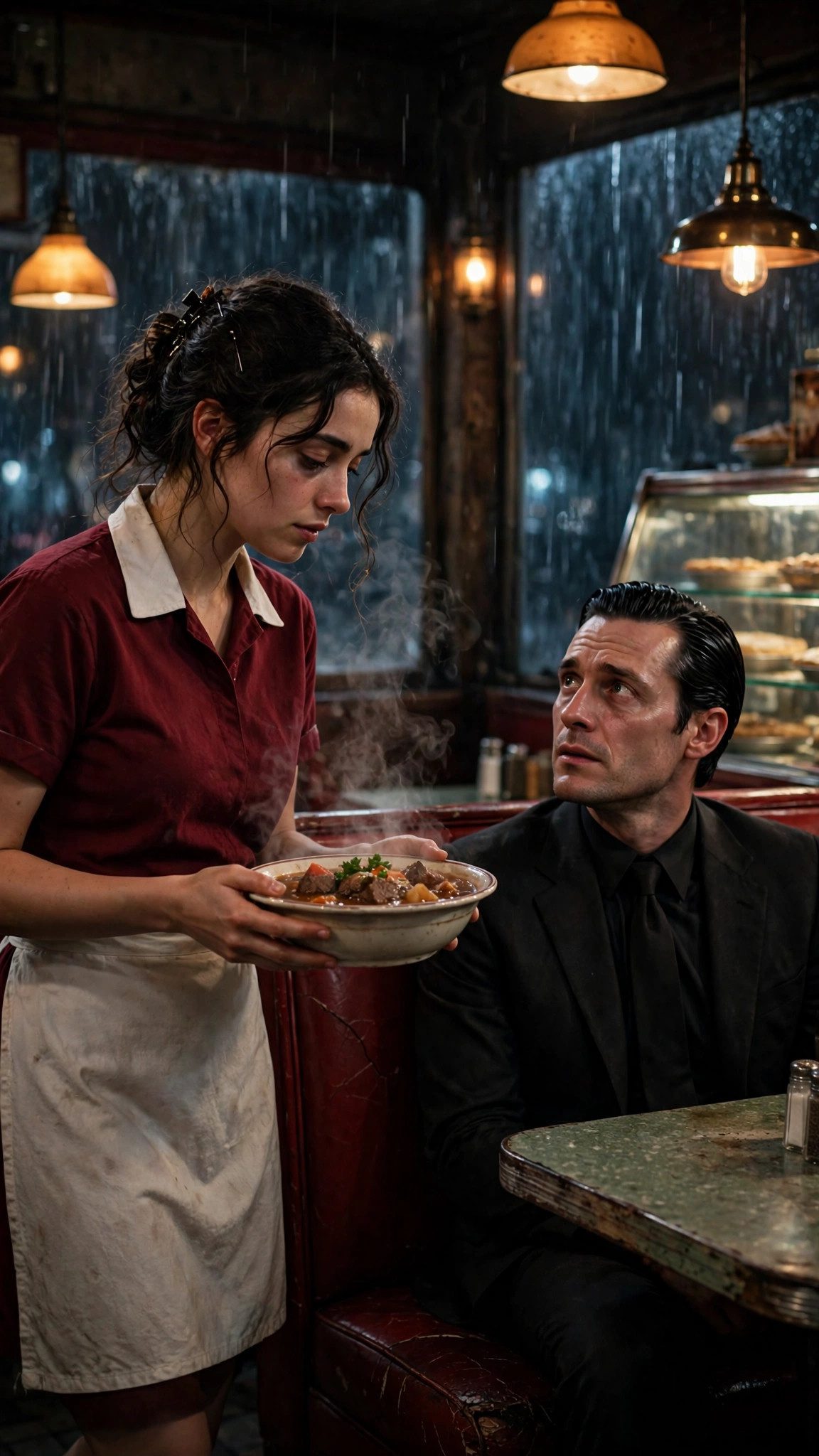
Gabriel Hayes did not become the most feared man in the city by trusting people. He became the most feared man in the city by understanding, very early, that trust was the most expensive thing a man could buy — and the easiest thing to lose.
He learned that lesson in his mother's kitchen, before he was old enough to understand what he was learning.
The kitchen was small and warm, with yellow curtains that his mother had sewn herself and a stove that was always too hot on one side. His mother, Elena Hayes, sang while she cooked. She sang old songs in a voice that was not beautiful but was always certain, and the smell of her cooking filled the whole house — thyme and garlic and cinnamon, the smell of a woman who believed that a meal could hold a family together even when everything else was falling apart.
And standing beside her, always, was Rosa Marchetti.
Rosa was not family. Rosa was the cook, a quiet woman in her forties with flour on her hands and patience in her eyes, who had come to the Hayes house when Gabriel was six years old and stayed until the house itself fell apart. She was the one who taught Gabriel how to peel a potato without cutting himself. She was the one who slipped him an extra piece of bread when his father was in a bad mood. She was the one who told him, on the nights when his parents fought downstairs and the walls shook, that the kitchen was the safest room in the house, because nobody ever fought in a kitchen that smelled like dinner.
"The secret," Rosa used to say, stirring a pot of stracotto with a wooden spoon that had been in her family for forty years, "is the dirt and the spice. Thyme for the earth. Cinnamon for the soul."
Gabriel was twelve when his mother died. It was not a dramatic death. There was no gunshot, no car crash, no enemies at the door. She got sick in the winter — a cough that would not go away, a fever that came and went — and then one morning she did not wake up. The doctor said it was her heart. Gabriel said nothing at all. He stood at her funeral in a suit that was too big for him and stared at the ground, and when people tried to hug him, he stepped away.
His father, Daniel Hayes, drank himself into an early grave two years later. By fourteen, Gabriel was alone in a house that smelled like nothing anymore, because Rosa had left the week after Elena's funeral. Nobody told Gabriel why she left. Nobody told him where she went. One day she was there, and the next day the kitchen was empty, and the house was quiet in a way that made his chest hurt.
He went into the streets with nothing but his name and his anger. He ran errands for men who paid in cash and asked no questions. He learned to fight. He learned to listen. He learned that the men who survived were not the strongest or the fastest, but the ones who never trusted anyone completely — not their friends, not their lovers, not even their own family.
By twenty-five, he had his own crew. By thirty, he had his own territory. By thirty-eight, he controlled the city's criminal underworld, and he had done it through intelligence and fear, the way the stories said. He owned buildings and businesses and politicians, and he had a penthouse with a view of the whole city, and a chef who had worked for him for six years, and a dining room with a mahogany table that could seat twenty people.
And he had not eaten a real meal in eight days, because the one man he had trusted with his life had died face-first in a plate of food.
Paulie Romano had been more than an underboss. Paulie had been the closest thing Gabriel had to a brother since his mother died. Paulie was the one who had stood beside him in the early days, when they were both young and hungry and stupid, and Paulie was the one who had taken a knife for him once outside a warehouse in the rain, and never once mentioned it afterward. Paulie was the one who knew where the bodies were buried, literally, and had never once used that knowledge against him.
When Gabriel got the call that Paulie was dead, he was in a meeting with three city councilmen. He listened to the voice on the phone, he thanked the caller, he hung up, and he finished the meeting. He did not raise his voice. He did not break anything. He waited until the councilmen were gone, and then he went to Paulie's house and stood in the dining room and looked at the body.
Paulie was still face-down in the risotto. The plate had not been cleared. The chef's apron was still on the floor where he had collapsed on his way to the phone. The paramedics said the chef had died in the ambulance. The poison had been fast. Whoever had done this had wanted it to be fast, and certain, and impossible to miss.
"Who did this?" Gabriel asked Leo, and his voice was very quiet, which was how Leo knew he was more dangerous than he had ever been.
"We don't know yet, boss," Leo said. "The chef's family says he was scared the last few weeks. Said someone was threatening his daughter. We think somebody got to him. Made him put something in the food, or made him look the other way while somebody else did."
"Somebody inside," Gabriel said. It was not a question.
"Has to be," Leo said. "Nobody outside gets into Paulie's kitchen. Nobody outside knows what Paulie eats on a Tuesday night."
Gabriel stood over Paulie's body for a long time. Then he went home, and he looked at his own kitchen, and he understood something terrible: if someone could reach Paulie in his own dining room, with his own chef, then someone could reach him anywhere. The poison did not need a gun. It did not need a knife. It only needed one person in the kitchen who had been bought, or threatened, or turned.
That night, his chef prepared dinner the way he always did. Gabriel watched him through the kitchen door. He watched the man's hands. He watched the way the man tasted the sauce with a clean spoon. He watched everything, and he still could not bring himself to eat.
"Boss, you have to eat," Leo said, standing near the dining room entrance with the plate in his hands. Leo was a broad-shouldered man with scarred knuckles, a man who had been with Gabriel longer than anyone, a man who could break bones without hesitation. But that night, his voice shook.
Gabriel stared at the untouched plate. The Wagyu steak on the porcelain had cost more than most people's monthly rent, but Gabriel didn't see an expensive meal. He saw poison. Arsenic. Cyanide. He saw Paulie's face in the risotto.
His hand reached forward, trembling slightly, before he pushed the meal away. The scrape of china against the mahogany table echoed through the silent room.
"Get it out of here."
"Gabriel, please." Leo stepped closer. "The chef tasted everything. I watched him. It's clean."
Gabriel's eyes hardened. "Paulie's chef tasted the risotto. He died in the ambulance. Paulie died on the floor."
He did not eat that night. He did not eat the next night. His body began to turn on him. His hands shook. His head ached. He could not sleep, and when he did sleep, he dreamed of Paulie's face in the plate, and of his mother's kitchen, and of a smell — thyme and cinnamon — that he had not smelled in twenty-six years.
On the third day, his lieutenant Marcus Hale came to see him. Marcus was forty-one, sharp-suited, ambitious, the kind of man who smiled with his mouth but not his eyes. He had been with the organization for nine years, and he had been waiting, patiently, for his turn.
"Boss," Marcus said, "the families are talking. They say you're sick. They say you're weak. Castellano's people are already moving on the docks. If you don't show your face soon, they're going to think the throne is empty."
"I'll show my face when I'm ready," Gabriel said.
"With respect, boss, the city doesn't wait. Paulie is dead. Somebody has to run the docks. Somebody has to collect. If you won't eat, at least let me handle—"
"No," Gabriel said. "Nobody handles anything until I say so."
Marcus smiled, and the smile did not reach his eyes. "Of course, boss. Take all the time you need."
After Marcus left, Leo said, "I don't like him, boss. I never have. He was at Paulie's house the night before it happened. Said he was dropping off paperwork."
Gabriel filed that away. He filed everything away. That was how he had survived this long — by remembering every detail, every visit, every word, and waiting for the pattern to show itself.
On the fifth day, Gabriel could barely stand without holding onto furniture. On the sixth day, the rumors reached the newspapers — not by name, but everyone in the city knew what "a prominent businessman in failing health" meant. On the seventh day, Leo found him sitting on the floor of his bedroom, his back against the wall, staring at nothing.
"Boss," Leo said, kneeling beside him. "You have to eat something. Anything. Let me bring you something sealed. A can. A package nobody has opened. I'll open it in front of you."
Gabriel looked at him, and for a moment he was not a boss at all. He was a tired, starving man who was afraid of his own kitchen.
"I can't," he said. "Don't you understand? If I eat, and it's poisoned, I'm dead. If I don't eat, I'm dead slower. Either way, somebody wins."
"Then let me drive," Leo said. "Away from your kitchens. Away from your people. Somewhere nobody knows you're coming. Somewhere the food doesn't come from your house."
And that was how, on the eighth night, three black SUVs moved through the pouring rain toward the South End, toward a broken neon sign that said Benny's, toward a tired waitress in a burgundy uniform who was studying for her nursing exams and had no idea that her life was about to change forever.
My name is Norah Bennett, and I was twenty-four years old, and I had been working at Benny's Diner for eleven months.
I had not planned to work in a diner. I had planned to be a nurse. I had been studying for my nursing exams for two years, working nights to pay for the classes, sleeping four hours a day, and telling myself that it was temporary, that it would all be worth it when I finally had a real job and a real life.
My mother worked double shifts at a laundry downtown. She had worked double shifts for as long as I could remember. She was a good woman, a tired woman, a woman who had given me everything she had, which was never quite enough, but I loved her for it anyway.
When I was small, my mother could not afford a babysitter, so she left me with Rosa Marchetti in Apartment 4B. Rosa was an old woman with flour on her hands and patience in her eyes, who lived two floors below us in a building with old wallpaper and a broken radiator that clanged all night in the winter. Rosa's apartment was the warmest place I knew. It smelled of thyme and garlic and cinnamon, and there was always a pot on the stove, and there was always a place for me at her table.
Rosa taught me to read. Rosa taught me to sew a button. Rosa taught me that a person could be poor and still be dignified, that a clean floor and a hot meal were a kind of wealth. And when I was nine years old, she taught me one recipe. Stracotto. She stood me on a chair so I could reach the stove, and she put a wooden spoon in my hand, and she said, "The secret, Norah, is the dirt and the spice. Thyme for the earth. Cinnamon for the soul."
I asked her once where she had learned to cook like that. She smiled, and the smile had sadness in it, and she said, "In a house that is gone now, for a family that is gone too. But the recipe is still here. Recipes don't die, Norah. People do. Recipes live as long as someone remembers them."
Rosa died when I was eighteen. I held her hand in the hospital, and she told me to be a nurse, because I had gentle hands and a steady heart, and then she was gone. I kept her recipe card in my apron pocket every shift, folded and refolded until the edges were soft. I had never cooked it for anyone outside my family. It was the one thing in the world that was only mine.
Until the night Gabriel Hayes walked into Benny's Diner and sat in a cracked red booth and asked for something fresh, something unopened, something he could trust.
And I stood behind the kitchen doors, frozen, watching the most dangerous man in the city, and I saw something nobody else in that room could see.
I saw a man who was starving. Not just for food. For something he had lost a long time ago, in a kitchen that smelled like thyme and cinnamon, in a house that was gone now.
I saw a little boy who missed his mother.
And before I could talk myself out of it, I stepped forward and said, "Move."
That night, after my shift ended, I walked home through the rain with Rosa's recipe card in my apron pocket, and my mother was waiting up for me at the kitchen table, the way she always did when I worked late. She took one look at my face and said, "Norah, what happened?" And I told her — about the men in black suits, about the boss who would not eat, about the stew, about the name he whispered. My mother listened without interrupting, the way she always did, and when I finished, she reached across the table and took my hand, and she said, "Your Rosa would be proud of you, baby. She always said that recipe would save somebody one day. She just didn't say who." I went to bed that night with my nursing textbook open on my chest, and I dreamed of Apartment 4B, and of Rosa's kitchen, and of a small boy with serious eyes standing half hidden behind his mother's skirt, waiting for someone to feed him.