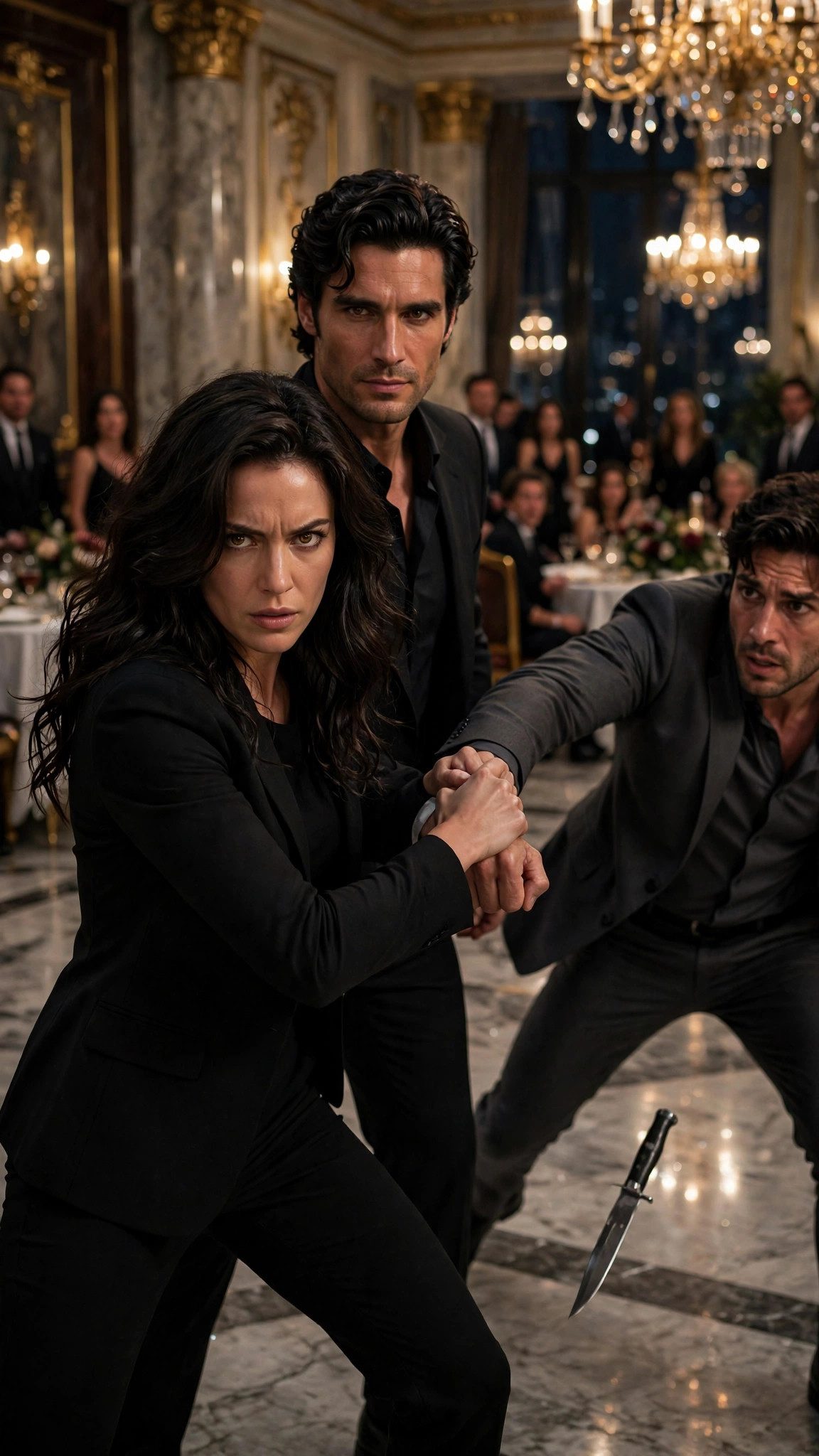
The council met on a Thursday, in the same grand hall where, four nights earlier, a man had lunged at Leo with a knife and I had stepped in front of a gun.
The room was different now. There were no chandeliers lit for a party, no string quartet, no wine. There were only the long table, the twelve men who sat at it, and the silence of a family waiting to find out whether it was going to survive.
Leo sat at the head of the table. I stood behind his chair, where a bodyguard stands, my hands loose at my sides, my eyes on the doors. Marco sat at the far end, between two of Leo's men, his hands free now but his face still gray. And in the middle of the table, laid out in a neat row, was the proof.
The photograph from the parking garage. The matchbook from Castellano's restaurant. The bank records Enzo and I had pulled together over three days — fifty thousand dollars a month, paid through Lakeshore Properties, into an account in Marco's wife's maiden name. The convoy manifests, with Marco's initials on every route that had been hit. The phone records, showing calls from Marco's private number to a number registered to Aldo Ferrante, made in the middle of the night, again and again, for two years.
And the last piece, the one that mattered most: a letter, in Marco's own handwriting, found in the safe at the country house where he was being held. A letter to Vincent Castellano, promising him the docks, the trucks, and the head of Leo Costello, in exchange for the chair.
Leo stood up, and the room went quiet, and he said, "You all know why we're here."
He told them the story, from the beginning. The late truck. The angled camera. The moved meeting. The gray sedan. The warehouse fire. The convoy. The matchbook. The mission that was meant to kill Quinn. The gala. The knife. The gun. He told it plainly, without anger, the way a man tells a story he wishes he did not have to tell, and when he finished, he sat down, and the room was silent.
Then the oldest man at the table — a captain named Salvatore, who had been with the family since Leo's father was a young man — stood up, slowly, the way old men stand when their knees hurt, and he said, "Marco. Is it true?"
Marco looked at the proof on the table. He looked at the photograph. He looked at the letter in his own handwriting. And then he looked at Salvatore, and he said, "Yes. It's true. All of it."
The room erupted. Men shouting, fists on the table, one captain standing so fast his chair fell over backward. It took Leo three words to bring them back to order.
"Sit down," he said. And they sat.
"Marco has confessed," Leo said. "The question before this council is not whether he is guilty. The question is what we do with him."
"The old law says death," Salvatore said. "Betrayal is death. It has always been death. Your father would have—"
"My father is dead," Leo said, and his voice was very quiet, and the room went still again. "My father is dead, and I am the head of this family now, and I am telling you that the old law is finished. We are not going to kill a man who has already lost everything. We are not going to give Castellano the public execution he wanted. We are going to do something he will never expect. We are going to be better than him."
He looked at Marco, and Marco looked back at him, and for a moment, neither of them said anything.
"Marco," Leo said, "you will give us everything. Every name. Every account. Every plan Castellano made. You will sit with our lawyers and you will write it all down, and you will sign it, and then you will go to the authorities yourself, and you will tell them what you did, and you will serve whatever sentence they give you. And when you have served it, you will leave this city, and you will never come back. Your wife and your daughter will be taken care of. That is my word. That is the mercy I am giving you, and it is more than you gave me."
Marco's face crumpled. Not with anger, but with something that looked almost like grief. "Leo," he said, and his voice broke. "I carried your father's coffin. I taught you to run the docks. I—"
"Yes," Leo said. "You did. And then you sold us. And I am still giving you mercy. Do not make me regret it."
Marco nodded, slowly, and two of Leo's men took him by the arms, and they led him out of the grand hall, and the council sat in silence, watching him go.
Then Salvatore stood up again, and he looked at Leo, and he said, "You are not your father, Leo Costello. Your father would have killed him in this room, in front of all of us. You let him live. I don't know if that makes you weaker or stronger. But I know it makes you different. And maybe different is what this family needs."
One by one, the other captains stood, and one by one, they nodded, and the council was over.
That afternoon, the second part of the war began.
Leo's lawyers took Marco's confession, and the bank records, and the letter, and they took them to a federal prosecutor named Daniel Reyes — a man Leo had known for years, a man who had been waiting for a reason to move against Vincent Castellano and had never had one good enough. Now he had one.
By evening, the news was everywhere. Castellano's restaurants were raided. His warehouses were searched. His accounts were frozen. Aldo Ferrante was arrested at the airport, trying to board a plane with a suitcase full of cash. And Vincent Castellano himself — the man who had tried to kill Leo three times, the man who had promised Marco a throne — was taken from his home in handcuffs, in front of the cameras, while the whole city watched.
I watched it on the television in the security room, with Enzo, and neither of us said anything for a long time. Then Enzo said, "You did this, you know. None of it happens without you."
"No," I said. "Leo did this. I just wrote things in a notebook."
"You wrote things in a notebook," Enzo said, "and then you stood in front of a gun. Don't pretend that was nothing, Miss Quinn. I've been in this family for twelve years, and I have never seen anyone do what you did in that grand hall. Not once. Not ever."
That night, Leo found me in the garden, where I had gone to be alone for a minute, and he stood beside me without speaking for a while, looking out at the dark beyond the walls.
"Castellano is finished," he said. "The prosecutor says he will never get out. Marco will serve his sentence, and then he will leave, and the family will go on. It is over, Quinn."
"Is it?" I asked.
"Yes," he said. "It is over. And I owe you something."
"You don't owe me anything," I said. "You paid me. Three times what the club paid me, remember?"
"I owe you more than money," he said. "I owe you the truth. So here it is. When I hired you, I hired you because you saw a gun before it was drawn. I thought I was hiring a pair of eyes. I didn't know I was hiring a conscience. You are the first person in my life, Quinn, who has ever told me the truth when it would have been easier to lie. The first person who has ever stood between me and something that wanted me dead — not because you were paid to, but because it was right. I don't know what to do with that. But I know I don't want to lose it."
He was quiet for a moment. Then he said, "Stay. Not as my bodyguard. As my —" He stopped. He looked out at the garden, and then back at me, and he said, very carefully, "As whatever you want to be. Head of my security. My partner. My friend. All of it, or none of it. But stay."
I looked at him, and I thought about Danny, and about the day I buried him in the rain, and about the promise I had made to myself that day. I thought about the club, and the long nights standing by a door, and the hollow place in my chest that had never quite filled. And I thought about the grand hall, and the gun, and the moment when I had stepped forward without thinking, because there was no other thing to do.
"I'll stay," I said.
Leo smiled then — a real smile, the kind that reaches a man's eyes — and he held out his hand, and I took it, and we stood there in the garden, in the dark, and the city hummed beyond the walls, and for the first time in a very long time, I was not afraid of what was coming next.
Because whatever it was, I would not be facing it alone.
The next morning, I sat in a federal building downtown, in a plain room with a plain table, and I told Prosecutor Daniel Reyes everything I knew. I told him about the truck, and the camera, and the meeting, and the sedan, and the warehouse, and the convoy, and the matchbook, and the mission, and the gala, and the gun. I showed him my notebooks — both of them, the one with the facts and the one with the pattern — and he read them the way a man reads a map of a minefield, slowly and carefully, and when he finished, he looked up at me and said, "Miss Quinn, in fifteen years of prosecuting organized crime, I have never seen a civilian build a case this clean. You should have been an investigator."
"I was a soldier," I said. "Close enough."
He smiled at that. "Castellano's lawyers will come after you. They will say you are a hired gun with a grudge. They will say you invented all of it. Are you ready for that?"
"I've been ready since the night I stepped in front of his gun," I said.
On the way out of the building, a woman was waiting for me on the steps. She was in her fifties, with graying hair and tired eyes, and I recognized her from the photographs on Marco's desk. His wife. Elena.
"Miss Quinn," she said. "May I speak with you?"
I stopped. I did not know what she wanted. An apology, maybe. Or an accusation. Or a scene, right there on the steps of a federal building, in front of everyone.
"I wanted to thank you," she said.
I stared at her. "Thank me?"
"My husband was going to die," she said. "Not in prison. In the street, or in a warehouse, or in a car with no brakes. Castellano does not reward men who fail him, Miss Quinn. He uses them and then he removes them. Marco would have been next. You stopped that. You exposed him before Castellano could finish using him, and Leo gave him mercy instead of a grave. My daughter will have a father who comes home one day. Because of you."
She took my hand, and her hand was shaking, and she held it for a moment, and then she let go, and she walked away down the steps, and I stood there, watching her go, and I thought about how strange the world was — that a woman could thank the person who had destroyed her husband's life, because destroying it had been the only way to save it.
That evening, I drove to the country house where Marco was being held, and I asked Enzo to let me see him alone. He hesitated, and then he nodded, and he left us in the small sitting room, with the windows open and the evening light coming in, and Marco sat in an armchair, looking out at the fields, and he did not look up when I came in.
"I came to ask you one question," I said.
He looked up then. "Ask it."
"Why?" I said. "You had everything. Twenty years. The docks. Leo's trust. A wife. A daughter. Why did you throw it all away for a man like Castellano?"
Marco was quiet for a long time. Then he said, "Because I was afraid. When Vincent Costello died, I was forty years old, and I had given my whole life to this family, and I looked at Leo — twenty-six years old, a boy, sitting in his father's chair — and I thought, he will never be his father. He will lose everything his father built. And I thought, if the family is going to fall, I should be the one holding something when it falls. Castellano offered me the chair. I told myself I was saving the family. I told myself that for two years. And by the time I knew it was a lie, I was too deep to climb out."
"You're not too deep now," I said. "Leo gave you a way out. Take it."
"I will," Marco said. "And Quinn —" He stopped. He looked at me, and his eyes were wet, and he said, "You were right about me. From the first week. I saw you writing in that notebook, and I knew. I knew you saw me. And I hated you for it. But I was wrong. You were the only one in this house who was doing her job."
I left him there, in the sitting room, looking out at the fields, and I drove home through the dark, and I thought about the strange mathematics of loyalty — how a man could love a family and betray it in the same breath, and how the only thing that had saved him was the woman he had tried to kill.
When I got back to the estate, Leo was waiting in the study, and he had a folder on his desk, and he slid it across to me.
"New rules," he said. "For the family. From tonight, no one man controls the docks, the trucks, and the money. Three men, three jobs, and they report to me separately. No more blind spots. No more single points of failure. And you —" He tapped the folder. "You are head of my security now. All of it. The house, the docks, the convoys. Enzo reports to you. The captains report to you. Anyone who has a problem with that can take it up with me."
I opened the folder. Inside was a contract, and a salary figure that made my eyes widen, and a single line at the bottom, in Leo's own handwriting: "She stood between me and death. She stays."
I signed it. And then I put my notebook in my pocket, and I went to my post by the door, and I watched the dark beyond the gate, the way I had watched it every night since I came to this house.
Only now, the dark did not frighten me. Because I knew what was in it, and I knew how to face it, and I knew I would not be facing it alone.