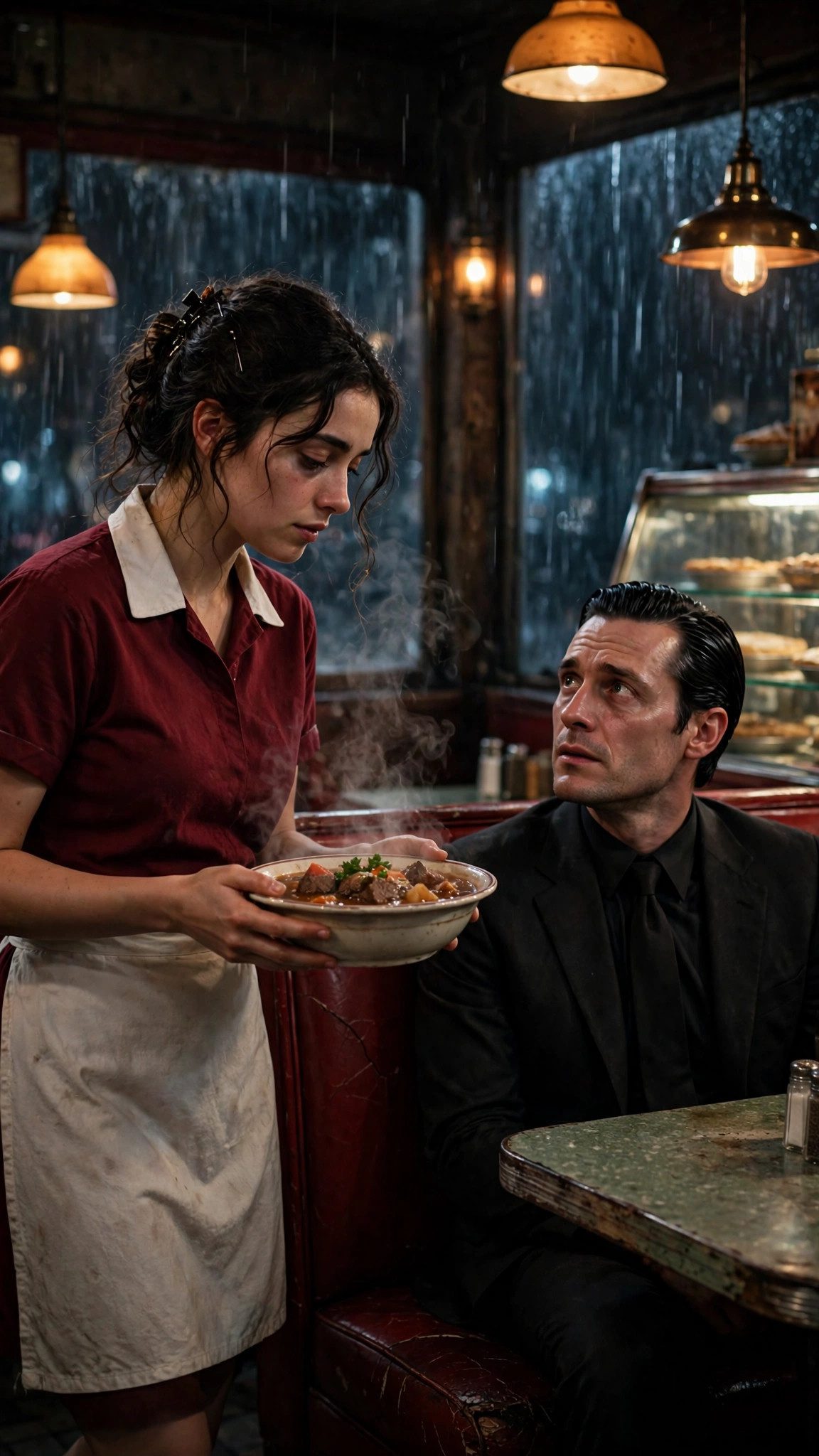
The day Gabriel left the hospital, he did something he had not done in twenty-six years.
He went to see Rosa.
Not to Apartment 4B — Rosa was gone from there, and the building had been torn down two years after she died, replaced by a parking lot. He went to the cemetery on the edge of the city, to a small, quiet section under an old oak tree, where the headstones were simple and the grass was always a little bit longer than everywhere else.
Rosa Marchetti's headstone said: ROSA MARCHETTI, 1939–2020. BELOVED FRIEND. And underneath, in smaller letters: "The secret is the dirt and the spice."
I stood beside Gabriel, holding a bunch of white lilies, and I watched the most feared man in the city kneel in the wet grass in his dark suit, and put his hand on the headstone, and close his eyes.
"I never got to say goodbye," he said. "I never got to thank her. I never got to tell her that I remembered."
"She knew," I said. "Rosa always knew when someone remembered. She used to say that recipes don't die as long as someone remembers them. And you remembered. Even when you didn't know you remembered."
Gabriel was quiet for a long time. Then he stood up, and he brushed the grass off his knees, and he looked at me.
"Norah, I need to find out what Rosa knew. About my mother. About that house. About why she left. I need to know the truth, even if it's terrible. Especially if it's terrible."
"How?" I asked.
"Rosa kept a box under her bed," I said. "I found it after she died. Letters. Photographs. And the recipe card. I kept the card. But the letters — I gave them to my mother, because I thought they were private, and my mother put them in a box in our apartment, and I never read them."
"Then let's read them," Gabriel said.
We went to my mother's apartment that afternoon. My mother was at work — she worked double shifts, the way she always had — and the apartment was quiet and small and clean, the way it always was. I found the box in the closet, under a stack of blankets. It was a shoebox, old and soft at the edges, with ROSA written on the lid in my mother's handwriting.
Inside were letters. Dozens of them. Some were in Rosa's handwriting. Some were in a handwriting I did not recognize — neat, slanted, careful. And at the bottom of the box, wrapped in a piece of faded blue cloth, was a small leather notebook.
Gabriel picked up the notebook first. He opened it carefully. The first page said, in Rosa's handwriting: FOR THE BOY, WHEN HE IS OLD ENOUGH TO UNDERSTAND.
He read it aloud, slowly, his voice shaking.
"Gabriel. If you are reading this, then I am gone, and you are old enough to know the truth. Your mother did not die of a weak heart. Your mother was poisoned. I know this because I cooked her food, and I saw what was in it, and I saw who put it there.
"It was a man named Vincent Castellano. He came to the house three times in the winter your mother died. Each time, he brought a gift — a bottle of wine, a box of chocolates, a jar of honey. And each time, after he left, your mother got sicker. I tasted the honey once, when she was not looking. It was bitter at the back, like almonds. I knew what it was. I had seen it before, in the old country, when I was a girl.
"I told your father. He did not believe me. He said Castellano was a friend, that Castellano would never do such a thing. He said I was an old woman with an old woman's fears. So I did the only thing I could do. I threw away the honey. I threw away the chocolates. I threw away the wine. But it was too late. Your mother was already sick, and she did not get better.
"The week she died, Castellano came to the house again. He stood in the kitchen, and he looked at me, and he said, 'Old woman, you have seen too much. If you ever tell anyone what you saw, I will make sure the boy pays for it.' And I believed him. So I left. I left the house, and I left you, and I have regretted it every day of my life since.
"But I took the recipe with me. Because the recipe is the one thing he cannot poison. The recipe is love, and love is the one thing Castellano has never understood, and never will.
"If you are reading this, Gabriel, then someone has remembered the recipe. Someone has fed you. And that means you are not alone anymore. Trust that person. Protect that person. And do what I could not do: make Castellano pay for what he did to your mother.
"With all my love, Rosa."
Gabriel closed the notebook. His hands were shaking. His face was white. And then, very slowly, he put the notebook down, and he put his face in his hands, and he cried — not the quiet tears of the diner, but deep, shaking sobs, the kind of crying that comes from twenty-six years of holding something in.
I sat beside him on the floor of my mother's small apartment, and I put my arms around him, and I held him while he cried, and I thought about Rosa, and about Elena, and about a little boy in a house that was gone now, who had never gotten enough to eat — not food, but love — and about how Rosa had spent the rest of her life making sure that someone, somewhere, would remember the recipe.
When Gabriel finally stopped crying, he wiped his face, and he looked at me, and his eyes were red, but they were clear.
"Norah," he said, "I need you to help me. I need to finish this. I need to make Castellano pay — not with a gun, not with violence, but with the truth. I need to take Rosa's notebook to the police. I need to take Marcus's confession to the police. I need to take everything we have, and I need to end this the right way."
"Why the right way?" I asked. "Why not your way?"
"Because my way is what made me the man who starves in his own house," Gabriel said. "My way is what killed Paulie. My way is what almost killed me. Rosa didn't teach me the recipe so I could keep being that man. She taught you the recipe so you could bring me home. And home isn't a penthouse with armed men at the door. Home is a kitchen that smells like thyme and cinnamon. Home is a table where nobody is afraid of the food."
He stood up, and he helped me to my feet, and he held my hands in his.
"Norah Bennett," he said, "will you help me come home?"
I looked at him — at the most feared man in the city, standing in my mother's small apartment with Rosa's notebook in his hands and tears on his face — and I thought about the stray dogs I used to feed behind my old apartment building, terrified and starving and dangerous only because they were desperate.
And I thought about the man in the cracked red booth, who had whispered Rosa's name like a prayer.
"Yes," I said. "I'll help you come home."
That night, Gabriel did something no one in the city had ever seen him do. He walked into a police station — not with lawyers, not with threats, not with money, but with a notebook, a folder, and a witness — and he told the truth. He told them about Marcus Hale. He told them about Vincent Castellano. He told them about Paulie. He told them about his mother. And he gave them Rosa's notebook, and Marcus's confession, and the photographs of Marcus meeting Castellano at the warehouse on the docks.
The police arrested Marcus that night. They arrested Castellano three days later, at his house, in front of his family, with the cameras rolling. The charges were conspiracy, murder, and attempted murder. The evidence was overwhelming. The trial would take months, but the outcome was never in doubt.
And Gabriel Hayes — the most feared man in the city — walked out of the police station into the morning light, and he looked up at the sky, and he took a deep breath, and for the first time in twenty-six years, he did not feel like he was waiting for someone to kill him.
He felt like a man who had just come home.
He came to the diner that night, at nine o'clock, the way he always did. He sat in the cracked red booth. He ordered the stracotto. I cooked it in the kitchen with the door open, and I carried the bowl out myself, and I placed it in front of him.
He picked up the spoon. His hand did not tremble at all.
"Norah," he said, before he took the first bite, "I have one more thing to ask you. And this time, it's not about the recipe."
"What is it?" I asked.
He reached into his jacket, and he took out a small box — not a wooden box, not an old box, but a new one, velvet, dark blue. He opened it, and inside was a ring. It was not a large ring. It was not a flashy ring. It was a simple gold band, with a single small stone that caught the light.
"Rosa told me once," he said, "that the secret is the dirt and the spice. Thyme for the earth. Cinnamon for the soul. But she never told me the third part. I think the third part is this: love is the reason you cook at all. And Norah — you cooked for me when I was starving, and you saved me when I was poisoned, and you brought me home when I was lost. Will you marry me?"
The diner went silent. Benny dropped a dish towel. Leo, standing by the door, smiled for the first time since I had met him.
I looked at the ring. I looked at Gabriel. I thought about Rosa, and Apartment 4B, and a little boy in a house that was gone now, and a bowl of stew that had brought him back.
"Yes," I said. "Yes, I'll marry you."
And Gabriel Hayes — the most feared man in the city — smiled, and he took the first bite of his stew, and he did not look afraid at all.
After the proposal, I went home and told my mother. She was sitting at the kitchen table, mending a shirt, the way she always did in the evenings, and when I showed her the ring, she put down the needle and thread, and she looked at the ring, and then she looked at me, and she started to cry — not sad tears, but the kind of tears that come when something you have prayed for finally happens.
"Your Rosa would have loved this," she said. "She used to tell me, when you were small, that one day a good man would see what I saw in you. She said, 'That girl has a steady heart, and one day someone will be smart enough to notice.'"
The next day at the diner, the regulars all knew. Old Mr. Kowalski, who came in every morning for coffee and toast, shook Gabriel's hand and said, "About time." The night-shift nurses from the hospital downtown brought a cake. The taxi drivers who parked outside at midnight honked their horns when Gabriel's car pulled up. Benny put a small hand-painted sign in the window that said: CONGRATULATIONS TO OUR NORAH — AND TO THE LUCKY MAN WHO FINALLY LEARNED TO EAT.
That night, Gabriel came to the diner with a different box — not velvet, not new, but old and wooden, with a brass clasp that had gone green with age. He set it on the table in the cracked red booth, and he opened it, and inside, wrapped in a piece of faded blue cloth, was a wooden spoon. It was worn smooth from years of use, and the handle was dark from decades of stirring.
"This was Rosa's spoon," Gabriel said. "I found it in my mother's things, in a box I hadn't opened in twenty-six years. It was in the kitchen drawer, wrapped in the same blue cloth as the photograph. Rosa must have left it behind when she left the house. Or maybe my mother kept it, because she knew Rosa would come back for it one day."
He held the spoon out to me, and I took it with both hands, and I felt the weight of it — not heavy, but solid, the way a good tool feels when it has been used by someone who loved their work.
"She never came back for it," I said.
"No," Gabriel said. "But you did. You came back for all of it — for the recipe, for the kitchen, for the boy who was hungry. So this belongs to you now."
I held Rosa's spoon, and I thought about Apartment 4B, and about the chair I used to stand on so I could reach the stove, and about Rosa's hand over mine, guiding the spoon in slow circles, telling me the secret was the dirt and the spice.
"Thank you," I whispered.
Gabriel reached across the table and took my hand — the hand holding the spoon — and he held it, and he looked at me, and he said, ""No, Norah. Thank you. You brought me home."
We sat in the diner for a long time after that, not saying much, just sitting together in the cracked red booth with Rosa's spoon on the table between us. Outside, the street was quiet. The neon sign buzzed softly in the window. And I thought about how strange life was — how a recipe written on a faded card could travel twenty-six years and two lifetimes, from a kitchen with yellow curtains to a diner in the South End, and how it could bring a lost boy home to the woman who had been waiting for him all along without even knowing it."