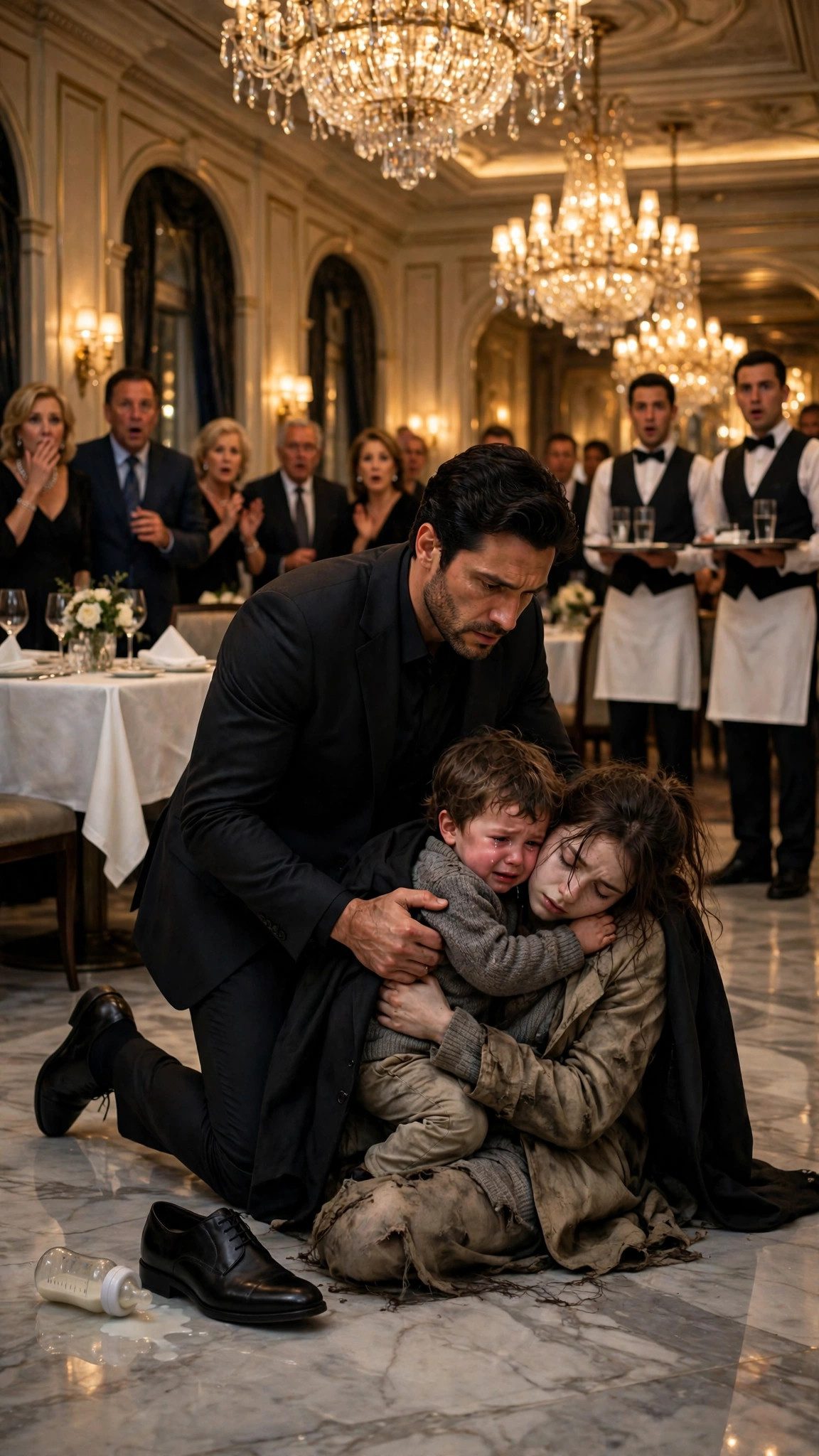
Maya woke to the smell of soup.
It was the first thing she was aware of, before the light, before the voices, before the softness of the bed beneath her: the smell of chicken soup, rich and warm, with something green in it, the way her mother used to make it when she was sick as a child. For a moment she thought she was home, in the apartment on Damen Avenue, and that Daniel would come through the door any minute with his boots dusty from the site. Then she opened her eyes, and the ceiling above her was not her ceiling, and the room was not her room, and the panic came up in her throat like water.
She sat up too fast, and the room spun, and a hand caught her shoulder, steady and gentle, and a woman's voice said, "Easy. Easy now. You've been out for nearly an hour. Don't sit up too fast."
The woman was a nurse, or a doctor — Maya couldn't tell which — a woman in her fifties with graying hair and kind eyes, wearing a dark coat over a sweater, with a stethoscope around her neck. Behind her stood a man in a black suit, tall, dark-haired, with a face Maya recognized and did not recognize at the same time, because she had seen it only in the last moments before everything went dark.
Ethan Hayes.
"Where's Leo?" Maya said, and her voice came out cracked and thin. "Where is my son?"
"He's right here," the doctor said, and she stepped aside, and there was Leo, sitting at a small table by the window, eating a bowl of soup with both hands, a napkin tucked into his shirt, a glass of milk beside him. He looked up when he heard her voice, and his whole face lit up, and he said, "Mama! They gave me soup! And milk! Real milk, Mama!"
Maya's eyes filled with tears, and she pressed her hand to her mouth so she wouldn't sob out loud in front of strangers. Leo had not had real milk in weeks. She had been watering down the last of the powdered milk, a little more water every day, telling herself it was still milk, telling herself it was enough. It had not been enough. Nothing had been enough, for so long.
"You're in the private dining room," the doctor said. "Mr. Hayes had you brought here. Your blood sugar was dangerously low, and you were severely dehydrated. You've been eating almost nothing for days, haven't you?"
Maya nodded, because lying to a doctor seemed pointless, and because she was too tired to lie anyway.
"You need food, and rest, and a great deal of water," the doctor said. "I've given you something for the dizziness. Eat slowly. Small bites. And if you feel faint again, you tell someone immediately. Do you understand?"
Maya nodded again. The doctor patted her hand, gathered her bag, and left, and then it was just Maya and Leo and Ethan Hayes, standing by the window with his jacket gone — he had left it draped over her on the dining room floor, she remembered that now, the weight of it, the smell of his cologne on the wool — and his white shirt open at the collar, and his eyes on her face in a way that made her feel like she was the only person in the room.
"Eat," he said. It was not a request. It was not a command, either. It was something in between, the voice of a man who was used to being obeyed and was trying very hard not to sound like it.
A waiter came in with a tray: a bowl of soup, bread, butter, a glass of water, a plate of chicken and rice. Maya stared at it the way a person stares at something they are afraid might disappear. Her hands were shaking. She picked up the spoon, and the first mouthful of soup nearly undid her, because it was hot and rich and real, and she had forgotten what real food tasted like. She ate slowly, the way the doctor had told her to, small bites, and with every bite she felt a little more of herself come back into her body, and Leo watched her from his table and said, "Mama, eat the bread too. The bread is the best part."
Ethan Hayes watched her eat. He did not speak. He did not look away. And when she had finished half the soup and some of the bread, he pulled out a chair across from her and sat down, and folded his hands on the table, and said, "Tell me your name."
"Maya Carter," she said.
"And the boy is Leo."
"Yes. He's three."
"And you used to work here."
It was not a question. Maya looked at him, and for a moment she considered lying, because Voss had fired her, and fired people did not usually get to sit in the private dining room eating soup while the owner of the restaurant watched them. But she was too tired to lie, and too angry, underneath the tiredness, to pretend.
"I worked here for four years," she said. "I was a waitress. Mr. Voss fired me eight weeks ago."
"Why?"
"Because I asked him where my tips went. And because I said the word 'theft' out loud in his office."
Ethan's expression did not change. But something in his eyes went very still, the way a lake goes still before a storm.
"How much does he owe you?" he asked.
Maya hesitated. "One thousand eight hundred and forty dollars. In wages and tips."
"And the others? The other waiters?"
"I don't know exactly. Rosa — she's been here eleven years — she kept a notebook. She said the tips have been short for eight months. Maybe longer. Everyone's afraid to say anything, because Voss fires anyone who asks."
Ethan was quiet for a long time. Then he said, "My mother worked in this restaurant for twenty-three years. Her name was Rosa Hayes. She carried trays across that floor when she was young, and she carried them when she was sick, and Mr. Marlowe paid her medical bills out of his own pocket because that was the kind of man he was. I bought this restaurant because it was hers. Because nobody was ever going to be thrown out of this dining room again for asking where their own money went."
Maya stared at him. She had not expected that. She had not expected anything, really — not the soup, not the doctor, not the man in the black suit sitting across from her talking about his mother as if she were still alive in the room with them.
"I don't want charity," Maya said, and her voice was steadier than she expected. "I don't want a handout, Mr. Hayes. I want what I'm owed. That's all I've ever wanted."
"Good," Ethan said. "Because I don't give handouts. I give people what's theirs. And starting tomorrow, you're the head waitress of the Marlowe Room, at twice what Voss was paying you, with your tips counted in the open, in front of everyone, the way Mr. Marlowe used to do it. And Leo — Leo comes with you. There's a room upstairs, next to my office, with a bed and a desk and a window that looks out over the avenue. He can do his drawing there while you work. And when he's older, if he wants, he can learn the business from the ground up, the way I did."
Maya's eyes filled with tears again, and this time she did not try to stop them. "Why?" she whispered. "Why would you do all this for a stranger?"
Ethan looked at her for a long moment, and then he looked at Leo, who had finished his soup and was now carefully tearing his bread into small pieces and lining them up in a row on his plate, the way small children do when they are happy and safe and have nothing to worry about for the first time in weeks.
"Because when you fell on my floor tonight," Ethan said, "your son cried for you, and you didn't let go of his hand even when you were unconscious. And because my mother used to say that a person is measured by what they do when nobody important is watching. And because, Mrs. Carter, I have spent fourteen years being the most feared man in Chicago, and tonight, for the first time in my life, I was afraid. I was afraid that a woman and a little boy were going to die on the floor of my restaurant while a room full of billionaires watched. And I never want to feel that again."
He stood up then, and straightened his shirt, and looked down at her with an expression she could not read at all.
"Eat the rest of your soup," he said. "And then my driver will take you and Leo to a hotel for the night. A real hotel, with a real bed and a hot shower. Tomorrow morning, Marco will bring you the keys to the room upstairs. And tomorrow night, Mrs. Carter, you will come back to this restaurant, and you will work in the dining room where you belong, and Derek Voss will not be here. Do you understand?"
Maya nodded. She did not trust her voice. She picked up her spoon, and she ate the rest of her soup, and Leo came over and climbed into her lap, and she held him with one arm and ate with the other, and for the first time in eight weeks, she felt something she had almost forgotten how to feel.
She felt safe.
That night, Maya and Leo slept in a hotel room with a real bed and a hot shower, and Maya stood under the water for a long time, letting it run over her shoulders, washing away eight weeks of church basements and cold mornings and hunger, and she cried, quietly, so Leo wouldn't hear her, and when she came out, Leo was already asleep in the big bed, curled up under the white covers with his bottle tucked against his cheek, and she lay down beside him and held him, and for the first time in months, she slept without dreaming about rent or eviction notices or empty refrigerators.
She woke once in the night, disoriented, reaching for Leo in the dark, and he was right there, warm and breathing, and she lay awake for a while after that, staring at the ceiling, thinking about the man in the black suit who had knelt on a marble floor and put his jacket over her. She had heard the stories about Ethan Hayes. Everyone in Chicago had heard the stories. But the man she had met tonight did not match the stories. The man she had met had held her son like something precious, and had talked about his mother with tears in his voice, and had offered her a job instead of a handout. Maya did not know what to make of it. She only knew that her son had eaten real food tonight, and drunk real milk, and fallen asleep in a warm bed, and that was more than she had dared to hope for that morning when she woke up on a cot in a church basement with twelve dollars and forty cents to her name.
In the morning, Marco Bellini came to the hotel with a paper bag full of fresh clothes for Leo and a set of keys on a brass ring. He was a big man, built like a doorway, with a kind face that did not match his size at all, and he spoke to Maya gently, the way a man speaks to someone who has been through something terrible.
"Mr. Hayes asked me to bring you these," Marco said, setting the bag on the bed. "There's a room upstairs at the restaurant, next to his office. It has a bed, a desk, a window. Leo can stay there while you work. And there's an envelope in the bag with your first week's pay, in advance. Mr. Hayes said to tell you it's not charity. It's what you're owed, and he's paying it early."
Maya opened the envelope with shaking hands. Inside was more money than she had held in eight weeks, and a note in a strong, plain handwriting that said only: "Welcome back to the Marlowe Room. — E.H."
She folded the note carefully and put it in her pocket, next to her heart, and she looked at Marco, and she said, "Tell Mr. Hayes thank you. And tell him I'll be there tonight, and I'll work hard, and I won't let him down."
Marco smiled. "He knows," he said. "That's why he hired you."
That evening, Maya walked back into the Marlowe Room for her first shift as head waitress, and the whole staff was waiting for her in the kitchen. Rosa was the first to reach her, wrapping her in a hug so tight Maya could barely breathe, and whispering, "I prayed for you every night, mija. Every single night. And look — look at you. You're home." The young busboys clapped. The bartender Sal nodded at her, gravely, like a man greeting a returning soldier. And old Benito came out of the kitchen wiping his hands on his apron, and he looked at her for a long moment, and he said, "Your mother would be proud of you, Maya. And Mr. Marlowe would be proud of this restaurant tonight."
Maya put on the new black uniform, and she braided her hair the way she used to braid it, and she walked out into the dining room with her tray in her hand, and the marble floor gleamed under the chandeliers, and the guests were already arriving, and for the first time in eight weeks, she was not afraid. She was exactly where she belonged.