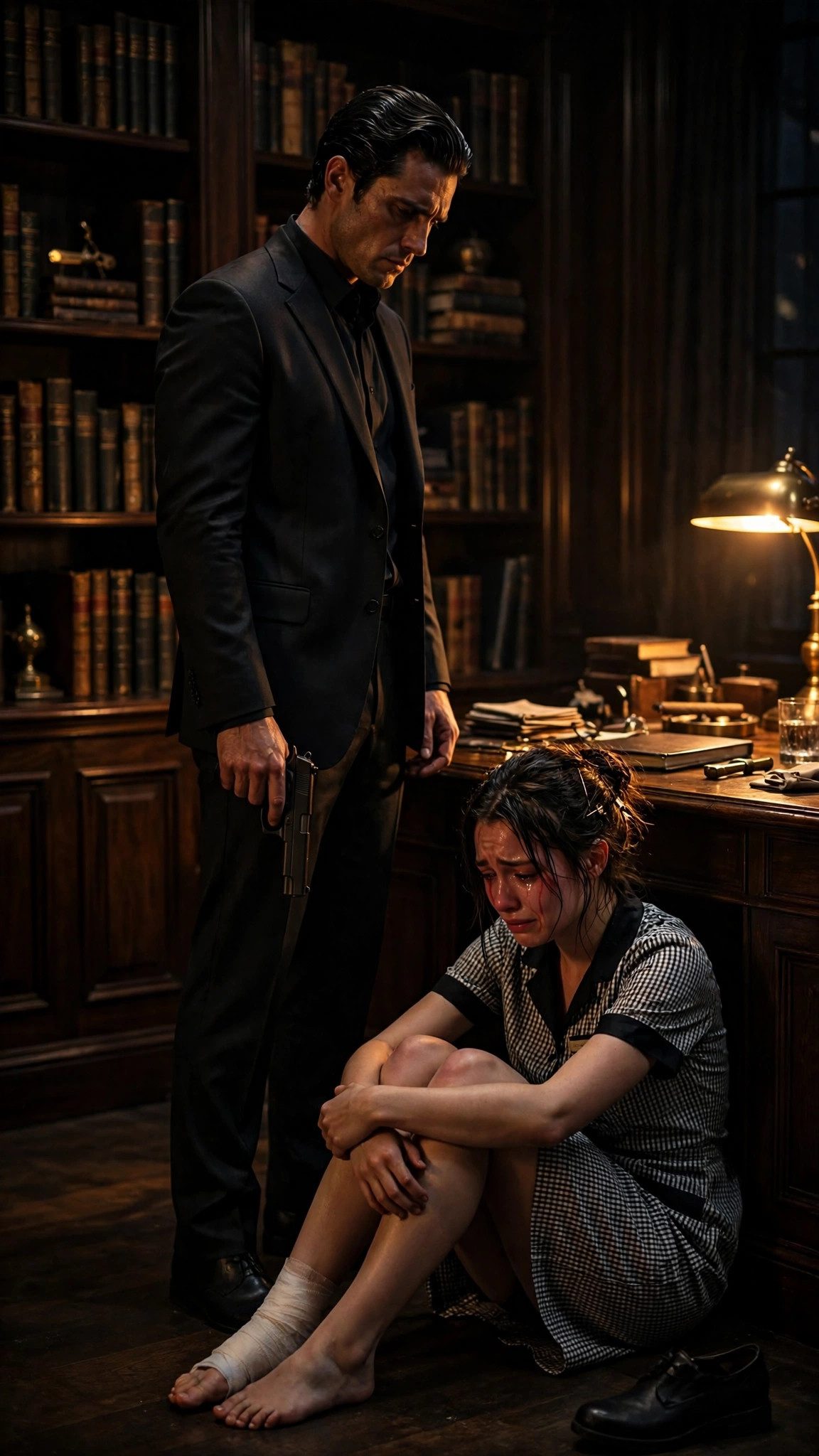
Gabriel Hayes had not always been the coldest man in the room. Once, a very long time ago, he had been a boy who believed that being strong meant never needing anyone, and that needing anyone was the same thing as being weak.
He had learned that lesson the way his family taught all its lessons: with a loss that could not be undone.
His father, Frank Hayes, had been a careful man. Not a kind man, but a careful one. He had built the Hayes family from a single dockside warehouse into something that controlled half the shipping on the river, and he had done it by never taking a risk he had not already priced. He had taught Gabriel three rules. Never drink when you are working. Never let anyone see you afraid. Never love anything you cannot afford to lose.
Gabriel had been twenty-four years old when his father was shot in the parking lot of a restaurant on the South Side, on the night of Gabriel's thirtieth birthday. No. That was wrong. He had been twenty-four when his father died, and thirty when the men who killed him finally stopped trying to finish the job. The dates blurred together now, the way dates do when every year brings another attempt on your life. What Gabriel remembered clearly was the phone call, and the drive to the hospital, and the doctor standing in the hallway with his hands in his pockets, telling him that his father had been dead before the ambulance arrived.
He remembered the chair. The big leather chair behind his father's desk, in this same study, with the same brass switch and the same smell of old paper and tobacco. He remembered sitting in it that night and understanding, with a clarity that felt like ice water in his veins, that from that moment on, every man in the city would be watching him to see whether he was strong enough to hold what his father had built, or whether he was simply the next body in the parking lot.
He had held it. For twelve years, he had held it. He had done it by being colder than every man who tested him. He had done it by never drinking, never sleeping more than five hours a night, never letting anyone close enough to learn where he was vulnerable. He had done it by turning his birthday into a performance — a grand party, a ballroom full of politicians and judges and men who owned things they were not supposed to own, all of them smiling and all of them watching for weakness.
He hated his birthday. To him, it was simply an annual reminder of how many people had failed to put a bullet in his head.
But there was another reason he hated it, one he had never told anyone, not even Thomas, who had been his head of security for nine years and knew more about him than any living man.
His sister Anna had died on the night before his eighteenth birthday.
Anna had been fifteen years old, all elbows and laughter, with their mother's dark hair and a gap between her front teeth that she refused to let a dentist fix. She had come home from school one Friday with a fever, and by Sunday she could not stand up. The infection had spread fast, faster than anyone expected. The family doctor had been away that weekend, visiting his daughter in another state, and the hospital had wanted a deposit before they would move her to the intensive care ward. A deposit. A piece of plastic with a high enough limit. Frank Hayes had been away on business, unreachable, and the money in the house had been tied up in a shipment that had not yet cleared the docks.
Gabriel had been seventeen years old. He had sat beside Anna's bed in a crowded public ward, holding her hand, watching her breathe, and he had promised her that their father would come and fix everything. He had promised her that she would be all right. He had believed it, because he was seventeen and he still believed that the people who loved you could fix anything if they tried hard enough.
Anna had died at four o'clock in the morning, while Gabriel was asleep in the chair beside her bed. He had woken up to a nurse gently pulling the sheet over her face, and he had understood, in that moment, that his father had not come, and the money had not come, and the promises had not mattered. Nobody had come. Nobody had paid. And a fifteen-year-old girl had died in a crowded ward because a hospital wanted a deposit first.
Gabriel had not cried at her funeral. He had stood beside his father in a black suit that was too big for him, and he had watched them lower the small coffin into the ground, and he had made himself a promise. He would never be helpless again. He would never need anyone's mercy. And he would never, ever let himself care about someone he could not protect.
It was a promise he had kept for eighteen years.
Now he was standing in his study on his thirty-sixth birthday, with a gun in his hand, and a crying girl in a catering uniform was telling him that her nineteen-year-old sister was going to die in a hospital because nobody had paid the bill in time.
"Her name is Sophie," Clare said. She was sitting in the leather armchair across from his desk now, because her legs had given out halfway through her story and Gabriel had caught her elbow and steered her into the chair before she could fall. A glass of water sat untouched on the desk beside her. Her hands were wrapped around each other in her lap, white-knuckled and shaking. "She's a nursing student. She was going to be a nurse. She wanted to work in the children's ward. She said sick kids shouldn't have to be scared alone."
Gabriel stood behind his desk, the gun now resting on the polished wood, safety on, barrel pointed at the wall. He did not sit down. Sitting down felt like surrender, and Gabriel Hayes did not surrender.
"How much?" he asked.
Clare looked up at him. Her eyes were swollen, her face still blotchy, but the crying had stopped, and in its place there was something harder. Something that looked almost like anger.
"Thirty thousand dollars," she said. "That's what they want by six in the morning. Thirty thousand, or they move her to a lower-priority ward. Do you know what that means? It means the nurses check on her less. It means if her fever spikes again in the middle of the night, nobody notices for an hour. It means she dies because I didn't have a piece of plastic with a high enough limit."
Gabriel said nothing. He walked to the window and pulled the heavy curtain aside a fraction of an inch. Below, in the ballroom, the party was still going. He could see the lights, the movement, the glittering crowd. Somewhere down there, Sullivan was waiting for him to come back. Somewhere down there, a toast was being prepared for midnight. Somewhere down there, men were drinking Scotch older than Sullivan's operation and deciding whether Gabriel Hayes was still strong enough to be feared.
"I work three jobs," Clare said behind him. Her voice was steadier now, as if telling the story had given her back some small piece of herself. "I waitress at a diner in the morning. I clean offices in the afternoon. I cater at night, when there's work. I sleep four hours. I sold my mother's piano. I sold my car. I sold my grandmother's locket. I sold everything except the phone, because the hospital needs to reach me, and the shoes, because I need them to work. And it still wasn't enough."
She laughed, a short, broken sound that was not really a laugh at all.
"My mother died when Sophie was eight. My father left before that. Sophie is the only family I have. She is the only person in the world who ever looked at me and thought I was enough. And now she's dying in a hospital bed, and I'm sitting on the floor of a stranger's study, crying, while a man points a gun at me."
Gabriel turned away from the window. He looked at her for a long time. He thought about Anna, fifteen years old, dying in a crowded ward because a hospital wanted a deposit first. He thought about the promise he had made at her funeral, standing in a black suit that was too big for him. Never be helpless again. Never need anyone's mercy. Never care about someone you cannot protect.
He had kept that promise for eighteen years. He had kept it by never letting anyone close enough to matter. And now a stranger had walked into his sanctuary, sat on his floor, and cried for her sister, and the promise was cracking open like ice on a river in spring.
"Your heel is bleeding on my floor," Gabriel said.
Clare looked down at her shoe. The dark stain had spread. She started to apologize, but Gabriel held up one hand.
"Take the shoe off," he said.
She stared at him. Then, slowly, she bent down and pulled off the left shoe. Her sock was soaked through with blood. The skin of her heel was split open, raw and angry, the blister torn clean away. Gabriel walked to the cabinet beside the fireplace, opened it, and took out a first-aid kit. He set it on the desk and opened it with hands that had done this before, on men who had been shot and stabbed and broken in his service.
"Sit still," he said.
Clare sat very still while Gabriel Hayes, the coldest man in the room, the man who had ordered men killed before breakfast and never lost a night of sleep over it, knelt on the floor of his study and cleaned the blood from a catering waitress's heel with a cotton pad and antiseptic, his movements careful and precise, as if the wound were the most important thing in the world.
"Why are you doing this?" Clare whispered.
Gabriel did not answer at first. He wrapped a clean bandage around her heel, taped it in place, and helped her ease her foot back into the shoe, gently, the way a man handles something fragile.
"Because once," he said, very quietly, "there was a girl in a hospital bed, and nobody came. And I have spent eighteen years making sure I would never be the man who did not come."
He stood up. He walked to his desk. He picked up his phone.
"Stay here," he said. "Do not leave this room. Do not open the door for anyone except me or Thomas. Do you understand?"
Clare nodded, too stunned to speak.
Gabriel dialed a number. He spoke in a low, clipped voice, the voice he used when he gave orders that were not to be questioned.
"Thomas. Come to the study. Alone. Bring the car keys and the black bag. And tell the kitchen I will not be coming down for the toast. If Sullivan asks, tell him I am indisposed. If anyone else asks, tell them nothing."
He ended the call. He looked at Clare.
"Your sister's name is Sophie Dawson," he said. "St. Jude's Hospital. Thirty thousand dollars by six in the morning."
Clare's eyes went wide. "How did you know her last name? I never told you my last name."
"You didn't have to," Gabriel said. "Your uniform has a name tag. It says Clare D. The hospital will have the rest. I am going to pay the bill. All of it. Tonight."
Clare stared at him. Her mouth opened. No sound came out.
"Why?" she whispered, when she finally found her voice. "You don't know me. You don't know her. Why would you do that?"
Gabriel Hayes looked down at the crying girl in his study, at the bandage on her heel and the mascara on her cheeks and the cracked phone in her apron pocket, and he told her the truth.
"Because I have spent eighteen years being the coldest man in the room," he said. "And tonight, for the first time, I am tired of being cold."
Downstairs, the jazz band played something upbeat and brassy. The laughter drifted up through the floorboards, loud and uninhibited and expensive. And upstairs, in the dark study of a man who had never shown mercy to anyone, Gabriel Hayes picked up his phone and began to save a nineteen-year-old girl he had never met.
He did not know it yet. But the girl crying on his floor had already saved his life.
Every year, on the morning of his birthday, Gabriel Hayes drove to a small cemetery on the edge of the city, before the sun was fully up, before anyone could see him. He parked the black car at the gate, and he walked alone between the rows of stones, and he stopped at a small white marker half-hidden under an old oak tree. Anna Hayes. Beloved daughter and sister. Fifteen years old, forever.
He never brought flowers from a shop. He brought white roses from his own garden, cut the night before, because Anna had loved white roses, and because buying them felt like a transaction, and this was not a transaction. He laid them on the stone. He stood there for ten minutes, sometimes twenty, and he did not pray, because Gabriel Hayes had stopped praying the morning a nurse pulled a sheet over his sister's face. He simply stood there, and he remembered.
He remembered the way Anna laughed when she beat him at cards. He remembered the gap between her front teeth, and the way she refused to let a dentist fix it, because she said it made her smile hers and nobody else's. He remembered sitting beside her bed in the crowded ward, holding her hand, promising her that their father would come and fix everything. He remembered waking up to the nurse, and the sheet, and the silence.
Thomas always waited in the car. Thomas never asked where they were going. Thomas had been there the night Anna died, a young enforcer then, standing in the hospital hallway with his hands in his pockets, watching a seventeen-year-old boy walk out of a ward with his sister's death on his face. Thomas had never spoken of it. Thomas never spoke of anything that mattered, which was why Gabriel trusted him more than any man alive.
This morning, Gabriel had gone to the cemetery as always. He had laid the white roses on the stone. He had stood there for twenty minutes. And then he had gone home, put on his black suit, and walked downstairs into a ballroom full of people who wanted something from him, and he had smiled, and he had shaken hands, and he had waited for the night to end.
He had not expected to find a crying girl in his study. He had not expected to kneel on the floor and bandage a stranger's heel. He had not expected to feel the promise he had made at Anna's funeral crack open in his chest like ice on a river in spring.
But standing in the amber light of his study, with the smell of old paper and leather around him, Gabriel Hayes understood something he had not understood in eighteen years. Anna had died because nobody came. Nobody paid. Nobody listened. And tonight, a girl had come to his house, and she had cried, and he had listened, and for the first time since he was seventeen years old, Gabriel Hayes had done the one thing he had sworn he would never do again.
He had cared.