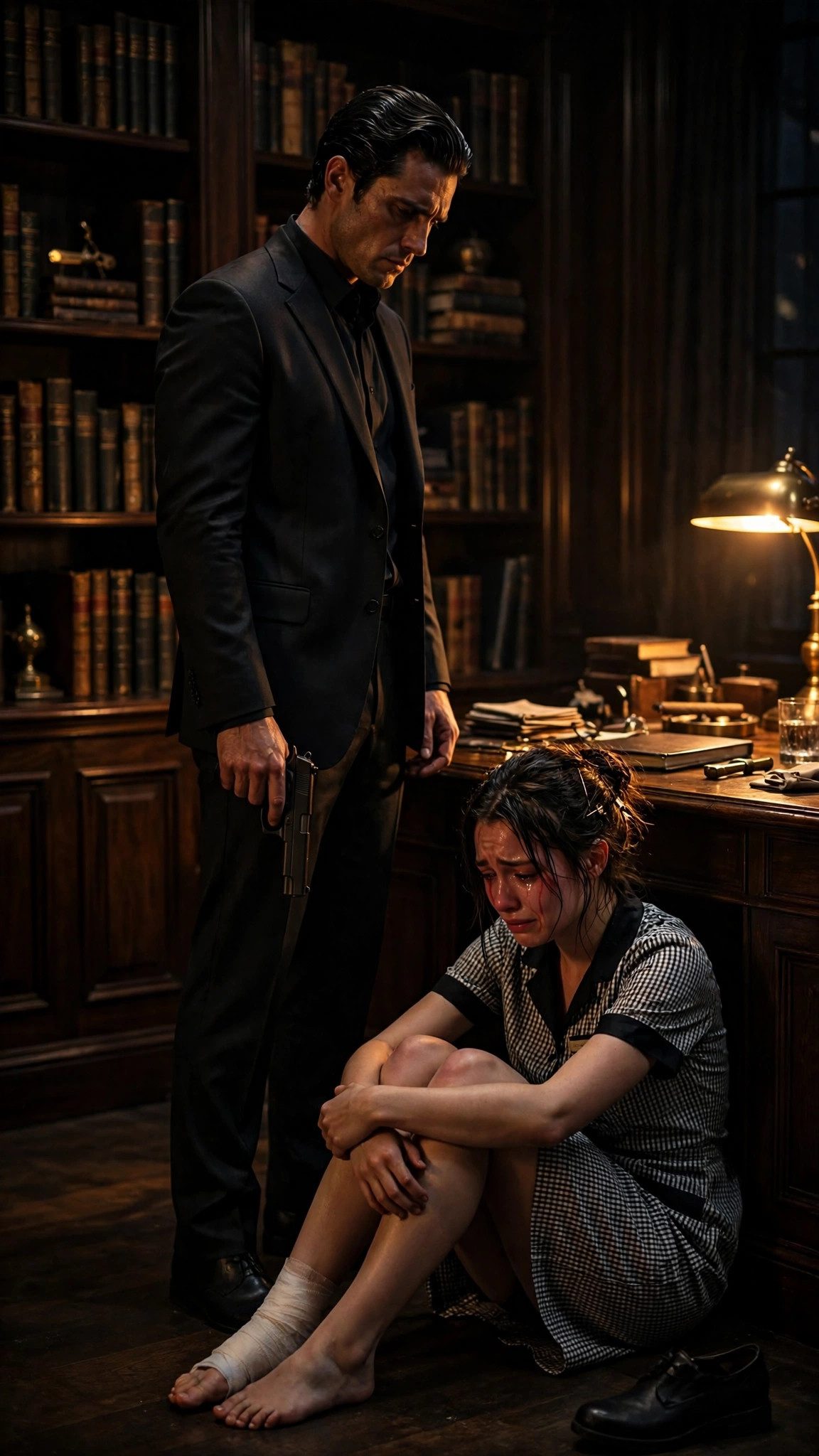
One year later, on the night Gabriel Hayes turned thirty-seven, he did not hide in his study.
The house was full of light and music. The ballroom was crowded, but not with politicians and judges and men who owned things they were not supposed to own. It was crowded with people Gabriel actually liked. Thomas, standing near the grand staircase, smiling for the first time in nine years. Dr. Patel, dancing badly with his wife. Benedetti, the old capo, telling stories in the corner to anyone who would listen. And Sophie Dawson, twenty years old now, healthy and strong, her dark hair shining, laughing with a group of nursing students from St. Jude's, wearing a blue dress that made her look like the future she had almost lost.
Gabriel stood beside the fireplace with a crystal glass of water in his hand. He did not drink alcohol. It dulled reflexes and loosened tongues. Some things never changed. But other things had changed, more than he had ever thought possible.
The docks were his. The river routes were his. The family was his. But for the first time in twelve years, the chair did not feel like a prison. It felt like a place he had chosen, not a place he had been trapped in. He had spent the year cleaning house, quietly, carefully, the way his father had taught him. He had ended the family's dealings with the men who used children as leverage. He had paid off the debts of three families Sullivan had threatened. He had funded a small foundation, in Anna's name, that paid hospital bills for families who could not pay them. The Anna Hayes Foundation. It had paid thirty-seven bills in its first year. Gabriel kept the list in his desk drawer, and on bad nights, he read it, and he remembered why he was doing this.
"Happy birthday," a voice said beside him.
Clare stood there, wearing a dark green dress that made her eyes look like summer leaves, her hair pinned up the way it had been on the night they met, except now it was pinned up neatly, and there was no mascara running down her face, and her left heel was whole and unbandaged. She held a glass of champagne in one hand, and in the other, she held a small velvet box.
"What is this?" Gabriel asked.
"Open it," Clare said.
Gabriel opened the box. Inside, on a bed of dark velvet, lay a small gold locket. It was old, and worn, and the clasp was slightly bent. Gabriel stared at it. He knew this locket. He had seen it once before, in a pawnshop window, years ago, when he had been a boy with no money and a sister in a hospital bed. No. That was not right. He had never seen this locket before. But he knew what it was. He knew what it meant.
"It was my grandmother's," Clare said. "I sold it two years ago, to pay for Sophie's medicine. I thought I would never see it again. Thomas found it. He bought it back. He said you told him to look for it."
"I did," Gabriel said. His voice was rough. "I told him to find it. I told him to buy it back, no matter what it cost. I told him that some things should not have to be sold."
Clare took the locket out of the box. She opened it. Inside, on one side, was a tiny photograph of a young woman with dark hair and a gap between her front teeth. On the other side, in small, careful handwriting, were the words: "For Sophie. Be brave."
"She would have liked you," Clare said softly. "My grandmother. She would have liked you very much. She always said that the coldest men are the ones who feel the most, because they have to work so hard to hide it."
Gabriel closed the box. He put it in his pocket. He looked at Clare, standing beside him in the ballroom of his house, on his thirty-seventh birthday, and he thought about the night a year ago, when a crying girl had walked into his study by mistake, and sat on his floor, and fallen completely apart, and changed everything.
"I have something for you too," he said.
He took her hand. He led her through the ballroom, past the dancing couples, past the waiters with their silver trays, past the grand staircase, and up the narrow private stairs concealed behind the library. The sounds of the party diminished with every step. The brass instruments became a low thrum. The laughter faded to a distant murmur. They reached the second floor. The private wing. His sanctuary.
Gabriel opened the heavy oak door to his study. The room was warm. The amber light was on. The leather-bound books stood in their rows. The heavy oak desk stood in its place. And on the floor, beside the door, where Clare had sat and cried a year ago, there was a small table, and on the table there was a vase of white roses, and beside the vase there was a ring box.
Clare stared at it. Her hand went to her mouth.
"Gabriel," she whispered. "What is this?"
"A year ago," Gabriel said, "you walked into this room, and you sat on my floor, and you cried for your sister. And I pointed a gun at you. And then I listened to you. And you saved my life, and you did not even know it. And I have spent a year trying to be the man who deserves to have you in this room, not as a stranger, and not as a debt, but as the woman I love."
He opened the ring box. Inside was a simple gold ring, with a single small diamond, the kind of ring a man buys when he does not care about impressing anyone, only about asking honestly.
"Clare Dawson," Gabriel Hayes said, and his voice, the coldest voice in the room, shook. "Will you marry me? Will you stay in this house, not because you owe me anything, but because you choose to? Will you let me spend the rest of my life making sure that no one you love ever has to cry alone on the floor of a stranger's house again?"
Clare looked at the ring. She looked at the white roses. She looked at the place on the floor where she had sat and cried, a year ago, with a bleeding heel and mascara down her face, and she thought about everything that had happened since. The hospital. The private room. The fever coming down. The sit-down. The warehouse. The hand in his, in front of forty dangerous men. The year of learning to live in a house that had once been a fortress, and was now, slowly, becoming a home.
"Yes," she said. "Yes. I will stay. I choose to stay."
Gabriel slid the ring onto her finger. It fit perfectly. He had measured it in secret, three weeks ago, while she was asleep, using a ring she had left on the bathroom counter. He had been terrified the whole time that she would wake up and catch him. He had faced down assassins and capos and poison, and nothing had frightened him as much as measuring a ring in the dark while the woman he loved slept in the next room.
Downstairs, the band struck up a slow song. The clock above the fireplace read eleven fifty. Ten minutes to midnight. The toast was scheduled for midnight exactly, a tradition Gabriel's father had started and Gabriel had never bothered to stop.
But this year, there would be no toast to Gabriel's health, and his long life, and his continued good fortune. This year, Gabriel Hayes was going to walk downstairs with Clare Dawson on his arm, and he was going to raise his glass of water, and he was going to drink to something else entirely.
He was going to drink to the girl who had cried in his study. To the sister who had lived. To the man who had finally learned that being strong did not mean being cold. To the night the coldest man in the room had refused to leave a stranger behind, and had found, in refusing, everything he had spent eighteen years trying not to need.
They walked down the grand staircase together, hand in hand, into the light and the music and the warmth of the ballroom. Sophie saw them first. She saw the ring. She screamed, a happy, startled scream that made everyone turn and look, and then she was running across the ballroom, her blue dress flying, and she threw her arms around her sister, and around Gabriel, both of them at once, and she laughed, and she cried, and she said, "Finally. Finally. I knew it. I knew it from the first night."
Thomas raised his glass. Benedetti raised his glass. Dr. Patel raised his glass. Every person in the ballroom raised a glass, and at midnight, Gabriel Hayes raised his glass of water, and he looked at Clare, and at Sophie, and at all the people he had chosen to let into his life, and he smiled, a real smile, the kind of smile that reaches a man's eyes.
"To family," he said. "To the ones we are born with. To the ones we find. And to the ones who refuse to leave us behind."
The room erupted. Glasses clinked. Music swelled. Laughter filled the ballroom, loud and uninhibited and warm.
And upstairs, in the dark study of a man who had once been the coldest in the room, the white roses stood on their small table beside the door, and the amber light glowed softly through the keyhole, and the house that had once been a fortress was, at last, a home.
Gabriel Hayes had spent eighteen years believing that survival meant never showing mercy.
He had learned, on the night he turned thirty-six, that survival meant something else entirely.
It meant opening the door.
It meant listening to a stranger cry.
It meant refusing to leave her behind.
And it meant, in the end, letting her stay.
Later that night, after the toast, after the music had slowed and the lights had dimmed, Gabriel found Sophie standing alone by the window, looking out at the garden where the first snow of the year was beginning to fall, soft and slow, dusting the dark hedges white.
"May I have this dance?" Gabriel asked.
Sophie turned. She laughed, a bright, startled laugh, and she put her hand in his, and he led her onto the empty floor, and they danced, slowly, carefully, because she was still thin, and still tired, and he did not want to wear her out. But she danced well, and she smiled the whole time, and when the song ended, she stood on her toes and kissed his cheek.
"Thank you," she said. "For my sister. For all of this. For giving her a home. For giving me a home too."
"You gave it to yourself," Gabriel said. "You fought for it. Every day in that hospital bed, you fought for it. I only paid the bill. You did the rest."
Sophie shook her head. "You did more than pay a bill, Gabriel. You taught her that the world is not always cold. You taught me that too. And I am going to spend the rest of my life making sure other people learn it. That is what nurses do. We tell sick kids that they are not alone. We sit beside them, and we hold their hands, and we stay."
Gabriel looked at her, this twenty-year-old girl who had almost died, and who was now standing in his ballroom in a blue dress, talking about spending her life beside sick children so they would not have to be scared alone, and he thought about Anna, fifteen years old, dying in a crowded ward because nobody came. He thought about how different the world might have been, if someone had come for Anna the way he had come for Sophie.
"Your sister chose to stay," he said. "I hope you will stay too. This house is your home now, for as long as you want it. That is my word."
Sophie smiled. "I am not going anywhere. I have a sister here. I have a brother now too, I think. Whether he likes it or not."
Gabriel laughed. It was a real laugh, deep and surprised, the kind of laugh he had not heard from himself in eighteen years. He put his arm around Sophie's shoulders, and together they walked back across the ballroom, toward Clare, who was waiting for them by the fireplace with a glass of champagne in her hand and a ring on her finger, and the snow fell outside, soft and slow, and the house was warm, and the music played on, and the night went on, and Gabriel Hayes, the coldest man in the room, stood in the middle of his own birthday party, surrounded by the people he loved, and he was not cold at all.
He was home.
Later, when the guests had gone and the lights had dimmed and the house was quiet, Gabriel and Clare stood together on the terrace, looking out at the garden where the snow lay white and unbroken under the moon. Clare leaned her head against his shoulder. The ring on her finger caught the moonlight, small and bright, and Gabriel took her hand in his, and held it, and thought about the year that had passed, and the girl who had cried on his study floor, and the sister who had lived, and the man he had been, and the man he was becoming.
"Do you remember the first thing you said to me?" Clare asked softly.
"I said you were crying in my study," Gabriel said.
"And the second thing?"
"I asked who you were crying for."
Clare smiled. "And I said my sister. And you listened. That was the moment everything changed. Not the gun. Not the money. Not the sit-down. You listened. That was all it took."
Gabriel kissed the top of her head. "Then I will spend the rest of my life listening," he said. "To you. To Sophie. To anyone who walks into my study and needs someone to hear them. That is my promise. Not the cold one. A new one."
The snow fell, soft and slow, over the garden, over the house, over the city, and inside, the amber light glowed in the study window, and the white roses stood on their small table beside the door, and Gabriel Hayes held the woman he loved in his arms, and he knew, with a certainty he had never felt before, that he would never spend another birthday alone.
The End.
THE END