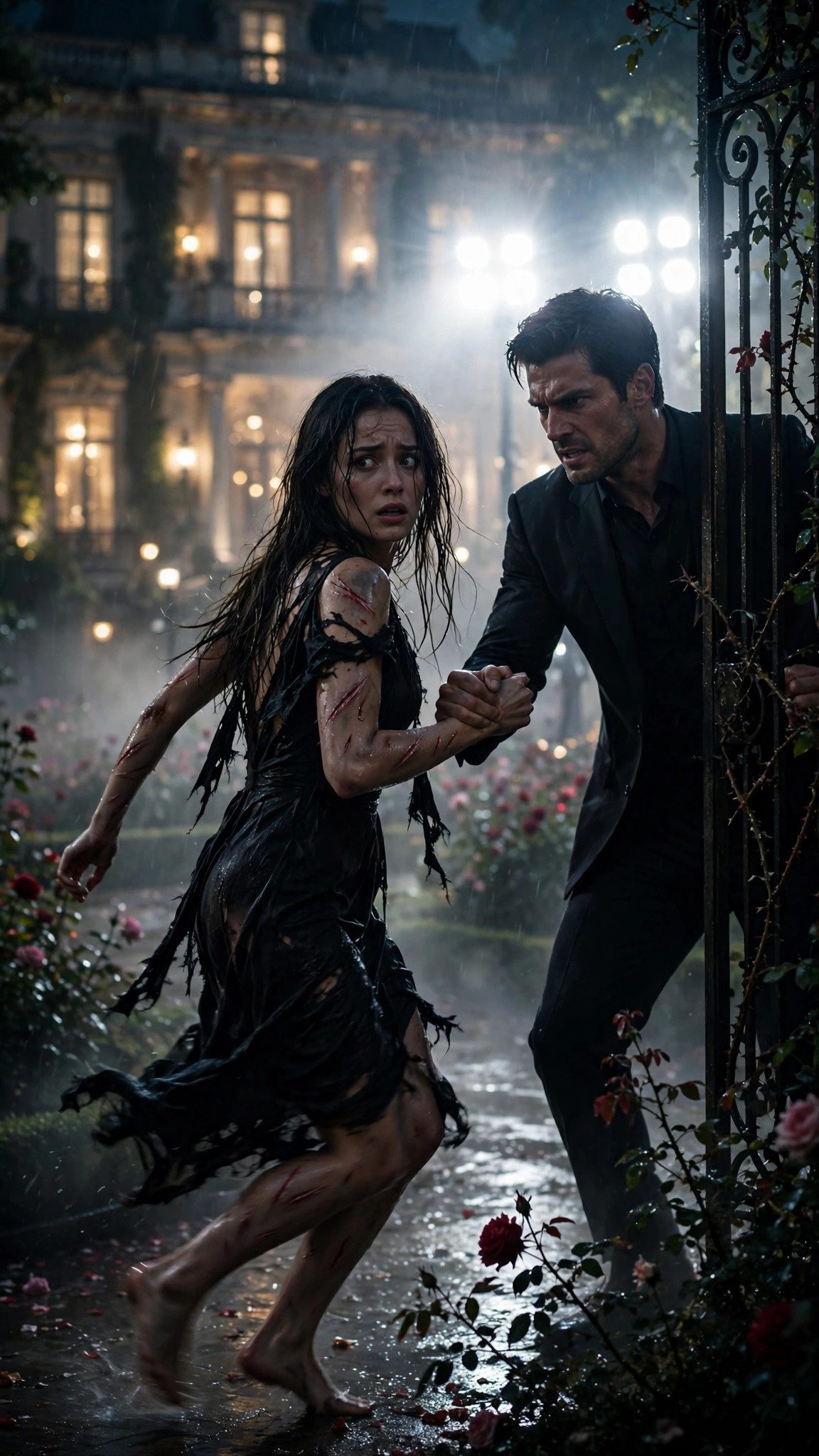
The roses changed everything. Not because of what they were, but because of what they proved. Castellano's men were not just watching me. They were close enough to leave a box on a counter and walk out. Close enough to have killed Sofia, or me, or the coffee shop owner, and no one would have known until it was too late.
Nico doubled the guards. He moved Sofia into my room, because the guest room faced the street and mine faced the garden, and he moved me into his room, because his room was in the center of the house, behind three locked doors, with no windows anyone could shoot through. He did not ask me. He told me. And for the first time in three years, I did not argue with him about it.
I slept in Nico's bed, in Nico's room, with Nico on the floor beside the bed in a sleeping bag, like a guard dog. He did not touch me. He did not try. He just lay there, in the dark, awake, listening to the house the way a man listens for a sound he has been waiting his whole life to hear.
On the fourth night, I could not sleep. I lay in the dark and listened to Nico breathing, slow and even, and I thought about Arthur. About the way he had smiled at Sofia that afternoon in the garden. About the way he had kissed her hand. About all the questions he had asked me over the years. Where I would be on Thursday. What time I left the office. Which route I took home.
And I thought about something else. Something I had not told Nico. Something I had almost forgotten.
Three weeks ago, I had found a listening device in my office. A small black disc, no bigger than a coin, stuck to the underside of my desk. I had found it by accident, reaching for a pen I had dropped, and I had stared at it for a long time, and then I had done something I was not proud of. I had left it there. I had told myself it was probably Nico's, that he had men who listened to everything in his house, that it was just business. I had told myself not to make a fuss. I had told myself that if Nico wanted me to know, he would tell me.
I had not told him. I had not told anyone. And now, lying in the dark in his room, I understood what I had done. I had left a door open for the man who wanted me dead, and I had done it because I was afraid of asking a question I did not want the answer to.
"Nico," I whispered. "Are you awake?"
"Yes," he said.
"I found something three weeks ago," I said. "In my office. Under my desk. A listening device. I left it there. I did not tell you. I am sorry."
He was quiet for a moment. Then he sat up in the dark, and I could see the outline of his shoulders, and I could hear the change in his breathing.
"Show me," he said.
We went to my office in the dark, the two of us, barefoot, moving through the house like thieves in our own home. Nico carried a flashlight, and I carried the shame of three weeks of silence, and when we got to my desk, I knelt down and reached underneath, and my fingers found the disc, still there, still stuck to the wood, still listening.
Nico took it from me and held it up to the light. It was small and black and ordinary, the kind of thing you could buy anywhere, the kind of thing that meant nothing until you understood what it was for.
"This is not mine," he said. "My men do not listen to you. I told them never to listen to you. This is Arthur's. Or Castellano's. It has been here for weeks. Everything you said in this room, everything you did, they heard it."
"Then they heard me," I said. "They heard me talking to you. They heard me on the phone. They heard everything."
"Yes," Nico said. "And that is why they know your routine. That is why they know the coffee shop. That is why they know the bookshop. Arthur has been listening to your life for weeks, and he has been selling it, piece by piece, to a man who wants you dead."
I sat down at my desk, in the dark, and I put my head in my hands. Three weeks. For three weeks, a stranger had been listening to me live my life, and I had known, and I had said nothing, because I had been afraid.
Nico knelt beside me. He did not touch me. He just waited, the way he had waited in the garden, the way he had waited in my room, patient and still, until I was ready to look at him.
"Norah," he said. "I need you to do something for me. I need you to stop being afraid of asking questions. The questions are the only thing that will keep you alive now. Ask me anything. I will answer. I promise."
So I asked him. I asked him everything I had been afraid to ask for three years.
I asked him how many men he had killed. He said he had lost count, and that he remembered every one of them, and that he did not sleep well because of it.
I asked him if he had ever loved anyone before me. He said no, not like this, not in a way that made him afraid.
I asked him if Arthur had always been a traitor, or if something had changed him. He said Arthur's wife had died two years ago, and after that, Arthur had started drinking, and started gambling, and Castellano had found him at a card table in Atlantic City, down two hundred thousand dollars, and had offered him a way out. Money. Protection. A future. All Arthur had to do was tell Castellano what he needed to know.
I asked him if he had known about Arthur for a long time. He said he had suspected for a year, and known for a month, and that the hardest thing he had ever done was sit across a table from a man he knew was betraying him and smile like he did not know.
I asked him what he was going to do to Arthur. He said, "When this is over, Arthur will answer for what he has done. But not before. Not until I have the proof, and not until Castellano is finished. If I move too soon, I lose everything."
I asked him about his father. He said his father, Vittorio Moretti, had built the family from nothing, from a fish market stall in Naples to an empire in Chicago, and had died when Nico was twenty-four, shot in his own driveway, and Nico had taken over the family the next morning, before the body was cold, because that was what the family expected, and because there was no one else.
"He taught me two things," Nico said. "Never show fear. Never trust a man who smiles too much. I have spent fourteen years trying to unlearn the first one. I have never unlearned the second. Arthur smiled too much. I should have seen it sooner."
I asked him about his mother. He said she had died when he was sixteen, quietly, in her sleep, and that she had been the only gentle thing in his life, and that after she was gone, his father had become harder, and Nico had become harder too, and that was when he had stopped believing that the world was a kind place.
"She used to sing in the kitchen," he said. "In Italian. Old songs. I have not heard them since. Sometimes I hear a woman humming in a restaurant, and for one second, I am sixteen again, and I think she is still alive. Then I remember."
I asked him about Enzo. He said Enzo Marchetti had been his father's driver, then his bodyguard, then his consigliere, then the closest thing to a brother he had ever had. Enzo had carried him out of the parking garage the night of the knife, when Nico was twenty-two and bleeding, and Enzo had held pressure on the wound with both hands and told him, over and over, "Do not die. Do not you dare die on me."
"Enzo is the only man alive who has ever seen me cry," Nico said. "He saw it that night, in the garage, and he has never mentioned it since. That is loyalty. Not the kind you buy. The kind you earn by bleeding next to someone."
I asked him the hardest question of all. I asked him if he had ever killed a man with his own hands, and if he remembered their faces, and if he was sorry.
He was quiet for a very long time. The flashlight was still on, lying on the desk, throwing our shadows up onto the wall, huge and strange.
"Yes," he said, finally. "I have. And I remember every face. And I am sorry for all of them, and I am not sorry for any of them, and both of those things are true at the same time. That is what this life does to a man. It makes two opposite things true, and it makes you live with both of them, every day, until you die."
I did not ask him anything else after that. I had asked enough. More than enough. And I understood, sitting there in the dark, that the man I loved was not a monster and not a hero. He was a man who had been handed a life he did not choose, at twenty-four, before his father's body was cold, and who had done what he had to do to survive it, and who had spent fourteen years trying to be better than it, and mostly failing, and trying again anyway.
I asked him what would happen to Sofia. He said, "Sofia knows the risk. She chose it. But I will not let her die if I can help it. She is under my protection now, the same as you."
And then I asked him the question I had been most afraid to ask. The question that had been sitting in my chest since the night I ran.
"Do you love me?" I asked. "Not protection. Not ownership. Love. Do you love me?"
Nico was quiet for a long time. The flashlight was still on, lying on the desk, throwing our shadows up onto the wall, huge and strange. I could hear the house breathing around us. I could hear my own heart.
"Yes," he said. "I love you. I have loved you since the night you caught a falling tray in a hotel ballroom and smiled like nothing had happened. I loved you when you were my assistant. I loved you when you became the woman at my table. I love you now, in the dark, in my office, with a listening device in my hand and a killer outside my walls. I love you, Norah Bennett. And I am sorry it took a man trying to kill you for me to say it out loud."
I cried then. Not loudly. Quietly, the way you cry when something you have been holding for a very long time finally breaks. Nico held me, and for the first time in three years, he did not hold me like a man protecting something he owned. He held me like a man holding something he was afraid to lose. There is a difference. I felt it in the way his hands shook. I felt it in the way he pressed his forehead to mine and whispered, "Stay. Please. Just stay."
"I am staying," I said. "But not because you told me to. Because I choose to. And when this is over, Nico, you and I are going to have a very different conversation about what love means. Because I am not replaceable. No one is. And if you ever say that word about me again, even as a performance, even to save my life, I will walk out of this house and I will not come back."
"I understand," he said.
"Do you?" I asked.
"Yes," he said. "And I will never say it again."
We went back to his room, and I slept, really slept, for the first time in a week. And in the morning, Sofia was waiting for us at breakfast, and she had made pancakes, which was strange, because Sofia Romano did not look like a woman who made pancakes, and she had set the table with the good plates, and she was humming, very quietly, an old song in Italian.
"My brother used to make pancakes," she said, when she saw me looking. "Marco. Every Sunday. He burned them, every single time, and he served them anyway, and he said, 'Eat them, Sofia, they are made with love.' He was twenty-six when he died. A drive-by. Wrong place, wrong time, they said. But it was not wrong place. It was a message. A man wanted to send a message to a rival family, and my brother was the envelope."
She flipped a pancake, and it landed perfectly, golden on both sides, and she looked at it for a moment, and she said, "I have spent eight years looking for the man who ordered it. I found three of them. They are all in prison now, or in the ground. The fourth is Castellano. When this is over, I will have found all four. And then I will be able to make pancakes on a Sunday without thinking about a brother who will never eat them again."
I sat down at the table, and Sofia put a plate in front of me, and I ate the pancakes, and they were perfect, and I thought about how strange it was that the bravest woman I had ever met made pancakes like a mother, and shot a gun like a soldier, and hummed old Italian songs like a girl from Naples who had lost her brother and never stopped looking for the men who took him.
"Thank you," I said to her. "For being here. For being me, when I could not be."
"Do not thank me," Sofia said. "When this is over, you will owe me nothing. But if you want to do something for me, learn to make pancakes. Burn them, the first time. It is tradition."
I laughed. I had not laughed in days, and it felt strange, and good, like a muscle I had forgotten I had.
And then Sofia's face went serious. "Arthur called me last night," she said. "He wanted to know where you would be today, Norah. He said Nico had a meeting at the Meridian Hotel, and he wanted to know if you were going with him. I told him you were staying home. I told him you were sick. He sounded disappointed."
"Good," Nico said. "Let him be disappointed. The Meridian is a trap. Castellano's men will be there. Enzo and I will be there too. And this time, we will be ready for them."
"What about me?" I asked. "What do I do while you walk into a trap?"
"You stay here," Nico said. "With Sofia. Behind these walls. And you wait. And when it is over, I will come home, and I will tell you everything."
I wanted to argue. I wanted to go with him. I wanted to stand beside him the way I had stood beside him for three years. But I had promised myself I would stop being the woman who mistook protection for love, and I had promised Nico I would stay, and a promise is a promise, even when it tastes like ash in your mouth.
So I stayed. Sofia and I stayed in the house, behind the walls, with the guards at the gate and the alarm on and the floodlights ready. And we waited. And at seven o'clock that evening, the phone rang, and Sofia answered it, and her face went white, and she looked at me, and she said, "It is Enzo. Something has gone wrong."