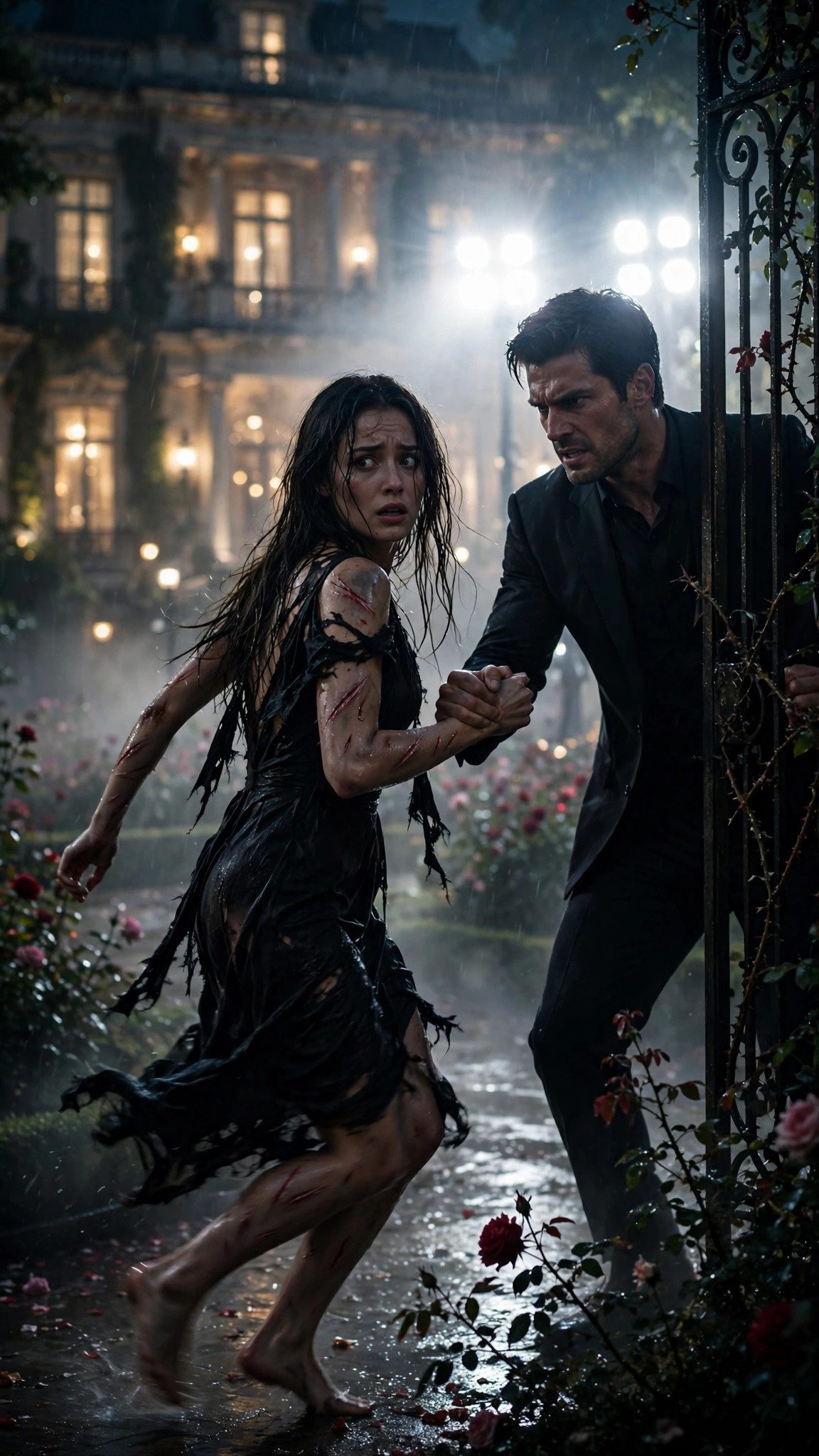
Six months later, on a warm evening in June, I married Nico Moretti in the garden where I had once run for my life.
It was not a large wedding. Nico had wanted a large wedding, with two hundred guests and a string quartet and a seating chart that would have taken someone three weeks and two shouting matches with the caterer. I had said no. I had said, "Small. The people who matter. The people who stayed." And Nico, who had learned by then that when I said no, I meant it, had agreed.
There were twenty guests. Enzo, who cried during the vows and denied it afterward. Sofia, who wore a red dress and danced with three different men and told me, loudly, that she had never looked better in her life. Marcus Hale's daughter, Emma, who had finished her first year of college and who brought me a bouquet of white roses, and who whispered, when she hugged me, "Thank you for my father."
There was no Arthur. Arthur was in a federal prison, testifying, remembering, living with what he had done. Nico had visited him once, and had come home quiet, and had said only, "He asked about you. I told him you were happy. I think that was the hardest thing he has ever heard."
There was no Castellano. Castellano was in a cell of his own, awaiting trial, and the ledger was in an evidence locker, and the empire he had built on other people's fear was coming apart, piece by piece, the way empires built on fear always do.
There was my mother, who had flown in from Ohio, and who had cried when she saw the house, and cried harder when she saw the garden, and who had taken Nico's hands in hers and said, "You take care of my girl," and Nico had said, "I will. I promise. Not by keeping her. By choosing her. Every day."
The ceremony was short. The vows were shorter. Nico had written his own, which surprised everyone, including me, because Nico Moretti did not do words. But he stood in front of me, in the garden, with the roses behind us and the evening light on his face, and he said, "Norah Bennett, I once told the world you were replaceable, so that the world would leave you alone. I was wrong to say it, even to save you. You are not replaceable. You never were. You are the woman who caught a falling tray in a hotel ballroom and smiled like nothing had happened. You are the woman who stood in a garden with a spade and saved my life. You are the woman who chose me when she was free to leave. I choose you back. Today. Tomorrow. Every day. For the rest of my life."
I cried. Of course I cried. I had spent three years learning not to cry in front of Nico Moretti, and in that moment, I cried like a woman who had finally stopped holding her breath.
My vows were simpler. "Nico Moretti," I said, "I once believed that protection was love and control was caring. I was wrong. Love is a choice. You gave me one, and I am giving you one back. I choose you. Not because you need me. Not because you own me. Because you are the man who offered me my freedom and meant it. I will choose you every day. For the rest of my life."
Enzo, who had agreed to officiate because he said he was the only one who could be trusted not to cry, cried. Sofia cheered. My mother cheered louder. And Nico kissed me, there in the garden, with the roses behind us and the gap in the hedges long since repaired, and for the first time in my life, I did not feel like a woman who had been kept. I felt like a woman who had been chosen.
After the ceremony, there was dinner. A long table, under the trees, with candles and good wine and food I had chosen myself. Nico sat beside me, not across from me, the way he always had, and he held my hand under the table, and he did not let go, not once, all evening.
Sofia sat across from us, and she told the story of the night in the garden, the way she always told it, making herself the hero and me the woman with the spade, and everyone laughed, and I laughed too, because it was funny now, in the evening light, with the people I loved around me. It had not been funny then. But time does that. Time takes the worst nights of your life and turns them into stories you can tell at dinner, and that is how you know you have survived them.
Later, when the dancing started, Nico took me by the hand and led me to the middle of the garden, where the grass was soft and the roses were blooming, and he held me, and we danced, slowly, to music only we could hear.
"Do you remember what you said to me?" he asked. "In the garden. The night you ran. You said, 'You do not know me.'"
"I remember," I said.
"I know you now," he said. "I know the way you take your coffee. I know the way you stand when you are trying not to be heard. I know the sound of your laugh, and the way you bite your lip when you are thinking, and the way you look at me in the morning, in the quiet of the kitchen, like I am the only good decision you have ever made. I know you, Norah Moretti. And I will spend the rest of my life learning the rest."
"Norah Moretti," I said, trying the name out loud for the first time. "It sounds strange."
"It sounds right," he said. "It sounds like home."
We danced until the candles burned low and the guests went home and the garden was quiet again. And then Nico took my hand, and we walked back into the house, through the doors that were no longer locked, past the study where the listening device had once been, past the kitchen where the roses had once arrived in a box, and up the stairs to our room. Our room. Not his. Not mine. Ours.
The passport was still on the dresser. The new name. The new life. The freedom, in a small blue booklet. Nico picked it up, and he looked at it, and he handed it to me, and he said, "Burn it, if you want. Keep it, if you want. It is yours. It was always yours. The choice was always yours."
I took it. I opened the drawer of the dresser, and I put it inside, on top of a stack of letters I had written to my mother and never sent, and I closed the drawer. Not burned. Not thrown away. Kept. Because freedom is not something you burn when you choose to stay. Freedom is something you keep in a drawer, and you look at it sometimes, and you remember that you chose this life, and that you could have chosen another, and that the choosing is what makes it love.
Nico watched me close the drawer, and he smiled, the real smile, the one I had seen only a few times in three years, the one that reached his eyes and stayed there.
"What are you thinking?" he asked.
"I am thinking," I said, "that three years ago, a man told his underboss that if I disappeared, he would forget my name by Friday. And tonight, that same man stood in a garden and told twenty people that my name is the only name he has ever been afraid to lose. I am thinking that people can change. I am thinking that love can change them. And I am thinking that I am the luckiest woman in the world, because the man I love finally learned the difference between owning someone and choosing someone."
"And what is the difference?" Nico asked.
"Owning is easy," I said. "Choosing is hard. Owning means you never have to ask. Choosing means you have to ask every day, and risk hearing no. You asked me, Nico. You gave me a passport and an open door, and you asked me. And I said yes. That is the difference. That is everything."
He kissed me then, in our room, with the garden below us and the roses blooming and the house quiet around us, and I thought about the night I had run, barefoot, through those same roses, with thorns tearing at my arms and floodlights snapping on and his voice shouting my name into the dark.
I had run because I believed I was replaceable. I had stayed because I learned I was not. And somewhere between the running and the staying, I had learned the most important thing of all.
No one is replaceable. Not me. Not Sofia. Not Marcus's daughter. Not anyone. We are all irreplaceable, every one of us, and the people who love us know it, even when they forget how to say it.
Nico knew it. It had just taken him three years, and a killer, and a garden full of roses, to find the words.
And now, finally, he had.
Three months after the wedding, on a quiet Sunday morning, I woke up in our room to the smell of pancakes burning.
I found Sofia in the kitchen, standing over the stove, scraping a blackened pancake into the trash, laughing at herself. She had moved into the guest house at the back of the garden, and she had taken over as head of Nico's security, and she had started coming to the main house on Sunday mornings to make breakfast, because, as she put it, "Someone in this family needs to know how to feed people, and it is clearly not your husband."
Nico was at the table, reading the newspaper, pretending not to watch her. He had changed, in the months since Castellano's arrest. Not all at once. Slowly. The way the tide comes in. He had started coming home for dinner. He had started taking Sundays off. He had started asking me what I thought about the business, and actually listening to the answer. He had begun the long, careful work of legitimizing everything his father had built, moving money out of the shadows and into the light, closing the doors that should never have been opened, and opening the ones that should have been opened years ago.
"You are burning them again," Nico said to Sofia, without looking up.
"I am making them with love," Sofia said. "That is what matters. Marco always said so."
"Marco was right," I said, and I took the spatula from her, and I flipped the next pancake, and it landed perfectly, golden on both sides, and Sofia stared at it like I had performed a miracle.
"You learned," she said.
"I had a good teacher," I said. "Two of them, actually. One who makes them, and one who burns them."
We ate on the terrace, the three of us, in the morning light, with the garden below us and the roses blooming, and Nico told us about the foundation. The Moretti Foundation, which had been a name on a gala invitation for years, was becoming something real. A scholarship fund, for the children of women who had escaped violent homes. A clinic, in the neighborhood where his mother had grown up. A program, run by Emma Hale, who had finished her nursing degree and had come to work for us, to help women who had been hurt the way her father had once been afraid she would be hurt.
"You should run it," Nico said to me, over coffee. "The foundation. Not as my wife. As yourself. You were an events manager. You know how to make a room full of strangers feel like they belong. That is what a foundation is. A room full of strangers, learning to belong."
I said yes. Of course I said yes. I had spent three years managing Nico's life. It was time to manage something of my own.
That afternoon, my mother called from Ohio, and she asked me if I was happy, and I said yes, and she said, "Good. Because the last time I asked you that, you paused, and a mother knows what a pause means." She was right. I had paused, the last time, because I had not known. Now I knew.
In the evening, Nico and I walked in the garden, the way we did every evening now, past the roses, past the place where the gap in the hedges had been, past the spot where I had swung a spade and saved his life. The new hedge was thick and green, and the thorns were sharp, and Nico had planted white roses there, the same kind Castellano's men had left at the coffee shop, because he said he wanted to take the memory back. White roses, he said, were not a threat. They were a promise. And now they were ours.
"Do you ever think about leaving?" he asked me, as we walked. "The passport is still in the drawer. The door is still unlocked. I need you to know that. I need you to know that every day, for the rest of our lives, the door will be unlocked, and the choice will be yours."
"I know," I said. "That is why I stay."
He stopped walking. He took my hands. The evening light was on his face, and the roses were behind us, and the house was quiet, and for a moment, it was just the two of us, in the garden, the way it had been on the night I ran, except this time, no one was running.
"I love you, Norah Moretti," he said.
"I love you, Nico Moretti," I said. "And I choose you. Today. Tomorrow. Every day. For the rest of my life."
We walked back into the house together, through the doors that were no longer locked, and up the stairs to our room, and I thought, as I had thought a hundred times since the night I ran, that the bravest thing I had ever done was not running through the garden with thorns tearing at my arms. The bravest thing I had ever done was walking back into that same garden, three months later, in a white dress, and choosing to stay.
The End.
THE END